Greatest Sculptors Ever
List of World's Best 3-D Plastic Artists, Stone Carvers, Bronze Modellers, Wood Carvers, Ceramicists, Assemblage.
Encyclopedia of Irish and World Art - HOMEPAGE


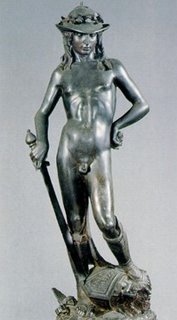
David (c.1435-53). By Donatello.
Has there ever been a more
astounding interpretation of a
traditional Biblical figure?

The World's Greatest 3-D Artists

Contents

Ancient Egyptian Sculptors
Greek Sculptors
Roman Sculptors
Byzantine Sculptors
Romanesque Sculptors
Gothic Sculptors
Italian Renaissance Sculptors
Baroque Sculpture
18th Century Rococo/Neoclassical Sculpture
19th Century Sculpture
20th Century Modern Sculptors
20th Century Contemporary Sculptors

• For a guide to the plastic arts, see Art of Sculpture.
• For origins and evolution, see History of Sculpture.
• For the greatest 3-D artworks, see Greatest Sculptures Ever.
• For sculptors in Ireland, see Irish Sculpture.

BIOGRAPHIES OF ALL ARTISTS LISTED BELOW WILL BE ADDED
OVER THE NEXT FEW WEEKS


TYPES OF SCULPTURE
For bronzes - statues and reliefs,
see: Bronze Sculpture.
For marble and other similar
forms of carving, see:
Stone Sculpture.
For sculptures in wood,
see: Wood Carving.
For sculpting in clay, see:
Ceramic Sculpture.

MOVEMENTS, PERIODS, ARTISTS
For more information, see:
History of Art

FINE ART CHRONOLOGY
For details about the development
of Western painting and sculpture
see: History of Art Timeline.

WORLD'S GREATEST ARTISTS
See our compilations of the top
creative practitioners in history:
Best Artists of All Time: Top 10
The greatest painters & sculptors
.

MEANING OF ART
For more about the different types,
styles and values of traditional and
contemporary visual art, see:
Definition of Art.

Ancient Egyptian Sculptors

Despite the innovation and ingenuity of Egyptian sculptors, stone masons and carvers who established Egyptian Sculpture as early as the late 2nd Dynasty of the Ancient Kingdom of Egypt, they and their eastern Mediterranean neighbours have remained almost completely anonymous.

Ancient Greek Sculptors (c.500-100 BCE)

The golden era of sculpture in ancient Greece (c.500-100 BCE) is famous for its masterpieces like the bronze Farnese Heracles (5th Century BCE), the Youth of Antikythera (4th Century BCE), the Dying Gaul (c.240 BCE), Nike of Samothrace (c.190 BCE), Laocoon (c.150-50 BCE) and Aphrodite of Melos ("Venus de Milo") (c.100 BCE), yet only a handful of Greek sculptors are known to us by name, and none of their works survive in the original.

Phidias (c.488-431 BCE)
Greatest Greek sculptor of the High Classical period of ancient Greece.
Myron (Active 480-444 BCE)
Master of life-like figurative sculpture (eg. The Discus-Thrower).
Polykleitos (5th century BCE)
Noted for his gold/ivory Hera statue, and his bronze Kanon of Polykleitos.
Callimachus (Active 432-408 BCE)
Highly innovative 5th-century sculptor and architect.
Skopas (Active 395-350 BCE)
With Praxiteles & Lysippos, one of the three major 4th century sculptors.
Lysippos (c.395-305 BCE)
Official sculptor to Alexander the Great, noted for his lifelike naturalism.
Praxiteles (Active 375-335 BCE)
Renowned for his Aphrodite of Cnidus.
Leochares (Active 340-320 BCE)
Collaborated on the Mausoleum of Halicarnassus with Skopas.

Roman Sculptors (c.200 BCE - c.200 CE)

Despite the influence of the earlier and highly convivial Etruscan sculpture, Roman sculpture was unidealized, realistic, and generally mediocre. Only its historical reliefs (eg. the spiral bas-relief of Trajan's Column, and Ara Pacis in Rome) are regarded as exceptional. The mediocrity of its freestanding statues and the like, may account for the fact that almost no sculptors of ancient Rome are known to us.


Byzantine Sculptors (c.450-1200)

Sculpture in the round was not permitted by the Eastern Orthodox Christian Church based in Constantinople, nor was any form of 3-D representationalism. Thus Byzantine sculptors were limited to reliefs, executed mainly in stone, ivory or soapstone, but unfortunately their individual names are mostly unknown. See also: Medieval Sculpture.

Romanesque Sculptors (c.800-1100)

Romanesque sculpture describes the 3-D architectural art created in western Europe during roughly the 9th to the 12th century. It was mostly commissioned by monasteries or Monastic Orders. Church architects regularly made available two spaces for Romanesque sculptors: the capitals (tops) of columns, which were commonly decorated with lively biblical scenes; and the semi-circular area of wall between the west door of a church and the arch above it (the tympanum), often used to depict gospel scenes such as the Last Judgement. Restricted by space, Romanesque sculptors tended to make squat, chunky, and angular figures. Significant centres for Romanesque sculptors included (in France): Cluny, Autun, Vezelay, Toulouse and Moissac; (in Italy) Como, Modena, Verona, Ferrara, Parma, Pisa, Lucca and Apulian cities; (in Spain) Leon, Madrid and Santiago de Compostela. See also: Celtic High Cross Sculptures.

Gislebertus (active 1st half 12th century)
French Romanesque sculptor, noted for works at Cathedral of Saint Lazare.
Master of Cabestany (active 2nd half 12th century)
Anonymous artist noted for Romanesque-style tympanum, at Cabestany.
Master Mateo (active 2nd half 12th century)
Spanish Romanesque sculptor famous for his Portico de la Gloria.
Benedetto Antelami (active 1178-1196)
One of the top Italian sculptors preceding the Gothic Nicola Pisano

Gothic Sculptors (c.1100-1500)

Gothic sculpture, closely associated with gothic religious architectural art, emerged during the 12th century in the abbeys and cathedrals Northern France. In contrast to the squat Romanesque reliefs and figurative sculpture, Gothic sculptures are tall and thin, very much in keeping with the soaring vertical lines of the new architecture. Archetypal examples include the biblical kings and queens by the triple entrance in the west facade of Chartres cathedral. Standing on a tiny platform, their bodies are enormously elongated while their faces are realistic and benign, creating a mood of great calmness. The Abbey of St Denis, run by Abbot Suger, pioneered Gothic art. In Italy, Gothic sculptural masterpieces included the Pisa Baptistery pulpit, the Siena pulpit and the Scaliger Tombs in Verona.

Between the fall of Rome (c.450 CE) and the mid-13th century (c.1250), there was virtually no statues made as sculptors focused only on reliefs. Then during the period of High Gothic sculpted relief figures began to detach themselves from pillars and walls. Examples of this new statuary include the four figures by the west porch of Reims cathedral, and the unknown emperor or king on horseback (the Bamberg Rider) set high on a platform against one of the walls of Bamberg cathedral. These figures are the precursors of freestanding Italian Renaissance sculpture and its accompanying equestrian statues. North of the Alps, however, the classical forms of Renaissance sculpture were much less popular, and sculptors continued working in a Late Gothic style until the 16th century.

Other examples of Gothic sculpture can be seen in the Cathedrals of Amiens, Notre Dame de Paris, Reims, and Cologne, among others across Europe. See also: English Gothic Sculpture and German Gothic Sculpture.

Nicola Pisano (c.1206-1278)
Born in Apulia, Nicola Pisano heads the tradition of Italian sculpture.
Giovanni Pisano (c.1250-1314)
Architect of Siena cathedral; also created the marble altar at Arezzo.
Arnolfo di Cambio (c.1240–1310)
Master of Gothic-style tomb sculpture and funerary art.
Lorenzo Maitani (c.1255-1330)
Italian architect/sculptor responsible for the facade of Orvieto Cathedral.
Giovanni di Balduccio (c.1290–1339)
Medieval artist noted for the Shrine of St Peter Martyr at S. Eustorgio, Milan.
Andrea Pisano (1295-1348)
Trained as goldsmith, created first bronze doors for the Florentine baptistery.
Filippo Calendario (before 1315-1355)
Sculptor & architect of the 14th century Doge's Venetian Palace.
Andre Beauneveu (c.1335-1400)
Netherlandish sculptor for the French King Charles V, and Duke Jean de Berry.
Claus Sluter (c.1340-1406)
Flemish artist, leader of the Dijon school, pioneer of "northern realism".


Renaissance Sculptors (c.1400-1600)

Italian Renaissance art covers the Early (1400-90) and High (1490-1530) Renaissance, followed by the period of Mannerism (c.1530-1600). Renaissance sculpture was marked by a return to classical models, notably the male nude, and a wide range of individual and equestrian statuary. Much of this sculpture in the round was designed as public art to be located in specific public places. This period witnessed the emergence of genius Renaissance sculptors such as Donatello, Michelangelo, and the Mannerist artist Giambologna, and its monuments can be found in Florence, Rome, Venice and most of the churches and cities of Northern Italy.

Nanni di Banco (1375-1421)
With Brunelleschi, Ghiberti, Donatello, a key figure in Florentine Renaissance.
Filippo Brunelleschi (1377-1446)
Architect, engineer, sculptor; designed Dome of Florence Cathedral.
Lorenzo Ghiberti (1378-1455)
Florentine sculptor, International Gothic style; noted for Gates of Paradise.
Donatello (Donato di Niccolo) (1386-1466)
Greatest European sculptor of the 15th century (quattrocento).
Luca Della Robbia (1400-1482)
Great carver in stone noted for Singing Gallery and Benozzo Federighi tomb.
Antonio Rossellino (1427-1479)
Known for the tomb of Cardinal Jacopo of Portugal in Florence.
Antonio Pollaiuolo (1432-98)
Florentine goldsmith & artist popular with the circle of Lorenzo de' Medici.
Andrea Della Robbia (1435-1525)
Master of ceramic, terracotta and marble sculpture.
Niccolo Dell'Arca (1435-94)
Expressionist religious sculptor noted for his terracotta statues.
Andrea del Verrocchio (1435-1488)
Italian goldsmith, sculptor and painter. Leonardo da Vinci was a pupil.
Guido Mazzoni (1450-1518)
Terracotta sculptor, active in Modena, Naples and France.
Michelangelo (1475-1564)
Greatest sculptor of all time, masterpieces include Pieta and David.
Alonso Berruguete (c.1486-1561)
Greatest Spanish Mannerist sculptor.
Jacopo Sansovino (1486-1570)
Florence-born High Renaissance sculptor, active in Venetian architecture.
Baccio Bandinelli (1493-1560)
Stunning terracotta statuettes; failed at larger works to rival Michelangelo.
Benvenuto Cellini (1500-1571)
Goldsmith, medallionist & sculptor to Pope Clement VII and Francis I.
Francesco Primaticcio (1504-1570)
Sculptor, architect, head of the First School of Fontainebleau.
Juan de Juni (1507-1577)
French artist active in Spain; ranked alongside Alonso Berruguete.
Germain Pilon (1529-1590)
Most powerful and innovative French sculptor of the 16th century.
Giambologna (Giovanni Bologna/Jean Boulogne) (1529-1608)
Greatest sculptor of the age of Mannerism.
Jean Goujon (Active 1540-1563)
French Mannerist sculptor noted for decorations on Fountain of the Innocents.
Barthelemy Prieur (1536-1611)
French artist, sculptor to King Henry IV of France.
Adriaen de Vries (1560-1626)
Mannerist Dutch artist, pupil of Giambologna, master of bronze sculpture.
Stefano Maderno (1576-1636)
Roman sculptor, noted for his marble statue of St Cecilia in Trastevere.

Northern Renaissance Sculptors

Hans Multscher (c.1400-1467)
German sculptor noted for his realism, especially in drapery.
Michel Colombe (c.1430-1512)
Gothic/Renaissance sculptor, noted for the tomb of Francis II of Brittany.
Veit Stoss (c.1447-1533)
Late Gothic German wood-carver.
Adam Kraft (c.1455-1509)
Late Gothic Nuremberg stone sculptor, noted for tabernacle in Saint Lorenz.
Tilman Riemenschneider (c.1460-1531)
The greatest Late Gothic German wood-carver.
Gregor Erhart (c.1460-1540)
Late Gothic German sculptor in wood/stone, noted for Blaubeuren Altarpiece.

Baroque Sculptors (c.1600-1700)

Baroque Sculpture was part of the general 17th century Baroque movement of art and architecture, which grew out of the religious political situation of the previous century, triggered by Luther's Protestant Reformation and the Catholic Counter-Reformation. The dramatic, theatrical, Baroque style was well suited to sculpture, in which Bernini was the outstanding exponent, although Baroque religious sculpture was confined to Catholic areas, as Protestantism turned its back on grandiose religious art. However, statues of secular rulers and nobility became popular throughout Europe. For more, see: Baroque Sculptors.

Juan Martines Montanes (c.1568-1649)
Greatest Spanish sculptor of the 17th century, virtuoso wood-carver.
Francesco Mochi (1580-1654)
First Baroque sculptor; the sculptural equal of Caravaggio and Carracci.
Francois Duquesnoy (1597-1643)
Flemish artist; with Algardi one of the top sculptors in Rome after Bernini.
Alessandro Algardi (1598-1654)
Bernini's great rival. Master of marble, ivory and gold sculpture.
Bernini (1598-1680)
Acclaimed as the greatest of all Baroque sculptors. Worked for 8 popes.
Alonzo Cano (1601-1667)
Spanish sculptor, painter, architect; "the Spanish Michelangelo".
Pierre Puget (1622-1694)
The greatest French sculptor of the 17th century.
Gaspard and Balthazar Marsy (1624-1681)
French sculptors employed by King Louis XIV, at Versailles Palace.
Pedro Roldan (1624-1699)
Spanish artist, master of polychrome woodcarving.
Pedro de Mena (1628-1688)
Spanish Baroque scultor famous for unrivalled technical skill.
Francois Girardon (1628-1715)
The most classical of sculptors working at Versailles for Louis XIV.
Melchiore Caffa (1638-1667)
Maltese artist known for his Ecstasy of St Catherine of Siena.
Charles Coysevox (1640-1720)
French sculptor, noted for Fame Mounted on Pegasus.
Grinling Gibbons (1648-1721)
England's greatest ever wood carver in limewood.
Balthasar Permoser (1651-1732)
Leading Dresden sculptor, carved in wood, ivory, stone, coloured marble.
Guillaume Coustou (1677-1746)
French sculptor noted for Horse Restrained by a Groom (The Marly Horse).
Andreas Schluter (1664-1714)
German baroque artist/architect associated with Petrine Baroque style.


18th Century Sculptors: Rococo and Neoclassical Styles

Rococo (flourished c.1715-50) was centred on France in the wake of the death of Louis XIV and the ensuing preeminence of Paris, whose new town houses benefited from the pretty curvaceous shapes of Rococo interior design. Rococo sculpture was best suited to smaller works, notably in porcelain: its larger forms being confined mainly to the Catholic south of Germany, and Austria.

A serious form of art based on antique models, Neoclassical sculpture (flourished c.1790-1830) was a reaction against both the melodramatic Baroque and whimsical Rococo styles, and a reflection of the growing scientific (viz. archeological) interest in classical antiquity. Promoted by the great German art historian, Johann Joachim Winckelmann, it attached particular importance to Greek-style forms, whose style was academic, noble and restrained. See also: Neoclassical Sculptors.

Louis-François Roubillac (1695-1762)
Famous for his seated marble statue of Handel.
Jean-Baptiste Pigalle (1714-1785)
Noted for his nude figure of Voltaire and the tomb of Maurice of Saxony.
Etienne Maurice Falconet (1716-1791)
The most Rococo of all 18th century French sculptors.
Jean-Jacques Caffieri (1725-1792)
Sculptor to Louis XV, noted for his portrait busts, in terracotta or marble.
Augustin Pajou (Paris, 1730-1809)
Best known for his portraits, and sculpture in Opera House at Versailles.
Franz Xavier Messerschmidt (1736-1783)
Austrian sculptor famous for his caricature busts.
Joseph Nollekens (1737-1823)
Neoclassical artist; finest British sculptor of the late 18th century.
Claude Michel, called Clodion (1738-1814)
French sculptor in the Rococo style.
Jean Antoine Houdon (1741-1828)
Neoclassical French sculptor noted for his portraits.
Franz Anton von Zauner (1746-1822)
Austrian sculptor noted for bronze Equestrian Statue of Joseph the Second.
John Flaxman (1755-1826)
Outstanding English Neoclassical sculptor.
Antonio Canova (1757-1822)
The greatest Neoclassical sculptor; huge influence on contemporaries.
Johann Gottfried Schadow (1764-1850)
German Neoclassical sculptor, graphic artist; head of Berlin Academy.
Bertel Thorvaldsen (1770-1884)
The most famous Neoclassical sculptor after Canova.

19th Century Sculptors

The 19th century was rather a watershed for sculpture. Neoclassicism was still active in America, but generally speaking, European sculptors experienced a serious downturn in religious sculpture, and were largely occupied with historical monuments to secular figures like Kings and military leaders. It wasn't until the first decades of the 20th century that new forms and ideas began to emerge. Auguste Rodin was a notable exception from this era. For more, see: 19th Century Sculptors.

Horatio Greenough (1805-1852)
American sculptor, known for his colossal statue of George Washington.
Honore Daumier (1808-1879)
French caricaturist, printer and terracotta modeller.
Antoine-Auguste Preault (1809-1879)
Ornamental carver, leading French sculptor of the Romantic movement.
Alfred Stevens (1817-75)
Outstanding Victorian painter and sculptor.
George Frederick Watts (1817-1904)
Highly revered English portraitist and sculptor of the late 19th century.
Jean-Joseph Perraud (1819-76)
French academic sculptor during the Second Empire.
Pierre-Louis Rouillard (1820-81)
French 3-D artist famous for his bronze Horse with a Harrow.
Jean-Baptiste Carpeaux (1827-1875)
Noted for his masterpiece Ugolin et Ses Fils (Ugolino & his Sons).
Charles Henri Joseph Cordier (1827-1905)
Powerful ethnographic sculptor at the Natural History Museum Paris.
Frederic Leighton (1830–1896)
English painter and sculptor, President of the Royal Academy.
Jean-Alexandre-Joseph Falguiere (1831-1900)
Noted for his marble sculpture Tarcisus the Christian Boy-Martyr.
Constantin Meunier (1831-1905)
Belgian sculptor noted for his portrayal of coal miners.
Frederic-Auguste Bartholdi (1834-1904)
French sculptor best known as the designer of the Statue of Liberty.
Edgar Degas (1834-1917)
Painter & sculptor noted for his bronze Little Dancer Aged Fourteen.
Auguste Rodin (1840-1917)
Greatest sculptor of the 19th century.
Marius Jean Antonin Mercié (1845-1916)
Professor of Drawing and Sculpture at the Ecole des Beaux Arts.
Auguste Saint-Gaudens (1848-1907)
American sculptor noted for works like his bronze relief Amor Caritas.
Daniel Chester French (1850-1931)
American sculptor best known for Abraham Lincoln at the Lincoln Memorial.
George Minne (1866-1941)
Belgian sculptor with a naturalist, highly expressive style.


Modern Sculptors: 20th Century

The early years of the 20th century witnessed a revolution in sculpture, thanks to pioneer artists like Brancusi, Picasso, Boccioni and Naum Gabo, and new modernist movements like Cubism, Dada and Surrealism. Abstract forms were fully explored, new materials including "found" objects were used for the first time.

Aristide Maillol (1861-1944)
Best known for his monumental female nude entitled The Mediterranean.
Henri Matisse (1869-1954)
Painter/sculptor noted for his Fauvist sculptures, gouache collages.
Ernst Barlach (1870-1938)
German sculptor, wood carver, ceramics and stone artist.
Raymond Duchamp-Villon (1876-1918)
Futurist/Cubist sculptor noted for Horse (1914), later cast in bronze.
Constantin Brancusi (1876-1957)
Romanian virtuoso, arguably the first sculptor of the modern era.
James Earle Fraser (1876-1953)
American sculptor noted for his Native Americans and historical figures.
Anna V Hyatt Huntington (1876-1973)
American artist famous for her naturalistic animal sculptures.
Pablo Picasso (1881-1973)
Spanish painter & sculptor; African sculpture inspired his Cubism.
Umberto Boccioni (1882-1916)
Italian Painter & sculptor in revolutionary Futurist style.
Elie Nadelman (1882-1946)
Polish-American sculptor noted for his graceful works in wood or metal.
Henri Laurens (1885-1954)
Best known for his Cubist "constructions", of wood and polychrome plaster.
Jean Arp (1886-1966)
Dada artist, abstract sculptor, married to Sophie Taeuber-Arp.
Marcel Duchamp (1887-1968)
Conceptual artist, painter, sculptor noted for his "ready-mades".
Sophie Taeuber-Arp (1889-1943)
Bauhaus follower, now seen as one of the precursors of Concrete art.
Ossip Zadkine (1890-1967)
Russian sculptor best known for his monumental bronze Destroyed City.
Naum Gabo (1890-1977)
Born Naum Borisovich Pevzner, noted for his constructivist/kinetic art.
Henri Gaudier-Brzeska (1891-1915)
Avant-garde French sculptor and draughtsman, active in London.
Jacques Lipchitz (1891-1973)
Lithuanian-born Jewish Cubist sculptor; painted by Modigliani in Paris.
Joan Miro (1893-1983)
Spanish artist took up sculpture 1944 (terracottas, ceramics, large bronzes).
Katarzyna Kobro (1898-1951)
Considered to be one of the greatest female Polish sculptors.
Alexander Calder (1898-1976)
Best known for his invention of kinetic sculpture (mobiles).
Henry Moore (1898-1986)
Noted for his reclining nudes & organic forms in wood, bronze & stone.
Louise Nevelson (1899-1988)
Noted for her assemblage art of complex and rhythmic abstract shapes.
Alberto Giacometti (1901-1966)
Known for his elongated, emaciated figures of existential art.
Marino Marini (1901-80)
Italian artist, noted for his series of stylised equestrian statues.
Jean Dubuffet (1901-1985)
Painter & sculptor best known for his vinyl-painted polystyrene sculpture.
Richmond Barthe (1901-1989)
African American sculptor known for Toussaint L’Ouverture Monument, Haiti.
Barbara Hepworth (1903-1975)
Arguably the greatest British abstract sculptor, Member of St Ives School.
David Smith (1906-1965)
Most influential American sculptor of the period after World War II.
Meret Oppenheim (1913-85)
Best known for her Surrealist sculptural work Furry Breakfast.

20th Century: Contemporary Sculptors

Replacing modernism with postmodernism, contemporary sculpture has greatly extended the notion of three-dimensional art. "Found" objects continue to be used widely as well as a whole new range of materials (from foam-rubber to concrete); new 3-D art forms have appeared, like installation art and assemblage; pure abstraction is arguably being superceded by conceptualism (the point behind the artwork), while the idea of representationalism has been extended by new forms of super-realism. Traditional types of classical realism seem to be out of favour, at least artistically, although the value of postmodernist art has recently taken a severe battering, thus raising the possibility of a return to more traditional practices. On balance, however, one feels that contemporary materials and methods in sculpture are here to stay, and that classical realism has lost its appeal.

Louise Bourgeois (b.1911)
Long-lived French artist noted for her monumental 'spider' sculptures.
Cesar Baldaccini (1921-1998)
Gained international notoriety with sculptures made from crushed cars.
Pol Bury (1922-2005)
Calder-inspired Belgian sculptor noted for his kinetic or moving sculpture.
Nandor Glid (1924-97)
Renowned for his Holocaust art and sculpture.
Eduardo Paolozzi (1924-2005)
Highly innovative Italian-born sculptor, ceramicist, mosaic designer.
Sir Anthony Caro (b.1924)
Influential British artist, known for abstract sculptures in welded metal.
Jean Tinguely (1925-1991)
Swiss sculptor, experimental artist, noted for Homage to New York.
Duane Hanson (1925-96)
Famous for Super-realism life-size sculptures of people in everyday life.
Takis (Panayiotis Vassilakis) (b.1925)
Paris-based Greek artist, innovative exponent of kinetic sculpture.
Robert Rauschenberg (1925-2008)
Noted for his "Combines", collages and assemblages, as well as paintings.
Armand Fernandez, called Arman (1928-2005)
French sculptor known for his "accumulations" and recomposition of objects.
Sol LeWitt (1928-2007)
American sculptor famous for his minimalist, geometric structures.
Claes Oldenburg (b.1929)
Swedish artist, noted for his Pop art sculptures of everyday objects.
Magdalena Abakanowicz (b.1930)
Polish sculptor, noted for fabric sculptures, happenings & anatomical works.
Jasper Johns (b.1930)
American painter, sculptor, printmaker, pioneer of early Pop art.
Marisol (Maria Sol Escobar) (b.1930)
Venezuelan sculptor noted for her contemporary assemblage & sculptures.
Niki de Saint-Phalle (1930-2002)
French-born painter/sculptor best known for her 1960s "shot-reliefs".
Fernando Botero (b.1932)
Columbian painter/sculptor famous for his hallmark obese figures.
Mark Di Suvero (b.1933)
American artist, noted for his large scale iron/steel public sculpture.
Carl Andre (b.1935)
American minimalist artist noted for linear/grid format sculptures.
Walter de Maria (b.1935)
American artist noted for his minimalist sculptures and conceptual art.
Richard Serra (b.1939)
American minimalist sculptor best known for his public steel sculptures.
Bruce Naumann (b.1941)
Versatile contemporary artist/sculptor noted for his neon sculptures.
John De Andrea (b.1941)
American figurative sculptor noted for his hyper-realist nudes.
Anthony Gormley (b.1950)
British sculptor Turner Prize winner 1994, noted for Angel of the North.
Anish Kapoor (b.1954)
British abstract sculptor, Turner Prize winner 1991.
Jeff Koons (b.1955)
American sculptor, conceptual artist; famous for his Neo-Pop artworks.
Damien Hirst (b.1965)
Postmodernist sculptor, installation artist, Britart leader of YBAs.

More Information

Classical Antiquity
Most Greek Sculpture is traditionally divided into six basic styles: Daedalic Greek Sculpture (c.650-600 BCE) Archaic Greek Sculpture (c.600-500 BCE), Early Classical Sculpture (c.500-450 BCE), High Classical Sculpture (c.450-400 BCE), Late Classical (c.400-323 BCE), and Hellenistic Greek Sculpture (c.323-27 BCE). For additional information, please see also: Greek Statues & Reliefs: Hellenistic Period. For a guide to 3-D art in ancient Rome, see: Relief Sculpture of Ancient Rome. For stonework by the Celts, see: Celtic Sculpture.

• For more about the plastic arts in Ireland, see: Irish Art Encyclopedia.


HOME | Art Questions | Sitemap: Art in Ireland | Sitemap: Irish Painters/Sculptors | Sitemap: International Art | Art Glossary | Best Art Museums
ENCYCLOPEDIA OF IRISH AND WORLD ART
© visual-arts-cork.com 2008-2009 All rights reserved.