Master of Cabestany
Biography of Medieval Romanesque Sculptor.
MAIN A-Z INDEX - A-Z of SCULPTURE

|
Master of Cabestany
|
|
BEST WORKS OF SCULPTURE EVOLUTION OF SCULPTURE MEDIEVAL SCULPTURE |
Master of Cabestany (c.1130-1180)The Master of Cabestany is an anonymous Romanesque sculptor who was active during the second half of the 12th century. His particular contribution to medieval sculpture was first encountered and identified in the 1930s after the discovery of several pieces remarkable for their craftsmanship and style. These included sculpted reliefs in the tympanum (semicircular space above a doorway) of the church in Cabestany, a town near Perpignan in the Roussillon.
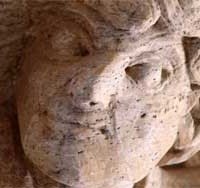
Style of Religious Carving Working in the idiom of Romanesque architecture - the first international style of architectural sculpture, employed on religious buildings in France, Germany, Italy and Spain - the Master of Cabestany's sculpture is relatively crude when compared to that of classical Greek and Roman sculptors, but notably superior to that of many of his contemporaries in medieval Europe. His distinctive style of medieval art is visible in his human figures that typically are carved with triangular faces (with large foreheads but no chin); high, intricately carved ears; wide-open almond-shaped eyes with drilled pupils; out-sized hands with long, tapering fingers; clothing drapery with many folds; along with a considerable amount of detailed work on his principal figures. His distortion of proportions may be more normal than it seems. Romanesque sculpture typically had little of the naturalism and human warmth that Gothic sculptors would introduce later. |
|
BEST SCULPTORS |
|
|
Cabestany Church The exceptional workmanship of the tympanum relief sculpture, together with the originality of the theme attracted the curiosity of medieval art scholars, who compared his work with other examples taken from capitals, sarcophogi, corbels and other tympanum. Meanwhile, they dubbed the artist the "Master of Cabestany". Before long, subsequent research confirmed the existence of work by the same artist in the departments of Aude and Languedoc (France), in Catalonia and Navarre (Spain), and in Tuscany (Italy). In all, some 121 sculptures have been attributed to the Master of Cabestany or to his studio. Exhibition In 1993, the municipal authorities of Cabestany established a committee composed of eminent French and European scientists to select important examples of the Master's works, from which moldings were then taken and stone castings made. The same grain and colour were used as in the originals, making them look almost identical to the original sculptures. Since 2004, these sculptural replicas have been exhibited in a refurbished winemaking cave which now functions as a centre devoted to Romanesque art of the period. It acts as a museum, education centre, and research and study centre into medieval plastic arts. The museum also displays reliefs and statues made by the Master's contemporaries. The museum also explains the historic and artistic contexts of the Master and his work, along with local history of the Cabestany locality and the department of the Pyrenees-Orientales.
Sculpture Sites Pyrenees-Orientales (France) - Cabestany - the tympanum of the parish
church of Notre-Dame-des-Anges. Aude (France) - Rieux-Minervoi - the capitals of the
church of Saint-Marie. Catalonia (Spain) - Sant-Pere-de-Rodes - the west doorway
of the abbey. Navarre (Spain) - Errondo Parish church tympanum - now in The Cloisters of the Metropolitan Museum of Art. Tuscany (Italy) - St. Antimo's Abbey - a capital in the nave area. More Articles on 12th Century Romanesque Art For other influential styles of Romanesque art in Western Europe, please see the school of Mosan Art, centered around Liege in Belgium and exemplified by the glorious metalwork and goldsmithery of Nicholas of Verdun (1156-1232) and Godefroid de Claire (1100-1173). |
|
• For the history and types of sculpture, see: Homepage.
ENCYCLOPEDIA OF SCULPTURE |