Medieval Sculpture
History, Characteristics: Roman, Early Christian
Sculptures, Carolingian and Ottonian Art.
MAIN A-Z INDEX - A-Z of SCULPTURE

|
Medieval Sculpture
|
|
Art Education |
Medieval Sculpture (c.300-1000)
|
|
|
Forming the link between Christianity and the classical heritage, the civilization of Late Antiquity occupied a place between the Late Roman Empire and the Middle Ages. This period began with the long reigns of Diocletian (284-305) and Constantine (307-337) and lasted for two or three centuries, its duration varying from region to region. After Diocletian had established a tetrarchic government with two "Augusti" and two "Caesars", the system became a diarchy in 313 and then, in 324, Constantine, the conqueror of Licinius, united the Empire under Christianity. This religious liberty was soon expressed in monumental Christian art with the construction of the oldest Christian basilicas and the introduction of the first monumental decorations. In the towns, the municipal elites and the big proprietors, who often owned country residences, decorated their houses sumptuously. Public architecture strove to surpass the models of the past. The Basilica Nova in Rome was begun by Maxentius in 308 and completed by Constantine. Its three monumental aisles stood at the summit of a wide platform and were crowned by a vast western apse containing a colossal statue of the emperor. |
|
MIDDLE AGES TYPES OF SCULPTURE BEST SCULPTURE HISTORY OF SCULPTURE |
|
|
A manifestation of the city's pomp, the triumphal arch of Constantine built by the Senate and the people of Rome in 315 stands near the Palatine Hill. The monument comprises three openings with freestanding columns outside and a group of sculptures, including reused features from earlier famous monuments, as if to contirm the imperial heritage. The historical frieze, in a conspicuous position halfway up, illustrates both the imperial ideology and the style of the Constantinian period. In addition to depictions of speeches to the citizens and the distribution of subsidies, a particularly noticeable feature is the setting of a hieratic court ritual in which the emperor occupies a strictly frontal position. This arrangement, emphasized by the acclaiming figures shown in profile, was adopted by consuls on ivory diptychs, by villa owners on mosaics, and even for the representation of Christ among the apostles in the semidomes of church apses. A style common to sculpture and the arts of colour emerges during the first half of the fourth century. That is why the extremely linear and graphic rendering of the figures in the frieze on the Arch of Constantine and on contemporary sarcophagi is close to that of the figures on the mosaics of Piazza Armerina in Sicily, Santa Costanza in Rome, Aquileia in North Italy and Centcelles near Tarragona in Catalonia. The basic elements of the portrait, with wide open eyes and short hair accentuating the roundness of the head, are already observable in works produced under the Tetrarchy, the most famous of which is the porphyry group of the four sovereigns, reused in the Middle Ages on the lateral facade of the basilica of St Mark's in Venice. |
|
|
During the Roman Imperial period, the Christianization of society steadily increased, but we have to wait until Late Antiquity, in particular the fourth century, to see the public expression of the early Christian sculpture - at least in Rome. The first Christian images appeared in the Roman catacombs, those underground cemeteries with evocative names (Calixtus, Priscilla, Peter and Marcellinus), which, situated outside the city of the living. were the Roman equivalent of the surface necropolises located close to the entrances of the Empire's towns. We know those early Christian images, as well as the tastes and culture of the urban elites, from the sculptured decoration of the sarcophagi which were placed in mausoleums or private enclosures inside cemeteries. (See also: Christian Roman Art.) When they were carved out of marble or
porphyry, sarcophagi were ornamented with a sculptured decoration comparable
in every way to the friezes of the great public monuments. These characteristic
objects of Late Antiquity were sometimes "mass produced" and
could be bought as standardized products by anyone who wanted to perpetuate
his own memory in his lifetime or that of a close relation who had just
died, as an inscription at Arles testifies: "The 17 of the Calends
of April, here rests in peace Marcia Romania Celsa, a most illustrious
lady, who lived 38 years, 2 months and 11 days. Havius Januarius, a most
illustrious man, former consul ordinary, placed (this epitaph) to his
meritorious wife." It was also possible to have sarcophagi decorated
to meet individual requirements. In the second quarter of the 4th century
Flavius Januarius ordered that his defunct wife should be portrayed as
the praying figure situated in the centre of the main face of the sarcophagus
between two apostles and Gospel scenes.
Barbarian Sculpture
& Metalwork |
|
Stylistically these sculptures resemble 7th century Visigothic works and monuments in northern Italy. Sociologically, the Hypogeum of the Dunes at Poitiers illustrates the phenomenon of the "aristocratization" of a section of a necropolis: a privileged ecclesiastical tomb which may have been a chapel originally and in any case was in private use. Indeed, a fragment of the lintel bears the following inscription: "The memory of Mellebaudis (memoria), Abbot, debtor of Christ, is here. The devout come from all sides to Him (Christ) for the offerings, and they return every year." The sculptured decoration in the Poitiers hypogeum shows, as do the lettering of the inscriptions and the vestiges of painting, that the Merovingian elites had a hybrid culture combining classical culture fostered by eastern elements and the art of interlaces which so clearly defines the plastic innovations of the early Middle Ages in the West. Carolingian
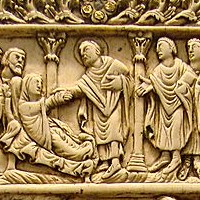
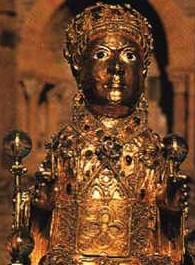
Art: Ivory and Goldsmithery Under Charles the Bald, the workshops of Corbie, Reims and Saint-Denis were particularly active and had more stylistic affinity with the Reims manuscripts. The cover of the Psalter of Charles the Bald (Bibliotheque Nationale, Paris) is especially reminiscent of the interpretation the ivory-carvers made of the manuscript illustrations. In this case, the model is the Utrecht Psalter. The Munich Crucifixion, with its representation of the Resurrection beneath personifications of the sun and moon, and its antique references to Oceanus and Roma, may well be the masterpiece of this period. This ivory cover is luxuriously framed by a setting of goldwork, precious stones and enamels which invite us once again to speculate about the collaboration between ivory carvers and goldsmiths in these outstanding workshops. (For more, see also: Celtic Metalwork art.) The development of the cult of relics and the increasing size of the main churches were the source of the luxurious output of goldsmith's work in the Carolingian period: urns, various types of statue, reliquaries of all kinds, book covers and other objects for liturgical use made up the essential part of a production destined to play an important role in the development of monumental sculpture. We find a good example of this in the reliquary called the Triumphal Arch of Eginhard known only from a drawing. It undoubtedly served as the foot of a cross and its rich decoration finds its inspiration in Roman and Early Christian triumphal programs, while at the same time heralding the monumental iconographic display of the great Romanesque church portals. Carolingian gold work benefited by the progress made in the Merovingian period and combined the ancient practice of cloisonne with that of chasing and inlays. Among the most famous works are the binding of the Codex Aureus of Munich, with a decoration divided into five fields, and the ciborium of King Arnulf. Also outstanding for size, prestige and influence on sculpture is the gold and silver altar frontal of Milan, commissioned from the goldsmith Volvinius under the episcopate of Angilbert II. It has christological scenes on the front, while the back is reserved for the life of Ambrose, the Milanese saint. The differences in style observable between the two sides exactly match the situation of Carolingian art torn between a dazzling Antiquity and a new aesthetic. The bronze sculpture or statuette "Charlemagne" (Louvre, Paris) clearly suggests this double dimension affirming the imperial idea. It is a reflection of the activity of the bronze-founders' workshops which have left other famous works in the Aachen chapel. such as the grilles of the galleries and the doors. See also: Ottonian Art (c.900-1050). For another influential but later school of medieval art in Western Europe, which was greatly influenced by Carolingian culture, please see Mosan Art which emerged around Liege, exemplified by the metalwork and goldsmithing of Nicholas of Verdun (1156-1232) and Godefroid de Claire (1100-1173). REFERENCES |
|
|
|
• For more facts about Medieval sculptors, see: Homepage.
ENCYCLOPEDIA OF SCULPTURE |