Stone Sculpture
History, Types, Materials, Techniques: Famous
Stone Statues, Reliefs.
MAIN A-Z INDEX - A-Z of SCULPTURE

|
Stone Sculpture
|
|
|
Stone Sculpture (c.30,000 BCE - present)Contents • Introduction |
|
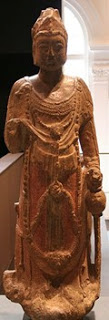
CHINESE STONE STATUES |
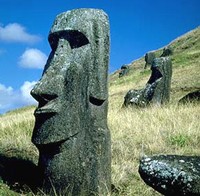
If petroglyphs (including the extraordinary cultural phenomena known as cupules) constitute the world's oldest art, stone sculpture is the oldest mobiliary (portable) art. For instance, the Stone Age sculptural effigies known as the Venus of Berekhat Ram (basalt) and the Venus of Tan-Tan (quartzite) are at least 200,000 years old, while the limestone figurine known as the Venus of Willendorf dates from around 30,000 BCE. One reason we know about these examples of prehistoric art, is precisely because they were fashioned out of a weather-resistant material like stone. Of course, wood carving and also ivory carving are equally traditional, but wood is too perishable, while ivory and animal bones are only useful for certain types of small-scale figures. As well as being relatively easy to obtain, stone - at least certain types of it - is easy to carve and very durable, without having (like bronze) any great intrinsic value. True, marble is much rarer and far more expensive than (say) limestone or sandstone, but marble is a special case and is dealt with separately, see: marble sculpture. Another special case, is Megalithic art, whose sculptural reliefs overlap with regular plastic art, but these too are dealt with elsewhere, as is precious stone like Jade (greenstone), which features so widely in Chinese art. Up until the 20th century, almost all the greatest sculptors would have practiced stone carving before progressing onto marble or bronze sculpture, while some, like the eminent Irish artist Seamus Murphy (1907-1975), spent their whole lives sculpting in stone. Stone sculpture really dazzled during the cathedral and abbey building programs in the era of Romanesque sculpture (c.1000-1200 CE) and Gothic Sculpture (c.1150-1300), since which time it has gradually declined, except for the carving of the extraordinary Moai tuff sculptures (c.1250-1500) at Rano Raraku, Easter Island. Despite its decline, stone, along with steel, remains the foremost medium for large-scale outdoor works, as exemplified by the Women's Titanic Memorial (1931, Washington DC), by Gertrude Vanderbilt Whitney. See also: How to Appreciate Sculpture. For later works, please see: How to Appreciate Modern Sculpture. |
|
|
|
Leaving aside the earlier but more controversial effigies, and the flat engravings seen in Paleolithic rock art, the first prehistoric sculpture in stone was the series of Venus figurines which began appearing across Europe from about 30,000 BCE. They include: the Austrian Venus of Galgenberg (also known as the Stratzing Figurine), the French Venus of Monpazier (Steatite), the Italian Venus of Savignano (Serpentine), the Russian Venus of Gagarino (basalt), and the Swiss Venuses of Engen and Monruz/Neuchatel (both carved in jet stone). Friezes of stone relief sculpture were also a popular feature of Paleolithic cave art, as exemplified by those at Cap Blanc, Roc de Sers and Roc-aux-Sorciers. Examples of Neolithic stone sculpture have also been discovered in various parts of Central and Eastern Europe, including Turkey (see the animal reliefs at Gobekli Tepe c.9000 BCE) and Serbia (see the Fish God of Lepenski Vir c.5000 BCE, National Museum, Belgrade). See also: Ancient art.
Egyptian sculpture also made full use of stone in both statues and reliefs - see, for instance, the sandstone Statue of Akhenaten (c.1350 BCE), and the greywacke Psametek Protected by Hathor Cow (c.550 BCE) both in the Egyptian Museum, Cairo - as well as monumental works like the Great Sphinx at Giza (c.2575-2465 BCE). Stone was also used heavily in Ancient Persian art and also in Mesopotamian art and Mesopotamian sculpture. See for instance the Human-headed Winged Bull and Lion (859 BCE) from Ashurnasirpal's palace at Nimrud, a typical example of Assyrian art (c.1500-612 BCE). Stone masons and craftsmen from these ancient cultures are believed to have been a key influence on Greek sculpture, notably the less sophisticated style of Archaic Greek sculpture (c.650-480 BCE), as in the limestone statue known as "The Auxerre Kore" (c.630 BCE, Louvre). Thereafter most 3-D Greek art, including that of the Parthenon, created during the glorious golden age of High Classical Greek sculpture (450-400 BCE), was made out of marble or bronze. An exception was the 100-foot high Colossus of Rhodes - a huge statue of the god Helios, built on the island of Rhodes by Chares of Lindos about 280 BCE, during the era of Hellenistic Greek sculpture. Deemed one of the Seven Wonders of the Ancient World, it was made from stone (and earth) decorated with bronze plates. Before its rickety structure collapsed in 226 BCE, following an earthquake - it was one of the greatest sculptures ever seen. The use of stone sculpture was widespread during the Roman Empire, which made full propaganda use of items like portrait busts of the Emperor, as well as historical stone reliefs such as Trajan's Colum (106-113, Rome), designed by Apollodorus of Damascus; the frieze on the Ara Pacis Augustae (13-9 BCE), the frieze on the Column of Marcus Aurelius (c.180-193 CE), and the reliefs on the Arch of Constantine (312-15 CE). Stone sculpture was also a decorative motif of Christian sarcophagi, during the era of early Christian art (c.150-550). |
|
The zenith of stone carving occurred during the period 1000-1300, when Rome and its monastic orders instituted their massive program of church building, based on a new style of church architecture, known as Romanesque. (See also: Medieval sculpture.) This led to a huge demand for a wide range of new statues and reliefs to decorate each new cathedral, church and abbey. In France, important centres of Romanesque art included Cluny, Autun, Vezelay, Toulouse and Moissac. In Italy, there were located at Como, Modena, Verona, Ferrara, Parma, Pisa, Lucca and the Apulian cities. In Spain, Romanesque sculpture was centred at Leon, Madrid and Santiago de Compostela. In Ireland, the monastic authorities erected Celtic High Cross Sculptures - the largest body of free-standing sculpture since the Renaissance. Famous stone sculptors of the period included: the Frenchman Gislebertus (noted for his work at the Cathedral of Saint Lazare); the Master of Cabestany (named after his Romanesque-style tympanum, at Cabestany); the Spaniard Master Mateo (famous for his Portico de la Gloria at Santiago de Compostela cathedral); and Benedetto Antelami (known for his work at Parma and elsewhere).
After the Romanesque era came the golden age of stone work, in the form of Gothic architecture, exemplified by the great French Cathedrals of Chartres, Notre Dame de Paris, Amiens, and Reims, with their soarching vaults, huge stained glass windows, perched gargoyles, Biblical relief sculpture and ranks of column statues. In fact these awesome structures contained the greatest collection of three-dimensional religious art ever seen in the history of sculpture. Like a 3-D version of Michelangelo's fresco paintings on the roof and walls of the Sistine Chapel in Rome, the exteriors and interiors of these monumental churches displayed a massive array of Saints, Apostles, members of the Holy Family, along with various angels and other gospel figures, plus narrative reliefs depicting the Birth of Jesus, The Passion of Christ and other Biblical events. Famous Gothic sculptors, all of whom sculpted in stone, included: Nicola Pisano (c.1206-1278), the leader of the Italian school; his son Giovanni Pisano (c.1250-1314), who created the marble altar at Arezzo; Arnolfo di Cambio (c.1240–1310), who specialized in tomb sculpture and funerary art; and Giovanni di Balduccio (c.1290–1339), noted for the Shrine of St Peter Martyr at S. Eustorgio, Milan. Late Gothic stone sculptors included Andre Beauneveu (c.1335-1400), who served the French King Charles V, and Duke Jean de Berry; and Claus Sluter (c.1340-1406), leader of the Dijon school.
Moai Sculptures from Easter Island The Polynesian territory of Easter Island is home to a particularly striking and unusually durable type of Oceanic art - the famous Moai or mo'ai. These are a series of 887 monolithic human figures - also known as "Easter Island heads" - carved out of volcanic tuff during the period 1250-1500. Averaging about 13 feet tall, about 5 feet wide at the base, and weighing about 14 tons, their elliptical eye sockets were intended to hold coral "eyes", with pupils made from black obsidian or red scoria. Many moai are still at the Rano Raraku quarry, but a large number have been moved to stone platforms (ahu) around the island's perimeter. Some 13 moai are made from basalt, 17 from fragile red scoria and 22 from trachyte. Modern stone carvers have included Jean-Baptiste Carpeaux (1827-1875), famous for his wonderfully animated Dance (1865-9, Musee d'Orsay); Constantin Brancusi (1876-1957), who produced The Kiss (1907, Kunsthalle, Hamburg); Jacob Epstein (1880–1959) responsible for the evocative Adam (1938, Harewood House); the Gothic-inspired German expressionist sculptor Wilhelm Lehmbruck (1881-1919), creator of Kneeling Woman (1911, MOMA); Henri Gaudier-Brzeska (1891-1915), noted for the Red Stone Dancer (1913, Tate Gallery); Henry Moore (1898-1986), noted for Mother and Child (1924-5, Manchester Art Gallery); the painters Andre Derain (1880-1954), famous for his Standing Nude (1907, Pompidou Centre) and Modigliani (1884-1920), who always preferred to carve directly in stone; and others. And as far as monumental stone works go, look no further than Gutzon Borglum's Presidential Portraits on Mount Rushmore (1941). Interestingly, in nearly all these examples of stone carvings, the form of the person seems to emerge from out of the stone. Sculpting Methods and Materials Stone comes in many different varieties, giving artists plenty of choice in respect of colour, quality and hardness. The hardest and most weatherproof stone is igneous rock, formed by the cooling of molten rock, such as granite, diorite and basalt. Sedimentary stones like alabaster (gypsum) may also be used, although they contain noticeable strata. Metamorphic stones, formed by changes to igneous and sedimentary rock caused by extreme temperature or pressure, are very popular with sculptors: the best example being the different types of marble. In general, the softer the stone, the easier it is to carve. According to the MOHS Scale of Mineral Hardness, invented by the German geologist Carl Friedrich Mohs (1773-1839), Soapstone, with a MOHS hardness of about 2, is one of the easiest stones to work. Next, comes Alabaster, and softer kinds of serpentine, all with a MOHS value of about 3. Stones that have a value of 4 include Limestone and sandstone. Harder stone, with a MOHS value of 6, includes travertine, marble, and onyx, with granite and ultimately basalt (both 8) being the most durable but the most difficult to carve. The carving begins with the chiseling away of large chunks of redundant rock (a process known as "roughing out", "pitching", or "knocking off"), using a point chisel and a wedge-shaped pitching chisel, together with a masons driving hammer. Once a rough figure emerges, more precise markings are made with charcoal, pencil or crayon on the stone, and the sculptor then uses basic hammer and point work technique to create more definition. Other specific tools (like a toothed chisel, claw chisel, rasps and rifflers) are used to create the final figure. During the Renaissance period these the main tools for a sculptors would include: a set of chisels (Gli Scalpelli) including flat (Scalpello), pointed (Subbia), round-ended (Unghietto), toothed (Gradina), and splitting (Scapezzatore) chisels; a mallet (La Mazza) used to strike the chisel. As well as this, the sculptor would use several different hammers - to strike the edge-tools like the chisels and also the stone itself. In addition to these traditional tools, 20th-century sculptors had access to pneumatic hammers, as well as other power tools like a diamond-bladed angle-grinder, and numerous hand drills. Today, in keeping with the principles of postmodernist art, stone carvers may use even more sophisticated equipment, such as oxy-acetylene torches, lasers and jet heat torches. The latter was used to create the granite Crazy Horse Memorial at Mount Rushmore. Celebrated stone statues and reliefs can be seen in some of the best art museums and sculpture gardens around the globe. Masterpieces include: Prehistoric Stone Carvings - Venus of Berekhat Ram (230,000 - 700,000
BCE) Basalt Effigy, Golan. Medieval Stone Carvings Romanesque - Canterbury Cathedral Stone Reliefs (10th
Century), England. Gothic - Notre
Dame Cathedral Reliefs & Statues (c.1160-1250) Paris. Oceanic - Moai monolithic human figures (c.1250-1500) Rano Raraku, Easter Island. Modern Stone Carvings - The Dance (1865-9) Musee d'Orsay. By
Jean-Baptiste Carpeaux. |
|
• For more details about stone carving, see: Visual Arts Encyclopedia.
ENCYCLOPEDIA OF SCULPTURE |