Oldest Art
Prehistoric Cupules, Cave Painting, Ivory
Carvings.
MAIN A-Z INDEX - A-Z of PREHISTORIC ART

|
Oldest Art
|
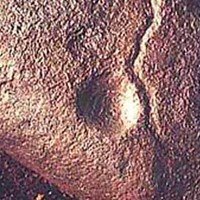 The oldest known prehistoric art. A cupule at the Auditorium Cave at Bhimbetka, Madhya Pradesh, India. It dates from (290,000-700,000 BCE). |
Oldest Prehistoric Art: "The Top 10"Contents • Introduction • See also:
Oldest Stone Age Art: Top 100 Works. |
|
OLDEST CERAMICS |
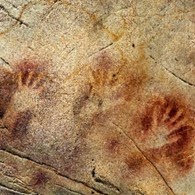
Here is a list of the top 10 oldest works of Prehistoric art created during the Stone Age. It features all the major types of Paleolithic art yet discovered, including: petroglyphs (the oldest type of cultural expression), parietal art (like cave painting, as well as hand stencils and other abstract signs) and also mobiliary art (like ivory carving and other portable forms of sculpture). Please note that any compilation of Stone Age art is bound to be both selective and subject to revision as new archeological discoveries are made. Furthermore, despite the widening range of archeological dating techniques - such as radiometric carbon dating, Uranium/Thorium and thermo-luminescence dating - not every work of art can be dated with great accuracy if the geological environment lacks important measurable elements. Thus sometimes, dating is dependent on paleontologist scholarship to provide the historical context against which an artifact's relevance and age can be assessed, through stylistic comparison with cave paintings and engravings at other archeological sites. At present, a large variety of fossils, tools and artifacts are being studied by paleoanthropologists and other Stone Age scholars, in order to fix their date of origin. The same applies to archeological sites, containing rock art like cupules, petroglyphs, pictographs and other prehistoric works. Thus this list of the earliest art by our ancestors like Homo erectus, Homo heidelbergensis, Homo neanderthalensis, and Homo sapiens sapiens - should be seen merely as a snapshot of an ongoing process of discovery. Only recently (2012), we have seen the chronology of Paleolithic art and culture changed completely by Uranium/Thorium dating tests on the cave art of El Castillo and Altamira. In addition, it seems likely that Aboriginal rock art in Australia will also - in the not too distant future - be discovered to be much older than presently thought. Sadly, none of the prehistoric rock carvers, sculptors or painters are known to us, so their works will have to speak for themselves! Also, any compilation of ancient art is limited by the hand of nature: after all, over hundreds of millennia, soft rock crumbles, pigments disappear, and wood perishes. Thus much of the finest African art and primitive "tribal art" as well as aboriginal "Oceanic art" from the Paleolithic world, are already lost to us.
|
|
|
|
|
The World's Oldest Art - Top 10 1. Bhimbetka
and Daraki-Chattan Petroglyphs (290,000-700,000 BCE) 2. Venus
of Berekhat Ram (230,000-700,000 BCE) 3. Venus
of Tan-Tan (200,000-500,000 BCE) 4. Blombos
Cave Rock Art (c.70,000 BCE) 5. Diepkloof
Eggshell Engravings (c.60,000 BCE) 6. La
Ferrassie Cave Cupules (c.60,000-40,000 BCE) |
|
|
7. El
Castillo Cave Paintings (Red Disk) (c.39,000 BCE) 8. Sulawesi
Cave Art (c.37,900 BCE) 9. Lion
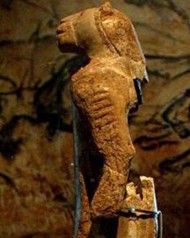
Man of the Hohlenstein Stadel (38,000 BCE) 10. Venus
of Hohle Fels (c.38,000-33,000 BCE) Short Guide To Stone Age Chronology Here is an outline of the basic timeline and dates of the Stone Age. Paleolithic Stone Age Lower Paleolithic (2,500,000 - 200,000
BCE) Middle Paleolithic (200,000 - 40,000
BCE) Upper Paleolithic (40,000-8,000
BCE) CHRONOLOGY OF THE UPPER PALEOLITHIC The Magdalenian period witnessed the apogee of Franco-Cantabrian cave art, with the Lascaux cave paintings and the Altamira cave paintings setting awesome standards of colouring and composition. Meanwhile, in Australia, the Bradshaw Paintings (c.15,500 BCE) appeared, along with a wide variety of pictographs and petroglyphs made by the aboriginal creators of Ubirr Rock Art in Arnhem Land, Kimberley Rock Art in northern Australia and Burrup Peninsula Rock Art in the Pilbara. Meanwhile Japanese art emerged in the form of ancient Jomon Pottery (from 14,500 BCE). Mesolithic
Period Neolithic Period Bronze Age (Europe: c.3000 BCE - 1200 BCE) Noted for its metallurgy, including exquisite early bronze, gold and silver metalwork, and ceramics. The first Near East civilizations (Minoan, Mycenean) appear. Trade flourishes around the Mediterranean, leading to exchange of artistic techniques and materials. Celtic Metalwork also inspires. Iron Age (Europe: c.1500 BCE - 200 BCE) Greek civilization flourishes on mainland Greece. From about 400 BCE - as Greek art begins to dazzle - we leave prehistory and enter great era of Classical Antiquity characterized by Greek sculpture and Greek Pottery and the more sobre style of Roman art. Early Chinese Pottery also flourished, as did the art of India. Preliminary investigation by paleontologists of the age of a particular stone artifact or rock begins with a thorough examination of the location-site together with a study of the geological record. In order to confirm that the object is contemporaneous with the soil or sedimentary deposit in which it was found, and not a later intrusive burial in an older deposit, comparisons with other fossils, rocks and rock strata are made to establish the site's biostratigraphy. Once contemporaneity has been established the age of the object can be assessed, sometimes quite precisely, using techniques of "absolute" or chronological dating. A major type of absolute dating is radiometric dating. This relies on the fact that a number of radioactive isotopes (like uranium) are known to decay into daughter products at a known constant rate. Probably the best known example of radiometric testing of living organisms, that may have been found at the site, is carbon-14 (radiocarbon) dating, which relies on Carbon-14 absorption. A newer form used by Dr. Pike at the caves of El Castillo and Altamira is known as Uranium/Thorium dating. More recent isochron radiometric dating methods avoid the problems which can potentially result during radiometric testing. Another form is potassium-argon radiometric testing which compares the proportion of potassium to argon in volcanic rock. Thermion mass spectrometry can be used to improve results of uranium-decay dating methods. Another type of prehistoric dating method is thermoluminescence (like quartzite, flint), designed to stimulate volcanic rocks into releasing electrons from their energy 'pockets'. While regular thermoluminescence (TL) uses heat as a source of stimulation, Optically Stimulated Luminescence (OSL) uses laser light. Other dating methods include: the Uranium Fission-Track method, Obsidian Hydration Dating, Amino Acid Racemization, Patination Dating, Electron Spin Resonance and Cosmic-ray Exposure Dating. |
|
• For the origins of painting and sculpture, see: Homepage.
ENCYCLOPEDIA OF STONE AGE ART |