La Ferrassie Cave
Dordogne, France: Neanderthal Cupule Art:
Description.
MAIN A-Z INDEX - A-Z of PREHISTORIC ART

|
La Ferrassie Cave
|
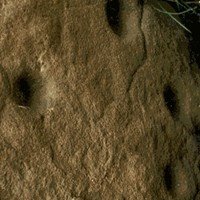 Examples of Prehistoric Cupules The world's oldest petroglyphs and the most ubiquitous form of prehistoric abstract signs. |
La Ferrassie Cave Cupules (c.60,000 BCE)Summary The oldest known site of Franco-Cantabrian cave art, La Ferrassie is a large Neanderthal cave complex, situated near Les Eyzies, in the Perigord region of the Dordogne in south-west France. It is famous for its series of cupules - a primitive form of rock art - dating back to Mousterian culture (c.60,000 BCE), which makes it the oldest prehistoric art in Europe. As well as its Neanderthal cupules, the cave also contains a number of rock engravings dating to the Aurignacian. (For Mousterian art in Africa, see: Blombos Cave Engravings c.70,000 BCE, and Diepkloof Eggshell Engravings c.60,000 BCE). For Neanderthal engravings, see: Gorham's Cave art (c.37,000 BCE), Gibraltar. The Dordogne area is home to numerous other important Stone Age art sites including: Abri Castanet (35,000 BCE), Chauvet Cave (30,000 BCE), Abri du Poisson Cave (23,000 BCE), Lascaux Cave (17,000 BCE), Cap Blanc Frieze (15,000 BCE), Font de Gaume Cave (14,000 BCE), Les Combarelles Cave (12,000 BCE), Abri Pataud, Bernifal, and Abri Reverdit, as well as the French National Museum of Prehistoric Culture (Musee National de Prehistoire). |
|
PREHISTORIC CARVING
|
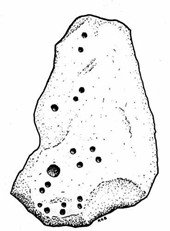
La Ferrassie Cave: History & Excavation Paleo-archeological excavations began at the site during the early part of the 20th century, under the supervision of Louis Capitan and Denis Peyrony. Fossils, stone tools and other signs of human occupation were uncovered, from a spectrum of Middle and Upper Paleolithic cultures, including those of the Mousterian, Chatelperronian, Aurignacian, and Perigoridian eras. The main occupants were Homo sapiens neanderthalensis, and the site included a Neanderthal Mousterian graveyard of unknown age, from which one of the most complete skeletons ever found of Neanderthal Man (aged 40-55 years) was unearthed - at La Ferrassie burial 1. Forensic examination of the skeleton revealed an osteo-arthritic condition indicating that the person was cared for despite his lack of mobility, which is another illustration of the known advanced nature of Neanderthal culture. Pleistocene remains were also found of six children and one other adult. In addition, in 1933, at La Ferrassie burial 6, a large limestone slab was found covering the grave of a Neanderthal child. On its underside was found an arrangement of cupule-art, consisting of 2 larger hollows and eight pairs of smaller holes, leading Robert Bednarik, the world-famous archeologist, to describe the entire site as one of significant cultural complexity.
Dating of Cupules at La Ferrassie Cave In view of the evidence of Mousterian occupation, the cupule art has been assigned an approximate date of 60,000 BCE, although Bednarik is of the opinion that it is "in all probability between 70,000 and perhaps 40,000 years old. The disappearance of Neanderthal Man from the archeological record from 40,000 onwards, suggests a date closer to 70K than 40K. Other cupules have been uncovered at European sites of the late Mousterian period (c.300,000 - 30,000 BCE), and at other excavations connecting the Mousterian with the early period of Aurignacian art, but the cupules at Ferrassie Cave remain the earliest art discovered in Europe.
Cupules Versus the "High Art" of Cave Painting and Sculpture In contrast with the 'modern' cave art of the Upper Paleolithic - such as the abstract red dots in the El Castillo Cave (39,000 BCE) and the magnificent cave painting at Altamira - cupules are a much more ancient form of anthropic art. They are the oldest art ever made (the Bhimbetka Petroglyphs), they exist on every populated continent, and were created during all three eras of the Stone Age - Paleolithic, Mesolithic and Neolithic - as well as in historical times. Unfortunately, experts are mystified by their meaning and cultural significance. As a result, they are not taken as seriously - as a form of art - as Ice Age murals or sculpture. Ferrassie Engravings In addition to cupules, the Ferrassie rock shelter also contains a number of stone blocks decorated with rock engravings, paintings and animal figures, some with deeply incised vulva. Most appear to date to the late Aurignacian period. |
|
• For more Franco-Cantabrian cave painting and engraving, see: Homepage.
ENCYCLOPEDIA OF STONE AGE ART |