Stone Age Art
History of Paleolithic, Mesolithic &
Neolithic Cultures.

|
Stone Age Art |
|
Resources |
Stone Age Art
|
|
|
The period of prehistory known as the Stone Age, is divided into three separate periods: the Paleolithic (2,500,000-10,000 BCE); Mesolithic (Europe, 10,000-4,000); and Neolithic (Europe, 4,000-2,000 BCE). Of these, the Paleolithic is by far the longer period, accounting for about 98 percent of the entire prehistoric era. The term "Stone Age art" refers loosely to any works created during these three periods. It is also commonly referred to as "prehistoric art". |
|
|
|
|
What are the Main Types of Stone Age Art? Before answering this, it's important to realize that our concept of "art" is often limited to images we see in books and museums, or at least to those forms that relate to our modern culture. This includes Greek art, as well as famous works from the Renaissance, all the way up to contemporary items by the likes of Damien Hirst. Put simply, when we think of art, we think of painting, sculpture, ceramics and modern forms including photography, installation, video art and so on. The earliest art of prehistory is quite different. I'm not talking about the famous venus figurines or the beautiful cave paintings of Lascaux and Altamira - these resemble our modern-style art quite sufficiently. I'm talking about the earliest forms of prehistoric artistic expression, specifically, "cupules", which represent one of the oldest and most prevalent forms of prehistoric art. For more, see: Oldest Stone Age Art: Top 100 Works. |
|
PREHISTORIC ART PREHISTORIC ARCHITECTURE DIFFERENT
FORMS OF ARTS |
|
Prehistoric Chronology • Aurignacian
Art |
A cupule is a cup-shaped hollow, pounded out of a rock surface (horizontal, inclined or even vertical). Typically found in groups, varying in number from half a dozen to several hundreds, they can be found in random groupings or in geometric patterns. Although many examples of cupules are the result of geological or climatic forces, archeologists have discovered thousands of prehistoric cupule-sites spread across every continent except Antarctica. See, for instance, the La Ferrassie Cave Cupules. For reasons no one understands, cupule-creation was a major form of artistic expression during the Stone Age, and - rather surprisingly - a form which has been largely ignored by many art historians as well as archeologists. Recently, the world famous archeologist Robert G. Bednarik has been drawing attention to cupules as a creative phenomenon of prehistory, but even he concedes that their cultural significance remains a mystery. He also makes the point that part of the reason for the lack of attention paid to these strange hollows, is that some experts don't even see them as art. In any event, they are worth checking out, not least because they were popular with so many Paleolithic artists! The main form of prehistoric art is "rock art". This includes (1) petroglyphs, otherwise known as rock carvings/engravings - see for instance, the Blombos Cave Engravings (c.70,000 BCE), the Diepkloof Eggshell Engravings (60,000 BCE) and the Abri Castanet Engravings (c.35,000 BCE); (2) pictographs, which includes drawn or painted signs, geometric symbols, hand stencils, and handprints - see for instance the tragic Gargas Cave Hand Stencils (25,000 BCE), the Roucadour Cave art (24,000 BCE) and the Placard Cave signs (17,500 BCE). Found in caves, rock shelters, cliff faces - indeed any type of rock surface, and dating back into the Lower Paleolithic (2,500,000-200,000 BCE), rock art continued to be produced throughout the Middle and Upper Paleolithic, and can be seen in Europe, Asia, Africa, Australasia, Oceania and the Americas. In addition to prehistoric engravings (petroglyphs) and cave murals (pictographs), another category of rock art is called Megaliths or Petroforms. These are arrangements of standing stones, as at Stonehenge or Newgrange). Sculpture/Carving of the Stone Age There are four main categories of prehistoric sculpture: (1) Ultra-Primitive humanoid objects from the Lower Paleolithic. These items display so little overt creativity that some experts doubt they can even be considered as art. Examples include: the Venus of Berekhat Ram (c.230,000 - 700,000 BCE) and the Venus of Tan-Tan (c.200,000 - 500,000 BCE or later). (2) Primitive relief sculpture. Examples include: the Salmon of Abri du Poisson Cave (c.23,000 BCE); the bas-relief limestone sculpture of a reclining female figure, known as the Venus of Laussel (c.23,000 BCE); and the relief clay sculptures of two bison in the Tuc d'Audoubert Cave (c.13,500 BCE). It also includes megalithic art such as the animal reliefs at Gobekli Tepe (9000 BCE.) (3) Venus Figurines. Produced mainly during the Aurignacian and Gravettian cultures, these small statuettes - mostly only a few inches in height and carved from a wide variety of stone, bone and clay - depicted obese female figures with enlarged breasts, bellies, hips and thighs, almost to the point of caricature. Experts consider them to be portable icons of a religious, totemic or supernatural nature, although their cultural significance remains a mystery. Examples include the ivory carving known as the Venus of Hohle Fels (38,000-33,000 BCE), Venus of Galgenberg (c.30,000), Venus of Dolni Vestonice (c.26,000), Venus of Monpazier (c.25,000), Venus of Willendorf (c.25,000), Venus of Savignano (c.25,000), Venus of Moravany (c.24,000), Venus of Brassempouy (c.23,000), Venus of Lespugue (c.23,000), Venus of Laussel (c.23,000), Venus of Kostenky (c.22,000), Venus of Gagarino (c.20,000), the Avdeevo Venuses (c.20,000 BCE), the Mal'ta Venuses (c.20,000 BCE) and the Zaraysk Venuses (c.20,000 BCE). For a later Russian Magdalenian ivory, see: Venus of Eliseevichi (14,000 BCE). (4) Figurative Carvings of human figures and animals. These first appeared during the early Upper Paleolithic. Examples include: the extraordinary ivory carving known as the Lion Man of Hohlenstein Stadel (38,000 BCE) and the Ivory Carvings of the Swabian Jura (c.33,000 BCE).
|
|
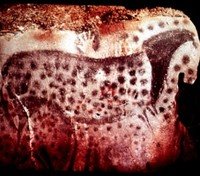
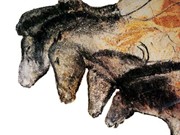
Cave Painting of the Stone Age As prehistoric society became sufficiently advanced to accept ritual and ceremony - of a quasi-religious or shaman-type nature - certain caves were reserved as prehistoric art galleries, where artists began to create a series of extraordinary paintings of animals, hunting scenes and other graphic illustrations of prehistoric life, as well as symbolic pictographs and patterns of abstract art. Among the greatest examples of Paleolithic cave painting are: the Dappled Horses of Pech-Merle (c.25,000 BCE) executed in charcoal and ochre on limestone; the "Hall of the Bulls" at the Lascaux cave, which has the largest known images of aurochs (male cattle); and the polychrome Altamira cave paintings, in Cantabria, Spain, which paleoanthropologists and others have described as "the Sistine Chapel of prehistoric art." For another style, see: the Russian Kapova Cave paintings (c.12,500 BCE) Burzyansky Region, Bashkortostan. What is the Oldest Stone Age Art? The oldest known art in the world is the Bhimbetka Petroglyphs - 10 cupules and a groove, discovered in the quartzite Auditorium rock shelter at Bhimbetka in Madhya Pradesh, central India, dating to at least 290,000 BCE. Archeological excavations in a second rock shelter at Indragarh Hill in the same region, are thought to be as old. The oldest known cave art are the abstract signs found among the El Castillo Cave paintings (39,000 BCE) in Cantabria. The next oldest is the Sulawesi Cave Art (c.37,900 BCE) found in the Leang Timpuseng Cave on the island of Sulawesi in Indonesia. After this comes the Fumane Cave paintings (c.35,000 BCE) in Italy, and the abstract art discovered at Altamira (c.34,000 BCE) in Spain. After this comes the fabulous parietal art discovered at Chauvet cave in the Ardeche area of France, dating from 30,000 BCE. In Australia, several areas are believed to contain Aboriginal rock art from the early part of the Upper Paleolithic (c.30,000 BCE). Western Australia, for instance, is home to Burrup Peninsula rock art from the Pilbara region, as well as Kimberley rock art and the later Bradshaw paintings from its northern coast. Meanwhile, Northern Territory is home to Ubirr rock painting and the recently discovered Nawarla Gabarnmang charcoal drawing (26,000 BCE) in Arnhem Land, Northern Territory. What Art Was Created During Mesolithic and Neolithic Times? These periods are noted for their ceramic art, monumental architecture (Egyptian, Sumerian and megalithic) and early bronze sculptures. Painting comes out of the caves and into the open-air, while portable art (pots, ornaments), often called mobiliary art, becomes more common. The Neolithic period is characterized by the development of agriculture, and animal husbandry, leading to a more settled way of life. This stimulated the growth of arts and crafts. With greater settlement in villages and other small communities, rock painting begins to be replaced by more portable art which becomes progressively enhanced by the use of precious metals (eg. copper is first used in Mesopotamian art, especially Mesopotamian Sculpture, while metallurgy is discovered in South-East Europe), and the design of new tools. Free standing sculpture, in stone and wood begins to be seen, as well as statues, pottery, primitive jewellery and decorative designs on a variety of artifacts. See for instance: Neolithic Art in China (7500-2000 BCE). For a list of dates in the prehistoric evolution and development of Asian culture, see: Chinese Art Timeline (c.18,000 BCE - present). Other important art-related trends which surface during the Neolithic period include writing and religion. The appearance of early hieroglyphic writing systems in Sumer heralds the arrival of pictorial methods of communication, while increased prosperity and security permits greater attention to religious formalities of (eg) worship (in temples) and burial, in megalithic tombs. |
|
The emergence of the first city state (Uruk, in Mesopotamia) predicts the establishment of more secure communities around the world, many of which will compete to establish their own independent cultural and artistic identity, creating permanent large scale artworks in the process. Meanwhile, new types of monumental art began to appear in the form of Egyptian pyramids, (for more details see: Ancient Egyptian Architecture) and other religious complexes such as Newgrange Megalithic Tomb (c.3300 BCE) and the Knowth Megalithic Tomb (c.2500 BCE) in Ireland. (For facts about the development of visual arts in Ireland, see the history of Irish art.) What Sort of Art Materials Were Used by Stone Age Artists? Prehistoric sculptors used almost every sort of material they could lay their hands on, including stone such as quartzite, steatite, sandstone, serpentine and limestone, as well as mammoth ivory, animal bones and reindeer antlers. Stone Age painters employed numerous combinations of materials to create their prehistoric colour palette, including various shades of clay ochre, manganese dioxide and charcoal. It is quite possible their knowledge of pigments derived from their use of body art, such as body painting and face painting. What Caused the Creation of Stone Age Art? The reason behind all human evolutionary advances, especially in both tool-making and art, was undoubtedly the gradual increase brain size, as measured by the volume of the inside of the brain case (cranial capacity). In early hominids like Australopithecus afarensis and Australopithecus africanus, brain capacity was about 350 to 500 cubic centimetres, compared to roughly 1350 cc for modern humans such as Homo sapiens. However, since Neanderthals had a brain capacity as large or even larger than more modern Homo sapiens, the relative complexity of the internal architecture of the brain is also an important factor. In any event, brain functionality is directly associated with linguistic and creative expression. What Sort of Human Artists Created Stone Age Art? According to most paleontologists, the human species (Homo or hominids) separated from gorillas in Africa about 8 million years ago, and from chimpanzees no later than five million years ago. (The discovery of a hominid skull [Sahelanthropus tchadensis] dated about 7 million years ago, may indicate an earlier separation). The very early hominids included species like Australopithecus afarensis, Australopithecus africanus and Paranthropus robustus (brain size 350-500 cc). Around 2.5 million years BCE, humans started making stone tools, and newer species like Homo habilis and Homo rudolfensis appeared (brain size 590-690 cc). By 2 million years BCE more species emerged, such as Homo erectus (brain size 800-1250 cc). Over the next 500,000 years, Homo erectus spread from Africa to the Middle East, Asia and Europe. Between 1.5 million BCE and 500,000 BCE, Homo erectus and other contemporaneous sub-species spawned several more advanced types of Homo, known as Archaic Homo sapiens. It was a group of artists from one of the Archaic Homo sapiens species that created the artworks in the Auditorium rock shelter at Bhimbetka in India. From 500,000 BCE onwards, these new types morphed into Homo sapiens, as exemplified by Neanderthal Man (from 200,000 BCE or earlier). It was probably Neanderthal sculptors (or their contemporaries) who created the Near East Berekhat Ram and Tan-Tan figures, as well as the African Blombos cave art. Finally, around 100,000 BCE, modern man (or "anatomically modern man) emerged in sub-Saharan Africa, and, like his ancestors before him, made his way northwards: reaching North Africa by about 70,000 BCE and becoming established in Europe no later than the end of the Middle Paleolithic (40,000 BCE). It was these painters and sculptors belonging to modern man (eg. Cro-Magnon Man, Grimaldi Man) who were responsible for the dazzling cave painting that appeared during the Aurignacian, Gravettian and Magdalenian cultures of the Upper Paleolithic. The earliest ancient art consisted of petroglyphs and cupules, dating to the Lower Paleolithic. This was followed, at the end of the period, by primitive rock carvings. Not much has been found of Middle Paleolithic art, other than the Blombos cave art. During the Upper Paleolithic, Stone Age art begins to flourish via the venus figurines and the cave painting at Chauvet, Pech-Merle, Cosquer, Lascaux and Altamira. The more recent Mesolithic and Neolithic periods of the Stone Age are memorable for portable artworks, such as ceramic pottery, as well as monumental architecture and early bronzes. |
|
• For the main index, see: Homepage.
Sitemap:
International Art |