Prehistoric Art Timeline
List of Dates of Stone Age Arts: Chronology of Paleolithic, Mesolithic & Neolithic Petroglyphs, Cupules, Cave Painting.


Stone Age Arts Timeline: 2.5 Million - 500 BCE

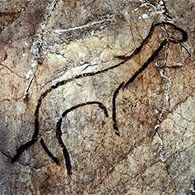
Here is a selected chronological list of important dates showing the development of prehistoric art and culture from the Pliocene epoch, through the Lower, Middle and Upper Paleothic eras of the Pleistocene epoch of the Stone Age, and reaching down to the Mesolithic (or Epipalaeolithic), Neolithic, Bronze and Iron ages of the Holocene epoch. Not content with simply making tools, Homo sapiens and later modern man created a huge range of Stone Age art, beginning with primitive Acheulean culture petroglyphs - such as cupules and rock carvings - and ending in stunning works of prehistoric sculpture (like the venus figurines), and the beautiful Magdalenian era cave paintings of Altamira. Stone Age artists used every sort of material they could find, ranging from rock-hard quartzite to softer stones like steatite, serpentine, sandstone and limestone, as well as mammoth ivory, reindeer antler, and animal bones. For colour, they used a range of red, yellow and brown ochres, manganese dioxide and charcoal. Art of the later Neolithic period is exemplified by exquisite ceramics, magnificent early bronze and gold castings, and the monumental architecture of the pyramids, ziggurats and megalithic structures of Newgrange and Stonehenge. Brought to life thanks to the efforts of archeologists and paleoanthropologists, the art of prehistory remains an integral chapter in the evolution of man. For a chronological dateline from 600 BCE onwards, see: History of Art Timeline.


Date Event
2,500,000 BCE


2,500,000


1,700,000
1,600,000


1,500,000
400,000
300,000

290,000


230,000
LOWER PALEOLITHIC ERA BEGINS
The first of three time periods of the Paleolithic - an era which witnessed several Ice Ages and glaciations, and during which early hominids like Australopithecus afarensis, Australopithecus africanus, and Paranthropus robustus, developed first into Homo habilis and Homo rudolfensis, then into Homo erectus, Homo ergaster, Homo erectus, and Homo heidelbergensis, before metamorphosing into Homo sapiens, Homo neanderthalensis and ultimately anatomically modern man (eg. Cro-Magnon man). Human evolution is defined via the development of stone tools, a process which impacts on the development of ancient art.
Olduwan tool Culture begins. Its key feature was the method of chipping stones to create a chopping or cutting edge. The first stone tools of the Lower Paleolithic. (Earliest types unearthed at Hadar, Ethiopia).
Oldest utilitarian (non-artistic) cupule discovered at the Olduvai Gorge in Tanzania.
End of Pliocene, start of Pleistocene geologic period. Coincides with the replacement of Olduwan cultures with more advanced Acheulean tool culture. the dominant tool-making tradition of the Lower Paleolithic era throughout Africa and much of Asia and Europe.
By this point, the human species has become a major predator.
Emergence of Clactonian culture of European flint tool manufacture.
Beginning of Mousterian tool culture in Europe, the Middle East and North Africa, associated with the production of serrated edge blades.
Earliest art: The Petroglyphs of Bhimbetka - cupules and other rock art found at Auditorium Cave, Bhimbetka and at Daraki-Chattan Cave, both in Madhya Pradesh, Central India, and both dated c.290,000 - 700,000 BCE or later. These are the oldest known prehistoric works of art, and the first examples of art from India.
Venus of Berekhat Ram
, rock figurine, (dated c.230,000 - 700,000 BCE). This is the oldest known Stone Age figurine. See also: Oldest Art (Top 50).
200,000
100,000

70,000

70,000-40,000

40,000

33,000


33,000-30,000

30,000


26,000


25,500
25,000


24,000
23,000


22,000
21,000
19,000


17,000


16,000


15,000

14,540
13,500
11,000
10,500

MIDDLE PALEOLITHIC ERA BEGINS
High point of Levallois culture, an advanced flint-knapping culture. Earliest African art appears, the Venus of Tan-Tan, quartzite figurine, (dated c.200,000 - 500,000 BCE)
Blombos Cave engravings with cross-hatch designs on two pieces of ochre rock. Possibly the very earliest form of Tribal Art.
Oldest prehistoric art of Europe: the La Ferrassie cave cupules.

UPPER PALEOLITHIC ERA BEGINs (Modern Man Replaces Neanderthal Man)

Start of Aurignacian culture. The ivory carving known as Venus of Hohle Fels is made.
Beginning of Perigordian (aka Chatelperronian) culture. Derived from the earlier Mousterian, practised by Homo neanderthalensis, it employed Levallois flake-tool technology, producing serrated stone tools as well as a signature flint blades known as "Chatelperron points".
Important animal and figurative carvings, like: Swabian Jura ivory carvings (Vogelherd cave) Lion Man of Hohlenstein Stadel, therianthropic statuette.
See also Venus of Kostenky, ivory carving, earliest of the venus figurines and the oldest known Russian sculpture. Venus figurines are European miniature carvings (in ivory, bone, stone or clay) of obese female figures with exaggerated body parts and genitalia.
Venus of Monpazier, steatite stone sculpture, France.
First known cave painting appears in France. Chauvet cave painting and ideomorphs, France. Chauvet is the earliest known example of Stone Age cave paintings, although they are monochrome in composition.
Ubirr Aboriginal Rock Art, Arnhem Land, Northern Australia, the earliest Oceanic Art. Other very early sites of Aboriginal Rock Art include Turtle Rock Queensland; the granitic region of the Pilbara; the limestone caves of southern Australia. All three involve Aboriginal cupules.
Gravettian culture begins. Practised in eastern, central and western Europe, its signature tool (a development of the Châtelperron point) was a small pointed blade with a blunt but straight back - called a Gravette Point.
Venus of Dolni Vestonice
, first ceramic figurine, Romania. Earliest work of ceramic art.
Apollo 11 cave paintings in charcoal and ochre, Namibia.
Venus of Willendorf, obese female oolitic limestone sculpture, Austria.
Cosquer cave painting - hand stencil art and drawings, ideomorphs, France.
Venus of Savignano, sculpture in serpentine stone, Italy.
Dappled Horses - Pech-Merle cave paintings & ideomorphs.
Venus of Moravany mammoth ivory figurine, Slovakia.
Limestone Venus of Kostenky, Russia.
Venus of Laussel limestone bas-relief sculpture, France.
Venus of Brassempouy, first prehistoric carving with facial features, France.
The Salmon of Abri du Poisson Cave, bas-relief limestone fish sculpture, France.
Venus of Lespugue, ivory sculpture, France.
Venus of Garagino, Ukraine's oldest rock sculpture.
Venus of Mal'ta oldest recorded Siberian figurative sculpture.
Beginning of Solutrean culture. Solutrean tool-makers developed a number of uniquely advanced techniques, some of which were not subsequently seen for several thousand years after their departure.
Sash Painting: Aboriginal Bradshaw-style Rock Art, Western Australia.
Lascaux painted caves featuring "Hall of the Bulls", France.
Font de Gaume polychrome cave art, France.
Magdalenian culture begins, the final major culture of the Upper Paleolithic,practised by Homo Sapiens (eg. Grimaldi Man) across France, Spain, Switzerland, central Europe, as the Ice retreated northwards, it replaced all earlier Aurignacian and Solutrean influence.
Cave of La Pasiega, animal paintings, symbols, ideomorphs, Spain.
Altamira cave paintings: "Sistine Chapel of Stone Age Art", Spain.
Lortet Reindeer, engraving on antler fragment, France.
Earliest Jomon pottery, Odaiyamamoto I site, Japan. Earliest known Japanese Art.
Tuc d'Audoubert Bison, relief clay sculptures, France.
Addaura Cave limestone engravings, Monte Pellegrino, Italy. End of Paleolithic art.
Cooper Bison Skull (Oklahoma). One of the oldest examples of American Indian art.

10,000


9,500


9,000

8,200
8,000


7,000


6,000
5,500

5,000


4,000


4,000-2,500


3,500


3,500-1,750
3,300
3,200


3,000


3,200
3,100

2,800

2,700
2,660


2,500


2,100
2,000
2,000-1,500
1,780
1,750

1,700
1,600
1,530-1,500


1,500

1,450
1,425
1,390
1,250
1,200

1,184
1,100
1050-221
900
800
800-700


753
600 BCE
MESOLITHIC ERA BEGINS IN EUROPE
This is associated with a wide variety of races, including the Azilian Ofnet Man (Bavaria); several types of Cro-Magnon Man, brachycephalic humans (short-skulled), dolichocephalic humans (long-skulled). The Mesolithic is a transitional era between the hunter-gatherer culture of the Upper Paleolithic, and the farming culture of the Neolithic. In areas with no ice (eg. the Middle East), people transitioned quite rapidly from hunting/gathering to agriculture. Their Mesolithic period was therefore short, and often referred to as the Epi-Paleolithic or Epipaleolithic. In 10,000 BCE we witness the end of the Pleistocene geological epoch and the beginning of Holocene Epoch. Start of Chinese Pottery.
Cuevas de las Manos (Cave of the Hands), stencils, paintings, Argentina, the earliest known prehistoric art of the American continent. Large quantity of Stone Age artifacts found at Fell's Cave in Patagonia and Blackwater Draw in eastern New Mexico (Clovis culture).
Bhimbetka Rock Art, paintings, stencils, ideomorphs, India.
Pachmari Hills: sandstone rock drawings, paintings, India.
Wonderwerk Cave engravings of geometric designs, ideomorphs, animals, South Africa.
End of the Ice Age. Tassili-n-Ajjer rock art, Algerian paintings and petroglyphs.
Ancient Persian pottery from Ganj Dareh (Valley of Treasure). Jiahu turquoise carvings, bone flutes, Henan Province China. Beginning of Neolithic Art in China (7500-2000 BCE).
Oven-fired pottery appears in Mesopotamia where farming begins. Pigs domesticated.
People settle on the banks of the River Nile.
Coldstream Burial Stone, Western Cape Province, South Africa.
Goddess terracotta figurine, Catal Huyuk, Anatolia, an early example of religious art.
Egyptian bone, ivory, stone figurines from Naquada I Period.
Persian Chalcolithic pottery.
Linear Ceramic culture emerges in France, Germany, Austria, Slovakia, Czech Republic.
Thinker of Cernavoda, the Romanian terracotta sculpture of the Hamangia culture.
Fish God of Lepenski Vir, sandstone carving of therianthropic figure, Serbia.
Samarra and Halaf ceramic plates: see: Mesopotamian art (c.4500-539).

NEOLITHIC ERA BEGINS IN EUROPE

Mesolithic Era ends in Europe, superceded by the Neolithic (New Stone Age), a much more settled form of existence, based on farming and rearing of domesticated animals. (Light plough introduced in Europe.) The major art form of the Neolithic art was ceramic pottery.
Jade carving begins in China, as does Chinese lacquerware and silk production.
Earliest megalithic architecture, like: the megaliths at Evora, in Portugal (from 5,000); Breton Cairn of Barnenez (from 4,450); the tombs and monuments of Carrowmore, Cúil Irra Peninsula, Ireland (from 4,300). Building of Stonehenge stone circle begins (c.2,600 BCE). See also: megalithic art.
Mesopotamian civilization begins (Iraq). Emergence of Uruk, first city-state. First wheeled vehicles appear in Europe. Ancient Persian art includes the intricate ceramics from Susa and Persepolis. Oldest known prehistoric bronze sculptures produced in the Maikop culture of the Russian North Caucasus around 3,500, using simple arsenic bronze process.
Sumerian civilization (S. Iraq). First writing system (hieroglyphs). Cuneiform script 3200.
Egyptian art and civilization begins. Building of Newgrange Megalithic Tomb begins.
Sumerian civilization develops its own monumental architecture - a type of stepped pyramid called a ziggurat, built from clay-fired bricks. See History of Architecture.

BRONZE AGE BEGINS IN EUROPE

Metallurgy develops, as does Bronze Age art. The more complex copper-and-tin bronze casting techniques appear in the Indus Valley Civilization of India during the period.
First use of horses for drawing wagons and carts. See: Egyptian Architecture (3000 on).
First wheeled transport (Sumeria).
Egyptians create first wall paintings in tombs.
Copper-working begins in southern France.
Emergence of Beaker culture in Europe (named after their distinctive drinking vessels).
Egyptians develop first painted relief sculptures.
Egyptians develop the first seated and free-standing statues.
Start of Egyptian Pyramids. Djoser's 'Step Pyramid' at Saqqara (2630); the Architect Hemon designs the Great Pyramid at Giza (2550); Khufu builds the Sphinx (2550). See also Early Egyptian Architecture (3100-2181).
Dabous Giraffe Engravings, Taureg Saharan culture. Knowth Megalithic Tomb built.
Valdivia Figurines, First 3-D images of the Americas (Real Alto Ecuador). Mesopotamian sculpture Ram in the Thicket, made from gold-leaf, copper, lapis lazuli. Sculptors make Maikop Gold Bull, North Caucasus. Start of Aegean Art in eastern Mediterranean.
Bronze Dancing Girl of Mohenjo-Daro, Harappan Culture, Indus Valley Civilization.
Famous Ziggurat constructed in Uruk. Egyptian Middle Kingdom Architecture (2055-1650).
"X-ray" style of Aboriginal rock art developed in Arnhem Land. Xia Dynasty culture, China.
Minoan Palaces built & rebuilt on Crete. Outstanding Minoan artworks: pottery/ceramics.
The written Code of Hammurabi (laws) displayed throughout Babylonian empire.
First outstanding Chinese art appears, bronzes of Shang Dynasty art, as well as the earliest Calligraphy. See: Traditional Chinese Art: Characteristics.
Linear A script introduced by Minoans.
Mycenaean civilisation flourishes in Greece. Glass making perfected in Mesopotamia.
Construction of massive temple complex of Karnak to the god Amon at Thebes. See also: Egyptian New Kingdom Architecture (1550-1069).

IRON AGE BEGINS IN EUROPE

Iron Age Art begins in Europe. Meanwhile, the first bronze sculptures appear in China.
Myceneans invent form of writing based on Minoan Linear B script. See Irish Iron Age Art.
Myceneans (Greek mainland) absorb Minoans.
Amenhotep III builds the palace at Malkata (near Thebes) and temple of Amon at Luxor.
Rameses II builds the Colossus at Memphis, the Hypostyle Hall of the Karnak temple Luxor. Decline of Mycenean civilization. (Architectural Dark Ages begins. Ends 600.)
Approximate beginning of Pre-Columbian art in mesoamerica and South America.
Fall of Troy in Asia Minor.
Foundation of the Kingdom of Israel. See also Late Egyptian Architecture (1069 - 200 CE).
First appearance of Geometric style of Greek Pottery.
Zhou Dynasty art, the last period of Bronze Age culture in ancient China.
Earliest settlements appear on Palatine Hill, Rome
Homer writes the Iliad and Odyssey. First Celtic culture discovered. Hallstatt style of art/design begins characterized by geometric designs. After this comes the elaborate and curvilinear La Tene style of Celtic art (450 BCE), with its spirals, zoomorphs and other Celtic designs.
Legendary founding of Rome by Romulus.
Hereafter, Greek art and architecture is divided into three basic eras: the Archaic Period (c.600-500 BCE), the Classical Period (c.500-323 BCE) and the Hellenistic Period (c.323-27 BCE). Egyptian, Greek and Etruscan artists greatly influence later Roman art, as well as Byzantine.

• For our main index, see: Art Encyclopedia.
• For more information, see: Art History Questions.
• For a brief timeline of visual arts in Ireland, see: History of Irish Art.


ENCYCLOPEDIA OF ART
© visual-arts-cork.com. All rights reserved.