Ancient Greek Art
Archaic, Classical, Hellenistic Arts.
MAIN A-Z INDEX

|
Ancient Greek Art
|
|
|
Aegean art of Classical Antiquity dates back to Minoan culture of the Third Millennium BCE, when the inhabitants of Crete, known as Minoans after their King Minos, began to establish a thriving culture around 2100 BCE, based on their successful maritime trading activities. Influenced by Sumerian art and other strands of Mesopotamian art, they built a series of palaces at Knossos, Phaestus and Akrotiri, as well as the creation of a wide range of fresco painting, stone carvings, ancient pottery and other artifacts. During the 15th century BCE, after a catastrophic earthquake, which destroyed most of her palaces, Crete was overrun by warlike Mycenean tribes from the Greek mainland. Mycenean culture duly became the dominant force in the eastern Mediterranean. Then, not long after launching the Trojan War (c.1194–1184), the city of Mycenae, along with its architecture and cultural possessions, was destroyed by a new set of maurauders, known as Dorians. At this point, most production of ancient art came to a standstill for about 400 years (1200-800), as the region descended into an era of warring kingdoms and chaos, known as the "Greek Dark Ages" (or the Geometric or Homeric Age). Ancient Greek art proper "emerged" during the 8th century BCE (700-800), as things calmed down around the Aegean. (See also Etruscan art) About this time, iron was made into weapons/tools, people started using an alphabet, the first Olympic Games took place (776), a complex religion emerged, and a loose sense of cultural identity grew up around the idea of "Hellas" (Greece). By about 700, kingdoms began to be replaced by oligarchies and city-states. However, early forms of Greek art were largely confined to ceramic pottery, as the region suffered continued disruption from widespread famine, forced emigration (many Greeks left the mainland to colonize towns in Asia Minor and Italy), and social unrest. This restricted the development of architecture and most other types of art. Not until about 650, when maritime trade links were re-established between Greece and Egypt, as well as Anatolia, did Greek prosperity finally return and facilitate an upsurge of Greek culture. |
|
|
|
PAINT PIGMENTS |
The practice of fine art in ancient Greece evolved in three basic stages or periods: • Archaic Period (c.650-480
BCE) The Archaic era was a period of gradual experimentation. The Classical era then witnessed the flowering of mainland Greek power and artistic domination. The Hellenistic Period, which opened with the death of Alexander the Great, witnessed the creation of "Greek-style art" throughout the region, as more and more centres/colonies of Greek culture were established in Greek-controlled lands. The period also saw the decline and fall of Greece and the rise of Rome: in fact, it ends with the complete Roman conquest of the entire Mediterranean basin.
|
|
|
|
Archaic Period (c.650-480 BCE) The most developed art form of the pre-Archaic period (c.900-650) was undoubtedly Greek pottery. Often involving large vases and other vessels, it was decorated originally with linear designs (proto-geometric style), then more elaborate patterns (geometric style) of triangles, zigzags and other similar shapes. Geometric pottery includes some of the finest Greek artworks, with vases typically made according to a strict system of proportions. From about 700, renewed contacts with Anatolia, the Black Sea basin and the Middle East, led to a noticeable eastern influence (Oriental style), which was mastered by Corinth ceramicists. The new idiom featured a wider repertoire of motifs, such as curvilinear designs, as well as a host of composite creatures like sphinxes, griffins and chimeras. During the Archaic era itself, decoration became more and more figurative, as more animals, zoomorphs and then human figures themselves were included. This ceramic figure painting was the first sign of the enduring Greek fascination with the human body, as the noblest subject for a painter or sculptor: a fascination rekindled in the High Renaissance painting of Michelangelo and others. Another ceramic style introduced by Corinth was black-figure pottery: figures were first drawn in black silhouette, then marked with incised detail. Additional touches were added in purple or white. Favourite themes for black-figure imagery included: the revels of Dionysus and the Labours of Hercules. In time, Athens came to dominate black-figure style pottery, with its perfection of a richer black pigment, and a new orange-red pigment which led to red-figure pottery - an idiom that flourished 530-480. Famous Greek Archaic-era ceramic artists included the genius Exekias, as well as Kleitias (creator of the celebrated Francois Vase), Andokides, Euthymides, Ergotimos, Lydos, Nearchos and Sophilos. For more details and dates, see: Pottery Timeline. It was during 6th and 7th centuries that stone was used for Greek public buildings (petrification), especially temples. Greek architecture relied on simple post-and-lintel building techniques: arches weren't used until the Roman era. The typical rectangular building was surrounded by a line of columns on all four sides (see, for instance, the Parthenon) or, less often, at the front and rear only (Temple of Athena Nike). Roofs were constructed with timber beams overlaid with terracotta tiles. Pediments (the triangular shape at each gable end) were decorated with relief sculpture or friezes, as was the row of lintels between the roof and the tops of the columns. Greek architects were the first to base their architectural design on the standard of proportionality. To do this, they introduced their "Classical Orders" - a set of design rules based on proportions between individual parts, such as the ratio between the width and height of a column. There were three such orders in early Greek architecture: Doric, Ionic and Corinthian. The Doric style was used in mainland Greece and later Greek settlements in Italy. The Ionic order was used in buildings along the west coast of Turkey and other Aegean islands. Famous buildings of ancient Greece constructed or begun during the Archaic period include: the Temple of Hera (600), the Temple of Athena on the Acropolis (550), and the Temples at Paestum (550 onwards). See also: Egyptian Architecture (c.3000 BCE onwards) and the importance of Egyptian architects such as Imhotep and others.
The history of art shows that building programs invariably stimulated the development of other forms of fine art, like sculpture and painting, as well as decorative art, and Archaic Greek architecture was no exception. The new temples and other public buildings all needed plenty of decorative sculpture, including statues, reliefs and friezes, as well as mural painting and mosaic art. Archaic Greek sculpture during this period was still heavily influenced by Egyptian sculpture, as well as Syrian techniques. Greek sculptors created stone friezes and reliefs, as well as statues (in stone, terracotta and bronze), and miniature works (in ivory and bone). The early style of freestanding Daedalic sculpture (650-600) - as exemplified by the works of Daedalus, Dipoinos and Skyllis - was dominated by two human stereotypes: the standing nude youth (kouros) and the standing draped girl (kore). Of these, the male nudes were seen as more important. To begin with, both the kouros and the kore were sculpted in a rather rigid, "frontal", Egyptian style, with wide-shoulders, narrow-waists, arms hanging, fists clenched, both feet on the ground, and a fixed "archaic smile": see, for instance, Lady of Auxerre (630, Louvre) and Kleobis and Biton (610-580, Archeological Museum of Delphi). As time passed, the representation of these formulaic statues became less rigid and more realistic. Later, more advanced, Archaic versions of kouroi and korai include the "Peplos Kore" (c.530, Acropolis Museum, Athens) and the "Kritios Boy" (Acropolis Museum, Athens). Other famous works include: the Strangford Apollo (600-580, British Museum); the Dipylon Kouros (c.600, Athens, Kerameikos Museum); the Anavysos Kouros (c.525, National Archeological Museum of Athens); and the fascinating frieze of the Siphnian Treasury, Delphi (c.525). Since most vases and sculptures were painted, the growth of pottery and sculpture during the 7th century led automatically to more work for Greek painters. In addition, the walls of many temples, municipal buildings and tombs were decorated with fresco painting, while their marble or wooden sculpture was coloured with tempera or encaustic paint. Encaustic had some of the lustre of oil painting, a medium unknown to the Greeks, and became a popular painting method for stone statues and architectural reliefs during the sixth century. Archaic Greek painting boasts very few painted panels: the only examples we have are the Pitsa panels decorated in stucco coloured with mineral pigments. Unfortunately, due to erosion, vandalism and destruction, few original Greek paintings have survived from this period. All that remains are a few painted slabs of terracotta (the terracotta metopes from the temple of Apollo at Thermon in Aitolia c.630), some wooden panels (the four Pitsa panels found in a cave in the northern Peloponnese), and murals (such as the 7th century battle scene taken from a temple at Kalapodi, near Thebes, and those excavated from underground tombs in Etruria). Apart from certain individuals, like Cimon of Cleonae, the names of Archaic Greek painters are generally unknown to us. The most prevalent art form to shed light on ancient Greek painting is pottery, which at least gives us a rough idea of Archaic aesthetics and techniques. Note, however, that vase-painting was seen as a low art form and is rarely referred to in Classical literature. Classical Period (c.480-323 BCE) Victory over the Persians in 490 BCE and 479 BCE established Athens as the strongest of the Greek city states. Despite external threats, it would retain its leading cultural role for the next few centuries. Indeed, during the fifth century BCE, Athens witnessed a creative resurgence which would not only dominate future Roman art, but when rediscovered by Renaissance Europe 2,000 years later, would constitute an absolute artistic standard for another four centuries. All this despite the fact that most Greek paintings and sculptures have been destroyed. The main contribution of Greek Classicism to fine art, was undoubtedly its sculpture: in particular, the "Canon of Proportions" with its realization of the "ideal human body" - a concept which resonated so strongly with High Renaissance art, a thousand years later. |
|
|
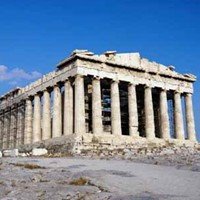
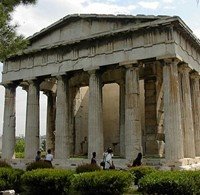
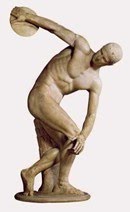
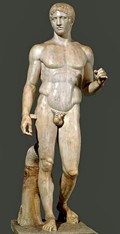
During this era, Ceramic art and thus vase-painting experienced a progressive decline. Exactly why, we don't know, but, judging by the lack of innovations and the increasing sentimentality of the designs, the genre appears to have worn itself out. The final creative development was the White Ground technique, which had been introduced around 500. Unlike the black-figure and red-figure styles, which relied on clay slips to create pictures, the White Ground technique employed paint and gilding on a white clay background, and is best illustrated by the funerary lekythoi of the late 5th century. Apart from this single innovation, classical Greek pottery declined significantly in both quality and artistic merit, and eventually became dependent on local Hellenistic schools. Like most Greek visual art, building design reached its apogee during the Classical period, as the two main styles (or "orders") of Greek architecture, the Doric and the Ionic, came to define a timeless, harmonious, universal standard of architectural beauty. The Doric style was the more formal and austere - a style which predominated during the 4th and 5th centuries - while the Ionic was more relaxed and somewhat decorative - a style which became more popular during the more easy-going Hellenistic era. (Note: The Ionic Order later gave rise to the more ornate Corinthian style.) The highpoint of ancient Greek architecture was arguably the Acropolis, the flat-topped, sacred hill on the outskirts of Athens. The first temples, erected here during the Archaic period, were destroyed by the Persians in 480, but when the city-state entered its golden age (c.460-430), its ruler Pericles appointed the sculptor Phidias to oversee the construction of a new complex. Most of the new buildings (the Parthenon, the Propylaea) were designed according to Doric proportions, though some included Ionic elements (Temple of Athena Nike, the Erechtheum). The Acropolis was added to, several times, during the Hellenistic and Roman eras. The Parthenon (447-432), remains the supreme example of classical Greek religious art. In its day, it would have been embellished with numerous wall-paintings and sculptures, yet even relatively devoid of adornment it stands as an unmistakeable monument to Greek culture. The biggest temple on the Acropolis hill, it was designed by Ictinus and Callicrates, and dedicated to the Goddess Athena. It originally housed a colossal multi-coloured statue entitled Athena the Virgin (Athena Parthenos), whose skin was sculpted by Phidias from ivory and whose clothes were created from gold fabric. Like all temples, the Parthenon was decorated throughout with architectural sculpture like reliefs and friezes, as well as free-standing statues, in marble, bronze and chryselephantine. In 1801, the art collector and antiquarian Lord Elgin (1766-1841) controversially shipped a large quantity of the Parthenon's marble sculpture (the "Elgin Marbles") to the British Museum in London. Other famous examples of Classical Greek architecture include: the Temple of Zeus at Olympia (468-456), the Temple of Hephaistos (c.449 BCE), the Temple at Bassae, Arcadia (c.430), which contained the first Corinthian capital, the Theatre at Delphi (c.400), the Tholos Temple of Athena Pronaia (380-360), the Mausoleum at Harnicarnassus, Bodrum (353), the Lysicrates Monument in Athens (335), and the Temple of Apollo at Delphi (330). In the history of sculpture, no period was more productive than the 150 years between 480 and 330 BCE. As far as plastic art is concerned, there may be sub-divided into: Early Classical Greek Sculpture (480-450), High Classical Greek Sculpture (450-400), and Late Classical Greek Sculpture (400-323). During the era as a whole, there was a huge improvement in the technical ability of Greek sculptors to depict the human body in a naturalistic rather than rigid posture. Anatomy became more accurate and as a result statues started to look much more true-to-life. Also, bronze became the main medium for free-standing works due to its ability to maintain its shape, which permitted the sculpting of even more natural-looking poses. Subjects were broadened to include the full panoply of Gods and Goddesses, along with minor divinities, an extensive range of mythological narratives, and a diverse selection of athletes. Other specific developments included: the introduction of a Platonic "Canon of Proportions", to create an idealized human figure, and the invention of contrapposto. During the Late Classical era, the first respectable female nudes appeared. Among the best known sculptors of the period, were: Myron (fl.480-444), Polykleitos (fl.450-430), Callimachus (fl.432-408), Skopas (fl.395-350), Lysippos (c.395-305), Praxiteles (fl.375-335), and Leochares (fl.340-320). These artists worked mainly in marble, bronze, occasionally wood, bone, and ivory. Stone sculpture was carved by hand from a block of marble or a high-quality limestone, using metal tools. These sculptures might be free-standing statues, or reliefs/friezes - that is, only partially carved from a block. Bronze sculpture was considered to be superior, not least because of the extra cost of bronze, and were typically cast using the lost wax method. Even more expensive was chryselephantine sculpture which was reserved for major cult statues. Ivory carving was another specialist genre, for small-scale, personal works, as was wood-carving. As mentioned above, the Parthenon was a typical example of how the Greeks used sculpture to decorate and enhance their religious buildings. Originally, the Parthenon's sculptures fell into three groups. (1) On the triangular pediments at either end were large-scale free-standing groups containing numerous figures of Gods and mythological scenes. (2) Along both sides were almost 100 reliefs of struggling figures including Gods, humans, centaurs and others. (3) Around the whole building ran another relief, some 150 metres in length, which portrayed the Great Panathenia - a religious 4-yearly festival in praise of Athena. Despite being badly damaged, the Parthenon sculptures reveal the supreme artistic ability of their creators. Above all, they - like many other classical Greek sculptures - reveal an astonishing sense of movement as well as a noted realism of the human body. The greatest sculptures of the Classical era include: Leonidas, King of Sparta (c.480), The Charioteer of Delphi (c.475); Discobolus (c.450) by Myron; The Farnese Heracles (5th Century); Athena Parthenos (c.447-5) by Phidias; Doryphorus (440) by Polykleitos; Youth of Antikythera (4th Century); Aphrodite of Knidos (350-40) by Praxiteles; and Apollo Belvedere (c.330) by Leochares.
Classical Greek painting reveals a grasp of linear perspective and naturalist representation which would remain unsurpassed until the Italian High Renaissance. Apart from vase-painting, all types of painting flourished during the Classical period. According to authors like Pliny (23-79 CE) or Pausanias (active 143-176 CE), the highest form was panel painting, done in encaustic or tempera. Subjects included figurative scenes, portraits and still-lifes, and exhibitions - for instance at Athens and Delphi - were relatively common. Alas, due to the perishable nature of these panels along with centuries of looting and vandalism, not a single Greek Classical panel painting of any quality has survived, nor any Roman copy. Fresco painting was a common method of mural decoration in temples, public buildings, houses and tombs but these larger artworks generally had a lower reputation than panel paintings. The most celebrated extant example of Greek wall painting is the famous Tomb of the Diver at Paestum (c.480), one of many such grave decorations in the Greek colonies in Italy. Another famous work was created for the Great Tomb at Verfina (c.326 BCE), whose facade was decorated with a large wall painting of a royal lion hunt. The background was left white, with landscape being indicated by a single tree and the ground line. As well as the style of its background and subjects, the mural is noted for its subtle depictions of light and shadow as well as the use of a technique called Optical Fusion (the juxtaposition of lines of different colours) - a rather curious forerunner of Seurat's 19th century Pointillism. The painting of stone, terracotta and wood sculpture was another specialist technique mastered by Greek artists. Stone sculptures were typically painted in bold colours; though usually, only those parts of the statue which depicted clothing, or hair were coloured, while the skin was left in the natural stone colour, but on occasion the entire sculpture was painted. Sculpture-painting was viewed a distinctive art - an early type of mixed-media - rather than merely a sculptural enhancement. In addition to paint, the statue might also be adorned with precious materials. The most famous 5th century Classical Greek painters included: Apollodorus (noted for his Skiagraphia - a primitive type of chiaroscuro); his pupil, the great Zeuxis of Heraclea (noted for his easel-paintings and trompe l'oeil); as well as Agatharchos (the first to have used graphical perspective on a large scale); Parrhasius (best known for his drawing, and his picture of Theseus in the Capitol at Rome); and Timarete (one of the greatest female Greek painters, noted for a panel painting at Ephesus of the goddess Diana). During the late classical period (400-323 BCE), which saw the flourishing of the Macedonian Empire under Philip II and his son Alexander the Great, Athens continued to be the dominant cultural centre of mainland Greece. This was the high point of ancient Greek painting, with artists like the talented and influential Apelles of Kos - official painter to Philip II of Macedonia and his son Alexander the Great - adding new techniques of highlighting, shading and colouring. Other famous 4th century artists included Apelles' rivals Antiphilus (a specialist in light and shade, genre painting and caricature) and Protogenes (noted for his meticulous finishing); Euphranor of Corinth (the only Classical artist to excel at both painting and sculpture); Eupompus (founder of the Sicyon school); and the history painter Androkydes of Cyzicus (known for his cntroversial history painting depicting the Battle of Plataea). |
|
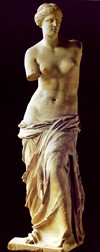
The period of Hellenistic art opens with the death of Alexander the Great (356-323) and the incorporation of the Persian Empire into the Greek world. By this point, Hellenism had spread throughout the civilized world, and centres of Greek arts and culture included cities like Alexandria, Antioch, Pergamum, Miletus, as well as towns and other settlements in Asia Minor, Anatolia, Egypt, Italy, Crete, Cyprus, Rhodes and the other islands of the Aegean. Greek culture was thus utterly dominant. But the sudden demise of Alexander triggered a rapid decline of Greek imperial power, as his massive empire was divided between three of his generals - Antigonus I who received Greece and Macedonia; Seleucus I who took over controlled Anatolia, Mesopotamia and Persia; and Ptolemy I who ruled Egypt. Paradoxically therefore, this period is marked by massive Greek cultural influence, but weakening Greek power. By 27 BCE, Greece and its empire would be ruled from Ancient Rome, but even then, the Romans would continue to revere and emulate Greek art for centuries. The division of the Greek Empire into separate entities, each with its own ruler and dynasty, created huge new opportunities for self-aggrandisement. In Asia Minor, a new capital city was built at Pergamon (Pergamum), by the Attalids; in Persia, the Seleucids evolved a form of Baroque-style building design; in Egypt, the Ptolemaic dynasty constructed the lighthouse and library at Alexandria. Palatial architecture was revitalized and numerous municipal structures were built to boost the influence of local rulers. Temple architecture, however, experienced a major slump. From 300 BCE onwards, the Greek peripteral temple (single row of pillars on all sides) lost much of its importance: indeed, except for some activity in the western half of Asia Minor temple construction came to a virtual stop during the third century, both in mainland Greece and in the nearby Greek colonies. Even monumental projects, like the Artemision at Sardis and the temple of Apollo at Didyma near Miletus, made little progress. All this changed during the second century, when temple building experienced something of a revival due partly to increased prosperity, partly to improvements made by the architect Hermogenes of Priene to the Ionic style of architecture, and partly to the cultural propaganda war waged (for increased influence) between the various Hellenistic kingdoms, and between them and Rome. In the process, temple architecture was revived, and an extensive number of Greek temples - as well as small-scale structures (pseudoperipteros) and shrines (naiskoi) - were erected in southern Asia Minor, Egypt and North Africa. As far as styles went, the restrained Doric style of temple architecture fell completely out of fashion, since Hellenism demanded the more flamboyant forms of the Ionic and Corinthian Orders. Admired by the Roman architect Vitruvius (c.78-10 BCE), famous examples of Hellenistic architecture include: the Great Theatre at Ephesus (3rd-1st century); the Stoa of Attalus (159-138); and the clock house Tower of the Winds at Athens. Hellenistic Greek sculpture continued the Classical trend towards ever greater naturalism. Animals, as well as ordinary people of all ages, became acceptable subjects for sculpture, which was frequently commissioned by wealthy individuals or families to decorate their homes and gardens. Sculptors no longer felt obliged to portray men and women as ideals of beauty. In fact, the idealized classical serenity of the fifth and fourth centuries gave way to greater emotionalism, an intense realism, and an almost Baroque-like dramatization of subject matter. For a typical style of this form of plastic art, see Pergamene School of Hellenistic Sculpture (241-133 BCE). As a result of the spread of Greek culture (Hellenization), there was also much greater demand from the newly established overseas Greek cultural centres in Egypt, Syria, and Turkey for statues and reliefs of Greek Gods, Goddesses and heroic figures for their temples and public areas. Thus a large market developed in the production and export of Greek sculpture, leading to a fall in workmanship and creativity. Also, in their quest for greater expressionism, Greek sculptors resorted to more monumental works, a practice which found its ultimate expression in the Colossus of Rhodes (c.220 BCE). Famous Greek sculptures of the period include: "The Farnese Bull" (2nd Century); the "Dying Gaul" (232) by Epigonus; the "Winged Victory of Samothrace" (c.1st/2nd century BCE); The Pergamon Altar (c.180-150); "The Medici Venus" (150-100); The Three Graces (2nd Century); Venus de Milo (c.100) by Andros of Antioch; Laocoon and His Sons (c.42-20 BCE) by Hagesander, Athenodoros and Polydorus. For more information, please see: Hellenistic Statues and Reliefs.
For the effect of Greek sculpture on later styles, see: Renaissance Sculpture (c.1400-1530) and also Neoclassical Sculpture (1750-1850). The increased demand for Greek-style sculpture was mirrored by a similar increase in the popularity of Hellenistic Greek painting, which was taught and propagated in a number of separate schools, both on the mainland and in the islands. Regarding subject-matter, Classical favourites such as mythology and contemporary events were superceded by genre paintings, animal studies, still lifes, landscapes and other similar subjects, largely in line with the decorative styles uncovered at Herculaneum and Pompeii (1st century BCE and later), many of which are believed to be copies of Greek originals. Perhaps the greatest contribution of Hellenist painters was in portrait art, notably the Fayum mummy portraits, dating from the 1st century BCE onwards. These beautifully preserved panel paintings, from the Coptic period - in all, some some 900 works - are the only significant body of art to have survived intact from Greek Antiquity. Found mostly around the Fayum (Faiyum) Basin in Egypt, these realistic facial portraits were attached to the funeral cloth itself, so as to cover the faces of mummified bodies. Artistically speaking, the images belong to the Greek style of portraiture, rather than any Egyptian tradition. See also Greek Mural and Panel Painting Legacy. The real tragedy of Greek art is the fact that so much of it has disappeared. Only a very small number of temples - like the Parthenon and the Temple of Hephaestus - have survived. Greece built five Wonders of the World (the Colossus of Rhodes, the Temple of Artemis at Ephesus, the Statue of Zeus at Olympia, the Mausoleum of Halicarnassus and the Lighthouse of Alexandria), yet only ruined fragments have survived. Similarly, the vast majority of all sculpture has been destroyed. Greek bronzes and other works of Greek metalwork were mostly melted down and converted to tools or weapons, while stone statues were pillaged or broken down for use as building material. Roughly 99 percent of all Greek paintings have also disappeared. Greek Artists Have Kept Traditions Alive But even though this part of our heritage has disappeared, the traditions that gave birth to it, live on. Here's why. By the time Greece was superceded by Rome, during the 1st century BCE, a huge number of talented Greek sculptors and painters were already working in Italy, attracted by the amount of lucrative commissions. These artists and their artistic descendants, thrived in Rome for five centuries, before fleeing the city just before the barbarians sacked it in the fifth century CE, to create new forms of art in Constantinople the capital of Eastern Christianity. They thrived here, at the headquarters of Byzantine art, for almost a thousand years before leaving the city (soon to be captured by the Turks) for Venice, to help start the Italian Renaissance. Throughout this entire period, these migratory Greek artists retained their traditions (albeit adapted along the way), which they bequeathed to the eras of Renaissance, Baroque, Neoclassical and Modern eras. See, for instance, the Classical Revival in modern art (c.1900-30). During the 18th century, Greek architecture was an important attraction for intrepid travellers on the Grand Tour, who crossed the Ionian Sea from Naples. In summary: Greek artworks may have disappeared, but Greek art is still very much alive in the traditions of our academies, and the works of our greatest artists. |
|
• For more information about painting and sculpture of Classical Antiquity, see: Homepage.
ENCYCLOPEDIA OF ART |