Genre Painting
Definition, Characteristics, Origins, History.
Famous Genre Painters.
MAIN A-Z INDEX - A-Z of PAINTING

|
Genre Painting
|
|
|
Genre Painting (c.1500-1960)Contents • Definition
and Characteristics of Genre Painting Note: Genre-painting is one of the five main types of painting, which form the traditional Hierarchy of the Genres. The five include: history painting, portraiture, genre painting, landscape and still life. |
|
CLASSIFICATION OF
THE ARTS |
|
|
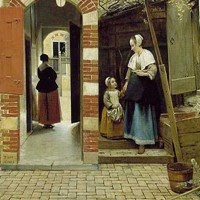
Definition and Characteristics of Genre-Painting In fine art painting, the term genre-painting (also called genre works) refers to pictures depicting situations and scenes of everyday life. Subjects typically include domestic settings, interiors, mealtimes, celebrations, tavern or peasant scenes, markets and other street scenes. In general, the key feature of a genre-painting is that the scene is presented in a non-idealized way, in contrast to the traditional classical approach of infusing scenes with heroic, noble or dramatic characteristics. Contrast for example the unvarnished characters in peasant scenes by Courbet, with the idealized street urchins portrayed by the Seville artist Bartolome Esteban Murillo. Arguably the finest exponents of the medium were the 17th century Dutch Realist school of genre painting, led by the great Delft artist Johannes (Jan) Vermeer (1632-75). |
|
|
Difference Between Genre Views, Landscapes and Still Life Interiors? When does a landscape become a genre painting, and vice versa? There is no precise answer to this question, as the line between this type of fine art and other genres is often blurred. For example, Joseph Wright of Derby's famous masterpiece An Experiment on a Bird in the Air Pump (1768) is part genre painting, part portraiture and part history painting. The great French Realist Jean Francois Millet (1814-75) painted a number of rural scenes (eg. The Angelus) which could be interpreted as either landscapes or genre-paintings, or both. Likewise, a picture of an 'interior' - like Peter Vilhelm Ilsted's Interior (1896) - might be considered to be more of a still life than a genre-painting, particularly if the composition was posed. As a general rule of thumb, a genre-painting is typically a portrayal of normal events, in which individual figures usually play an important role. In contrast, a typical landscape does not contain a significant figurative element, while an 'interior' or 'still-life' is really a domestic scene containing an artificial arrangement of items (including, more rarely, a figure). Even so, one could still argue that The Little Street (1658) by Vermeer was both an urban landscape or a genre-painting.
Narrative As Well As Decorative The Hierarchy of the Genres, referred to above, was the official 'ranking system' adopted by the French Academy of Fine Arts. According to this system, genre painting ranked in 3rd place, after history painting and portraiture. This was because genre paintings were not considered as 'inspirational' as history or portrait art, due to their lack of 'message' or 'narrative.' Admittedly, many genre scenes were commissioned and prized for their feel-good, decorative or nostalgic qualities, as well as the virtuosity of the artist. But (like still lifes) a significant number of genre paintings do contain a moral tale. Sometimes this must be deciphered by examining the symbolism on the canvas. In any event, contrary to the 'academic' view, genre paintings are perfectly capable of conveying moralistic messages. |
|
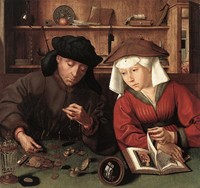
Renaissance Art - upon which most of Western visual arts are based - was predominantly public art, commissioned by Popes, churches and secular leaders to inspire the masses with religious and moral values. Thus most artworks (frescoes, altar pieces, sculpture) were deliberately large-scale pictorial presentations of uplifting messages, easily viewable and comprehensible to spectators. The beautiful Italian churches provided plenty of display space, and the fine weather was ideal for the use of fresco paint. The Reformation Then in 1517 came the Reformation - the revolt of the Protestant countries like Holland, Germany and Flanders against the Church of Rome - with the result that religious or quasi-religious works of art abruptly declined in importance across much of Northern Europe. However, as the demand for large-scale religious paintings declined during the sixteenth century, a new type of patron gradually emerged - belonging to the prosperous merchant class - who wanted a new type of small-scale painting to hang in their homes. This new patron was particularly visible in Protestant Holland, where easel portraits, genre paintings and still lifes became very popular. Early examples of genre scenes include works by Quentin Massys (c.1465-1530) - see The Money Lender and His Wife (1514) - Marinus van Reymerswaele (1490-1567) - who specialized in genre scenes that highlighted the sins of avarice and vanity - Lucas van Leyden (1494-1533) - see his Card Players (1517) - and Pieter Bruegel the Elder (1525-69) - see Peasant Wedding (1568), and Peasant Dance (1568). |
|
|
True, genre-painting was not unknown in Italy - small touches of genre can be found in 14th century and 15th century Italian artworks (like those of the Venetian Vittore Carpaccio - see, for instance, Two Venetian Ladies, 1510, Museo Correr, Venice) - but it was more background or context for the predominant religious themes on display. And even though it was developed somewhat by later Italians such as Caravaggio, Giuseppe Maria Crespi and Ceruti, it plays a minor role until the appearance of the 18th century Venetian artist Pietro Longhi (1702-1785). Dutch Realism - The Golden Age Genre-painting grew up as an independent art form in cities and towns of Protestant Northern Europe. The first great exponents of genre painting were the Dutch Realist artists of the 17th century, whose matchless style of "Dutch Realism" emerged from five main schools. (1) The Utrecht School, led by Hendrik Terbrugghen (1588-1629), included others like Gerrit van Honthorst (1592-1656) who was one of the main followers of Caravaggio. (2) The Haarlem School featured Adriaen Brouwer (1605-38), who specialized in scenes of drunkenness; Adriaen Van Ostade (1610-85) who painted genre scenes of peasants at home or in taverns; Jan Steen (1626-79), a tavern landlord who produced crowded scenes in homes and inns; Gerard Terborch (1617-81) and David Teniers the Younger (1610-90). (3) The Leiden School whose members included Gerard Dou (1613-1675), creator of numerous tiny character studies, and his pupils Gabriel Metsu (1629-67) - noted for his small intimate genre works - and Frans van Mieris (1631-81) - who portrayed the social pleasures, dissipations and fabrics of the very rich. (4) The Delft School led by Jan Vermeer (1632-75), probably the greatest of all Netherlandish genre painters, and Pieter de Hooch (1629-84) noted for his scenes of peasants and soldiers. For particular analysis of Vermeer's works, see: Famous Paintings Analyzed. (5) The Dordrecht School whose main figure was Nicolaes Maes (1634-93), noted for his early depictions of 'below-stairs' servant life.
Once established by the realists of the Dutch Baroque, genre-painting spread to Flanders, England, Spain, Italy and France, where it was developed by numerous artists of various schools. In Spain, for instance, the Bamboccianti painters introduced a sombre form of genre picture known as a bodegon, as exemplified by The Waterseller of Seville (1618-22) by Velazquez. |
|
History and Development of Genre-Painting Eighteenth Century Genre Paintings In France, an early practitioner of genre painting was Louis Le Nain (c.1593-1648) in company with his brothers Antoine (c.1588-1648) and Mathieu (c.1607-77). The Le Nain brothers were known for their small-scale interior settings of dignified peasant groups. Their works include: A Landscape with Peasants (1640) and Four Figures at a Table (c.1643). They were followed by Jean Chardin (1699-1779), one of the greatest 18th century artists, who produced a number of highly polished still-lifes and genre views with incredible reality, such as Soap Bubbles (1734), The Young Schoolmistress (c.1735), The Draughtsman (1737), The Governess (1739), and The Messenger (1739). His contemporary Jean-Baptiste Greuse (1725-1805) specialized initially in pictures with sentimental moral narrative, such as Broken Eggs (1756), Le Geste Napolitain (1757), Boy with Lesson Book (1757) and The Laundress (1761). See also: The Swing (Fragonard) (1767) by Jean-Honore Fragonard. Although Italy remained strongly influenced by the Grand Humanist traditions of the Renaissance, genre painting finally emerged in the 18th century, not least because of the Venetian artist Pietro Longhi (1702-85) who devoted a lifetime to it, portraying scenes of aristocrats and low-life in pictures like: Theatrical Scene (1752, and The Display of the Elephant (1774). In England, an early exponent of genre painting was William Hogarth (1697-1764). His scenes of contemporary life, such as the series The Rake's Progress and Marriage a la Mode, depicts human behaviour with a clear moral message. By comparison, the paintings of Thomas Gainsborough (1727-88) apply a refined veneer to scenes of bourgeois rural gentility and satisfaction. |
|
Nineteenth Century Genre Paintings As religious and historical painting declined during the 19th century, more and more artists sought inspiration from the everyday lives of ordinary people. Realists, especially in France, went further by placing their everyday genre scenes on large scale canvases - previously reserved for more highbrow or refined history works everyday life of ordinary people. In England, the most popular genre painters of 19th century included the Scottish artist David Wilkie (1785-1841), whose works included The Blind Fiddler (1806, Tate Gallery, London); The Letter of Introduction (1813, NGS); Distraining for Rent (1815, NGS); and Reading the Will (1820, Pinakothek, Munich) - see his works in the National Gallery of Scotland, Edinburgh - and William Powell Frith (1819-1909). Admired by the Queen, Frith was a chronicler of Victorian life at the races, at the seaside and when travelling, in paintings like Derby Day (1858) and The Railway Station (1862). Walter Sickert (1860-1942) - the leading British painter of the Impressionist and Post-Impressionist age - selected more humble subjects, such as street scenes, cheap interiors, prostitutes and musical halls, portraying them without glamour in a palette of muddy colours. In France, in the first half of the 19th century, the two great genre painters were the realists Jean-Francois Millet (1814-1875) and Gustave Courbet (1819-77). While the farmer's son Millet concentrated on scenes of rural France in which he depicted the hard but dignified life of the peasantry in works like The Gleaners (1857), The Angelus (1859) and Man with a Hoe (1862). Courbet widened the focus to include scenes from all provincial life: his most famous works being The Stone Breakers (1849), and A Burial at Ornans (c.1850). Honore Daumier (1808-79) the acute observer and caricaturist of the French Second Empire, used prints, watercolours and sketches to record the everyday lives of men and women. Among his huge number of works are: The Laundress (1860) and The Third Class Carriage (1864). See also the exquisite miniaturist works of Ernest Meissonier (1815-91), executed in academic style. Another type of genre-painting explored by French artists during the 19th century was Orientalist painting, typically of everyday scenes in Algeria, Egypt and elsewhere in North Africa. One of the leading exponents was the academician Jean-Leon Gerome (1824-1904).
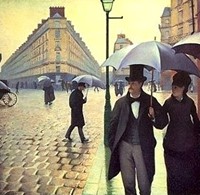
Genre painting reached another highpoint during the era of Impressionism and Post-Impressionism. Aside from plein-air purists like Monet, Pissarro and Sisley, most Impressionists focused on everyday scenes of Parisian life. Examples include: Frederic Bazille (1841-70) Mary Cassatt (1845-1926) Cezanne (1839-1906) Gustave Caillebotte (1848-94) Degas (1834-1917) Manet (1832-83) Monet (1840-1926) Berthe Morisot (1841-95) Renoir (1841-1919) Georges Seurat (1859-1891) John Singer Sargent (1856-1925) Toulouse-Lautrec (1864-1901) In Russia, the greatest genre painters included Ilya Repin (1844-1930) best known for Barge Haulers on the Volga (1870-73) and Religious Procession in Kursk Province (1883); Konstantin Savitsky (1844-1905) noted for Repairing the Railway (1874); and Abram Arkhipov (1862-1930) noted for Visiting (1915), The Washer-Women (Laundresses) (1899), Labourers at the Iron Foundry (1896), and Along the River Oka (1890). In America, the dominant school of genre-painting was realist, and was exemplified by the Civil War and sea-paintings of Winslow Homer (1836-1910), works like The Gross Clinic by Thomas Eakins (1844-1916), The Fall of the Cowboy (1895-6) by Frederic Remington (1861-1909), Stag at Sharkey's (1909) by George Wesley Bellows (1882-1925) and later nostalgic genre paintings by the magazine illustrator Norman Rockwell (1894-1978) like Freedom from Want (1943). Other influential practitioners included members of the American Scene Painting movement, such as Edward Hopper (1882-1967), and its offshoot the American Regionalism school whose genre painters included Thomas Hart Benton (1889-1975) and John Steuart Curry (1897-1946).
|
|
Twentieth Century Genre Paintings During the earlier part of the 20th century, artists of various schools continued to produce genre scenes of a high quality, ranging from quiet pictures such as: Interior with a Girl at the Clavier (1901) by the Danish "interiors" painter Vilhelm Hammershoi; The Cafe Royal in London (1912) by Sir William Orpen; Girls from Dalarna Having a Bath (1908) by Anders Zorn; and Expressionist masterpieces like: Berlin Street Scene (1913) by Ernst Ludwig Kirchner. Other unique art styles emerged, such as the "matchstick" men of L.S. Lowry, as in Coming from the Mill (1930). The colourist Pierre Bonnard continued to produce outstanding works: see The Green Blouse (1919) and The Terrace at Vernon (1939). In addition, specific genre schools emerged, like the London-based movements: the Camden Town Group and the Euston Road Painters. The mid/late twentieth century and early 21st century has witnessed a rise in stylistic abstraction, resulting in a degrading of genre art in the process. Edward Hopper (1882-1967) is a rare exception, with masterpieces like Nighthawks (1942), as is Alex Colville (b.1920), with works like The Swimming Race (1959). A successful Scottish artist working in a broadly similar idiom, though without Hopper's or Colville's painterly qualities, is Jack Vettriano. |
|
• For more about different types of
painting (portraits, landscapes, still-lifes etc) see: Painting
Genres.
ENCYCLOPEDIA OF ART |