Pieter Bruegel the Elder
Biography of Flemish Genre-Painter, Landscape
Artist.
MAIN A-Z INDEX - A-Z of ARTISTS

|
Pieter Bruegel the Elder
|
|
RENAISSANCE IN NORTH
EUROPE |
Peter Bruegel the Elder (c.1525-1569)Contents • Introduction |
|
WORLD'S BEST ART PRINTMAKING |
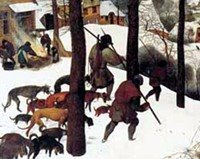
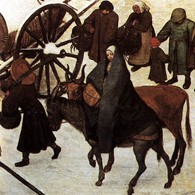
Pieter Bruegel the Elder is the one of the most famous Flemish painters, best known for his detailed landscapes, colourful comical views of peasant life and extraordinary visionary paintings. Like many figures in Flemish painting, he was strongly influenced by Hieronymus Bosch, the extraordinary Dutch Gothic artist, as well as Protestant Reformation art, and was one of the last painters of the Northern Renaissance in the Netherlands. His most notable works include: Hunters in the Snow (1565, Kunsthistorisches Museum, Vienna), The Census of Bethlehem (1566, Fine Arts Museum, Brussels), Peasant Wedding (1568, K.M. Vienna), Tower of Babel (1563, K.M. Vienna), Netherlandish Proverbs (1559, SMPK, Berlin), The Triumph of Death (1562, Prado, Madrid), Mad Meg (Dulle Griet) (1562, Mayer van den Bergh Museum, Antwerp) and The Parable of the Blind (1568, Museo Nazionale di Capodimonte, Naples). Bruegel enjoyed a high reputation in his lifetime - he is mentioned by both the art writers Giorgio Vasari and Giovanni Lomazzo - and he had a huge impact on later Flemish Baroque art, especially landscape painting and genre pictures. However, it wasn't until the 20th century that his contribution to religious art was fully appreciated. He is now seen as one of the finest Old Masters in European art. |
|
|
|
WORLDS TOP ARTISTS |
Little is known of Bruegel’s early life, but it is thought that he was born in Breda (located today on the Holland/Belgium border), around 1525. He was accepted as a Master in the Antwerp Guild in 1551, which presumes he was born between 1525 and 1530. Bruegel trained in Antwerp under Pieter Coecke van Aelst (d.1550) - he married Coecke's daughter, Mayken, in 1563. In 1552 and 1553, Bruegel made his first visit to Italy - at the height of the Mannerism movement - travelling via France, as far south as Sicily. In Italy he was accompanied by the painter and designer Marten de Vos, who possibly painted the figures in Bruegel's first signed & dated painting (Christ on the Sea of Tiberias, 1553, Pauw Collection, Brussels). Bruegel visited Sicily and in 1553 he was in Rome, where he seems to have sold a number of landscapes to the miniaturist Giulio Clovio (1498-1578). Despite his encounters with Italian Renaissance art, Bruegel remained close to Flemish traditions and worked to create his own original and complex style. His genre painting typically depicted solid peasants involved in everyday activities, painted with the use of bright pure pigment and compositions based on diagonal lines and S-curves which draws the viewers eye into the canvas. It is not clear when exactly Bruegel acquired the skill of engraving, but he appears to have had a natural talent for printmaking, from which he was to earn significant income. |
|
|
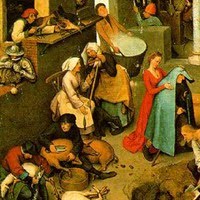
Drawings & Engravings on Return to Netherlands Exactly what route he took on his return to the Netherlands is not known, but his Alpine drawings of the trip are extremely important. One of them (now in the Duke of Devonshire's Collection, Chatsworth) is dated 1555, which suggests that these mountain drawings were in fact worked up in his studio after his return to Antwerp. From them he produced 12 prints (Large Mountain Series) and an elaborate composition (Great Alpine Landscape), published in Antwerp by the prestigious company of Hieronymus Cock. Cock also published Breugel's series of moralizing, satirical engravings which earned him the nickname 'the second Bosch' (The Temptation of St Anthony, 1556; Big Fish Eat Little Fish, 1557, after a drawing of 1556; The Seven Deadly Sins, 1558). These works made Bruegel's reputation and he continued to work in this vein until well into the 1560s. In Brussels: Bruegel's Prolific Period In 1563 he moved to Brussels, perhaps fleeing Antwerp due to fear of religious persecution but more likely to be near his patron, Cardinal Granvelle, President of the Netherlands Council of State, who was close to Bruegel's sculptor brother. In Antwerp, Niclaes Jonghelinck had been Bruegel's greatest patron, owning 16 paintings. It is during those highly productive years (1563-69) that his reputation as one of the great Dutch Northern Renaissance artists was founded. During his time in Brussels, Bruegel was commissioned by the municipal council to create some visual document of the excavation of the Brussels-Antwerp canal, then under construction, but his death on 9th September, 1569 intervened. The inscription on his tomb has been recognized as being based on the thought of the famous humanist and geographer Ortelius of Antwerp and it is certain that Bruegel was in contact with Ortelius's intellectual friends, including Plantin the publisher. Establishing the evolution of Bruegel's style is complicated by the fact that many copies of his paintings exist, some of them made by his sons Pieter and Jan. Even so, the autograph drawings are useful in disentangling problems of attribution. Bruegel's landscape drawings show the influence of the Flemish tradition exemplified by Joachim Patenier (1485-1524), but also demonstrate some contact with woodcuts by Titian (1487-1576). However, his treatment improves on their work in terms of realism and detail. The high viewpoint employed by him in his Large Landscape Series is particularly novel and gives the panorama a feeling of universality. For his satirical engravings he made a considerable study of the human figure and evolved a method of depicting people from behind, thereby endowing his studies with a universalising force similar to that of his landscape technique. Bosch-Style Religious Genre Paintings The panoramas of the landscapes and crowds of protagonists of some of his satirical genre prints come together in the famous Children's Games (1560, K.M. Vienna), a picture which reduces the activities of the adult world to the scale of foolish and sinful pastimes. Other crowded compositions, evidently derived from the principles of Bosch, include Netherlandish Proverbs (1559) and The Fight Between Carnival and Lent (1559), Mad Meg (Dulle Griet) (1562, Mayer van den Bergh Museum, Antwerp) and The Fall of the Rebel Angels (1562, Musee des Beaux-Arts, Brussels). Most notable of this period is his Two Monkeys (1562, Berlin-Dahlem), a masterpiece of originality. The two disturbingly human creatures are chained together - an enigmatic reference to the human condition. |
|
|
Landscapes and Peasant Genre-Works After his move to Brussels, Bruegel's style was influenced through greater contact with Italian works, including tapestry art by Raphael showing the Acts of the Apostles. As a result his figures became more amplified (The Adoration of the Magi, 1564, National Gallery, London). His most famous paintings, the series of the Months (three in K.M Vienna; one in the Metropolitan Museum of Art, New York; one in the National Museum. Prague), were painted in 1565; five are extant. Although he based these on the early calendar illustrations in Books of Hours of the International Gothic style, Bruegel increases the importance of nature so that man's actions do not dominate the landscape but become part of it. Man is controlled by the seasons. The paintings are unique in their perception of the almost oppressive atmosphere of the outdoors. Other compositions balance figures and settings (The Massacre of the Innocents, 1566, Hampton Court, and K.M. Vienna; The Numbering at Bethlehem, 1566, M.B.A. Brussels), while some concentrate more on satire through the clumsy figures (Wedding Dance, 1566, Detroit Institute of Arts; The Peasant Wedding, 1566, K.M. Vienna). In fact, The Peasant Wedding Feast is one of his most famous 'humane' works, and demonstrates his droll sense of humour as well as his ability to make the even the most mundane events fascinating to view. He stressed the vulgar, the ugly and the absurd, but with a sympathetic, narrative eye. His works are best viewed in the original because being so detailed it is easy to miss some of their characters and unique facial expressions. This peasant series includes some of the greatest genre paintings of the period. Bruegel's final painting is the Magpie on the Gallows (1568, Hessisches Landesmuseum, Darmstadt). Its landscape has a new luminosity of colour and an almost miniature touch. It combines a panoramic landscape with a small but expressive group of figures and a moralistic meaning which has yet to be explained in detail - an amalgam of the various elements of his art. Bruegel's signature style and subject matter were most closely followed by his elder son, Pieter Bruegel the Younger (1564–1637), who copied and sometimes adapted many of his compositions, beginning some years after his father's death. Bruegel's younger son, Jan Bruegel (1568–1625), developed his own style of painting, based on still life as well as his father's perception of landscape, but he endowed nature with his own miniature, drawing-room lustre, earning himself the name 'Velvet Bruegel'. (Note: Both his sons spelt their names Brueghel, keeping the 'h' that their father had discarded around 1559.) Although he was greatly admired by Peter Paul Rubens (1577-1640) and emulated by a good number of lesser artists - Roelandt Savery (1576-1639), Adriaen Brouwer (1605-38), Lucas (1525-97) and Marten (1535-1612) van Valckenborch, and Joos de Momper (1564-1635) - Bruegel's reputation suffered an eclipse from the middle of the 17th century until his rediscovery in the later part of the 19th century. He is now recognized as the major Netherlandish master of the 16th century, and one of the most innovatory painters in the history of art, exerting an appeal both for the scholar and for the lay public. Brugel's works can be viewed in many of the best art museums around the world, notably the Kunsthistorisches Museum, Vienna. |
|
|
|
• For a list of important dates in
the development of visual arts, see: History
of Art Timeline.
Visual
Artists, Greatest |