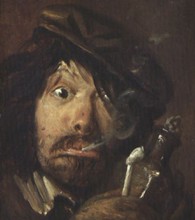
Adriaen Brouwer
Biography of Dutch Genre-Painter, Haarlem
School.
MAIN A-Z INDEX - A-Z of ARTISTS

|
Adriaen Brouwer
|
|
DUTCH GOLDEN AGE |
Adriaen Brouwer (1605-38)Biography One of the more alcoholic Old Masters of 17th century Dutch painting, Brouwer lived the life of the stews and pothouses, and in them paradoxically finds the raw material for a very delicate art. What contemporary or later gossip tells about his short and disordered life suggests an odd blend of a roisterer and a cynic philosopher. He hated the social hypocrisies, perhaps also the social decencies, and made a point of showing them up. In the process he created some of the greatest genre paintings of the period. He was born at Oudenarde in Flanders about 1605, was early at Amsterdam, in 1626, became a fellow member with Frans Hals (1582-1666) in the Haarlem chamber of rhetoric called "Love above All." Earlier he must have been Hals' pupil, surely a close student of such pictures as the Merry Company. He was precocious - at twenty-one he was hailed as a master. For the five years between his initiation into "Love above All" and his registration in 1631 as a master in the painters' guild at Antwerp, we have little idea of his movements. But within a year of his settling at Antwerp we find him deep in debt, his entire property signed over to a friend to save it from hostile creditors. |
| DUTCH
REALISM SCHOOL For details and information about the 17th Century style of easel-art which flourished in Holland, see: Frans Snyders (1579-1657) Still life painter from Antwerp. Hendrik Terbrugghen (1588-1629) Painter of the Utrecht school. Gerard Terborch (1617-81) Genre painter, Amsterdam, Haarlem. Aelbert Cuyp (1620-91) Dordrecht landscape artist. Jacob Van Ruisdael (1628-82) Haarlem-born landscape painter Pieter de Hooch (1629-83) Famous Delft school genre-painter. Gabriel Metsu (1629-67) Intimate small-scale genre scenes. Jan Vermeer (1632-75) Greatest Dutch Realist artist. Baroque Art Movement 17th century art movement. |
|
DUTCH STILL
LIFE ART WORLD'S BEST ART AESTHETICS |
Still another year, and we find him a
political prisoner in a Spanish castle. A contemporary writer says he
was imprisoned for approaching the castle "dressed as a Hollander."
However unlikely this seems, it indicates that Brouwer was suspected of
Dutch and Protestant sympathies. It was not a harsh imprisonment, for
Brouwer's expense account, met by a friend, for about six months was a
massive five hundred gulden. In that highly organized Alsatia which great
prisons then were - where a prisoner could freely enjoy any pleasures
for which he could pay, the bankrupt painter was living at the modern
rate of about fifty thousand dollars a year. |
|
WORLDS TOP ARTISTS
|
|
|
Brouwer had, with the defects, also the qualities of his Bohemianism - a ready wit, friendliness and generosity, a scorn of pretense and hypocrisy. He sold his little pictures at very high prices, and is said to have destroyed a picture before a haggling patron rather than reduce the price. He had reason for such pride, for Rubens bought no less than seventeen of his pictures, Rembrandt (1606-69), eight and a book of sketches. There could be no higher compliment to any draughtsman than to have his sketches desired by Rembrandt. Brouwer's brief, stormy and brilliant career was cut off abruptly towards the end of 1638, probably by the plague. He had just entered his thirty-third year. He lived on in local legend as a wag and boon companion.
Brouwer's early fine art painting at Haarlem has been identified by painstaking connoisseurship. Its feeling is drastic, even brutal, rather painty, with the edgy sort of construction practiced by Peter Bruegel and his imitators. It is like Old Bruegel also in a tendency to caricature - squat proportions and incredibly bestial faces. In these early pictures, he tends to employ the greatest variety of local colour that the subject permits. |
|
This early, really juvenile, manner may
be sufficiently represented by Drunken Peasants. He is unsparing
in his emphasis of the ugliness of raucous intoxication. These figures
are dehumanized, have ceased to be a company, are so many maudlin individuals.
But the pictorial arrangement is as refined as the feeling is coarse.
The scene is one Brouwer always loved - a basement tap-room with the light
filtering in from above. The shadow at its deepest is aerial and transparent,
never vague or dead. The compact group is admirably composed both in pattern
and depth. The play of light and dark on faces and headdresses is most
picturesque and expressive of form. The incidental still life is touched
in with tenderness and strength, and unobtrusively enhances the character
of the scene. The figure construction is large and simple. Paradoxically,
the effect is at once lively and stable. We have drunkenness seen very
specifically, but yet in a sort of eternal aspect. Within a few years
Brouwer was to paint with greater finesse - indeed, this picture shows
nothing of his later glorification of tavern life - but it does already
give promise of a great master.
Adriaen Brouwer is yet another example of the apparent lack of connection between character and genius. The artist in him was exquisitely disciplined; the man always at loose ends. Again it seems as if the creative part of the man was a sort of second personality - a better self. Until psychology solves these paradoxes - and I much doubt if it ever will - we must be content to receive great art from whatever hands make and offer it, even if these hands are not clean.
Legacy |
|
• For biographies of great artists,
see: Famous Painters.
Visual
Artists, Greatest |