Jan Vermeer
Biography of Dutch Realist Genre-Painter,
Portrait Artist, Delft School.
MAIN A-Z INDEX - A-Z of ARTISTS

|
Jan Vermeer
|
|
|
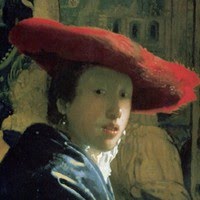
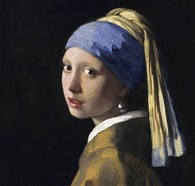
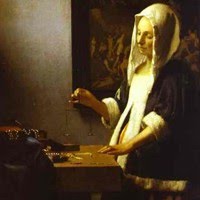
Jan Vermeer (1632-1675)Contents • Biography The leader of the Dutch Realist artists, Jan (or Johannes) Vermeer specialised in genre painting and informal portrait art (mostly domestic interiors with one or two figures), although he also painted a very small number of cityscapes and allegorical works. Active in Delft, he was a moderately successful painter while alive, but after his death his work was largely forgotten about. That was until 200 years later when the art critic Thore Burger published an essay in 1866 acknowledging him as one of the greatest Old Masters of the school of 17th century Dutch painting, and a key figure in Protestant Reformation art of Northern Europe. As Vermeer worked extremely slowly, he only produced about 45 paintings in his lifetime. His best known works include Girl with a Pearl Earring, (c.1665, Mauritshuis, The Hague), The Milkmaid (c.1658, Rijksmuseum, Amsterdam), The Art of Painting: An Allegory (c.1666, Kunsthistorisches Museum, Vienna), Girl With the Red Hat (1665-6, National Gallery Washington DC), Woman Reading a Letter at an Open Window, (Gemaldegalerie, Dresden), Woman Holding a Balance (1662-3, National Gallery of Art, Washington DC), and View of Delft (1661 Mauritshuis). He is regarded as one of the best genre painters in the history of art, and one of the best portrait artists of the Dutch Golden Age. |
|
|
|
DUTCH
REALISM SCHOOL WORLDS TOP ARTISTS |
Early Life Little is known of Vermeer's early life, but he was born in 1632 in Delft, Netherlands, to a lower-middle class family. His father was a silk weaver and art dealer who later also became an innkeeper. When his father died, Jan inherited the inn and art sales business, which helped to supplement his career in painting. His early apprenticeship years are vague, but it is thought that he may have studied with the Dutch artists Leonaert Bramer (who painted nocturnal scenes and frescoes) and/or Carel Fabritius. Other possible influences were Dirck van Baburen and Hendrick Terbrugghen (leading members of a group of Dutch artists who were influenced by Caravaggio, the so-called Utrecht Caravaggism group). It is difficult to give a chronological description of Vermeer's paintings, as he only dated three. These are The Procuress, 1656 (Gemäldegalerie, Dresden), The Astronomer, (1668, private collection) and The Geographer, (1669, Städelsches, Frankfurt). His early works tended to be larger in scale and brighter in palette. As he matured, his paintings became smaller and his colour palette cooler, dominated more by yellows, grays and blues. |
|
DUTCH REALIST STILL
LIFE WORLD ART PRICES WORLD'S BEST ART AESTHETICS |
Painterly Technique Vermeer is particularly renowned for his treatment of light which takes on an almost pearly veneer. He achieved this by a method called pointillé, which involves using layers of granular paint to give a transparent end effect. We are not sure how Vermeer prepared for his paintings, as no pre-drawings exist, but it is thought he may have used a camera obsura to achieve positioning in his compositions. This was an early imaging device, and when a composition was viewed through the lens, it would cast a subdued light over the subject, rather like the lighting achieved in Vermeer's paintings. These light effects are known as halation. When it came to colour, unlike many of his contemporaries, Vermeer liberally used ultramarine, which was created from the incredibly expensive pigment lapis lazuli. This can best be seen in the turban of his famous painting The Girl with a Pearl Earring. Light and Colour Above all, Vermeer was interested in the effects of colour, light and reflected light. Typically he tries to capture the moment when natural light floods a space, or the glittering reflections in metal vessels or surfaces, or fabrics. One of the curiosities of Vermeer's colour palette, compared with that of his his contemporaries, like Pieter de Hooch, was his preference for natural ultramarine (one of the costliest colour pigments, made out of crushed lapis lazuli) instead of the cheaper alternative azurite. He was also a supreme exponent in the use of white lead, umber and charcoal black to create white walls which reflect natural daylight with different intensities, permitting the display of uneven textures on the wall's plastered surface. In 1653 Vermeer became of member of the Delft Guild of Saint Luke, a local trade association for painters, which demonstrated respect among his peers. The guild records indicate that he did not initially pay his joining fee, which suggests that he had financial difficulties. Around 1662 he was elected head of the Guild. Vermeer died in 1675, he was only about 43 at the time. Had he lived longer, the world would not have been denied the opportunity to see how this master's works would have matured. As it is, thanks to his 'rediscovery' in the 1860s, Vermeer is now considered one of the greatest figures in Dutch Baroque art, and, due to his small output, his works are among the most valuable in the history of art. |
|
|
Vermeer produced some of the greatest genre paintings in the history of art, among which are the following: The Procuress (1656) Oil on canvas.
Alte Meister Gallerie, Dresden. |
|
|
The Art of Jan Vermeer (1632-75) Recovered from complete oblivion by modern research, the forty pictures or so which can be confidently ascribed to Jan Vermeer of Delft are now regarded as the consummation of Baroque painting in Holland. Technically considered, Vermeer is simply the most able and exquisite practitioner of the bright style that Holland produced. There never was an observation more exquisite than his of the degrees of absorbed or reflected light, a more scrupulous care in decorative and modelling edges, a more careful regard for substance and texture, a more simple and gracious method of construction. He was also the greatest exponent of the Dutch formula of composition. no one gave greater value to the arabesque of the figure locked into a pattern of architectural quadrilaterals. He had refinements of colour all his own - ineffable harmonies of pale blue and straw yellow. More briefly, as a creator of light, Vermeer exercises a "white magic" uniquely his own. |
|
|
After early experiments in bordello scenes, religious subjects and mythology, he settled practically to one theme - women serving or reigning in an exquisitely kept home. His finest pictures show only one woman - the Milkmaid, the Pearl Necklace, the Girl Making Tea, the Woman Reading a Letter**, the Portrait of a Girl, The Woman with a Water Jug - these are the finest Vermeers. When he adds a second figure, the picture loses; when he adds a third, the picture ceases to be a fine Vermeer. In short, people as related to each other, the very staple of Dutch genre painting, did not deeply engage his interest. He was engrossed with another relation - that of a woman to her home. That he made fairly sacramental, and such was the root of his peculiar poetry. One might also say that, in Vermeer's hands, these single-female pictures become a unique form of vanitas painting, as moralistic as any work by Harmen van Steenwyck (1612-56), Jan Davidsz de Heem (1606-83), Willem Kalf (1622-93), Willem Claesz Heda (1594-1681) or Pieter Claesz (1597-1660).
Vermeer's attitude has been described as
chivalric, and, without wholly accepting the term, one need not quarrel
with it. Nor does it seem sentimental to emphasize the fact that this
cultus of the home, this delicately worshipful feminism, seems to centre
around his fair and doubtless efficient wife, Catherine Bolenes,
whom he married at twenty-one, and who was still in her modest beauty
when he died at forty-three. |
|
|
They show Vermeer very seriously occupied
in assimilating the Italian Renaissance
style as interpreted by the best eclectic or baroque
masters. One is tempted to ask how far he might have gone, had he continued
the vein. Evidently he could have held his own with the best baroque painters
of Venice and Naples. On the expression of the faces, Vermeer
has spent himself. The Christ revealing himself as he breaks the loaf
is infinitely pathetic and benign. One feels deeply the nearness of the
ordeal of Calvary. The rapt attention of the two pilgrims and the woman
attendant is expressed with poignancy, and thoughtfully varied according
to the character involved. Very masterly is the expression of the pilgrim
with his back turned and his features hidden. A most exquisite compositional
passage is the arrangement of the three visible hands in a sort of reversed
crescent.
The question how Vermeer came to study
the Italians, what pictures he may have seen, is interesting but really
not very important. It is probable that Leonard Bramer brought back Italian
pictures or engravings that would deeply move such a sensitive and searching
spirit as was Vermeer's. In any case, good reproductive engravings of
earlier and recent Italian paintings abounded, and one need not necessarily
look beyond such material to explain Vermeer's Italianate beginnings.
Nor was this effort wasted, even if it was not followed up. The study
which Vermeer devoted to the making of Mary and Martha, Diana
and her Nymphs and the Supper at Emmaus amounted to a liberal
education in composition, and in taste generally, and this education he
was soon to put to use along sound Dutch lines. The pictures which we shall next consider were probably all painted between 1656 and 1666, Vermeer's twenty-fourth to thirty-fourth year. In them he capitalized the heavy but benign burden of an expensive home and a rapidly growing family. These little pictures are generally built around the figure of a woman working or at leisure in a room of a fastidiously appointed and beautifully kept house. The light usually falls gently in from a casement at the left, stealing over cool, gray walls, caressing pewter or latten jugs, drawing out the deep hues from an oriental rug which serves as a tablecloth, glinting on the carving of massive chairs or picture frames, hinting at the geographical pattern in a hanging map, finally, and most important, bringing out the rounded forms of the woman with an authority as convincing as it is gentle. This handling of the light, without strong contrasts, as a factor in construction is the distinguishing technical merit of Vermeer's painting, and it allies him with the greatest figure painters of all times. Of these pictures with one woman as focus, the Pearl Necklace, is the most exquisitely painted - in the perfection of its enamel and its iridescences of pale yellow and blue. The posture, the hands raising the bight of the necklace, is, while apparently casual, really very studied, as expressing a modest pride in possession. Everything seems to emanate from the pearls and the pearl-like delicacy of the face of their wearer. All the painting is of the most exquisite sort. More meditatively conceived, and possibly more rich in variety of surface, if less precious as colour, are two pictures (at Amsterdam and Dresden), on the theme of a woman standing quietly as she reads a letter. Possibly a shade the finer is the picture at Amsterdam, for the largeness of the construction of the figure and the close, fretlike pattern of the map and the rectangles made by it and the chair backs. It also has an attractive homeliness which the more aristocratic version at Dresden lacks. |
|
|
Another gem among these interiors with
a housewife is the superb little Vermeer which is variously called a Woman
at a Casement, or with a Jug. The woman is merely letting in the morning
air as she tidies up, but she tidies up with a gesture as grand as that
of a sibyl by Michelangelo.
The grandeur is of the essence, and not stylistically imputed. Vermeer
had seen and remembered precisely such an attitude as the daily ritual
which made his home a delight was being accomplished. He records it with
gratitude and affection, enhances it by every compositional device which
might express its dignity and convey the character of the place. All his
perfections in balance and manipulation of light-creating and form-giving
colour are so quietly present in this picture that it is easy to overlook
them. For concentrated elegance in feeling and tone, the little Girl
making Lace, has no rival. And again it is not any elegance arbitrarily
imposed upon the efficient girl at her feminine task - the elegance is
in the act itself, in the busy, skillful hands going carefully about a
routine act. Vermeer does not in the ordinary sense idealize, and never
sentimentalizes these household offices, rather he discovers and reveals
them in a beauty which is generally obscured by use and wont. Vermeer was an inerrant eye, a fastidious
and self-conscious artist, a devout admirer of women, whether in the aspect
of graciousness or serviceability, a lover of his home. It seems as if
he felt such a broadly moral estimate must suffice us, for the single
portrait of himself turns its back to us. The famous and rather large
picture, the Atelier (aka The Artist's Studio), consummately
well painted, repeats in unobtrusive form those refinements of composition
which we have just discussed in the case of the Letter. The painter
at the easel, in his fantastic striped jerkin and rumpled silk stockings,
is in our world. The heavy, brocaded curtain, the table, the rafters,
the big map, cut off another space, another world through which is passing
the strangest of apparitions - a woman rather Javanese in aspect, her
eyes closed, her hair fantastically decked out with big leaves, her left
hand holding firmly a big folio volume, her right hand delicately balancing
horizontally a long, straight trumpet. What does it all mean? Perhaps
we were never meant to know, possibly Vermeer himself did not know. It
is easy to see that the bulging and broken contour of the woman's drapery
- it is that, and not a frock - was just what was needed between the corner
of the table and that of the map, that the foreshortened quadrilateral
of the big book carries the diaper of the pavement into the upper part
of the picture, that the fantastic headdress relieves the oval of the
head from what might otherwise have been an insipid presentation. In short,
there are sound stylistic reasons for whatever may seem bizarre and enigmatic
in the picture. Works by Jan Vermeer can be seen in the best art museums across the globe, including the Rijksmuseum and the Mauritshuis in the Netherlands. |
|
|
|
• For information about Dutch Realist genre painting, see: Homepage.
Visual
Artists, Greatest |