Baroque Art
Definition, Styles, History.
MAIN A-Z INDEX - A-Z of ART MOVEMENTS

|
Baroque Art
|
|
|
Baroque Art (c.1600-1700)Contents • Definition: What
is Baroque Art?
|
|
|
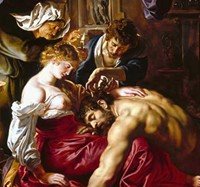
Definition: What is Baroque Art? In fine art, the term Baroque (derived from the Portuguese 'barocco' meaning, 'irregular pearl or stone') describes a fairly complex idiom, originating in Rome, which flowered during the period c.1590-1720, and which embraced painting, and sculpture as well as architecture. After the idealism of the Renaissance (c.1400-1530), and the slightly 'forced' nature of Mannerism (c.1530-1600), Baroque art above all reflected the religious tensions of the age - notably the desire of the Catholic Church in Rome (as annunciated at the Council of Trent, 1545-63) to reassert itself in the wake of the Protestant Reformation. Thus it is almost synonymous with Catholic Counter-Reformation Art of the period. Many Catholic Emperors and monarchs across Europe had an important stake in the Catholic Church's success, hence a large number of architectural designs, paintings and sculptures were commissioned by the Royal Courts of Spain, France, and elsewhere - in parallel to the overall campaign of Catholic Christian art, pursued by the Vatican - in order to glorify their own divine grandeur, and in the process strengthen their political position. By comparison, Baroque art in Protestant areas like Holland had far less religious content, and instead was designed essentially to appeal to the growing aspirations of the merchant and middle classes. |
|
|
In order to fulfill its propagandist role, Catholic-inspired Baroque art tended to be large-scale works of public art, such as monumental wall-paintings and huge frescoes for the ceilings and vaults of palaces and churches. Baroque painting illustrated key elements of Catholic dogma, either directly in Biblical works or indirectly in mythological or allegorical compositions. Along with this monumental, high-minded approach, painters typically portrayed a strong sense of movement, using swirling spirals and upward diagonals, and strong sumptuous colour schemes, in order to dazzle and surprise. New techniques of tenebrism and chiaroscuro were developed to enhance atmosphere. Brushwork is creamy and broad, often resulting in thick impasto. However, the theatricality and melodrama of Baroque painting was not well received by later critics, like the influential John Ruskin (1819-1900), who considered it insincere. Baroque sculpture, typically larger-than-life size, is marked by a similar sense of dynamic movement, along with an active use of space. Baroque architecture was designed to create spectacle and illusion. Thus the straight lines of the Renaissance were replaced with flowing curves, while domes/roofs were enlarged, and interiors carefully constructed to produce spectacular effects of light and shade. It was an emotional style, which, wherever possible, exploited the theatrical potential of the urban landscape - as illustrated by St Peter's Square (1656-67) in Rome, leading up to St Peter's Basilica. Its designer, Bernini, one of the greatest Baroque architects, ringed the square with colonnades, to convey the impression to visitors that they are being embraced by the arms of the Catholic Church. As is evident, although most of the architecture, painting and sculpture produced during the 17th century is known as Baroque, it is by no means a monolithic style. There are at least three different strands of Baroque, as follows: (1) Religious Grandeur (2) Greater Realism (3) Easel Art In addition, to complicate matters further, Rome - the very centre of the movement - was also home to a "classical" style, as exemplified in the paintings of the history painter Nicolas Poussin (1594-1665) and the Arcadian landscape artist Claude Lorrain (1600-82).
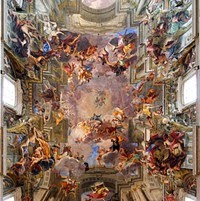
Following the pronouncements made by the Council of Trent on how art might serve religion, together with the upsurge in confidence in the Roman Catholic Church, it became clear that a new style of Biblical art was necessary in order to support the Catholic Counter Reformation and fully convey the miracles and sufferings of the Saints to the congregation of Europe. This style had to be more forceful, more emotional and imbued with a greater realism. Strongly influenced by the views of the Jesuits (the Baroque is sometimes referred to as 'the Jesuit Style'), architecture, painting and sculpture were to work together to create a unified effect. The initial impetus came from the arrival in Rome during the 1590s of Annibale Carracci and Carravaggio (1571-1610). Their presence sparked a new interest in realism as well as antique forms, both of which were taken up and developed (in sculpture) by Alessandro Algardi (in sculpture) and Bernini (in sculpture and architecture). Peter Paul Rubens, who remained in Rome until 1608, was the only great Catholic painter in the Baroque idiom, although Rembrandt and other Dutch artists were influenced by both Caravaggism and Bernini. France had its own (more secular) relationship with the Baroque, which was closest in architecture, notably the Palace of Versailles. The key figure in French Baroque art of the 17th century was Charles Le Brun (1619-90) who exerted an influence far beyond his own metier. See, for instance, the Gobelins tapestry factory, of which he was director. Spain and Portugal embraced it more enthusiastically, as did the Catholic areas of Germany, Austria, Hungary and the Spanish Netherlands. The culmination of the movement was the High Baroque (c.1625-75), while the apogee of the movement's grandiosity was marked by the phenomenal quadratura known as Apotheosis of St Ignatius (1688-94, S. Ignazio, Rome), by the illusionist ceiling painter Andrea Pozzo (1642-1709). Surely one of the best Baroque paintings of the 17th century.
Note: It took longer for the Baroque style to reach Russia. Indeed, it wasn't until the period of Petrine art in St Petersburg under Peter the Great (1686-1725), that architects like Rastrelli, Domenico Trezzini, Andreas Schluter, Gottfried Schadel, Leblond, Michetti, and Matarnovi began designing in the style of Russian Baroque.
By the end of the 17th century the grand Baroque style was in decline, as was its principal sponsor, Italy. The coming European power was France, where a new and contrasting style of decorative art was beginning to emerge. This light-hearted style soon enveloped architecture, all forms of interior decoration, furniture, painting, sculpture and porcelain design. It was known as Rococo. Famous Baroque Painters (and Paintings) Here is a short list of the greatest Old Masters of the Baroque Period, together with some of their works: • Annibale
Carracci (1560-1609) of the Bolognese
School (1590-1630)
• Peter
Paul Rubens (1577-1640) • Carravaggio
(1571-1610) • Domenichino
(1581-1641) • Simon
Vouet (1590-1649) • Artemisia
Gentileschi (1593-1656) • Nicolas Poussin (1594-1665) • Diego
Velazquez (1599-1660) • Rembrandt
(1606-69) • Carlo
Maratta (Maratti) (1625-1713) Among other outstanding Baroque painters are: the portraitist Van Dyck (1599-1641), see also: Baroque Portraits - and the foremost still life and animal painter Frans Snyders (1579-1657). Among the great Catholic Baroque painters from Spain are the intense realist painter Jusepe Ribera (1591-1652), the pious chiaroscuro expert and tenebrist Francisco Zurbaran (1598-1664) and Bartolome Esteban Murillo (1618-82) of Seville, known for his idealized and sentimental religious pictures. In French Baroque art, the top caravaggesque painter was Georges de la Tour (1593-1652). In Italy, mention should be made of the Parma artist Giovanni Lanfranco (1582-1647), noted for his extreme foreshortening technique (di sotto in su), and the Genoese decorative artist Baciccio (1639-1709), noted for his cangianti technique of using vibrant colours to depict shade. Exponents of Dutch Realism from the Baroque era include: the portraitists Frans Hals (1581-1666) - see his masterpiece The Laughing Cavalier (1624) by the great Dutch portraitist Frans Hals (1582-1666).and Rembrandt (1606-69); the genre painters Hendrik Terbrugghen (1588-1629), Jan Steen (1626-79) and Jan Vermeer (1632-75); the 'interiors' and 'perspective' artist Samuel van Hoogstraten; the still life painters Frans Snyders (1579-1657), Jan Davidsz de Heem (1606-84) and Willem Kalf (1619-93); the flower painter Rachel Ruysch (1664-1750); and the landscape artists Salomon van Ruysdael (1600-70), Aelbert Cuyp (1620-91), Jacob van Ruisdael (1628-82) and Meyndert Hobbema (1638-1709).
|
|
|
Famous Baroque Sculptors (and Sculptures) • Giovanni
Bernini • Juan
Martines Montanes (1568-1649) • Jorg
Zurn (1583-1638) • Francois
Duquesnoy (1597-1643) • Alessandro
Algardi (1598-1654) • Pierre
Puget (1622-1694) • Francois
Girardon (1628-1715) • Antoine
Coysevox (1640-1720) • Andreas
Schluter (1664-1714) • Guillaume
Coustou (1677-1746) Other, late Baroque sculptors include: Balthasar Permoser (1651-1732) and Louis-Francois Roubiliac (1695-1762). Also, for biographical details of one of the greatest wood-carvers of the period, see Grinling Gibbons (1648-1721).
Famous Baroque Architects (and building designs) • Pietro Berrettini da Cortona (1596-1669) |
|
• For other art movements and periods,
see: History of Art.
ENCYCLOPEDIA OF ART HISTORY |