Gian Lorenzo Bernini
Biography of Italian Baroque Sculptor &
Architect.
MAIN A-Z INDEX - A-Z of SCULPTURE

|
Gian Lorenzo Bernini
|
|
|
Gian Lorenzo (Giovanni) Bernini (1598-1680)Contents • Summary |
|
|
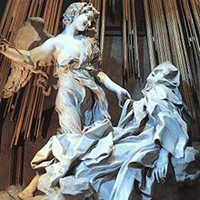
Gian Lorenzo Bernini was the most brilliant exponent of Baroque sculpture, one of the top Baroque architects, and a key figure in Baroque architecture. He spent almost his entire career in Rome and was responsible for some of the greatest sculptures of the 17th century. His contemporaries rated his genius as highly as that of Michelangelo, but in his sociable manner he possessed a temperament utterly different. If Michelangelo was a solitary artist who hardly ever communicated the essence of his sculpture to others, Bernini - despite antipathy from contemporary rivals such as the conservative Alessandro Algardi (1598-1654) - was an enthusiastic teacher who was able to delegate many tasks to his pupils and assistants. As a result, he was able to execute a series of major projects for a papacy keen to promote the power and grandeur of Rome. Noted above all for his masterpiece of Baroque art - the Ecstasy of St Theresa (Cornaro Chapel, Rome, 1647-55) Bernini was one of the most innovative artists in the history of sculpture. He worked for eight popes, and at his death was seen as one of Europe's greatest sculptors, and also one of Italy's greatest architects. |
|
17TH CENTURY SCULPTORS EUROPEAN SCULPTURE HISTORY OF WESTERN
ART |
|
|
Born in Naples, Gianlorenzo Bernini took his first lessons in plastic art from his father Pietro Bernini (1562-1629). A rare prodigy, he rapidly mastered the technique of marble carving. In Rome he studied Greek sculpture as well as the works of Michelangelo (1475-1564) and Giambologna (1529-1608). These influences are visible in his early works David Fighting Goliath (1613) and The Goat Amalthea Nursing the Infant Jupiter (c.1615; Musco e Galleria Borghese, Rome). As his father was employed by Pope Paul V, Bernini gained access to Borghese patronage, notably that of the Pope's nephew Scipione Borghese for whom his first large sculpture, the Aeneas, Anchises, and Ascanius (Musco e Galleria, Borghese, Rome) was executed around 1619. Here the fine Mannerist style of his father Pietro can be seen in the rich detail, but the spiraling movement of the entwined figures echoes the boldness of the Flemish genius Giambologna (1529-1608). After this, he executed a series of large, freestanding marble sculptures, commissioned by the same patron that still stand in the Museo e Galleria Borghese, Rome. Here Bernini tried in sculpture to equal the naturalistic manner of the paintings of the Carracci School in Rome, as exemplified by Annibale Carracci. Works in this series include Pluto and Persephone (1621-2), Apollo and Daphne (1622-5), and David (1623-4). In each statue, Bernini created a painterly effect: texture is subtly varied and marble achieves plastic effects never before obtained. In the David, the last of the series, the closed form of High Renaissance sculpture is denied by the figure's vigorous centrifugal motion. The representation of instantaneous movement had become the property of sculpture as well as painting. |
|
|
With the elevation of Cardinal Barberini to the papacy as Urban VIII (1623-44) Bernini discovered another devoted patron. It was for Urban that Bernini undertook his first architectural commission, the building of the entrance facade and portico of the church of S. Bibiana, Rome. For the high altar of the same church he carved his first major piece of religious art, S. Bibiana at her Martyrdom. Here Bernini's new sculptural techniques, developed in the Borghese statues, were put to the services of the religious zeal of the Counter-Reformation. Urban wished to embellish the newly rebuilt St Peter's Basilica in Rome. He commissioned Bernini, who was appointed architect of St Peter's in 1629, to erect a monumental canopy or baldacchino over the site of the tomb of St Peter. The Baldacchino (built 1624-33), which was made of bronze, was composed of four giant twisted columns surmounted by four volutes terminated by an orb and a cross. It successfully created a point of emphasis at the centre of the building. To further embellish the zone of the crossing, Bernini organized the placing of four large statues in niches set into the four giant columns, one of which (Longinus, 1629-38) he sculpted himself.
In 1632, while working on St Peter's, Bernini took time off to make a portrait bust of Scipione Borghese (Musco e Galleria Borghese, Rome), which revealed his extraordinary ability to capture an instantaneous moment in stone. In addition, he completed the projects already mentioned, this included the completion of the Palazzo Barberini (1629-33), one of the most beautiful modern buildings in Rome, the tomb of Countess Matilda, St Peter's (1633-7), the tomb of Urban VIII, St Peter's (1628-47, which was to be a prototype for later Baroque papal tombs), and the Triton fountain, Piazza Barberini (1642-3). Bernini was less happy with the project he took on to complete the facade of St Peter's, which, according to the sketches of Carlo Maderna, was to be accompanied by two bell towers. One of the towers partly fell when a part of the portico that served as a foundation for it collapsed in several places. Thereafter, the towers were totally demolished. This incident had no effect other than to stimulate Bernini's ardour. After the death of Pope Urban VIII and the election Pope Innocent X (1644-55), Bernini fell out of favour. Innocent was opposed to Urban's extravagance, at first no longer required Bernini's services: turning instead to other like Francesco Borromini (1599-1667). This gave Bernini the time to produce his greatest masterpiece - the decoration of the Cornaro Chapel, S. Maria delia Vittoria, Rome, 1647-55, for Cardinal Federigo Cornaro. The marble sculpture set on the high altar - the Ecstasy of St Theresa - depicts the intensity of one of the Saint's ecstatic visions. Sculptural reliefs portraying members of the Cornaro family appear in shallow panels in the two side-walls of the Chapel. The whole project - a typical Baroque affair, involving architecture, painting, and sculpture - has an incredibly dramatic effect. In 1648, Pope Innocent X finally turned to Bernini to create a large fountain symbolizing the Four Rivers in the middle of the Piazza Navona, in Rome. The fountain took the form of a rock on which personifications of the four rivers (the Danube, the Nile, the Plate, and the Ganges) are seated. On the death of Innocent and the election of Pope Alexander VII (1655-67), Bernini was restored to prominence. Increasingly preoccupied with architecture, Bernini now designed and constructed his two most famous churches - S. Andrea al Quirinale, Rome, and S. Maria dell'Assunzione, Ariccia. Determined to leave his own mark on the grandeur of Rome, Pope Alexander VII commissioned Bernini to redefine and decorate the piazza in front of Saint Peter's where pilgrims congregated for benediction. Bernini worked on the project from 1656-67. To enclose the area he built two massive colonnades which together form an oval piazza symbolizing the world gathered together before the Pope, and which correspond to the arms of the church open in greeting. Inside St Peter's he designed a monumental reredos at the high altar. Contained in this construction (known as the Cathedra Petri) is the throne of St Peter, a symbol of the Apostle's power as Christ's vicar and a witness to papal legitimacy. After the baldacchino, the Throne of St Peter, was Bernini's most significant work in gilded bronze. He also built the Scala Regia (1663-6), a stairway leading from the Vatican Palace to St Peter's, which was probably his least successful work. Bernini's various works spread his reputation throughout Europe. Louis XIV, in a calculated slight to Pope Alexander, ordered Colbert to invite Bernini to come and take charge of the completion of the Louvre, which he did in 1665. However, in the end Bernini became so tormented that he left Paris and construction of the facade fell to Claude Perrault instead.
The works Bernini created at the end of his life are overshadowed by the grandeur of his work on St Peter's in Rome. In general, Bernini's late works executed in Rome after 1665, when he was nearly 70, have a strong spiritual quality. He had already hinted at this manner in his sculpture Truth Revealed by Time (1646; Museo e Galleria Borghese, Rome), a statue whose figure was distorted (most unclassically) so as to highlight its emotion. Bernini developed the style in four later statues: Habakkuk and Daniel (1655-61; S. Maria del Popolo, Rome); St Mary Magdalen and St Jerome (1661-3; Siena Cathedral). But the best exemplars of this late spiritualism are the monumental Angel with the Crown of Thorns and Angel with the Superscription (1668-9; S. Andrea delle Fratte, Rome). These two statues were commissioned by Clement IX for the decoration of the Ponte S. Angelo, Rome, but were never erected. Bernini's spirituality is further shown in other late works: the altar and eiborium (1673-4; Cappella del SS. Sacramento, St Peter's Rome), the tomb of Alexander VII (1671-1678; St Peter's Rome), and the Death of the Blessed Ludoviea Albertoni (1674; S. Francesco a Ripa, Rome). Sculpture by Bernini can be seen in many of the world's best art museums and sculpture gardens. |
Bernini and the BaroqueArtists and theorists in the seventeenth and eighteenth centuries believed that a small amount of sculpture of the very highest quality had survived from antiquity, and that this alone provided a standard for their contemporaries. Little attempt was made to separate the different styles or periods of antiquity until the second half of the eighteenth century, when it was gradually realized that many of the canon were in fact Roman copies of Greek sculptures. However, even before they made formal distinctions sculptors showed an instinctive preference for one style or another, or interpreted the same object according to their own leanings. One of the great European sculptors in the history of art, Giovanni Lorenzo Bernini (1598-1680), for example, was attracted to the dramatic naturalism of what is often called Greek Hellenistic sculpture featuring Pergamese groups of the second and first century BCE, like the Vanquished Gaul Killing Himself and his Wife, while the classical sculptor Francois Duquesnoy (1597-1643) was drawn towards the Vatican Antinous or Hermes, a Roman imitation of a Greek original of probably the fifth century BCE. On the other hand, the Apollo Belvedere was the prototype for works as different in style as the figure of Apollo in Bernini's Apollo and Daphne, and Canova's Perseus. Like the words 'gothic' and 'rococo', 'baroque' was originally a term of abuse, meaning grotesque, deformed or over-elaborate. It carried with it the implication that the baroque style stood in opposition to the true classical principles of art and sought transitory effects that appealed to man's meaner desires. The academies of art that had grown up in the sixteenth and seventeenth centuries saw themselves as the custodians of the true classical tradition, whose principles were being threatened by the pursuit of a virtuosity that lured artists and patrons away from more demanding and elevated conceptions. The academies felt themselves to be the guardians of eternal values that had found their highest expression in antiquity, and they stood for an art which was restrained, simple and austere. Baroque sculptors, on the other hand, would have argued that the initial function of both painting and sculpture was to seduce the eye of the beholder by convincing him of the reality of the scene before him.
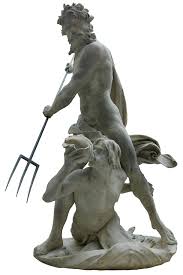
In practice the distinction between classical and baroque artists is less clear cut, and even Bernini believed himself to be working in the tradition of Michelangelo and antiquity. His baroque naturalism is more a reaction against the aestheticism of Mannerist sculpture than against the classical ideal; his work repudiates the elegant curves and balletic grace of his predecessors by an aggressive concreteness and naturalism. The contrast can be seen by comparing the figure of Neptune (c.1580-85) by Alessandro Vittoria, one of the best of the later mannerist sculptors, with Bernini's Neptune and Triton (c.1621). The contrapposto, or turning movement, of Vittoria's figure makes the sculpture 'work' from all angles, and it is clearly an object to be handled and admired for its changing contours. The movement is confined within one plane and there is no thrust in anyone direction, while the modelling is more delicate than powerful. Bernini's version still retains something of the mannerist contrapposto, but the thrust of the figure is behind the trident which carries the impetus of the action beyond the plane of the pedestal, as if calming the waters of the pond which it was originally intended to surmount, as can be seen from a seventeenth century engraving of Cardinal Montalto's garden. Vittoria's Neptune was, therefore, designed as a statue complete in itself, while Bernini's group was intended to be an active part of its setting, bringing the pond into an allegorical conceit. |
|
Bernini's Illusionist Sculpture Bernini's most important achievement was to create an illusion of reality that had previously been considered the province of Baroque painting, through the latter's use of trompe l'oeil techniques of foreshortening and quadratura. Painting by its nature was suited to deceiving the eye, and to achieve a comparable effect in sculpture required a virtuosity that Bernini was almost alone in possessing. He had the facility, in the words of Joshua Reynolds, to make stone 'sport and flutter in the air'. and he brought into the range of sculpture the depiction of a moment in time, gestures in transition and a pictorial background to the figures, by treating the relatively intractable materials of sculpture as if they were entirely malleable. Posterity dealt harshly with his facility and the argument against Bernini which was to condemn him to unpopularity until the beginning of this century was succinctly expressed by Reynolds in his Discourse on Sculpture:
Only with the twentieth century has the classical prejudice against the 'impurity' of his methods been overcome and he can now take his place amongst the greatest Old Masters. Giovanni Lorenzo Bernini was born in 1598, his father being a sculptor who had worked on many projects in Rome. Equally skilful with stone and bronze, Bernini's gifts revealed themselves even in his early teens and by the age of twenty he had established himself as the foremost sculptor in Rome. He was taken up by Cardinal Scipione Borghese, the Pope's nephew, who was engaged, in the years 1613-15. in building the Villa Borghese and filling it with antiquities. Scipione Borghese was typical of the Roman connoisseurs who emerged at the beginning of the seventeenth century: aristocratic, aesthetic in inclination and of wide classical learning. He epitomizes the relaxed feeling in Rome after the early austerity of the Counter-Reformation, as Church Militant became Church Triumphant. Bernini's sculptures for Scipione Borghese form a clearly defined phase in his work, and they show a rapid development from the late mannerist style of his father Pietro, who probably helped him with some of his earliest works, to a complete mastery of movement and gesture. The first of the series, the Aeneas and Anchises of 1617-19, has the serpentine movement of Giambologna (1529-1608), but it is rather uncertain in conception, perhaps because its original placing against the wall as a relief inhibited its movement in space. This was followed by the Neptune and Triton, a transitional work to the full-blooded baroque of his marble sculpture Pluto and Proserpine. As with the Aeneas and Anchises, the composition of the Pluto and Proserpine depends upon its being placed against a wall so that the beholder comes upon it directly from the front; the figure of Pluto is then seen to be advancing towards him. But now the group stands arbitrarily in the centre of the room where it was moved in the late eighteenth century. Unlike the Neptune and Triton, which is raised on a plinth to dominate the Montalto pond, the Pluto and Proserpine was intended to be seen at eye level, and the god appears to be stepping boldly off the pedestal while Proserpine struggles helplessly, looking outside the group for help. The composition depends not on an abstract movement but on the relationship between the figures of Pluto and Proserpine; the purposeful strength of the former is contrasted with the latter's discordant gestures, through the counterpoint of balance against unsteadiness, and firmness against softness. The explanation for Bernini's astonishing transformation in these years is perhaps to be found in the painting of the period; indeed the very feebleness of the sculpture of the period in Rome led him to look at the achievements of painters, such as Annibale Carracci's spectacular ceiling of the Farnese Gallery, which surpassed the Sistine Chapel frescoes in its illusionistic complexity. Bernini borrowed motifs from the Farnese ceiling, but it was more important to him as an example of the reconciliation of convincing naturalism with heroic monumentality. Carracci reveals his debt to Michelangelo and the Greek art of antiquity in his figures, but they are modelled with a greater attention to colour and texture, while his use of painted caryatids and pictures-within-pictures legitimized Bernini's experiments with illusion. It is also evident that Bernini had taken the opportunity to study Hellenistic works like the Vanquished Gaul Killing Himself and His Wife, the Dying Gaul and the wonderful Laocoon and His Sons. In the David (1623), the spectator is brought further within the orbit of the sculpture, for in contrast to Michelangelo's High Renaissance version, David is seen at the point of releasing the stone, which he aims - if the spectator is correctly positioned - directly at or above him. As an example of dramatic naturalism it is striking, but it lacks the poetic feeling of the masterpiece of the Borghese series, the Apollo and Daphne (1622-5), where virtuosity is subordinated to the poetic rendering of metamorphosis. The transformation of Daphne is shown taking place as if Apollo were still in hot pursuit, and Bernini has shown with remarkable sensitivity Daphne's terror and Apollo's sudden bewilderment. |
|
With the completion of the Borghese sculptures, Bernini was to move away from the circle of the aristocratic connoisseurs into the service of the papal policy. The Roman Church was in the throes of reform in the early seventeenth-century, and Bernini's entry into its service was to coincide with the final victory of the progressives who were sympathetic to the popular teachings of Ignatius Loyola and the Jesuits. Ignatius Loyola and Teresa of Avila were both canonized in 1622, a year which marks not only the beginning of a fully baroque religious style, but also of a new iconography based on the lives of more recent saints and martyrs. The text book of this phase was Ignatius Loyola's Spiritual Exercises, which Bernini is known to have used. It advocated a concrete form of religious experience, based on the tangibility of punishment and suffering. The religious man had to cleanse his soul by reliving the Passion of Christ and forcing his body to undergo the torments of hell through all his senses, so that he should be continually aware of his own mortality. His models of conduct were to be not only the modern saints but the holy men of the early Church who had achieved wisdom through self-denial. It is hard for us to reconcile this self-denying ethic with the ostentation of the high baroque, but Bernini would have seen no contradiction, for artists revealed the divine to men through their senses, regardless of their education or language. Urban VIII, who ascended to the pontificate in 1623, inherited the traditional papal role of developing the city of Rome in a manner worthy of the centre of Christendom, and in particular the problem of St Peter's which was still far from complete. Urban VIII was the ideal patron for Bernini, for he was sympathetic to the religious fervour of the Jesuits, while at the same time he saw the value of a magnificent display of temporal power. He took Bernini into service in 1624, and from then on the sculptor was permanently employed by the papacy under successive popes until his death. His work in St Peter's did not allow him to return to the Ovidian subjects of his youth, and it caused a fundamental shift in the formal basis of his work. He extends his concern for pictorial illusion into a total manipulation of the environment. In the Cathedra Petri and the Cornaro Chapel for example, the sculptural groups are enclosed within a new order of reality, which controls the light that falls upon them and the space they inhabit. The transition to a scenographic conception of sculpture can be seen in one of his earliest commissions in St Peter's, the baldacchino (1624-33), or canopy, which has both an architectural and symbolic function, acting as a kind of frame for the high altar of the Cathedra Petri (1657-66), which was planned at the same time as the baldacchino but not begun until twenty four years after the latter was completed. With the baldacchino the boundary between sculpture and architecture in Bernini's work becomes indeterminate, and later even painting was incorporated into Bernini's conception, In the words of his contemporary Baldinucci, it was "common knowledge that he was the first who undertook to unite architecture, sculpture and painting in such a way that they together make a beautiful whole". Not all of Bernini's commissions for St Peter's required such a complex solution and in the colossal figure of St Longinus he returned to the Renaissance problem of placing a figure within a niche. Just as the Apollo and Daphne shows the moment of Daphne's metamorphosis, so the St Longinus shows the Roman soldier's moment of conversion, his sudden vision of divine light. The figure is contained within the niche, but is placed frontally with arms spread out creating a jagged silhouette. The draperies play a vital part in the expression of emotion and they are carved with a largeness of form that allows them to be seen clearly from far away. The one surviving bozzetto shows the first idea to have been more classical, with the out-flung arm balanced by the curve of the body away from it. but the final work is more dramatic and original. A study of Bernini's preliminary sketches shows that he very frequently used a classical pose as a starting point for the development of the composition, although the final solution may bear little trace of the original idea. By contrast with the Longinus, the Cathedra Petri is so complex in its interaction of media that it is best described in Baudelaire's words as a 'mise-en-scene'. The architectural structure that frames the altar is dissolved by a symbolic vision of the elevation of the chair of St Peter. The window at the top is transformed into the divine light that bursts with a sudden radiance through the clouds, as the four fathers of the Church elevate St Peter's throne. As a solution to the problem of creating a climax grand enough for the immensity of the interior, it is a stunning achievement, but, in itself, it is too bombastic to be wholly satisfactory as a work of art. The most successful of Bernini's scenographic works is the earlier Cornaro Chapel (1647-52), which shows the conversion of St Teresa, watched by members of the Cornaro family. This work should be seen not as a sculptured altar, but as a completely unified side-chapel in which the donors are shown as participants in the sacred drama. St Teresa and the angel are shown as if suspended on a cloud above the altar, the whole scene within the niche being illuminated from heaven by a concealed window. In the chapel itself, in side-boxes, the Cornaro family, past and present, sit discussing the vision as if they were watching a theatrical performance. The architecture of the chapel is surfaced with different coloured marbles, and an illusionistic painted ceiling, made under Bernini's supervision, adds another order of reality to the scene below. It has been remarked many times since the eighteenth century that Teresa's ecstasy seems to be more physical than spiritual, but this misapprehension only serves to underline the concrete physical nature of St Teresa's description of her revelation. The Cathedra Petri (if we can dissociate it from the baldacchino, or indeed from the total concept of the interior of St Peter's), and the Cornaro Chapel represent the full exuberance of Bernini's middle years, when every project was a challenge to his ingenuity and to the vast resources he had available to him. As with many great artists his final years were more contemplative in mood and in his last works his virtuosity is tempered by a more subtle and profound human feeling. In the Death of the Blessed Lodovica Albertoni (1671-4) in the Altieri Chapel of St Francesco a Ripa, Bernini still uses a concealed light source but the tortured angularity of the drapery has a delicacy that reminds one of his early sculptures, and the pose recalls the classical Ariadne in the Vatican which was greatly admired by the eminent academic artist Nicolas Poussin (1594-1665). |
|
• For more facts about Italian Baroque sculpture and architecture, see: Homepage.
Visual
Artists, Greatest |