Michelangelo
Biography, Sculptures, Paintings of High
Renaissance Artist.
MAIN A-Z INDEX

|
Michelangelo
|
|
|
COLOURS USED IN
PAINTING |
Michelangelo di Lodovico Buonarroti Simoni, born in Florentine territory, was one of the three greatest Old Masters of Renaissance art. His nickname - il divino, the divine one - was an apt illustration of his exceptional gifts as a painter, sculptor, architect and engineer. Twenty years younger than his rival Leonardo da Vinci (1452-1519) and eight years older than his rival Raphael (1483-1520), his extraordinary diversity of talent made him one of the great inspirational forces behind the High Renaissance. He reinvigorated the classical idea that the nude human body is a sufficient vehicle for the expression of all emotions which a painter can depict, a notion that had an enormous influence on the subsequent development of Academic art - and on art as a whole. Above all, he promoted the idea that painting and sculpture merited the same status as architecture, and that painters and sculptors were real artists, rather than mere decorators or stone masons. Michelangelo's creative output has made him one of the most scrutinized artists of the Italian Renaissance, responsible for some of the greatest Renaissance paintings and also for several of the world's greatest sculptures. Several of his works, notably his statues Pieta and David, and his Genesis and Last Judgment frescos in the Sistine Chapel in Rome - are regarded as some of the most influential artistic accomplishments in the history of art. His place among the best artists of all time is assured. |
|
|
|
In 1492, after the death of his patron, Lorenzo de' Medici, the 17 year old Michelangelo moved to Bologna, and, in 1496, to Rome. There he carved the first of his great masterpieces of Italian Renaissance sculpture, the St Peter's Pieta, which was completed at the turn of the century. His mastery of anatomy and composition as revealed in this sculpture, made his name. He returned to Florence in 1501 as a famous artist, remaining there until 1505. Here he created David his second great marble sculpture, and painted his one and only surviving panel painting - the Doni Tondo. He may also have painted the Madonna and Child with John the Baptist. In 1505 Michelangelo was offered a commission by Pope Julius II for the design and sculpting of his tomb. The original dimensions of the tomb had room for almost 80 oversized figures. Due to various problems, the tomb was reduced drastically in size and Michelangelo made only one figure - Moses, his last major sculpture. He left Rome during wrangles over the tomb, but returned not long afterwards. In 1508, he was commissioned by the Pope to repaint the ceiling of the Sistine Chapel with what became known as his Genesis fresco. This masterpiece of High Renaissance painting took four years to complete (1508-1512). Painted from a scaffold supported by beams built out from holes in the wall, high up near the top of the windows, using a new plaster-mixture, called intonaco, the paintings contain bright colour, easily visible from floor-level. Although distracted by painting the Sistine Chapel, as soon as it was finished Michelangelo returned to work on Julius' tomb (1513-1516). He then returned to Florence to work for the Medici family in the person of Pope Leo X, the younger son of his former patron Lorenzo de' Medici. During the years 1516-1527 he performed a number of sculptural and architectural tasks for the Medici and Rovere popes. Political upheaval followed. Michelangelo remained in Florence working on the Medici Chapel but left in 1534 to return to Rome where he settled for the remainder of his life. Almost at once he received his next great commission from Pope Paul III - to paint The Last Judgment, on the altar wall of the Sistine Chapel. Many painting experts consider this to be his masterpiece. When unveiled in 1541 it caused a sensation equalled only by his fresco on the Sistine Chapel ceiling of 30 years earlier. |
|
|
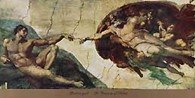
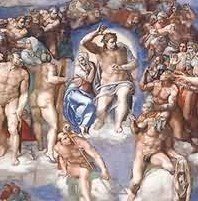
From High Renaissance to Mannerism Michelangelo's two famous Sistine Chapel frescoes (The Genesis fresco, and The Last Judgment fresco), were a study in contrasts. Genesis expressed the confident humanism and Christian Neo-Platonism which underpinned the High Renaissance (c.1490-1525). But all this confidence evaporated in the 1520s following first Luther's Revolt against the Church in Rome (1519), and then the Sack of Rome (1527) when unpaid mercenary soldiers looted the Holy City. These events triggered a widespread pessimism and despondency which was perfectly captured by the composition and style in Michelangelo's Last Judgement. The wall-painting depicts Christ's damnation of sinners and his blessing of the virtuous, along with the resurrection of the dead and the transport of souls to hell by Charon. The mouth of Hell gapes over the altar itself. The painting exemplifies the new style of Mannerism (a reaction against the perfection and self-assuredness of the Renaissance) which gripped artists throughout the unstable areas of Central Italy following the Sack of Rome in 1527. Indeed, Michelangelo was cited by the 16th century artist, art-theorist and biographer Giorgio Vasari (1511-74) as an important source for the new style of Mannerist painting, pursued by the young non-conformist artists of the mid-16th century. For the remaining 20 years of his life Michelangelo concentrated mostly on Renaissance architecture, a medium in which he achieved almost as much success as in painting and sculpture. In fact he was regarded by his papal and artistic contemporaries as one of the greatest architects of the Mannerist period. His major commission was the completion of St Peter's Basilica in Rome (in particular the domed roof), a project which Pope Julius II had started back in 1506. Although changes were made to Michelangelo's plans after his death, the exterior of St Peter's owes more to his designs than those of any other architect. Achievements in Sculpture, Painting and Architecture No other artist in history has approached Michelangelo's mastery of the three main types of art. In painting, he was the greatest ever painter of the male nude. No artist who has followed him in this area has remained uninfluenced by his figures. Also, his figurative expressiveness remains unequalled. These achievements - exemplified by his iconic fresco The Creation of Adam on the ceiling of the Sistine Chapel - had a lasting impact on the theory and practice of fine art as taught by the great academies of Europe. In sculpture - his main forte - his understanding of space, form and appearance remains unmatched, as does his ability to express a wide variety of differing emotions in three-dimensional marble, all of which makes him one of the greatest sculptors we have seen. In architecture, he was the equal of any of his contemporaries. His greatest designs were those for the Medici Chapel and the Biblioteca Laurenziana, as well as St Peter's in Rome. |
|
|
Michelangelo As a SculptorProblems of Attribution of Sculptures It has been customary to consider only six sculptures as representing his activity before the Pieta in St Peter's: the two reliefs of the Casa Buonarroti, the Madonna of the Stairs and the Battle of the Centaurs; the three small figures for the Tomb of St Dominic, and the Bacchus. At least six other works mentioned in our sources have been presumed lost: the Head of a Faun, the Crucifix, the Hercules, the Young St John, the Cupid, and the Sleeping Cupid. This has led us to overlook the very notion of experimental variety in Michelangelo's formative years. Of the surviving works, only the Battle of the Centaurs shows him approaching the style which he was to develop at the beginning of the cinquecento. The relief sculpture the Madonna of the Stairs is an essay in the flattened relief of Donatello, and the three statues for the Tomb of St Dominic are limited in theme by the obligations of the commission. Thus the Bacchus, the first work of any size which we have, appears almost unexplained, and for this reason was long taken to be a work of antique inspiration. Of the six sculptures of his youth and the two bronzes of his early maturity, David and Julius II, all of which are generally supposed to be missing, only one can be considered as indubitably lost: the statue of Julius II, executed between 1506 and 1508, and destroyed in 1511 on the return to Bologna of the House of Bentivoglio. Almost all the others are in fact extant. Michelangelo's lost Head of a Faun is probably the restored part of the Hellenistic Red Marsyas in the Uffizi. The wooden Crucifix we can identify as that in the church of San Rocco at Massa. The Young St John is to be found in the Bargello in Florence. The Sleeping Cupid is probably to be identified with the theme of the Hellenistic Hermaphrodite, all the versions of which should now be studied, with particular attention to the one in the Louvre. The other Cupid has come to light recently in a private collection, though unhappily only as a fragment. We can recognize a model for the bronze David in a small bronze acquired by the Capodimonte Museum in Naples, in 1898, which has not hitherto been attributed with certainty to any artist. To the list of works recorded in the sources, we can probably add a Venus, first attributed to Michelangelo by Marangoni, and a fragmentary Apollo, which was once in the Bardini collection, though its present whereabouts is unknown. While these works were considered lost, it is understandable that the Bacchus, the first work in which the artist competed successfully with the antique, appeared to be out of step with Michelangelo's development. But now we can understand the transition from the Young St John to the Bacchus by reference to the Cupid and the Apollo. These two permit us to see how the harshness of the earlier forms gradually matured into the delicacy and poise of the Bacchus and, later, of the Christ of the Pieta in St Peter's. One can truly speak of a conspiracy of history to conceal the youthful activity of this most famous of sculptors. To some extent, the responsibility lies with Michelangelo himself, who may well later have been dissatisfied with certain works, notably the Head of a Faun. In regarding the relief of the Battle of the Centaurs as the best proof of his natural destiny for sculpture, Michelangelo presumably had in mind its foreshadowing of the atmospheric freedom, and conscious lack of finish, which later become his personal means of expression. It would be understandable if he wished at the same time to draw a veil over the other works of his youth, with their conventional high finish. Posterity was unconsciously to support this judgment by attributing the Young St John to Donatello or to Francesco di Giorgio Martini. So, in time, the youthful works of Michelangelo were sifted out to leave only those which possess the central dramatic element, and show him searching for the means to express his unique sense of superhuman grandeur. This sense was innate; but, unless we are to believe that Michelangelo's style was born fully formed, it can have attained its full expressive power only after many trials. The first subject to which he applied himself was the Head of a Faun, which he had to copy from a much-damaged antique marble, and which is identified with the restored part of the so-called Red Marsyas in the Uffizi. The marble in which this antique is carved is in fact Greek, and not red at all; it might therefore be identical with the 'white' Marsyas, noted by Vasari at the entrance to the garden of the Palazzo Medici, the restoration of which he attributed to Donatello. The restored part, from the chest upward, is carved in white Carrara marble, and one cannot say that, in general, it is very satisfactory. But the head itself is an expressive piece of carving, still tied though it is to the preoccupation of Andrea del Verrocchio with 'atmospheric' surface values. It is with this untamed and bestial image, which stirs our imagination of the mythical beginnings of man, that Michelangelo begins his long dialogue with Greek sculpture. Battle of the Centaurs (Marble, High Relief) After the Head of a Faun came another treatment of the mythological theme of the man-animal, suggested to him by Poliziano: the Battle of the Centaurs. In this theme of violent struggle Michelangelo found a subject with which he could set out to emulate, not only the urns and sarcophagi of antiquity, but also the pulpit reliefs of Nicola Pisano and his brother Giovanni Pisano, which represented for him, as for Filippo Brunelleschi a century before, the beginning of modern sculpture. Neither Antonio Pollaiuolo, in his famous engraving of ten nude figures fighting, nor Bertoldo di Giovanni, in his magnificent bronze relief in the Bargello, managed to escape the constriction of precisely defined outlines, but Michelangelo, by leaving his work in an unfinished state, gave it an airy freedom, almost as if he were re-creating in relief the atmospheric perspective of the paintings of Masaccio. It was the first time this had been achieved in a relief; that is to say it was probably the first time anyone had admitted that a roughly finished work could be improved no further by polishing the surface. Michelangelo's career as a sculptor had a good start with this relief but straightaway the death of Lorenzo de' Medici left him in difficulties. The Palazzo Medici was in a state of crisis and he returned home to work alone on a larger than life-size figure of Hercules. This passed into the possession of the Strozzi family and stood in the courtyard of their palace. At the time of the siege of Florence, it was sent by Giovan Battista della Palla to Francis I, who had it placed in the Jardin de l'Etang at Fontainebleau. In 1713 it was taken away from there, and since then we have no further records. The Crucifix on the other hand, was Michelangelo's first piece of religious art, and the result of an experience which must have been decisive for the young artist. It is his sole wood carving, and he gave it to Niccolo Bicchiellini, the Prior of Santo Spirito, in gratitude for having been allowed to do his anatomical researches in the hospital of the monastery. The wood must have lent itself more easily than marble to working out the results of his new and intensive studies. Anatomy was the new science of the moment. At the age of 18 Michelangelo, through the friendship of a priest, was able to immerse himself in a repugnant task, which only strength of will and reason could render supportable, that of dissection. He explored in depth all the workings of the human body. From then on, he was its master. In his Crucifix, for instance, the body moves through subtle counterpoints and, rising against gravity, culminates in the weight of the head which hangs in an attitude of supreme abandon. The young and heroic character of the Christ we find again, though softened, in the Risen Christ in Santa Maria sopra Minerva, and it was later taken up by Cellini and more especially by Giambologna. The Crucifix therefore gives us the prototype of what we can from henceforth call the Michelangelo 'hero'. Tomb of St Dominic (3 Marble Statues) He had hardly finished it when he was recalled to the Palazzo Medici by Piero di Lorenzo. There he must have felt the clash between the corruption of the new Medici circle and the ideals of Christian regeneration which were being preached by Girolamo Savonarola (1452-98). Conscious of impending disaster, he left for Venice and subsequently established himself in Bologna, where, through the influence of a friend, Gianfrancesco Aldovrandi, he was given a commission of some difficulty. It involved carving the four small figures still lacking for the tomb of St Dominic, which Niccolo dell'Arca had left unfinished at his death some few months before. Only twice in his life did Michelangelo have to work on schemes not entirely of his own conception: this tomb and the Piccolomini altar in Siena Cathedral. In the case of the tomb he was particularly limited as to size: about 60 cm (24 in.) for the two Saints and 55 cm (20 in.) for the Angel. But, in spite of the scale, and the fact that the St Petronius had probably already been blocked out by Niccolo, the powerful personality of Michelangelo revealed itself immediately. The most personal of his own figures, the Angel Holding a Candlestick, has a virile, Olympian calm and a solemn aloofness which contrasts with the fragile beauty and modesty of its companion by Niccolo. The St Petronius is probably less surely handled because it had already been blocked out, as we believe, by the older sculptor. But the St Proculus is highly expressive, in spite of having been broken into more than fifty pieces in 1572. There is a threat of violence in that furrowed brow and piercing glance, the taut skin on the hand raised to the chest and the pent-up spring in that careful step. Young St John (Marble Sculpture) On his return home, Michelangelo enthusiastically subscribed to the ideals of Savonarola, which were then in the heyday of their success. His nature now showed its first proofs of true genius, for it was in the spirit of Savonarola that he created his Young St John for Lorenzo di Pierfrancesco, who belonged to the branch of the Medici family known as the Popolani. This figure was long believed lost, and has been identified with various other works, but it is recognizable in the Young St John of the Bargello. Since the 17th-century this had been assumed to be the work of Donatello, though Cicognara had suspected that it might be rather later. Kauffmann subsequently recognized in it the influence of Michelangelo but, inexplicably, sought too far afield and attributed it to the circle of Francesco da Sangallo. In fact, the youthful personality of Michelangelo is very clearly present in it. The lean, athletic figure of the young saint advances with his eyes fixed on the scroll which he holds in his left hand, and the summary treatment of the camel-skin is in conscious contrast to the brilliant anatomical skill of the uncovered parts of his body. The statue is carved from a long, narrow block and leans to the limits of equilibrium, thus foreshadowing the bronze sculpture David and, at the end of his life, the Rondanini Pieta. The restitution of this problematical work to Michelangelo's oeuvre throws more light on the meaning of his early activity. So long as several works mentioned in the sources remained unidentified, we could think of him as already immersed in some magnificent dream of his future achievements, but, as soon as we rediscover some of them, we can see the artist feeling his way from work to work in a logical progression. Sleeping Cupid (Marble High Relief) The titles of the subjects which he attempted in his early years suggest that the artist chose them for their contrasting themes. After the Young St John he carved a Sleeping Cupid which has also been considered lost. It has always been believed that this sculpture represented a baby cupid with wings. But Condivi said that it showed a boy of six or seven. As it was probably a version of an antique marble, was it perhaps a copy of one of the Hellenistic Hermaphrodites? Michelangelo's Sleeping Cupid had a curious history; it was probably thought wise to send it away from the Florence of Savonarola because of its erotic character, so, on the advice of Lorenzo di Pierfrancesco, it was aged with patina and sent to Rome. There the Cardinal Raffaello Riario acquired it as an example of sculpture from ancient Greece, but when he realized it was modern, he demanded his money back. Michelangelo went to Rome to try to recover it, but did not succeed. |
|
|
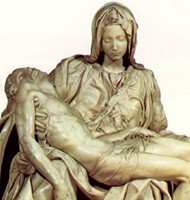
His journey to Rome, apart from this practical purpose, must also have had the more idealistic one of discovering the finest masterpieces of antiquity. He immersed himself in Greek art, and his own work gained from it a concentration and a depth which it had lacked before. Cardinal Riario, whose guest he was, commissioned a 'figure from life', now lost. Then, on 19 August 1497, Michelangelo wrote to his father that he had begun to work on his own account.' His first sculpture in Rome was the Cupid which has recently come to light, though sadly damaged. The little figure is carved in a block of Greek marble, the natural size of a boy of 4, and it reveals a mastery of space unequalled since antiquity. The surface is for the first time like living flesh; the ecstatic movement is irresistible. Dynamism has here overcome the gracefulness of the quattrocento, and this development was to continue, though sluggishly and inconsistently, through the art of the cinquecento until it erupted again in that of the baroque. It was probably directly after the Cupid, and before the Bacchus, that Michelangelo decided to carve an Apollo for Piero de' Medici, who was leading a dissipated life in Rome while dreaming of his return to Florence. This Apollo seems identical with the fragment which was sold in London, at Christie's, at the beginning of the 20th-century, but whose location is no longer known; from the photograph in the sale catalogue we can guess that it represented a transition between the Cupid and the Bacchus. The Bacchus was carved for Jacopo Galli, a rich banker and gentleman of culture, who understood the brilliant possibilities of the young artist. He acquired the Cupid and the Apollo which had been made independently, but the Bacchus he commissioned personally. In this work Michelangelo approached a well-known classical theme, that of the god of wine attended by a satyr, but freed himself from its constrictions with a completely original solution. He gave the god the slim but flaccid body of a young drunkard, his head crowned with vine-leaves, who advances with shaky step, a goblet in his right hand, and in his left a bunch of grapes which the little, grinning satyr plucks at from behind. In spite of the classical inspiration, everything about this figure seems new: its complex planes are subtly articulated and marvellously smooth, and this impression is due above all to the apparently unstable stance, which shows a mastery of form such as no sculptor had possessed before. Rome matured the youthful prodigy. From now on his art exudes a feeling of freedom and a powerful breath of life. The Pieta in St Peter's (Marble Statue) Michelangelo's Pieta closed this brief but intense period devoted entirely to the spirit of the antique. Its commissioning by Cardinal Jean Bilheres de Lagraulas represented a return to the religious themes which he had not touched since the Young St John. Direct contact with the antiquities of Rome had greatly broadened his powers of expression, and certain friends, who understood the significance of these powers, now sought to direct them into more spiritual channels. We should remember that it was at this time that the political ascendancy of Savonarola in Florence was drawing to its tragic end, and that this man represented for Michelangelo the symbol of his inner conflict. He must have realized, during his first years in Florence, what a problem Savonarola's teaching would present to his own strong sensuality, and yet, as with all his generation, he could not escape the fascination of its authority. All his life, that voice would haunt him with its call to a higher spiritual reality and to a total moral commitment; it would determine the notes of bitter remorse in his poetry, and the deep preoccupation with tragedy of his old age. Under Savonarola, the Florence Renaissance had felt itself the centre for the moral regeneration of the world, and when the news came of his death at the stake in 1498, it must have affected Michelangelo as an irrevocable turning point of destiny. Before the Pieta he had worked mostly for the refined tastes of private collectors. With the Pieta, he worked in the knowledge that it would be placed in St Peter's, in the chapel of the kings of France. When it was shown, to the admiration of all, he heard people attribute it to a more famous sculptor of the time, and, realizing how little his name was yet known, he carved it on the ribbon across the breast of the Virgin. In the Pieta, the sculptor set himself a most ambitious task, and admiration for its sheer audacity has to some extent impeded the proper understanding of the sculpture. The complex folds of the Virgin's robe form a rich background to the body of Christ, and are carried out lovingly to the smallest nuance of detail. Its strong naturalism is nonetheless subordinate to the formal design of the sculpture and to the depth of feeling expressed in it. This feeling is extremely intense, for, though full of the exalted spirit of classical antiquity, Michelangelo now discovered in himself an infinite capacity for response to suffering. The work was an immediate success, but from the beginning people tried to counter this with criticisms of its representational correctness; they complained that the Virgin was far too young. The artist silenced his critics by explaining that he had wanted to represent the Virgin with the perfection of a body untouched by sin. At the turn of the new century Michelangelo returned to Florence crowned with the laurels of this success. He brought with him a commission for fifteen small statues for the Piccolomini chapel in Siena Cathedral. He also began work on four of the other figures of saints, but in 1503 he was released from the urgency of this obligation by the death of Pope Pius III, who had given him the commission. In any event, he was primarily interested in a commission given to him by the administrators of Florence Cathedral, who had assigned to him a giant block of marble which everyone had considered unusable, since an earlier sculptor had already begun to carve it. (Although Leonardo da Vinci and other artists were consulted about the commission, it was the 26-year old Michelangelo Buonarroti, who convinced the authorities that he should be entrusted with the task.) Having obtained it for himself, Michelangelo found the opportunity to demonstrate freely his own conception of sculpture, and produced from this ruined block a perfect figure of David which is over 14-feet high.
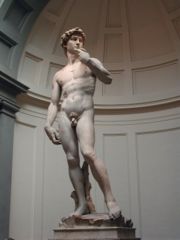
It is important to understand how Michelangelo's return to his home city of Florence revived his feeling of civic pride and involvement, just as it had when he came back from Bologna some years earlier. Now that Savonarola was gone, the republic of Florence lived through a period of muted glory under the Gonfaloniere Soderini, but there is no doubt that the absence of the Medici gave the city the air of freedom which it had lacked for so long, and the illusion of recapturing the atmosphere of that period, eighty years before, which had been the happiest in its history. If the political situation was insecure, the work of the artists appeared at last to bear the fruit of two centuries of astonishing development. Michelangelo's works of this period are the highest expression of the new climate. The marble David, which was completed in two and a half years, remains one of Michelangelo's greatest masterpieces of sculpture, and is arguably the most celebrated and recognizable statue in the history of art. Historically, the statue depicts the Biblical King David at the moment that he decides to do battle with Goliath; politically, it symbolised the Florentine Republic, an independent city state threatened on all sides by more powerful neighbours, a view supported by its original setting outside the Palazzo della Signoria in the Piazza della Signoria, the seat of civic government in Florence. When we see it we are amazed that a man of 30 could have achieved so immediately what Greek sculpture of antiquity had attempted in vain: a statue much bigger than life which does not oppress as a monstrous abnormality. Michelangelo overcame this problem of size by portraying his David, as the traditional figure of an adolescent, in such a way that we feel his inherent potential of further growth. It was no part of the artist's intention to emulate classical proportions, but rather to replace them with a new beauty of expressive suggestion, and there are many disproportionate elements in the figure which are precisely those of adolescence. The huge head, its mass increased by the curly hair, the long arms and heavy hands, the slender flanks and the excessively long legs, somehow combine to give this giant a feeling of spontaneous harmony. From now until the end of his very long life, exactly sixty years later, Michelangelo was the most famous artist in Italy. He was seen as a paragon, to whom any undertaking could be entrusted provided only that it seemed impossible. Michelangelo was now called to Rome by Julius II (the former Giuliano della Rovere), who commissioned him to design his tomb. This was to surpass those of all his predecessors, and was to be placed beside the throne of St Peter at the heart of the greatest temple of Christianity. The sculptor travelled to Carrara to supervise the quarrying of the marble he would need, and had it shipped to Rome, but at this point the Pope began to have second thoughts about the project. This may have been due to the intrigues of rival artists, especially Donato Bramante, or else to a sudden scruple in the Pope's own mind lest such a gesture of self-glorification might be going too far. Michelangelo, who could think of nothing else but this stupendous project, reacted violently. Proudly sure that he could not be replaced, he did not hesitate to offend the Pope by leaving Rome in a huff. Back in Florence, and probably still in the heat of his anger, he set about carving one of the twelve apostles which had been commissioned for the Cathedral. This was the St Matthew, which was to remain unfinished but which is for us the most perfect demonstration of how an image liberates itself, clear and untrammelled, from its block. The reconciliation with the Pope came about shortly afterwards, at Bologna in 1506. Julius II evidently realized that here was an artist different from the others, and that he had to come to terms with this man who dared to oppose him. First he ordered a statue of himself in bronze, larger than life. Set up on the facade of San Petronio in Bologna in 1508, it was thrown down in 1511 at the return to power of the Bentivoglio family. But Julius also came to hear of Michelangelo's reputation as a painter after his cartoon of the Battle of Cascina, and when the artist rejoined him in Rome, the Pope set him to another herculean labour, the decoration of the ceiling of the Sistine Chapel, and the artist was obliged to accept. Nonetheless, during the four long years of work on the ceiling, he never abandoned the thought of the papal tomb. On the death of Julius in 1513, Michelangelo renewed the contract with his heirs, the Della Rovere family, and set to work with the intention of finishing the task as soon as possible. The next Pope, however, was an old friend, Giovanni de' Medici who took the name of Leo X, and after three years he became impatient to employ the artist for his own ends. He wanted him to build the facade of the Medici family chapel of San Lorenzo in Florence. Though attracted by this new project, we can imagine how the artist must have suffered at having to postpone, yet again, his work on the tomb. Another contract was drawn up for a simplified monument in 1516, but not even this was to be completed. After the death of Leo X in 1521, and the brief pontificate of Hadrian VI (1522-3), there followed a long period of frustration over the tomb, and also, it seems, of remorse. This lasted until a fourth contract was drawn up in 1532, in which the project was further reduced to a single facade standing against the wall. In this form it was finally erected in San Pietro in Vincoli in 1545. If we follow the development of Michelangelo's attitude to the tomb of Julius II, as revealed in his letters, we see how his determination to complete it began to weaken about 1523. Let us therefore take this date as the turning point, before which he was adding new figures to the monument, but after which he thought only of reducing the project and of employing the elements which he had already finished. We can thus assume that none of the statues of Slaves was begun after 1523, and probably only the Victory was continued after that date, at the same time as the sculptures for the Medici chapel. Before that year, however, there had been a whole series of powerful creations destined for the tomb. The Moses dates from between 1513 and 1515, and seems to have been inspired by the sculptor's anger at the destruction of his bronze figure of Julius II at Bologna. With its gesture of restrained and compact power, the Moses is the most impressive example of that terribilita which is the new and personal dimension of Michelangelo. It is the culmination of the great Florentine tradition, and posterity has regarded it with a special veneration. At the same time he made the two Slaves, now in the Louvre, the only figures which he carved for the tomb while in Rome. In the Dying Slave and the Rebellious Slave the calm of the nude is infused with a unique passion. On the other hand, the four Slaves which he started carving in Florence before 1519 were never developed far enough for us to appreciate anything other than the drama of these forms which struggle to free themselves from their blocks. The only work of the series which succeeded in freeing itself was the Victory (see below). |
|
|
Work on the Medici Chapel began in September 1519 and the sculptures for the Medici tombs must have been begun a few years later. The rapid progress of the building, and the perfect accord between the conception of the tombs and the new spirit of Michelangelo's architecture, created the best possible atmosphere for work on the statues. In these allegories of the four divisions of the day the artist expressed the inexorable passage of time. He created precise images for the vaguest and most universal feelings: the pained awakening of Dawn and the apprehensive looking-back of Dusk; the restless, sensual sleep of Night, and the clouded face of Day, showing above massive shoulders. The character of these figures, more than that of any others, appears to find its roots in the Bacchus. Their bodies are elongated, with full, heavy forms closely knit together, but the heads of the two male figures are left unfinished. This is an act of freedom, and, according to Vasari, a conscious means of expression. Michelangelo was the first to realize the power of the indefinite, its power to stimulate our sense of the infinite. We find the same character in the small unfinished, Apollo (sometimes interpreted as a David), which embodies the last note of Renaissance hedonism in the work of Michelangelo. The Victory is a more evolved work, which distinguishes itself from the Slaves by its lighter elegance. A rather effeminate youth, in an affected and unconvincing pose, half-kneels on the crouching figure of the vanquished. Close to the Victory in feeling are the figures of Giuliano de' Medici, Duke of Nemours and Lorenzo de' Medici, Duke of Urbino. In life, these princes had hardly been heroes to excite the imagination, but such they became in the sculptures of Michelangelo, who, without any attempt at portraiture, created two classic images of condottieri. The last of his sculptures for the Medici chapel was the Virgin and Child, which was left unfinished. The Child sits astride the Virgin's knee in an attitude taken from a relief of Jacopo della Quercia (c.1374-1438) in Bologna, except that here he turns to look at his mother. It is a clear and refined image, a prelude to the last phase of the artist's development. There exists also at the Hermitage in St Petersburg the figure of a Crouching Youth again intended for the Medici tombs, and in the Casa Buonarroti there is a model for a River God which is treated with a vivid sense of realism. We find this same sense of realism in the body of the Christ in the Florentine Pieta. This remains an impressive and complex achievement, the sum of brilliant intuition and deep dissatisfaction. Never did the sculptor charge his marble with a passion more intense than that which flows from this martyred body, the mother sinking under its weight, or a compassion such as that of Nicodemus, his face veiled in the mist of the undefined. Michelangelo's works of sculpture were becoming rarer, but, after an interval, he was inspired by the murder of the tyrant Alessandro de' Medici in 1537 to carve his portrait bust of Brutus. (He was working on the Last Judgment fresco in the Sistine Chapel from 1536-41.) This surpasses the busts of antiquity, such as that of Caracalla, in its realistic vigour. Later on he supervised, and perhaps partly carved himself, the two figures of Leah and Rachel, symbolizing the active and the contemplative lives, which were needed for the final version of the tomb of Julius II. This was completed by his assistants and finally set up in San Pietro in Vincoli in 1545. Michelangelo had now arrived at his last period, which was almost barren of sculpture. Only one work of sculpture is known to have been undertaken after 1542, the Rondanini Pieta. We do not know the origin of this Pieta either. A drawing of uncertain date in the Ashmolean Museum, Oxford, shows us what the first version must have been like, but the artist later carved away the greater part of the group in order to draw out the essence of a much purer, freer composition; he was working on this six days before his death. In the final and excessively elongated composition, the nude body of Christ is still firmly of the flesh, but an infinity of ideas dwells among the roughly hewn masses. Michelangelo As a PainterMichelangelo was the creator of the fresco painting in the Sistine Chapel, which many people see as a pinnacle of western art. Yet he consistently denied that painting was his trade. The fact that both in his lifetime and during most of the intervening centuries he was regarded as the greatest sculptor who had ever lived is no more than a partial explanation of his reluctance to paint, since Florentines of the preceding generation, such as Antonio Pollaiuolo or Verrocchio, seem to have worked happily in both arts. One explanation probably lies in the controversy concerning the respective merits of painting and sculpture. This became a burning issue in Michelangelo's lifetime, and he saw himself as the leader of the sculptors' party. At the same time it is possible that he also had a personal reason for the stance which he took up. There was a strong vein of asceticism in his character. He seems to have been impervious to physical discomfort, and he had a corresponding contempt for any symptoms of softness in other people. And this may well have affected his preference for marble carving, as being vastly more strenuous than either modelling or painting. Regarding Michelangelo's views on the controversy we are fortunately well informed. In the 1540s the humanist, Benedetto Varchi, had sent out invitations to various painters and sculptors to express their opinions. In his reply Michelangelo said in effect that he saw no fundamental difference between painting and sculpture. Painting, in his view, was good to the extent that it resembled sculpture (he actually used the word 'relief') and sculpture bad to the extent that it resembled painting. This undoubtedly provides us with an authentic and fascinating key to Michelangelo's own aims in his painting, and we should bear his words constantly in mind. The distinction drawn by Michelangelo between painting which resembled sculpture and painting which did not, leads us to another controversy. Not only were the painters in Michelangelo's day forced into rivalry with the sculptors; correspondingly fierce differences were discovered between drawing-based painters (proponents of disegno) and colour-based painters (proponents of colorito) - that is, between painters whose ideal was the art of Antiquity, and those, such as the Venetians, who based their art on Nature. This dispute exacerbated Michelangelo's personal rivalry with the younger Raphael. Despite his triumph with the Sistine ceiling (1508-12) there were those in Rome in the years 1512-16, or thereabouts, who had a higher opinion of the young Urbino artist Raffaello Santi (Raphael). It was agreed that Michelangelo's incomparable drawing skills rendered him supreme as a painter of male nudes in art history. However, it was also claimed that whereas Raphael was supreme in almost every branch of painting Michelangelo could paint nothing except nudes. The prickly Michelangelo naturally resented this, and he was astute enough to realize that Raphael, at that time, still had a lot to learn about fine art painting. For example, skill with colour pigments, was not really Raphael's forte any more than it was Michelangelo's. In fact Raphael seems to have realized this himself, and set about enhancing his technique through a study of Venetian methods; but Michelangelo had no intention either of changing his ways or of intervening in the dispute in person. As it was, his rivalry with the younger man was ended by Raphael's premature death. Michelangelo Commissions "Official Biography" by Condivi Michelangelo was extremely touchy and tended to imagine that other High Renaissance artists were plotting against him. This side of his somewhat devious character is also seen in the extraordinary interest which he took in his public image, and in the trouble that he went to impose his version of it on the world. In 1550 the historian, Giorgio Vasari, had published a biography which, though almost extravagantly complimentary to Michelangelo, did not entirely please him. He therefore engaged a young pupil, Ascanio Condivi, to write what would now be called the official biography, and this was published only three years after Vasari's (1553). Michelangelo's memory for facts was still good, so that Condivi's book is basically sound in that respect. But the great man's prejudices had increased with age, and the hatred and resentment which he had felt in his youth for artists such as Ghirlandaio, Bramante and Raphael had lost nothing in intensity, despite the fact that these three were long since dead. Nevertheless the manoeuvre worked. Michelangelo's picture of himself as written by Condivi has remained the official image. For example, we can see from Michelangelo's surviving studies after frescoes by Giotto and Masaccio that his training must have been quite thorough, but Condivi's biography minimized it, downplaying Michelangelo's apprenticeship as painter to Domenico Ghirlandaio in order to make the miracles of the Sistine ceiling seem even more miraculous. The Battle of Cascina and The Doni Tondo It is nevertheless not in dispute that it was as sculptor that Michelangelo had his first overwhelming success. This came with the unveiling of the David in the summer of 1504. This was followed by a commission (executed in rivalry with Leonardo) for a painting of a battle scene - the Battle of Cascina - for the great hall of the Florentine republic. Michelangelo seems to have got no further than the full size cartoon. Though this was immensely admired at the time, and immensely influential, it soon fell to pieces, though its appearance is known from Aristotele da Sangallo's small copy. Possibly to prepare himself for this undertaking Michelangelo painted at this time the only easel picture which survives and which is attributed to him in a document dating from his lifetime - the Holy Family (Uffizi, Florence) known as the Doni Tondo. (This is the only surviving panel painting by Michelangelo. It is in the form of a tondo, or circular frame, which, during the Renaissance, was typically associated with marriage.)
That said, in the Doni picture Michelangelo seems almost to have set himself to ignore the innovations in painting which Leonardo was making at that time. In works such as the Mona Lisa, for instance, Leonardo had - in a technique called sfumato - developed a visual approach to painting, softening the outlines and muting the colours, in what may be seen as one of the first steps towards Impressionism. In contrast to this, Michelangelo's Doni Tondo, brilliant as it is in execution, looks old-fashioned. In accordance with his opinion that painting should resemble sculpture it is conceptual rather than visual. All the forms are equally, almost blatantly, distinct, and all the colours bright, with no relation between them. In addition, the forms have been fitted so ingeniously into the circular form that they have become distorted in the process. Of the very few other surviving easel pictures which have been attributed to Michelangelo the unfinished Entombment of Christ in the National Gallery has the best claim to being his work. Slightly less likely is the so-called Madonna of Manchester, in the same collection and likewise unfinished. The attribution to Michelangelo of both of these has frequently been disputed. |
|
|
The Genesis Fresco (Sistine Chapel Ceiling) Michelangelo's experience as sculptor and his predilection for sculpturesque painting are also very evident in his first major mural paintings which survive, namely the Sistine ceiling. Condivi says that the commission was given to Michelangelo by the papal architect Bramante in the hope that Michelangelo would be shown up as an inferior painter to Raphael. In either case it would divert him from the tomb of Pope Julius which is what Michelangelo most wanted to do. The facts are different. What Bramante told the Pope was that he did not think Michelangelo would agree to paint the ceiling. As to the tomb, it is likely that the Pope had turned against the idea of Michelangelo's working on it without any prompting from Bramante. It looks very much as though the ceiling was simply a means of occupying Michelangelo, whose services the Pope did not want to lose. From the point of view of posterity the most important factor is that the ceiling became in Michelangelo's eyes a kind of substitute for the tomb. It can be seen as an attempt to translate the sculptural iconography of his first project (the tomb of Pope Julius) into painting. In all of Michelangelo's major projects, whether as sculptor or painter, the pattern of his procedure is similar. He starts big and gets bigger. He himself said that his first idea for the Sistine ceiling consisted of a series of figures of the twelve apostles in the roughly triangular curved areas where the vault sweeps down between the windows. He planned a pattern of panels filled with ornamentation for the rest of the surface. Then he changed his mind and evolved an entirely different and much more ambitious scheme. The side walls of the chapel had been decorated by a team of artists from Florence and Umbria about a quarter of a century before. On one side were scenes from Christ's ministry, and on the other episodes from the Old Testament which were considered to prefigure the ministry scenes. On to this scheme, whose effect is delicate and restrained, Michelangelo grafted a vast new element - the semblance of an open air temple in which the side walls seemed to be prolonged upwards into huge painted thrones adorned with medallions, painted sculpture and supporting figures. Down the centre he painted a series of representations of the earliest history of the world, from the Creation of the Sun and Moon down to Noah's Flood, peopled with a race or sublime and gigantic heroes whose effect owed more to the magnificence of ancient Rome than to any previous Christian art. This scheme in itself would have been enough to crush the delicate existing decoration of the chapel, and produce a discordant effect on the whole. But his figures got bigger and bigger, and as the actual space naturally remained the same there had to be fewer and fewer figures. Indeed, Michelangelo's ideas were getting more grandiose all the time. He started work on 10 May 1508, though only on the sketches and cartoons while the scaffolding was being erected and technical preparations made. Michelangelo planned at first to use several assistants, but, after resolving certain technical issues concerning the fresco painting process, Condivi claims that he dismissed his assistants and carried out the whole of the gigantic task singlehanded. Nevertheless, he certainly had help in the more mechanical things.
By mid-August 1510 he had finished the first half and his work was exhibited. Condivi says all Rome flocked to see the marvel, and then makes the astounding claim that the arch-villain, Bramante, intervened again and tried to get the job of painting the other half of the same ceiling for Raphael. As it was, the entire project was finished on 31 October 1512. Michelangelo left no statement regarding the theological interpretation of the ceiling, and in recent times many different theories have been advanced, mainly contradictory and frequently far-fetched. However, the general theme is clearly mankind's fall from grace and the promise of redemption. The least satisfactory features of the ceiling are the scenes which contain many figures. Michelangelo's inexperience as a picture-maker meant that he could not grasp the relation of individual figures to painted space. This becomes clearer if we examine his fresco of the Flood - the one which contains the most figures. For example, if we compare the Flood with a work of Raphael's such as the School of Athens, Michelangelo's fresco appears somewhat crude. The innumerable felicities of Raphael's pictorial composition - the incredible mastery whereby each of his many figures has its own place in space, yet blends with all the others - is beyond Michelangelo. Where he scores over Raphael, however, is in the pathos of his figure-painting - something in the humanity of his figures, wrings the heart - even after four and a half centuries - in a way that Raphael cannot match. It is however when Michelangelo is able to avoid multi-figure compositions that he achieves, on the Sistine ceiling, his greatest heights as painter. Nothing in art is comparable, aesthetically, with the Ignudi (male nudes), though their doctrinal meaning is not clear. (Please Note: Michelangelo's Ignudi are believed to have been influenced by the figurative frescoes of the Cortona painter Luca Signorelli, 1450-1523.) Most of them are influenced by the Hellenistic sculpture-fragment called the Belvedere Torso, which Michelangelo is known to have admired. The curves and diagonals of the Sistine Ignudi are played off in innumerable inventive and fascinating ways against the rectangles of the blocks which they sit on, and of the frames between them. Yet the variety of the poses alone could never move us as these do. For the Ignudi are not just physically beautiful. Playful, reflective or terrified they are plainly activated by the spirit, and their visual beauty comes about for that treason. Nor is there anything in art like the four last scenes of the Creation (the Creation of Adam, Separation of Earth and Water, Creation of the Sun and Moon and Separation of Light and Darkness).
Similarly it is impossible to describe adequately the elemental, almost abstract force of the last scene of all - the Separation of Light and Darkness. The Almighty, depicted with such bold foreshortening that nearly all his face is concealed, shoots across the opening like a genie released from a bottle. The impression is of force, movement and light. The forms whereby this is conveyed are of little account in themselves.
In the intervening twenty-odd years, most of which he spent in Florence, Michelangelo's art took a surprising turn. In contrast both with the heroic style of most of the ceiling and the late style of the Last Judgment his work of the 1520s is remarkable for its elegance. The chief monument in it are the sculptures of the Medici Chapel, together with their architectural setting for which Michelangelo was also responsible. But the elegant style is also seen in the only painting which he did himself at this time, namely the Leda, which is only known from copies. The Last Judgment Fresco (Sistine Chapel) In September 1534 Michelangelo, then aged fifty-nine, took up residence in Rome and never again returned to Florence. Under the new Medici tyrant, Alessandro, his native city had become increasingly distasteful to him. His return to Rome coincided with the death of the Pope, Clement VII, who had already given him the commission for the Last Judgment. The commission was confirmed by the new Pope, Paul III, with whom Michelangelo was soon on intimate terms. He began painting the fresco in the summer of 1536 and finished it in 1541. Since his earlier Genesis ceiling commission, Rome had experienced the horrors of the Sack of 1527, when German troops rampaged through the city, robbing, raping and destroying. In consequence, the atmosphere of Rome in the 1530s was tragically changed from the spacious days of Leo X when Michelangelo had last been there, and the change is reflected in his painting. If the scale and dynamism of his ceiling fresco had overwhelmed the delicate decoration of the Sistine Chapel, so now his Last Judgment - which, at about 45 ft by 40 ft it is one of the largest religious paintings in the world - fills the entire altar wall annihilating everything else in the chapel, including Michelangelo's own ceiling. This time the discord comes from the colour. While the ceiling is painted in delicate, almost opalescent shades, there is much harsh blue in the Last Judgment. Like the ceiling the fresco for the altar wall started big and then got bigger. An early sketch, now at Bayonne, suggests that the space which Michelangelo originally planned to cover, though large, was less than half of the altar wall. A later drawing, now in the Casa Buonarroti in Florence, shows that by that time he envisaged filling more than half the wall, but probably retaining his own two lunettes at the top, and leaving vertical strips at the sides, also - very awkwardly - Perugino's frescoed altarpiece of the Assumption, which would have cut into the base of Michelangelo's fresco. Only at a later stage still did he plan to cover the entire altar wall with the Last Judgment, destroying two of his own lunettes as well as Perugino's fresco. With his dislike of strict symmetry, Michelangelo never intended his Christ to be perfectly central. In the fresco as it exists, he is significantly slightly off centre. In addition, the asymmetry of his pose reflects that of the even bigger figure of Jonah on the ceiling immediately above him, and it conditions the main element in the design of the colossal fresco as a whole. Christ is to the left of centre, and his upraised left arm initiates a diagonal movement towards the bottom right corner of the fresco. Both Condivi and Vasari speak of the Last Judgment as though Michelangelo's main motive was the academic one of introducing as many varied postures as possible. Yet at the age of 60 it seems certain that his art went far deeper than mere academic exercises. The expressionist element, present from the start, is here very obviously beginning to take priority over visual beauty. All commentators have noted how the bodies in the Last Judgment lack the grace of those on the ceiling, and as usual Michelangelo departs in some ways from tradition. He will have none of the bearded Christ. The Saviour of the Last Judgment is beardless. He is also gigantic and middle-aged, the Adam of the ceiling ten years older and running to seed. Adam actually appears again in the Last Judgment but is now unrecognizable. The languid demi-god who had been created at a touch of the Almighty's finger has now become elderly and irate and by a characteristic piece of humour Michelangelo had depicted his own head on St Bartholomew's flayed skin. Though the age of the Counter-Reformation, which was just beginning, led, among other consequences, to an oppressive prudishness, Michelangelo himself disregarded it to the extent of depicting Christ and the other males full frontally nude. In the event, however, even his superhuman prestige did not suffice to get away with it. As usual with him it is the single figures, when one can isolate them, which are the most memorable. We are haunted by the utter despair of the man in the lower right centre who is dragged by demons towards hell, a fiend like a serpent gnawing his thigh. The man covers half his face with his hand as though unable to contemplate the imminent torment. And we reel at the almost indecent ecstasy of one of the blessed who soars upwards from the earth in the lower left corner, her eyes shut, her arms tucked close to her body like those of a foetus. In the period of just over four centuries since Michelangelo died his reputation as painter has fluctuated. He was never entirely overlooked, but in the 18th-century his work tended to be minimized by the more refined and enlightened visitors to Rome. The extent of his influence on later painters was a different story. This was indeed widespread for a time, but most of it now seems pernicious. The complex poses which look sublime in the Ignudi of the Sistine ceiling become far-fetched and even ridiculous in the hands of followers such as Tibaldi or the Fontainebleau masters. That said, his awesome ability to illustrate key scenes from the Bible makes him one of the best history painters in Western art. In decoration, his example was more fruitful, and the scheme of the Sistine ceiling became for centuries the almost inescapable model for the decoration on a grand scale of a long apartment. Annibale Carracci used it as the basis of his work in the Farnese gallery, which in its turn became immensely influential, and even in the Galerie des Glaces at Versailles some echoes of the Sistine ceiling may still be traced. As to Michelangelo's painting technique, his work, as we have seen, was almost entirely in fresco, and though fresco continued to be used in Italy for another century and more its greatest days were over. Michelangelo's one certain surviving easel painting, the Doni Tondo, undoubtedly exercised a crucial influence in mid-16th century Florence. But both this, and the vision embodied in his frescoes, ran counter to what, from the standpoint of the next century, seemed the progressive one. This was, of course, the painterly vision, with soft outlines and subdued and mutually related colours. Starting with Leonardo it had been developed on different lines by Correggio and the Venetians, above all Titian. The hard outlines and vivid local colours which we see in the Doni Tondo, were the antithesis of this development. In academic circles the conflict between draughtsmanly, or Antique-oriented painters, and the painterly, or more naturalistic ones, continued to see-saw for three more centuries. In the seventeenth and early eighteenth centuries the essence of the controversy continued, with the followers of Nicolas Poussin ranged against those of Rubens. In the nineteenth it was the adherents of Ingres and the Classicists against Romanticism and Delacroix. Michelangelo's standing in these disputes varied from one age to the next. In the eighteenth century he was much less admired within the 'draughtsmen's', or 'Classicists', party than was Raphael, and by the beginning of the nineteenth he had, so to speak, gone over to the other side. His 'terribilita' endeared him to the Romantics, and the young Delacroix went so far as to pair him with Byron. The sustained interest in Michelangelo in the present century, to an extent far above that currently taken in Raphael, or, almost, any other artist, seems at least partly due to the extinction of interest in all of the former controversies. Now that no one bothers greatly about the differences between draughtsmanly and painterly painters, or even about classicists and romantics, we are able to regard Michelangelo as Vasari saw him, that is, as a giant who bestrode all the major types of fine art - sculpture, painting, drawing and architecture. And this may well prove to be a more enduring assessment of his stature than the intermediate ones. |
|
|
Works by Michelangelo can be seen in some of the best art museums across the world. Sculptures - Red Marsyas (1489-90) Uffizi, Florence. Paintings - Holy Family (Doni Tondo) (1503-5) Uffizi,
Florence. Drawings (collections) Michelangelo created some of the greatest drawings of the Renaissance, in the form of preparatory sketches, detailed studies and independent works. - Casa Buonarroti, Florence. Architecture - Chapel of Leo X (facade, 1514) Castel
Sant'Angelo, Rome. REFERENCES |
|
• For more about High Renaissance painting and sculpture, see: Visual Arts Encyclopedia.
Visual
Artists, Greatest |