Raphael
Biography of Italian High Renaissance Artist
Raffaello Santi.
MAIN A-Z INDEX - A-Z of ARTISTS

|
Raphael
|
|
|
Raphael (1483-1520)Contents • Introduction Together with Michelangelo and Leonardo da Vinci, the Italian painter Raphael is one of the three supreme Old Masters of the High Renaissance period. He is also known as 'Il Divino' (The Divine One). Influenced by Pietro Perugino, Leonardo da Vinci, Michelangelo, Masaccio and Fra Bartolommeo, he is famous for the perfect grace and spatial geometry of his High Renaissance painting and drawing. His most notable works include his frescos in the Raphael Rooms (including the Stanza della Segnatura) at the Palace of the Vatican - long regarded as being among the greatest Renaissance paintings - and his altarpiece compositions The Sistine Madonna (1513, Gemaldegalerie Alte Meister, Dresden) and The Transfiguration (1519-20, Vatican Museum). He was also an important contributor to Renaissance architecture, in works like Church of St Maria, Chigi Chapel, Rome (1513), the Palazzo Pandolfini (facade), Florence (1517), and Villa Madama, Rome (begun 1518). For more about Raphael's enduring influence on twentieth century artists, please see: Classical Revival in modern art (1900-30). |
|
COLOURS USED IN
PAINTING |
|
WORLDS TOP ARTISTS |
Early Days, Umbria and Florence Raphael was born Raffaello Santi in Urbino, central Italy, during the final years of the early Renaissance. His father Giovanni Santi was a court painter to Duke Federigo da Montefeltro and gave his son his first painting lessons. When he was a teenager, Raphael was sent to apprentice under Pietro Perugino, leading painter of the Umbrian school. Raphael became a 'Master', fully qualified and trained in 1501. His career falls into 3 phases. The first phase was his early years in Umbria when under the influence of Perugino (c.1450-1523) he produced works like The Spozalizio, The Marriage of the Virgin and The Coronation of the Virgin. His second period runs from 1504 to 1508 when he painted in Florence and produced works like The Entombment and La Belle Jardiniere. And his third and final period were the following 12 years when he worked in Rome for 2 Popes and produced works such as St Cecilia, The Madonna di San Sisto, and The Transfiguration. During his Florentine period, Raphael came to be influenced by the works of Leonardo da Vinci, who was 30 years his senior. This influence can be seen in his figure drawing of a young woman that uses the 3-quarter length pyramidal composition used by Da Vinci in the just-completed Mona Lisa. Raphael also perfected Da Vinci's sfumato technique to give subtlety to the flesh of his figures. See also: Best Drawings of the Renaissance (c.1400-1550). |
| WORLD'S
BEST ART For a list of the finest works of painting by the world's most famous artists, see: Greatest Paintings Ever. |
In 1508 Raphael moved to Rome where he lived for the rest of his short life. Gaining fame as one of the most outstanding artists of the High Renaissance, it was in Rome that he produced some of his most beautiful frescos on the wall of the Vatican. In 1511 he started painting the Stanza della Segnatura, the first of his most famous 'Stanze' or 'Raphael Rooms' at the Palace of the Vatican. He was commissioned to paint 3 others rooms with religious art, and increasingly started to rely on his team of skilled assistants - led by Giulio Romano (1499-1546) - to help complete works. He was strongly influenced by Michelangelo's religious paintings in the Sistine Chapel, which was being painted at the same time. Michelangelo was in fact to accuse Raphael of plagiarism and years later complained that 'everything he knew about art he got from me'. Work at the Vatican took up most of his time, but he still managed to paint several portraits of patrons, popes, rulers and friends. These included masterpieces like Portrait of Baldassare Castiglione (1514-15, Louvre) and Pope Leo X with Cardinals (1518, Pitti Palace, Florence). He also painted decorative frescos for the villas of rich patrons, and at the churches of Santa Maria della Pace and Santa Maria del Popolo. |
|
|
Raphael also excelled at tapestry art. For instance, in 1515 he received a commission from Pope Leo X to create a series of 10 cartoons (only 7 survive) for tapestries about the life of Saint Paul and Peter for the Sistine Chapel. (See also Sistine Chapel frescoes.) He drew the cartoons, which were then sent to Brussels to be woven. It is not certain if he saw the works before he died. His last work was a painting called The Transfiguration (completed by his pupil Giulio Romano after his death and now housed in the Pinacoteca Vaticana, Vatican Museum), which showed that his work was moving towards a more Mannerist style, exemplified by drama and grandeur. Raphael died in 1520 when he was only 37 years old. According to the art historian Giorgio Vasari, Raphael's unexpected death was caused by a night of excessive 'romance' after which he fell into a fever and died 15 days later. Despite his few years on Earth, he left behind a large volume of works and masterpieces and a reputation as one of the most naturally gifted painters in the history of art. Along with the Venetian painter Titian, Raphael remains one of the most famous exponents of Renaissance art.
[Note: Raphael's name was used in a nickname applied to mid-19th century English Romantics, who became known as "Pre-Raphaelites".]. |
|
|
Analysis of Raphael's Life and Paintings Raphael was born in Urbino on 6 April 1483, the son of Giovanni Santi, one of the most esteemed painters and thinkers at the court of Urbino. Although Santi was already dead by 1494 it seems likely that his influence on his son's education had already made itself felt: it was reflected particularly in his predilection for the highly analytical modes of thought which, since Piero della Francesca and Francesco Laurana, were current in literary and artistic circles at the court of Urbino. After the death of his father, Raphael left the city of his birth, possibly under the tutelage of Evangelista da Piandimeleto, a pupil and trusted friend of his father. Piandimeleto probably collaborated with Raphael in the execution of his first commissioned work, the Altarpiece of St Nicholas of Tolentino. By this time (about 1500) it is almost certain that he was a pupil of Pietro Perugino, who was his tutor and guide in both artistic and intellectual matters; numerous commissions followed the completion of the San Nicola altarpiece and the young Raphael achieved immediate fame. He soon recognized the need of escaping from the limitations of Umbrian painting towards Florentine ideas and techniques, already partly known to him through the teaching of Perugino. In October 1504, when he had finished the Marriage of the Virgin for the church of San Francesco, in Citta di Castello he arrived in Florence with a letter of introduction from Giovanni Feltria. This move did not sever his relations with Umbria completely, as he had left certain commissions there unfinished (Altarpiece of the Sisters of San Antonio, Ansidei Madonna). In Florence he was accepted at once into the neo-Platonic circle, now re-established after the Savonarola crisis. He became intimate with painters such as Fra Bartolommeo (also a pupil of Perugino), and before long, with the completion of the series of Madonnas and Holy Families, culminating in the magnificent Madonna of the Baldachin, he became the leading figure of the Renaissance in Florence during the early years of the fifteenth century. Leonardo da Vinci and Michelangelo being almost perpetually absent from the city, very young painters such as Andrea del Sarto, Franciabigio, and even Pontormo modelled themselves on Raphael's example. During this period, in short visits to Umbria, he completed the Deposition for Atalanta Baglioni (now in the Galleria Borghese) and the frescoes in San Severo, Perugia, of Christ in majesty with Saints. Between 1507 and 1509 he reached a turning-point in his career which has never been satisfactorily explained: it may possibly have been due to the fact that the work of completing the frescoes in the Salone of the Palazzo Vecchio (left unfinished by Michelangelo and Leonardo) was not assigned to him; or, more likely, to his awareness of the crisis, now becoming acute, in the cultural and political life of Florence. In any case, Raphael moved to Rome. In 1509 he received a salary as a court painter. Under the protection of Pope Julius II he began the decoration of the Stanze in the Vatican in 1511: his frescoes in the Stanza della Segnatura established him as a direct rival to Michelangelo (who was then painting the Genesis fresco on the ceiling of the Sistine Chapel), and as a key figure in neo-Platonic circles in Rome; literary members of the neo-Platonic circles included Cardinal Bembo, Cardinal Bibbiena, Castiglione, Aretino and Cardinal Inghirami. In the same year, in the company of the Venetian artist Sebastiano del Piombo (1485-1547) who would later become a rival, he worked for for Agostino Chigi, decorating the walls of his Villa Farnesina. He also painted The Prophet Isaiah in Sant'Agostino. Probably at the same time, also for Chigi, he was drawing plans for the chapel of Santa Maria del Popolo. Between 1511 and 1514 he painted the frescoes in the Stanza di Eliodoro in the Vatican. When Julius II died, Raphael remained in favour with his successor, the Medici Pope Leo X, who gave a new importance to the study of ancient Rome which was to make a strong impression on Raphael. Having become a kind of cultural dictator at the Papal Court (which was why Michelangelo chose to return to Florence), at the death of Donato Bramante in 1514, Raphael was given the position of architect in the rebuilding of Saint Peter's. During these years his activity as an architect intensified; besides the Chigi chapel, he built the Palazzo Caffarelli Vidoni, and rebuilt the Palazzo Branconio dell'Aquila. In 1515 he was commissioned to make cartoons for the tapestries in the Sistine Chapel; in 1516 he was appointed Curator of Roman Antiquities. In 1517 the Stanza dell'Incendio was completed; Raphael's part in this was to provide drawings, as he had for the Logge in the Vatican and the Loggia di Psiche in the Farnesina during the same year. On 6 April 1520, his birthday, he died after a violent fever which lasted seven days. Princely homage was paid to him: his body lay in state in the Vatican beneath the unfinished Transfiguration which he had started in 1519, and was buried in the Pantheon. Works Besides the various paintings that are attributed to Raphael but are not definitely by him, such as the small fresco showing the Madonna in the House of her Birth, in Urbino, or the exquisite Madonna della Misericordia in Citta di Castello, which bears a strong resemblance to works by Piero della Francesca, Raphael's first recorded commission was the Altarpiece of St Nicholas of Tolentino, painted for the Church of Sant'Agostino in Citta di Castello, and ordered on 10 December 1500. Three fragments of this painting survive, and also a series of beautiful drawings, now in the Musee Vicar, Lille. Research into the early years of Raphael's working life must be based on the examination of a group of paintings which, although they cannot be given an exact date, were certainly painted during the formative years, before Raphael's visit to Florence in 1504. This group includes the Resurrection, in Sao Paolo, Brazil, the altarpiece of the Coronation of the Virgin, in the Vatican Gallery, the Trinity in the Pinacoteca in Citta di Castello, the Solly Madonna in the Staatliche Museen, Berlin, St Sebastian in the Accademia Carrara, Bergamo, the Mond Crucifixion in the National Gallery, London, and finally the Marriage of the Virgin now in the Brera, Milan, signed and dated 1504. The attribution of this series of paintings to Raphael is beyond reasonable doubt; his vocabulary and his mind are revealed in them with great clarity. Already by this time his mind seems to have been exceptionally mature; a proposition was stated at the very outset which, notwithstanding later digressions, was never to be gainsaid in all his brief, meteoric career. His appropriation of the characteristics of the artistic milieu in which he was brought up stands out clearly; even if there were no record of it elsewhere, these paintings would establish the relationship between the young Raphael and Perugino beyond reasonable doubt. This relationship was to remain a feature of Raphael's paintings until the so-called Florentine period. It is often regarded by critics as nothing more than the necessary iconographic borrowings of a very young pupil. To our mind it is more illuminating to examine the relationship without regard to the limits that were imposed on Perugino's style by, in the first place, his Florentine contemporaries. Whilst we recognize the obvious change in the works painted during Perugino's old age, it seems to me extremely difficult to understand Raphael's career without taking into account the fact that Perugino was his guide not only in the acquisition of an exceptional painting technique, but also in matters of thought. Raphael's cultural education included the tremendous inheritance of Piero della Francesca, whose influence remained very much alive in artistic circles in Urbino; on the other hand his teacher would have expounded to him the disquieting theories of the neo-Platonic Accademia in Florence. For Raphael the experience of Piero di Cosimo, the late Botticelli and Andrea del Verrocchio made reconciliation with the rules set out by Careggi difficult; after the Savonarola upheaval these rules had been laid down again almost exactly as they were before. |
|
|
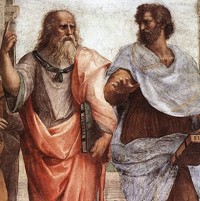
If we pause for a moment to consider Perugino's Roman frescoes, and to recall the distinction in them between the figures and the scene in which they are placed, even though the proportions and perspective are not confused, in the Sala del Cambio, in Perugia, for example, finished by Perugino in 1500, we find one of the clearest statements of the relationship between the artist and neo-Platonism. He takes as subjects moral and religious allegories; giving the figures in the allegories the faces of classical heroes; religious and pagan scenes are given equal importance. Even if the participation of the young Raphael in his master's work is regarded as most improbable, it is nevertheless clear that he had first-hand knowledge of it. If we take a work by Raphael of the same date for comparison, such as the Resurrection, now in Sao Paolo, there is no denying the distinction between the figures and their surroundings, or the statuesque quality of the figures themselves, isolated in space as if in a solid element. Raphael tackles the problem of space in the same way as it was later to be tackled (with even more determination) in the paintings of the Florentine School of San Marco, and in particular by Fra Bartolommeo. and Mariotto Albertinelli, with results which were to be of great importance to Italian painting in the sixteenth century. Even as early as this, Raphael allowed the important lessons learned from Perugino to pass through an extremely fine filter before making use of them himself: the son of Giovanni Santi, educated in Urbino, ' the centre of mathematics and the abstract arts during the Renaissance' (Chastel), very soon adopted a selective approach with regard to his mentor, submitting certain of his basic tenets (without denying their validity) to a rigorous spatial re-organization in which his overriding concern is with proportion. Reared on the teachings of Piero della Francesca, Alberti and Laurana, Raphael adopted (from the architect Donato Bramante) the creed of symmetry, and with it Bramante's ideals of space and proportion, closely linked, in conceptual terms, with the theory of Godhead propounded by Cusano. Although this is to a certain extent obvious in the spherical composition of the Solly Madonna, or in the immutable harmony of the Christ of Tosio Martinengo, Raphael's true voice speaks with its full linguistic and theoretical weight in the Marriage of the Virgin, in the Brera. The iconographic ties between the Marriage and Perugino's Giving of the Keys, in the Sistine Chapel, are well known; they are particularly obvious in Raphael's adoption of the temple, in the style of Bramante, in the background, and in the linking of this and the group of figures in the foreground by the device of dividing up the floor into geometrical squares. But these iconographic references only serve to throw into even stronger relief Raphael's rejection of and departure from Perugino's ideas. One can see how the architectural detail plays a key role in the structure of this long painting with its arched top; the temple is at once the point at which the lines of perspective meet and the axis of a circular area of space. The geometrical division of space, Raphael's hallmark, is used to place the group of figures in the foreground. Just as the temple is placed at the centre of a series of horizontal circles which comprehends the whole canvas, so from a point immediately above the ring which Joseph is putting on to Mary's outstretched hand there springs another series of concentric circles which also comprehend the whole structure of the painting on a vertical plane. The organization of space, dictated by the central position of the temple, is unexpectedly turned upside down and a new arrangement laid down by the vision in the foreground; the two principal axes (one in the temple and the other passing through the ring) meet in the composition of the picture at a perfect right angle. The rhythmic proportions of the individual figures and the view of the background through the doorway of the temple underline a complex symmetrical arrangement of space with strong spherical suggestions. The schema could be called cosmic; through it Raphael illustrates his understanding of the language of Bramante, and at the same time reaffirms, though with less attention to metaphysics, the rules of Piero della Francesca. In the same year in which this masterpiece was signed (1504), Raphael was in Florence. As will have been gathered from what has already been said, the arrival of the young Raphael in the Florence of the Medici family took place at a time when his taste and his pictorial and cultural orientation were already firmly established. In Florence Raphael seems, perhaps because of sharing a common artistic paternity in Perugino, to have become acquainted at once with the painters of the School of San Marco, and to have shared their models. The relationship between Raphael and Fra Bartolommeo has often been over-emphasized and distorted to the extent of suggesting that the young provincial painter depended on the friar, already by then a mature and well known painter. Their relationship has been further falsified by the erroneous dating of two important, paintings, painted during this time, the Three Graces, at Chantilly, and the Vision of a Knight in the National Gallery, London. These works, often placed at the outset of Raphael's career in Urbino, are in fact valuable documents, both historically and artistically, painted by Raphael at the start of his years in Florence. The group of the Three Graces is well known to have been taken from a Roman bas-relief discovered at about the turn of the century and sent in 1502 to Cardinal Passerini. Niccolo Fiorentino cast a celebrated medallion of the same group, and the symbolism of the Three Graces was close to the heart of neo-Platonic culture, particularly in Florence where it was used over and over again: see, for instance Botticelli's masterpiece La Primavera. We know that the young Raphael, at the beginning of his Florentine career, became involved at once in the lively arguments of the neo-Platonic Accademia and painted (if Chastel's theory is correct) a series of mythological scenes. Philosophical symbolism apart, the stylistic elements which link these two small canvases directly with details already examined in the Marriage of the Virgin in the Brera may be listed as follows: perfect spatial relationships between structural elements, the identification of the outward surface rhythms of the picture with the inward sense of proportion, linear perspective and spatial organization, the integration of the figures into the organisation of the whole, and the significant part played by the landscape. Raphael's rejection of Perugino's models, and his rejection of the isolated figures found in the composition of paintings by Fra Bartolommeo could not be more marked. It becomes even clearer when two paintings, whose themes and composition are more closely linked to the style of Fra Bartolommeo, are examined: the Ansidei Madonna and the Madonna of St Nicholas of Tolentino, both completed soon after Raphael's arrival in Florence, but certainly started before he set out. Fra Bartolommeo's floating figures, even when placed in a painting with a circular construction, are suspended in an element quite different from Raphael's carefully and immutably measured space: in Raphael's Madonna of St Nicholas of Tolentino, as in his Marriage of the Virgin, the concentric circles emanating from the right foot of the Holy Child are grafted to the centrally placed group of the throne and figures, this group being encircled by the arch of the canopy which perfects the sphere. The circles are spaced from foreground to background through the architectural details and figures. The exactness of the placing of architectural details, and the extreme clarity and brightness of the colours, make this altarpiece a perfect foil for the tender beauty of the Ansidei Madonna. Here we may as well abandon iconographic comparisons with Umbrian or Florentine works (from Fra Bartolommeo to Rafaellino del Garbo); the wonderful luminosity of the painting creates its own space and measure, and situates the figures, at once isolating them and bringing them together; the light establishes time and place in a way which is supremely emotional in appeal yet which is abstract in conception, in the tradition of the greatest and most metaphysical paintings of Piero della Francesca. |
|
|
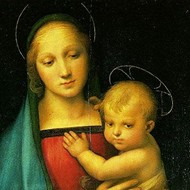
It is certain that while in Florence Raphael, lively and alert as he was, must have been aware of the extraordinary influence that the style of Leonardo da Vinci was having, and not only in Florence. This is not to suggest that his awareness was an inevitable historical development (this would be absurd, and particularly in the case of someone like Raphael, whose intellectual development was so coherent and self-sufficient); it was an active recognition of a development which attacked the basic tenets to which Raphael subscribed. He could never give full acceptance to the idea of space infinitely multiplied, nor to the destruction of the traditional modular system which this idea carried with it. Even when he borrows iconographic and pictorial details from Leonardo one is conscious of his awareness of the problem, and aware that a careful selection has been made. For example in the Terranova Madonna in Berlin, the face and the attitude of the Madonna clearly show their derivation from the Virgin of the Rocks; the treatment of light also obviously stems from a study of Leonardo's work; the light fades away very gently, quivering between light and darkness. But the choice of a circular canvas, and the way it is divided up into equal parts by the balustrade; the arrangement of the component parts around the axis of the index finger on the right hand of the principal figure; the unexplained gap between the heavily draped knee in the foreground and the head of the figure of Mary (unexpectedly placed between huge expanses of carefully measured space) - all these show that Raphael basically eschewed Leonardo's ideas. The Madonna's hand, poised in the half-light, is a kind of pointer to the orderly arrangement of space. Raphael re-states his case against Leonardo in a series of exquisitely lyrical masterpieces: the themes were ones he was to use over and over again, the Madonna and Child and the Holy Family. The first and most famous was the painting of the Virgin and Child known as the Madonna of the Grand Duke. Here the echoes of Leonardo are confined to the position and carriage of the Madonna. From the point of view of composition this is one of Raphael's most complex works; the perfect symmetry of the mother and child, based on a circle, is suddenly dramatically broken by the tilting of the Virgin's head towards the left, from whence it is brightly lighted by a strong source of light. The theme of mother and child is perfectly interpreted in the small Cooper Madonna, the Tempi Madonna, and the Orleans Madonna: in order to introduce variation Raphael re-arranges the figures and views them from different angles. Further consideration of Leonardo's style and his solution of spatial problems must surely have preceded the painting of the groups with the Madonna and Child and St John, which show full figures and are constructed on a triangular rather than a circular basis. These include the Esterhazy Madonna (Budapest Museum), the so-called Belle Jardiniere in the Louvre, the Madonna of the Goldfinch in the Uffizi, the Madonna and Child with St John in the Museum in Vienna, and lastly the Madonna and Child with St John, St Joseph and St Elizabeth (known as the Canigiani Madonna) now in Munich. The first of these groups, the Esterhazy Madonna, borrows its perfectly circular composition from the little Cooper Madonna; the way in which the figures are so firmly yet harmoniously linked to one another recalls similar usages in the work of Leonardo, from the Benois Madonna to the St Anne cartoon. Yet even though the sacred group is enclosed in a wide architectonic circle, the composition of the group is pyramidal; the different shapes are brought together by the intricately organized space which lies between them. Raphael modulates his space and, unlike Leonardo, paints figures that are in proportion to the landscape they occupy; the relationship between figures and landscape Is made very clear. He re-states this relationship in the three extraordinary masterpieces which followed: the Vienna Madonna, the Madonna of the Goldfinch and La Belle Jardiniere. The setting of the groups in their scenery is absolutely accurate; the spectator's eye roves unchecked over the group of figures; he imagines for a moment that the story they tell is a geometrical abstraction, and that the arrangement was coincidental and just happened to be chosen at the psychological moment. The dazzling perfection of the scene lifts it above mere historical narration, and permits the expression of the deepest and most secret feelings. The sedate, triangular cluster of figures glories in its architectonic arrangement; the figures are linked by the tenderest emotional tension. The landscape backgrounds, so perfectly set in perspective (they are the visible portion of the sphere which encircles the group, in perfect proportion, far beyond the edges of the canvas) are paeans of praise to nature. The Elysian fields in which Raphael places his holy groups are on a human scale and seen in everyday terms; this fond vision of a familiar landscape expresses all Raphael's religious feeling without ever becoming arid and cerebral. In these paintings Raphael, with that sublime intuition which only the young Andrea del Sarto among his Florentine contemporaries was ever to understand, investigates and establishes the time of day, making the movements and the expressions of the figures consistent with the early evening or the First light of dawn: the feeling of serenity and the scents and sounds are almost physically apprehensible. The culmination of Raphael's intellectual progress, the Canigiani Madonna, suggests fresh and even more complicated ideas; yet its composition directly approaches the composition of the painting which we described at the beginning of this account, the Marriage of the Virgin in the Brera. The halo above St Joseph's head, which is the apex of a triangle whose base is the line of buildings in the background, accentuates the perfect circle upon which the group of figures is based. The frontal view of the figures follows a circular plan as well: the line which passes through the two putti follows the ample curve of the body of the Madonna towards the standing figure of St Joseph. The body of the Virgin reveals Raphael's nascent interest in the work of Michelangelo, and this is confirmed in the highly organized composition of the Baglioni Deposition, in the Galleria Borghese. It was during these months that Raphael painted the marvellous pair of Portraits of Agnolo and Maddalena Doni, now in the Uffizi. In one of the Florentine houses of this noble family was to be found Michelangelo's famous Doni Tondo, also now in the Uffizi. Raphael had been until this time familiar only with the cartoons for the Battle of Cascina, of Michelangelo's painted works, and probably he did not share the general admiration for their massive proportions. Now however he became deeply aware of the tautness and immutability of the circular picture, exemplified by the Doni Tondo; here the portico in the background is the architectural counterpart of the tightly knit group of figures in the foreground. Raphael may have become emotionally involved with the Doni Tondo in the course of his work on the placing of the figures in his Baglioni Deposition; an early design for this turns back to Peruginesque themes, with strong reminders of Fra Bartolommeo. The result of his pondering of the work of Michelangelo can be seen in a marvellous drawing for the complete picture; here perspective and space are measured to the last millimetre. For Raphael drawing was a way of experimenting with detail so that in the final composition everything would be exactly right: a perfect illustration of the dominance of design (disegno) over painting (colorito). His figures were initially drawn as skeletons, placed in a position which was anatomically right; they were then clothed with flesh and with drapery strictly according to the capacity of their bone-structure. Although these drawings were semi-scientific in intention, this does not prevent their being masterpieces in their own right; drawing was now the most direct medium for the expression of Raphael's pictorial ideas. |
|
|
The final structural scheme of the Deposition is extremely complex; two violently contrasted groups of figures (those carrying the body of Christ and those surrounding the fainting figure of the Virgin Mary) are fused into a single entity by being encircled by an imaginary line whose axis would be the left hand of the central bearer. Around the circumference of the principal circle a series of lesser circles revolve, like small chapels round a nave; the two most clearly defined are on either side, one on the left made by the heads of the bearers, one on the right by the heads of the group around the Virgin. Inside the broad, dramatic structure of the painting little references and correspondences catch the eye. Viewpoints shift restlessly. The confrontation between the wide open group of bearers and the tightly closed little group around the Virgin is tragic, and in particular the pious lady kneeling down who is twisting right round to support the collapsed Madonna, a clear testimony to Raphael's familiarity with the Doni Tondo, from which it is a bold plagiarism. Raphael used Michelangelo's dynamic composition to the full, discarding anything he had no use for, and fitting the figure perfectly into his intricate schema. And just as in some of his Holy Families the borrowed figures are given new serenity and meaning, here the dramatic impact of the Michelangelesque figure seems just as fresh. It was during this period that Raphael moved to Rome and was commissioned by Julius II to begin the decoration of some of the rooms in the Vatican, beginning with the library, later to be called the Stanza della Segnatura. We know that these decorations had previously been entrusted to another group of artists, including Sodoma, Lorenzo Lotto and Baldassare Peruzzi. According to some art historians certain of the paintings in the vaulted ceiling owe their conception and execution to Sodoma. It is positively known, however, that when the Pope saw the extraordinary skill of the young painter from Urbino he discharged all the other artists and put the entire work into Raphael's hands. It was an extraordinary flash of intuition by someone who at the same time was pressing Michelangelo to undertake the decoration of the roof of the Sistine Chapel. In the Stanza della Segnatura Raphael gave full reign to his imagination and brought all his earlier experience into play, transforming the chamber beyond recognition. It was the first time that he had had to paint a room of any size, and he tackled it by using the shape of the room and the divisions of the ceiling as a basis for the layout of his paintings, accepting them as limitations rather than trying to disguise them. The two openings, the window and the door, are used as part of the overall design. The window is used as a reference for the perspective schema, the door as a support for a heavy archway which in its turn supports the steep hillside where the Virtues are portrayed. Underneath the frescoes there was an inlaid wooden dado by Fra Giovanni da Verona - this was traditionally part of the decorations of a small study during the renaissance. It was however removed in about 1540, which was a pity because its pattern of geometrical symbols must have accentuated the cosmic symmetry of the whole. Once the eye had appreciated the intricate inlay it would move upwards to the two grandiose visions, the Dispute over the Holy Sacrament and the School of Athens - arguably Raphael's greatest contribution to the Renaissance in Rome. The depth of expression which Raphael gives in these frescoes to the humanist state of mind has been definitively shown by Chastel; although the painter had been advised by Giovio, and no doubt by the Pope himself, he plainly exposes himself here as privy to the tenets of neo-Platonism. The relationship between myth and religion is demonstrated to perfection, through symbols and confrontations between participant figures. The speculum doctrinale is presented to the spectator with faultless logic. What is so overwhelming about these paintings is Raphael's complete control both of ideas and of their lyrical expression, and indeed his fusion of the two. His genius lies, here as in the works of his youth, in his bringing to life symbols and abstractions with the utmost feeling. The Dispute is possibly Raphael's greatest achievement: the painting is fitted into its allotted space in the room, as part of the whole, yet it is a living single organism. Like a huge side chapel adjoining a centrally-planned church, It belongs, and yet is autonomous. And like a satellite, launched by the movement of its parent system, it generates its own movement and becomes independent. In this painting there is a symbolic and structural centre: the Host is the point at which the perpendicular lines of perspective converge and it is the centre of a series of concentric circles which cover the whole fresco. Through the Host and the stem of the chalice lies the central axis around which rotate the three symbols of the Trinity, each enclosed in its own smaller circle, united in their movement round the axis, yet divided from one another. Around this axis the huge structure, of which the nave with figures that we can see is only a section, also gravitates. The axis lies in the middle of the chamber and it is identical with that of the School of Athens, whose structure is analogous. Just as a landscape may miraculously stretch beyond the horizon, the life that we see in the next painting, the School of Athens, stretches beyond the huge architectural structure (this shares the central plan of the Dispute and is another exact section of a sphere). The presence of the influence of Bramante in this picture, the echoes of Piero della Francesca and of Michelangelo's ceiling of the Sistine Chapel, all connect in some way with the final additions to the painting: the figure of Democritus, and in the foreground a portrait of Michelangelo. The architectural setting of this picture corresponds to the great arch in the section containing the Dispute, but here the design of the building is shown far more clearly. Inside the building the 'heroes of reason' are portrayed with impressive characterization. Raphael includes himself in their number, one of the figures in the right-hand foreground; Michelangelo and Leonardo can be found as well. This then is painting used as an intellectual statement. From the moment of his arrival in Rome Raphael increasingly affirmed an attitude which was to become more and more important as the years passed, and which has been almost entirely misunderstood by students of his work: this was his rejection of the idea of autography. In Raphael's estimation a picture could be planned and have its composition carefully laid out by himself: if the actual painting were then left to pupils and assistants to execute, this would not diminish the value of the work in the least. For this reason, when he was asked by Albrecht Durer to send him a sample of his drawing, Raphael sent off to Nuremberg a drawing by Giulio Romano which was based on an idea by Raphael. This was certainly not out of lack of consideration for his German colleague. The ethical and theoretical implications of what he had done were certainly clear to him, and were very probably fully appreciated and shared by Durer himself. In spite of the continual cross-references in their works, it is clear, in fact, that the intellectual path that Raphael followed differs widely from the paths of Leonardo and Michelangelo, though all three shared a common heritage of Florentine neo-Platonism. The paintings in the Stanza della Segnatura are in fact probably the last works that Raphael completed on his own (discounting the usual practice of employing apprentices to help hurry the painting along). Two masterpieces, painted at this time, the Aldobrandini Madonna (now in London) and the Alba Madonna (now in Washington) were also single handed works. There are some splendid portraits and small paintings which date from about this time in which the work of Raphael's pupils was not very extensive, but nevertheless always to be found. One extremely important painting, the Foligno Madonna, painted immediately after the frescoes in the Stanze, presents a complicated problem: certain famous artists who were not members of Raphael's close entourage have been linked with its execution. The decoration of the chamber known as the Stanza d'Eliodoro was probably started in 1511: in this room, possibly at the suggestion of the Pope, the direct interventions of God in the history of mankind are portrayed. The first fresco to be painted was almost certainly the picture of The Expulsion of Heliodorus from the Temple. Here the subject is highly dramatic, and Raphael's narrative ability is given ample scope. He re-uses the centralized architectural schema, but disposes the figures in the schema with great vigour, creating two circular centres of dramatic focus, on either side of the foreground. The painting was mainly carried out by pupils, Raphael reserving for himself only a small area in the left hand corner where, with a nice touch of wit, we see Julius II, carried on his throne by Giulio Romano and Marcantonio Raimondi, watching the mythical event. The tonal difference between this corner and the rest of the fresco suggests that the portrait was painted as Julius II contemplated the scene which he had suggested to Raphael. At the same period as these frescoes Raphael painted a series of canvases which were still largely his own work. Included were the Portrait of Castiglione in the Louvre, the Portrait of Cardinal Inghirami in the Pitti, the Madonna of the Chair and its variant (or predecessor) the Madonna of the Fish in the Prado and the Sistine Madonna (1513-14), now in the Gemaldegalerie Alte Meister, Dresden. |
|
|
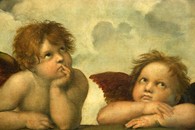
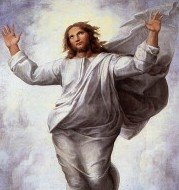
The Madonna of the Chair and the Sistine Madonna are certainly the most interesting non-fresco works of this period of Raphael's stylistic development. The first re-states the old Florentine puzzle, the circular painting or tondo (a puzzle obviously classical in origin), and solves it with impressive skill and ease; the space around the figures is almost non-existent, and the figures themselves are linked together in perfect circular motion. Like a reflection in a convex mirror the sphere seems to protrude towards the spectator. The clever solution of the puzzle is supported by marvellous painting, here and in the Sistine Madonna. The latter - one of the great works of Christian art - was painted on canvas for the high altar in the church of the monks of San Sisto in Piacenza, and was intended to portray the Virgin appearing as a vision. The vision was to be a focal point from all parts of the nave; the arrangement of the drapery echoed the patterns of the architecture around it so that the roof appeared to have opened to admit the divine vision. The figure is constructed according to the Golden Section, yet it has a subtle vigour and urgency, an airy majesty and the total abstraction ova vision. This is the last large painting entirely attributable to Raphael. The Lady with a Veil and the Vision of Ezekiel in the Pitti, and the Portrait of Leo X between two Cardinals in the Uffizi, are the last great works in which Raphael's part, albeit a small one, can be identified. The large number of works painted in the few years that remained until his death were entirely, or almost entirely, executed by his pupils. Even in the Stanza dell'Incendio, painted between 1514 and 1517, apart from the plan of the component parts and certain beautiful sections in the fresco which gives its name to the room, Raphael's hand is hardly detectable. The Fire in Borgo is nevertheless a masterpiece of the School of Raphael, and a seminal work in the history of sixteenth-century painting. Raphael's usual plan of composition has been developed: the perfectly regular central plan is still there, the section we can see dependent on a perspective system centred on the rose window of the tympanum of the church in the background. But in this rationalized space the story unfolds around architectural protrusions, some of which are in motion, like the high wall on the left (almost hidden by the splendid figure of the young man climbing down from it), some holding firm, like the colonnade on the right between whose pillars the magnificent file of women passes. The buildings play an unprecedentedly important part in the narrative action; this is a new departure and was to be a very influential one. It was also the first instance of the use of a massive 'monumental' setting, brought in by Raphael on the strict advice of the Papal Court which, under the leadership of Leo X, was trying hard to Latinize contemporary classical learning; hitherto the neo-Platonists had relied on the Greek classical world for their inspiration. The Greek ideal proportions, which had been rediscovered and revived by the Florentines in the fifteenth century, and which Raphael had used particularly frequently in his paintings, gave way now to the proportions of ancient Rome; these introduced a more majestic and dramatic use of space, and in effect were the occasion of the collapse of the proportional schemes that had been in use until this time. Naturally this fundamental change of composition is more noticeable in these later works by the School of Raphael because of the absence, in the execution, of the guiding hand of the master, who was capable of turning an abstract intellectual proposition into pure poetry. Very often the hasty way in which his ideas seem to have been translated into painting (the poor state of preservation is partly to blame for this) makes them difficult to identify, and this is the case in the other three frescoes in the Stanza dell'Incendio. Nevertheless his interpretation of imaginary archeological scenes in frescoes painted immediately after these is marvellous. These include the decorations in the Farnesina and the Loggia in the Vatican (1515-17). Yet here, quite apart from the sections which were certainly executed by a group of painters including Giulio Romano, Penni and Giovanni da Udine, even the composition and preliminary cartoons may not be attributable to Raphael. Another important series, in spite of the determining presence in their composition of the work of Giulio, Penni and Giovanni da Udine, are the cartoons for the tapestries intended to hang on the wall beneath the fifteenth-century frescoes in the Sistine Chapel. Of course the whole cycle does not achieve the same high level of expression. The Punishment of Elymas, for example, in spite of the magnificence of its plan and the rhythmic arrangement of space around the figure of the seated emperor, is simply one of the most typical examples of the monumental approach to composition which is characteristic of Raphael's last works. The Healing of the Cripple, with the imposing relationship between colonnade and figures (a juxtaposition which was to be a favourite with painters until the time of Rubens and beyond), arranged in the same way as in the Fire in Borgo, introduces a strong representational technique. The composition of the Death of Ananias is even more impressive, with its iconographic echoes of the School of Athens and the Expulsion of Heliodorus; the way the two groups revolve is brilliantly original, and so is the contrast between the static hieratic figure in the centre and the twisted motion of the two figures in the foreground. The two masterpieces of this series are The Draught of Fishes and Christ's Charge to Peter. The Draught of Fishes is set in a scene of utter tranquility, beside a lake; from the distance comes a flight of birds, some of them landing on the strand, in the right, giving definition to the perspective of the landscape. The strand curves round two circular groups of figures, which are separated by the standing figure of the saint. The right hand group of figures is full of dramatic tension, but this is dissipated in the elongated forms of the two apostles, stretched in supplication towards Christ. Christ himself, with a gesture, stills the turbulence of the drama and leads the eye on into the peaceful landscape over which herons fly. The composition of Christ's Charge to Peter is if anything more lyrical and sublime; it is clearly derived from Tribute Money by the early 15th century master Masaccio, and as a homage to the earlier master shows a strong sense of history. It bears the unmistakable imprint of Raphael's imagination. In a broad landscape, as pure and transparent as the landscape in the Dispute, the figures are disposed according to a plan which is perfection in itself. Whether Raphael was entirely responsible for it is immaterial. The wonderfully straightforward, monumental design flows so smoothly and so harmoniously from the figure of Christ, that this is surely one of the greatest of human achievements, a milestone in human experience. In one of his last works Raphael has truly achieved his ideal: a perfectly symmetrical design realised with the utmost poetry. The most interesting examples of Raphael's increasing involvement with architecture are really to be found in his paintings. Even the limpid plan of a chapel, such as the Chigi Chapel in Santa Maria del Popolo, which gives such dynamic expression to the ideas of Bramante, does not achieve the same heights as the imagined settings of the Dispute or Christ's Charge to Peter. Raphael had by now risen, although he was still a young man, to a position of vital importance in the world of art. The embodiment of Renaissance painting, he also produced beautiful drawings, cartoons for tapestry and stained glass, and - following his appointment as Capomaestro for St Peter's Basilica in Rome - numerous architectural designs. In his next painting, the Transfiguration - his final and most innovative contribution to the Italian Renaissance - he introduces an even more complex narrative scheme: the triumph of Christ is organized on a ground plan very like the one used in the early Marriage of the Virgin in the Brera. The importance of this painting is greatly increased if one remembers that Raphael, in order to confound the critics at the Papal Court who were accusing him of exploiting his pupils' work, had decided to paint the Transfiguration entirely by himself. The composition is extremely daring: the central plane revealed by the cleft in the rock on which the apostles are lying, opens out into a great spiral culminating in the symbolic sphere containing the vision; this is linked with the foreground group by a triangle of convergent perspectives. The symbolic and structural complexity of the painting is obscured by the dramatic intensity of the figure of Christ, an echo of the 'vision' theme first introduced in the Sistine Madonna. The painting was interrupted by the death of Raphael, and as a result is chiefly the work of pupils working without their master's guidance. During the regal funeral accorded to Raphael by the Papal Court, this painting, half-finished but dazzling, was displayed at one end of the catafalque. Raphael and the Critics Critical attitudes to Raphael, his works and his theories constitute one of the most complex chapters in the history of art. During his lifetime his activity was acknowledged throughout the arts and literature, even more so perhaps than the activity of Michelangelo. However, after his death this situation changed appreciably. His biggest rival, Michelangelo, lived on for many years, and Vasari's Lives of the Painters, which was widely accepted as an official text, placed Michelangelo at the top of the artistic tree, so that Raphael's stock went down. He received effective support from Dolce's Dialogo della Pittura, published in Venice in 1557, and from the favourable judgements of Aretino and Castiglione. His status was not enhanced by the work of his pupils, in particular Giulio Romano, who very quickly became violently manneristic. They finally adopted painting techniques which were directly derived from Michelangelo, and not, as Dolce had predicted, from the purism and classicism of Raphael. A strong stimulus to the re-instatement of Raphael in the painters' Parnassus was provided by the Bolognese Accademia in the seventeenth century, and later by the Roman Accademia. These academies looked to Raphael as one of their safest strongholds against the invasion of the baroque; and it was they that gave birth to the 'classical ideal' typical of the seventeenth century. This 'classical ideal' was to be a point of departure for theorists such as Bellori, and also for painters, including Poussin (though he had reservations about Raphael) and Claude Lorrain. These attitudes towards Raphael remained constant in painting, particularly in both the Roman and Bolognese school, throughout the seventeenth century, and in the eighteenth century they became one of the fundamental components of so-called neoclassicism. Appeals to the example of Raphael are to be found in the works of writers and artists such as Winckelmann, Albarotti, Mengs and Reynolds, culminating in the praises of Goethe. The coming of romanticism naturally brought about a sudden reversal of opinion on the part of artists and critics. The careful thought and measurement which is an integral part of Raphael's work conflicted with the romantic search for spontaneity which led to the rediscovery of the Italian primitive painters. Raphael's youthful works, in which the premeditation is least obvious, remained in favour. Works by Raphael can be seen in the best art museums across the world. |
|
• For information about the best High Renaissance artists, see: Visual Arts Encyclopedia.
Visual
Artists, Greatest |