Renaissance Art in Florence
History, Characteristics of Florentine Painting
& Sculpture.
MAIN A-Z
INDEX - A-Z of the RENAISSANCE

|
Renaissance Art in Florence
|
|
The Early Italian Renaissance in Florence
Contents • Introduction During the fourteenth century, Italy was composed of states of various sizes. Although the inhabitants of all of these states spoke the same language, the local dialects differed, as did many of their local customs and their forms of government. Naples was governed by a king, while the areas of central Italy around Rome, were governed by the Pope. In the north there were numerous small principalities, the large Duchy of Milan, and the republics of Venice and Florence. Despite these differences, many leading Italians were united in a growing sense of pride in their own national identity, which led to a growing respect for Roman and Greek art of antiquity. Florence In Florence, where an independence of spirit
and intellect had flourished since the time of Dante (1265-1321), this
new sense of pride in cultural achievement was even greater than in other
Italian states. Pope Boniface VII had recognized the ingenuity and originality
of the Florentines as early as 1300, when he complimented one of their
envoys by remarking, "You Florentines are the fifth element."
The Pope was referring to the general contemporary belief that the world
was composed of four elements - fire, water, air, and earth. The fifth
element was the genius that the Florentines had added to the make-up of
the universe. During the 14th century, this civic genius achieved tangible
artistic success in Pre-Renaissance
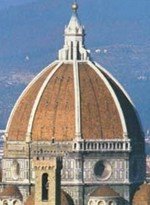
painting, thanks to Giotto di Bondone. The central figure of this group, which included the sculptor Donatello and the painter Masaccio, was the architect and sculptor Filippo Brunelleschi (1377-1446). See also: Renaissance Architecture and Renaissance Sculptors. For biographies of individual Florentine sculptors, see: Nanni di Banco (1386-1421), Luca Della Robbia (1400-1482), Antonio Rossellino (1427-79), Antonio Pollaiuolo (1432-98), Andrea Della Robbia (1435-1525), Benvenuto Cellini (1500-71), Andrea del Verrocchio (1435-88), Baccio Bandinelli (1493-1560). Brunelleschi was engaged by the wool merchants' guild and the city government to complete construction of the Duomo, or cathedral. Although most of the structure had been built in the earlier Gothic style, which is characterized by soaring pointed arches and limited interior embellishment, the Florentines wished to increase its majesty by crowning it with a large dome or cupola. The desire for a domed structure illustrates the intention of Renaissance men to stress their links with the ancient past, for not since the Romans had erected the Pantheon, the great temple built in the second century CE, had a dome of such large proportions been attempted in Italy. Brunelleschi submitted a daring and successful
plan, and this initial commission was followed by many others, including
the family church of the Medici, San Lorenzo, a chapel for their rivals,
the Pazzi, and the Ospedale degli Innocenti (Foundling Hospital). Meanwhile,
the sculptor Donatello (c.1386-1466)
- the most innovative figure in early Italian
Renaissance sculpture - turned his back on Gothic wall sculpture,
introducing in its place free-standing figures whose proportions, postures,
and clothing drew closely from antique models, and demanded a precise
knowledge of human anatomy. In addition and simultaneously with Lorenzo
Ghiberti (1378-1455), Donatello invented a painting-like bas-relief sculpture
in deep perspective (rilievo schiacciato). Although forms of perspective were known to artists of earlier periods, they were usually employed on an intuitive rather than a scientific basis. Brunelleschi wished to perfect a system of perspective which would give his architectural drawings a greater degree of reality or visual truth. In his various experiments to develop perspective aids, he constructed panels on which he inscribed views such as that of the Baptistry of Florence. The viewer would peer at the image through a hole cut from the reverse side of the panel. In his other hand, he would hold a mirror in which he would see the reflected image of the Baptistry. Through the hole or aperture, the eye of the observer would be drawn immediately to the spot which corresponded to the vanishing point. Notwithstanding Brunelleschi's individual role, the simultaneous appearance of innovations in all areas of Florentine culture between 1410 and 1440 remains a remarkable phenomenon. The notion of the "uomo universale", the universal man - the many-sided intellectual who was both a successful artist and scienist - encouraged a fertile, interdisciplinary creativity. For example, the sculptors Donatello and Ghiberti self-confidently designed stained-glass windows for the Florence Cathedral, while the Brunelleschi and his fellow architect Alberti provided the theoretical basis for a new revolution in art.
|
||||
|
Masaccio - The
Second Revolution in Painting Relatively little is known of the life of this artist, whose name means 'clumsy Tom'. In his Lives of The Artists, the art historian Giorgio Vasari says that he learned a great deal from Brunelleschi; he certainly produced an amazing body of work before he died at the age of twenty-seven. His style has been likened to those of both Giotto and Michelangelo; he shares with them a common concern for creating convincingly three-dimensional human forms and for the representation of deep feeling (see: Expulsion From the Garden of Eden). Also like Giotto and Michelangelo, he worked extensively in fresco, that challenging medium which demands such clarity and precision from the artist. His fresco "Holy Trinity" marks a turning point in the history of art. The viewer gazes into a barrel-arched room whose depth is suggested with mathematical precision. By means of linear perspective (costruzione legittima), a relatively simple geometrical process, the various planes and layers of the three-dimensional space are projected onto the surface of the painting. Lines of vision direct the viewer's eye into the depths of the reconstructed pictorial room, and both real and virtual lines of perspective culminate in a vanishing point. Masaccio faced the problem of arranging
figures in a mathematically defined space without making the picture appear
to be artificially constructed, and thus isolating them from the composition
or even sacrificing them to the ideal proportions of the room. Masaccio
solved the problem by placing the traditional portraits of his patrons,
the figures of Mary and John next to the cross in different spatial planes,
whereas the postion of God the Father remains unclear, thus softening
to some extent the rigors of the mathematical perspective. |
||||
|
In the "Tribute
Money" painted on the walls of a Florentine church, Masaccio
depicts one of the miracles described in the New Testament: how Christ
and the Apostles were confronted by a Roman tax collector, who demanded
the "tribute"; how Christ told Peter to go to a nearby stream
and extract the money from the mouth of a fish; how Peter, after following
Christ's instructions, handed the tribute money over to the tax collector.
This mural painting is an example
of what is called "continuous narrative," since it represents
consecutive events or moments in a single, unified space. Masaccio places
his figures in a landscape and varies the character of the background
slightly, so that each event is clearly separated from the others. The way in which Masaccio distinguishes
the tax collector, a worldly man, from the other, sacred figures is interesting.
While Christ and all of the apostles wear long, flowing garments that
recall the costumes of the Greeks or Romans, the civil official is shown
in the short jacket and tights of the artist's own time. In 1435, some 7-8 years after the death of Masaccio, the architect and Italian intellectual Leon Battista Alberti (1404-1472) published his influential treatise "On Painting" (Della Pittura). (For a comparison between Alberti's view of colourism and Titian's, see: Titian and Venetian Colour Painting c.1500-76.) Alberti was the ideal "uomo universale", or universal man. A pioneer in architecture, and active as both a sculptor and painter, his treatise and its influence on his contemporaries cannot be overestimated. Alberti's book prescribes artistic ideals which in effect record those of the early Florentine Renaissance as evolved by Donatello, Masaccio, Ghilberti and Brunelleschi, to whom the Italian version is dedicated. As a whole, Alberti elevates painting from a craft to the ranks of intellectual knowledge. In his first section, Alberti advocates the principles of linear perspective, as first employed by Masaccio: that is, the use of a single central vanishing point. In the second section, he concerns himself with "disegno" - a term which incorporates both drawing as well as all aspects of pictorial composition, including the choice and use of the right colours. Alberti's tract was directly influential on Leonardo Da Vinci and on certain non-Florentine artists, notably Mantegna. Piero della Francesca (c.1420-92) is one of the most mysterious figures of the Italian quattrocentro. There are only a few fixed dates that provide even a vague idea of the creative life of the painter as he moved between Sansepolcro, Florence, Rimini, Arezzo, and Urbino. Like Masaccio, Piero was another artist fascinated by perspective. A drawing of a street in an Italian town reveals his mastery of the principles of this subject - principles that he subsequently expanded and illustrated in a theoretical study of his own. All the diagonal lines in the drawing, those following the edges of the houses along the street and those implied by the projecting edges of the roofs, meet at a central vanishing point in the distance. This creates the illusion of an open and deep space, into which one could easily fit three, five, or fifteen figures. In fact, the general impression of the drawing is rather like that of a stage set awaiting the arrival of the actors. |
||||
|
Antonio Pisanello In Pisanello's "Portrait of a Princess of the House of Este", we find the important characteristics of this older style of figure painting. The young woman is shown in profile against bushes and flowers, which stand out against the clear blue sky. Her features are extraordinarily simple; her hair style is severe. In marked contrast to the simple rendering of the features is the amazing ornateness of the background elements and the curious way in which they absorb the complicated pattern of the young lady's dress. No attempt has been made to maintain clearly the separateness of the human form from the strangely artificial foliage; yet no conflict results, because the viewer's eye is content to explore the abstract. linear quality of the composition. Domenico Veneziano In his Santa Lucia Altarpiece (St Lucy or Magnolia Altarpiece), probably one of the most exciting paintings of its age, Veneziano's subtle gradations of colour fill the room with air, light, and shadows for the first time in the Italian Renaissance. When viewed from above, the fascade of the Arcadian architecture runs parallel to the surface of the painting, and appears to be the front, or first plane of the picture. Viewed from below, however, the columnar architecture seems to be in a second plane, in front of which the saints are standing on the boldly foreshortened floor tiles. Like Masaccio, Veneziano developed a pictorial room as an outgrowth of the space of the viewer. The enthroned Mary is not clearly to be located on a single pictorial plane, for the necessary points of reference are lacking. To faithful believers praying before the picture, she moves closer, or remains distant- the choice is left up to the viewer, who thus actively participates in the process. Although some early Renaissance artists were experimenting with the placement of figures in a clearly defined space, other painters at the beginning of the fifteenth century seemed hesitant about moving into this vanguard. They clung to the techniques and attitudes of the older, traditional style of painting that we have seen in the work of Pisanello and Veneziano - while making use of some of the innovations of the new spirit represented by Masaccio and Piero della Francesca. Typical of this more conservative group were Gentile da Fabriano (c.1370-1427) and Fra Angelico (1387-1455). Some four years before Masaccio painted "The Tribute Money," Gentile da Fabriano produced a panel almost ten feet high that depicted the story of the visit of the Wise Men to the Christ Child, "The Adoration of the Magi". Although the work contains remarkable examples of the contemporary preoccupation with recording nature, such as the careful representation of various kinds of animals and different types of people, like the exotically clad figures reminding one of the Orientals described in Marco Polo's adventures, the major impression is still that of a richly worked, jewel-encrusted surface. Space is not treated three-dimensionally, in a unified way, and clarity is sacrificed to sheer numbers of figures. Indeed, the crowding is so great that we feel that the artist must have had a positive dislike of empty spaces. Another major difference between this style of painting and that of Masaccio and Piero della Francesca is reflected in the atmosphere of the work. While their frescoes relate stories in a restrained yet dramatic manner, the mood of Gentile's panel is festive to the point of noisiness. Gentile da Fabriano also worked with the lesser-known Jacopo Bellini (1400-70), father of Giovanni Bellini (1430-1516) the leading figure in Venetian painting of the Renaissance era. |
||||
|
Fra Angelico Fra Angelico came from a peasant family and joined a Dominican monastery at the age of twenty. Like other members of his order, he entered into the usual activities of the monastery, performing both his spiritual and physical duties with humility and conviction. However, when it was discovered that he had uncommon artistic ability, he was assigned the task of decorating the walls of the chapels and the monks' cells with sacred stories that would serve to inspire their inhabitants. One of the most popular themes of Christian art he represented was The Annunciation, which he was to paint many times. In one of these interpretations, he reveals the major characteristics of his style. Notice his gentle and poetic approach to the dramatic confrontation and his ability to portray the events of religious teaching in a tender, intimate way. Fra Angelico possessed a wonderful colour sense, which is demonstrated in the contrast of delicate crimson and royal blue. He was able to combine the linear grace and lovely colour of earlier painters such as Duccio and Cimabue with the new desire for clarity and dramatic realism. In 'The Annunciation,' he juxtaposes events
which are related to one another, although widely separated in time. In
the garden at the left, Adam and Eve, grief-stricken and ashamed, are
being driven from Paradise by an angel because of their disobedience to
God. In the open cloister, the humble and pious Virgin receives the angel
Gabriel's announcement that she has been chosen to be the mother of God's
Son. One event is clearly the consequence of the other, for Christianity
taught that it was Adam and Eve's original sin which brought about the
need for a Redeemer. Space is developed convincingly, though
not as logically worked out as in the works of Masaccio and Piero della
Francesca, but there is a tendency towards clear, sharply outlined forms,
rather than towards the rounding of forms through the use of light and
shade. The cloister, with its combination of Gothic vaulting and classical
decoration, such as the slender Corinthian columns, reflects the revolution
which was taking place in contemporary architecture through the efforts
of Brunelleschi. Fra Angelica also imbues the classical architectural
decoration with Christian meaning, for on the facade of the building,
directly above the central column which so effectively separates the Virgin
from the angel, we see a likeness of God the Father. His head has been
placed against a shell pattern, one of the old pagan symbols of immortality. |
||||
|
While Fra Angelico's paintings illustrate
some of the ways in which painters adapted old formulas or techniques
to the program of the new descriptive or naturalistic art, those of Paolo
Uccello (c.1396-1475) show some of the difficulties that resulted
from an imperfect understanding of the spatial innovations of Masaccio
and Piero della Francesca. Uccello began his career as an assistant to
the famed early fourteenth-century sculptor Lorenzo
Ghiberti (1378-1455), with whom Brunelleschi had once unsuccessfully
competed for a monumental commission, the creation of gilt bronze doors
for the Baptistry of the Cathedral of Florence. Uccello also accompanied
Gentile da Fabriano to Venice in 1425 to work on mosaics. When he returned
to his native Florence six years later, he was apparently quite sought
after as a painter. In 1456, Cosimo de' Medici engaged him to paint a
series of three battle pictures for the walls of a bedroom in his palace.
(The Medicis are now not thought to have commissoned the painting.) The
subject of all three panels was the Battle
of San Romano, a supposedly glorious victory of 1432 in which
Florence's general, Nicholas of Tolentine, held off the opposing Sienese
army with only a handful of knights.
|
||||
|
Typical of the growing response to the challenge of perspective is a painting executed for the ducal Court of Urbino, a town somewhat east of Florence, which is celebrated as the birthplace of Raphael - one of the later great painters of the High Renaissance. The subject of "The Birth of the Virgin" is encountered in many fifteenth-century paintings, for the Virgin enjoyed high religious prestige from the Gothic period throughout the Renaissance. The artist has recently been identified by the Italian scholar Bruno Zeri as Giovanni Angelo di Antonio (c.1447-1475), who painted this panel and a companion piece "The Presentation of the Virgin," in the Museum of Fine Arts, Boston. He was surely a painter of extraordinary ability; there is great virtuosity in his handling of space and in his sense of accessory detail. The panel does not concentrate on the representation of a single scene taking place in one space, but rather depicts the momentous event within the context of a bustling and indifferent world. The birth is almost obscured by the profusion of detail and activity that accompanies or surrounds it. The viewer is so engrossed in the elegant Renaissance palace architecture, the costumes of the figures, and the general pageant of the scene, that he almost forgets the significance of the religious theme. Where thirty years before, Uccello still struggled with the problem of making two-dimensional forms seem three-dimensional, the anonymous master of this panel has succeeded remarkably in conveying an impression of considerable depth. The figures are grouped with assurance and contribute forcefully to the impression of a logically ordered space. The painting also vividly reflects the splendor and variety of fifteenth-century life. The handsomely garbed women in the foreground, the gentleman with his trained bird framed in the doorway, the hunters and horsemen in the background are all citizens of a wealthy and cultivated secular society - a society with a taste for luxury and for the refinement of the arts. While we can conclude that leisure was the privilege of the wealthy, pomp and pageantry could be found in the city streets, as well as in the palaces. In Renaissance Italy, whole cities often served as stages for entertainment. Carnivals, religious mystery plays, and horse races on local feast days or civic holidays involved all segments of the population, and many of these events are recorded in paintings. An important dimension of art in the fifteenth
century is its relation to the ceremonial aspects of life. To celebrate
weddings or births, artisans often created beautiful articles such as
chests or ceramic plates painted with scenes pertinent to the occasion.
Similarly, painters would often lend their talents to the decoration of
metal or leather objects. Like the city he symbolizes, Castagno's
David is triumphant. The head of the slain giant Goliath can be seen in
the foreground, where it is framed by the young hero's legs. David, with
his short classical tunic and muscular legs and arms, seems the embodiment
of nervous energy. Indeed, every form in the painting has been animated,
from the curly hair of the giant's head to the dynamic swirls of David's
costume. Even the blue sky seems troubled by the presence of quickly passing
clouds that indicate the effect of a strong wind. |
||||
|
No artist is more closely identified with
painting towards the end of the early phase of Italian
Renaissance than Sandro Botticelli
(1444-1510). Like many young Florentines, Botticelli was originally apprenticed
to a goldsmith. Later he studied painting with the worldly monk Fra Filippo
Lippi. If we compare the central portion of Botticelli's "The Adoration
of the Magi" to Lippi's "Virgin Adoring the Christ Child",
we see a definite similarity of approach to form in the two artists' works.
The figures are delicately conceived in each, and there is the same warm,
golden beauty about the Virgin and Infant. The atmosphere of sweetness
and reverence that prevails in Lippi's painting is still very much present
in Botticelli's bigger and somewhat busier composition. Domenico Ghirlandaio The principal action in the "Birth
of the Virgin" centers around the washing of the newborn baby by
the midwife. Looking at a drawing that Ghirlandaio made in preparation
for this fresco, we can see how the painter anticipated the marvelous
flowing movements of the woman who pours water into the basin. With studies
like this, a painter could build a repertoire of physical types, movements,
and attitudes that could be used again and again. |
||||
|
Italians were the first Europeans to study
carefully plants and animals and to create botanical gardens and menageries.
In paintings by Gentile da Fabriano, Benozzo Gozzoli, and Sandro Botticelli
there are examples of extraordinary animals and plants. Gozzoli did not
have to invent the exotic leopard that accompanies the young man in "The
Journey of the Magi", for it was quite common for nobles to keep
leopards and lions as household pets. The lion was sufficiently well known
to be the symbol of Florence's power. Some Renaissance princes even created
human menageries: Cardinal Ippolito de' Medici, the natural son of Giuliano,
kept a strange company of Africans, Tartars, Indians, and Turks. Lorenzo
the Magnificent, Poliziano, and others devoted much of their poetry to
celebrating the beauty of human life and the wonders of nature. Their
enthusiasm was not confined to the grander, more majestic aspects of nature,
but extended to the tiniest and humblest of her forms. A similar delight
was evidenced by contemporary artists. A drawing by Leonardo da Vinci
that examines lovingly the anatomy of a tiny crab, or the larger studies
of the human body in action by Luca
Signorelli both display the same passionate concern with detailed
visual truth. The same touching quality found in the Ghirlandaio portrait of the old man and child is also seen in a painting by Lorenzo di Credi (c.1459-1537), the "Virgin and Child with St. John and Angels". Unlike earlier, more ceremonial religious art, Lorenzo's painting is concerned with one poignant moment. The atmosphere of the painting is sad and gentle; the artist tries to show that all of those present recognize that the Infant who blesses St. John will one day sacrifice His life on a cross. The mood of this painting is very different from the static beauty of earlier Byzantine-influenced works by artists like Duccio di Buoninsegna (c.1255-1319). Clearly, religious painting was changing in the late fifteenth century in Italy, and we can see that it was affected by the increasing awareness of human emotion - something that had an even greater impact on the later Mannerism art movement. For chronological lists of more Renaissance
painters and sculptors, please see: The True Florentine Gentleman The study of the human body was complemented
in this period by the study of human nature. During the age of Lorenzo
de' Medici, simplicity of character was no longer necessarily regarded
as a virtue. No more was it enough for a man to lead a simple, pious life.
A true gentleman was expected to be a man of thought, as well as a man
of action; he was a connoisseur of the arts, music, and literature, as
well as of horses and weapons. So great was the general desire to appear
competent and cultivated that a writer named Castiglione (see Raphael's
Portrait
of Baldassare Castiglione) produced an immensely popular volume
entitled The Book of the Courtier, which advised the potential gentleman
how best to create the impression of culture and character. According
to Castiglione, the ability to appreciate painting, sculpture, and architecture
was indispensable to a more general appreciation of beauty.
For information regarding the High Renaissance in Florence, see the careers of the artists Fra Bartolommeo (1472-1517) and Andrea del Sarto (1486-1530). Further Information • For events in other cities, see
Renaissance in Rome and Renaissance
in Venice. |
|
• For the chronological history of
Italian culture, see: History
of Art Timeline.
ENCYCLOPEDIA OF ART HISTORY |