Mannerist Artists
Painters and Sculptors From the 16th Century
Mannerism School.
MAIN A-Z INDEX - A-Z of ART MOVEMENTS

|
Mannerist Artists
|
|
|
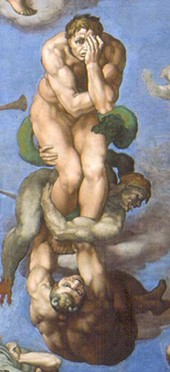
Artists of the Mannerist School (1520-1600)Contents • Introduction Mannerism (from the 'maniera' meaning simply style or stylishness) was primarily a reaction to the over-idealistic aesthetics and super-achievements of the High Renaissance. It also reflected the political turbulence of the cinquecento (16th-century). For example, the dramatic writhing style visible in Michelangelo's Last Judgment fresco on the wall of the Sistine Chapel (1535-41) in Rome, perfectly captured the anguish of the sack of the city by a German mercenary army in 1527. Giambologna's dramatic and emotional sculpture also perfectly fits the mood of the era. |
|
RENAISSANCE ART |
|
WORLD'S GREATEST
ARTWORKS |
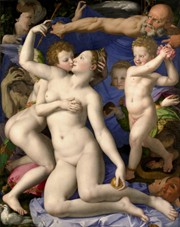
To compare the High Renaissance with an arrival on a high plateau that enjoys a climate more benign than that of the mountainside that leads to it, is fair up to a point; so also is the corollary that to continue beyond that desirable summit involves an inevitable descent. (For more about the High Renaissance, see Renaissance Art in Rome.) It is true, of course, that artists of the second rank - men sensitive enough to carry on the great tradition of their predecessors but insufficiently creative to add to it or to see the world through their own eyes - have always existed, and will inevitably produce paintings that are worthy, scholarly, and competent but, because of their unfortunate position on the downward slope, uninteresting. Such a school of artists arose at the Fontainebleau School in France (1530-1610), and at the Bolognese School (c.1590-1625) centred on the Accademia degli Incamminati set up by the Carracci brothers, at Bologna. Raphael was their inspiration, but a Raphael softened by some of the sensuousness of Correggio and a little of the glow of Titian. The Carracci had their followers, of whom the most proficient was Domenichino (1581-1641) and the most famous in his day, Guido Reni (1575-1642). They were prolific, but (arguably) they added nothing to the creative achievement of their time. At that moment of climax, therefore, when the high summit has been reached, only two courses are possible if achievement is to be added to. Artists can continue to admire and to emulate their predecessors, and in doing so they are bound to exaggerate and caricature them, and therefore to turn what was once sincere into a set of mannerisms. Or they can start afresh on a new journey exploring new country, climbing a new mountain and aiming at a new summit. During the sixteenth century, in various parts of Italy, we can trace both movements. The first, Mannerism, was bound to come to an end through sheer exhaustion. The second, Baroque, was capable of new growth, and it continued and flourished during the century that followed, not only in Italy but throughout a great deal of Europe. The two movements did, of course, merge and intersect, but for the sake of simplification - and with a warning to the reader that simplification usually means over-simplification - they should be kept separate. In Tuscany, Mannerism implied hero-worship and could hardly fail to spread under the shadow of such giants as Michelangelo and Raphael, whose achievement was so ultimate that, in the end, they even barred the way to their own progress. It is both astonishing and ludicrous to watch Pontormo, Vasari, Bronzino, and Tibaldi parodying the muscular developments and the physical contortions of Michelangelo and inventing, in a spirit halfway between hero-worship and parody, complicated gestures that bear no relation to the subject-matter of their pictures. Their works must not be ignored in a history that aims at a certain measure of objectiveness. When focused on portrait art Bronzino (1503-1572) does shed some of the absurd histrionics of his religious fresco painting. His portraits are hard, and mainly lacking in humanity, but they have a fine dignity and only betray the influence of Michelangelo in a slight restlessness in the hands and an artificial haughtiness in the turn of a head or the set of a mouth. The accomplished, but over-anxious Parmigianino (1503-40) almost succeeds in convincing us of his sincerity when he proudly elongates his figures, but he looks sadly hollow when set beside El Greco (1541-1614) - the greatest Mannerist of the Spanish Painting school - who used the same elongations a generation later, and turned them into symbols of ecstasy. In Venice, the situation was not quite so desperate. Titian, at his death, had certainly not said the last word in the field he had begun to explore. Even as late as the end of the nineteenth century Renoir was still building on the foundations laid by him towards the end of his life. And Tintoretto had hinted at a new dynamism that was to be used by Rubens, and a new world of light that was to be exploited by Rembrandt. Indeed some art historians are reluctant to apply the the term 'Mannerist' to Venetian painting of the late sixteenth century. Tintoretto, in particular, effected, by the power of his own genius, a natural transition between Venetian High Renaissance painting and the fully-fledged Baroque painting of the seventeenth century. (See also Renaissance Art in Venice.) |
|
|
Yet it would be wrong to regard the Mannerists, who filled Italy in the late three-quarters of the sixteenth century with their restless paintings, as impotent and barren. The very fact that one cannot look at their pictures without being acutely conscious of their restlessness is a proof that they had created something new, and had tapped a hitherto undiscovered vein of human emotion. I have described them as men caught in a cul-de-sac, and therefore deprived of the full freedom of movement that their predecessors had enjoyed. But restricted movement, like that of a caged animal, has its own fascination, and art historians today are becoming increasingly sensitive to it. Mannerism cannot be explained merely by saying that a set of minor artists had chosen to exaggerate the stylistic tricks of their predecessors. Everywhere but in Venice a new political situation had arisen. Small, highly civilized courts ruled over by families who had lost much of their political power but none of their intellectual arrogance, imposed their will on the artists who served them. One can imagine a Parmigianino in Rome and Parma - see Parma School - or a Tibaldi in Bologna, responding to the sophisticated preciousness of such an atmosphere and reproducing its exact equivalent in formal terms, while in the ampler air of Venice Tintoretto's wild grandeur and the suave urbanity of Paolo Veronese showed no sign of the taint. It was a moment in history that could not be prolonged, and it was towards the end of it, in the last quarter of the sixteenth century when the whole tradition of Renaissance art seemed in danger of breaking down, that the arrival of a new personality brave enough to desert the old High Renaissance plateau and to tackle an entirely new ascent, altered the complexion of Italian art and afterwards the attitude of many Italian Baroque artists. Caravaggio Rejects Beauty in Favour of Truth Caravaggio (1571-1610) was no hero-worshipper nor was he a parodist. His advent was even more unexpected than that of Correggio and his influence more immediate and more revolutionary. Throughout the long journey from Masaccio to Titian, the history of art had been guided by a set of principles, sometimes instinctively followed, occasionally consciously stated as in the writings of Alberti and Leonardo. The art of painting, it was agreed, consisted in reproducing the appearance of nature; Alberti even likens the relationship between a painting and the objects it represents to that between the reflection in a mirror and the three-dimensional world that is reflected in it. But since 'nature' is full of defects, adjustments must be made by the artist in the interests of 'beauty'. Thus there is a perpetual reconciliation to be made and a balance to be struck between realism and beauty. It was Raphael who first upset the balance. All over Central and Southern Italy his formula for 'beauty' had become so obsessive that art was in danger of becoming a mere search for formal perfection and beauty herself, hitherto a by-product of the artist's desire to express his meaning, began to perish because she had become an end rather than a means. It was, therefore, a daring step that Caravaggio took when he elected to renounce beauty altogether and to concentrate entirely on truth, Titian's breadth and mastery in the handling of paint and his concentration on the play of light on surfaces were familiar to every artist in Italy by the time Caravaggio had developed his mature style. It was inevitable, therefore, that Caravaggio's realism should be a realism of light. But whereas Titian's use of light had been 'poetized' and his whole object, like that of his Venetian compatriots, had been to create a world more sensuously desirable, more ideal, than the world of everyday life, Caravaggio used his command of chiaroscuro and his immense technical ability to present the world to us as it is, not robbed of beauty - that would have been to follow a wilfully partisan policy - but certainly not artificially inseminated by it. The harsh light in which Caravaggio's figures are seen is dramatic enough to impress the beholder and to make even an awkward gesture significant. His characters emerge, fitfully illuminated, from dark backgrounds described by the term tenebrism. But what must have made him seem particularly revolutionary to his contemporaries was his choice of the characters themselves and his emphasis on what the High Renaissance would have called their physical defects. To us, accustomed to the matter-of-fact realism of Velazquez, Rembrandt, or Goya, this frank acceptance of men and women as they are is not at all disturbing; but to refuse, at the end of the sixteenth century, to ennoble or idealize humanity as Titian and Raphael had done, and to deny them the leisurely Veronesian opulence or the heroic Tintorettesque dynamism must have seemed both shocking and irreverent. Peasants with gnarled hands and wrinkled brows - painted in all sincerity, for that, surely, was the true physical appearance of the simple men whom Christ chose as His disciples - or young men whose elegance was rather that of a fashion-plate than of a hero, take the place of the demigods of an earlier generation. It is a democratic invasion, an inevitable sign of the times. No sooner did it appear in Caravaggio's work than it began to have its inevitable effect on the next generation of artists. Tenebrist pictures filled with figures of an uncomfortable realism, make their appearance not only in Italy but in Spain and in Northern Europe. Velazquez himself was to fall temporarily under the spell of Caravaggism. Even Rubens, though he was by nature a painter of exuberance and radiance, found himself momentarily attracted by the dark Caravaggian drama. But these inevitable references, in an account of late sixteenth century painting, to Caravaggio's influence on seventeenth century artists, shows that Caravaggio, who seemed to his contemporaries a rebel, was in fact a prophet. |
|
See below for an alphabetical list of Old Masters and other artists of the Mannerism movement. Adriaen
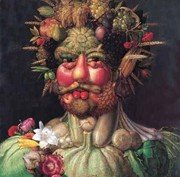
de Vries (1560-1626) Dutch Sculptor Greatest Paintings of the Mannerist Style The characteristics of Mannerist painting are well illustrated by the following selection of paintings. Giuseppe Arcimboldo (1527-93) Hans Baldung Grien (1484-1545) Jacopo Bassano (1517-92) Agnolo Bronzino (1503-72) Annibale Carracci (1560-1609) El Greco (1541-1614) Michelangelo (1475-1564) Parmigianino (1503-40) Jacopo Pontormo (1494-1556) Tintoretto (Jacopo Robusti) (1518-1594) Giorgio Vasari (1511-1574) Paolo Veronese (1528-88) Caravaggio (1571-1610) |
|
• For styles of painting, see: Homepage.
ENCYCLOPEDIA OF ART HISTORY |