High Renaissance Art
History, Characteristics, Aesthetics.
MAIN A-Z
INDEX - A-Z of the RENAISSANCE

|
High Renaissance Art
|
|
|
Italian High Renaissance Period (c.1490-1530)Contents • What is the
High Renaissance? Characteristics Further Resources • High
Renaissance Painting NOTE: For the ongoing influence of High Renaissance classicism on 20th century art, see: Classical Revival in modern art (c.1900-30). Note: the term "Renaissance", used to describe the new forms of architecture, painting and sculpture which appeared in Italy, during the period 1400-1530, was first coined by the French historian Jules Michelet (1798-1874.) |
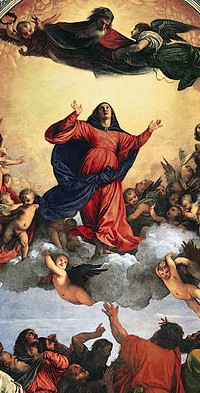 Assumption of the Virgin (1516-18) S. Maria Gloriosa dei Frari, Venice. By Titian. |
|
EVOLUTION
OF VISUAL ART ARCHITECTURE RENAISSANCE FIGURATIVE
ART PAINT-PIGMENTS,
COLOURS, HUES GREAT EUROPEAN PAINTERS |
What is the High Renaissance? - Characteristics The period known as the High Renaissance roughly spans the four decades from 1490 to the sack of Rome in 1527. It represents the accepted apogee of Renaissance art - the period when the ideals of classical humanism were fully implemented in both painting and sculpture, and when painterly techniques of linear perspective, shading and other methods of realism were mastered. While the preceding Early Renaissance had been centred on Florence and largely paid for by the Medici family, the High Renaissance was centred on Rome and paid for by the Popes. Indeed, it very nearly bankrupted the city. The key High Renaissance artists in Rome included Leonardo da Vinci (1452-1519) master of oil painting and sfumato; Michelangelo (1475-1564), the greatest sculptor and fresco painter of the day; Raphael (1483-1520), the finest painter of the High Renaissance; Correggio (1489-1534), the Parma painter, famous for his illusionistic Assumption of the Virgin (Parma Cathedral) (1526-30); and Donato Bramante (1444-1514), the leading architect of the High Renaissance. Provincial painters included Luca Signorelli (1450-1523), whose Sistine Chapel murals and Orvieto Cathedral frescoes are believed to have been an important influence on Michelangelo. |
|
|
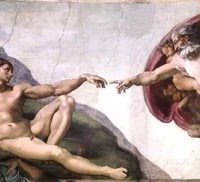
Masterpieces of High Renaissance painting include: Michelangelo's Genesis Sistine Chapel frescoes; Leonardo's Virgin of the Rocks (1484-6, Louvre, Paris), Lady with an Ermine (1490) Czartoryski Museum, Krakow, Last Supper (1495-8, Santa Maria delle Grazie, Milan) and Mona Lisa (1503-5, Louvre); Raphael's Sistine Madonna (1513), Transfiguration (1518-20), Portrait of Baldassare Castiglione (1514-15) and School of Athens (1509-11), in the Raphael Rooms in the Vatican; and Titian's Assumption of the Virgin (1518, S. Maria Gloriosa dei Frari).
The High Renaissance unfolded against a back-drop of mounting religious and political tension, which affected painters and sculptors, as well as patrons of the arts throughout Italy. After the sack of Rome in 1527, it was superceded by the more artificial and dramatic style of Mannerism. |
|
|
Political Developments During the High Renaissance Christopher Columbus's discovery of the Americas in 1492, together with Magellan's first circumnavigation of the world in 1522, trashed the prevailing dogma of a flat earth; in 1512 Copernicus placed the sun (not the earth) at the centre of the visible universe. These discoveries rocked the foundations of theology along with many assumptions about human life. In 1494, Charles VIII of France invaded Italy, causing upheaval throughout the country. In the same year, political rivalry in Florence led to the rise and fall of the fanatical cleric Girolamo Savonarola (1494-8), which severely shook Florentine art in the process. (During this time it is said that Botticelli actually pledged to renounce art.) In 1517, Martin Luther posted his 95 Theses in Wittenberg, triggering the Reformation and plunging much of Europe into chaos. This led to a number of military conflicts between Charles V (ruler of Spain, Austria, the Low Countries and southern Italy), Francis I of France, Henry VIII in England and the Popes in Rome. The era ended with the sacking of Rome in 1527. |
|
|
With such uncertainty at large, it seems incredible that the High Renaissance could have occurred at all. Yet it did. Indeed, the years between 1490 and the sack of Rome in 1527 saw a huge outpouring in Italy of all the visual arts. This golden age - perhaps the most creative era in the history of art - set the standards in both fine art painting and sculpture for centuries to come. Rome: The Centre of the High Renaissance Rome now superceded Florence as the focal point of the Early Renaissance, not least because of papal ambition to make Rome even greater than its Florentine rival. The exorbitant patronage of Pope Julius II (1503-13) and Pope Leo X (1513-21) secured and retained the services of painters like Raphael, Leonardo and Michelangelo, all of whom created oils and mural painting of startling novelty, plus architects like Donato Bramante, a key figure in the redevelopment of St Peter's Basilica. Driven by Popes who wished to use art to reinforce the glory of Rome, the High Renaissance marked the zenith of the return to classical humanist values based on ancient Greek art and culture. As the Church was the major patron, Christian art remained the major genre.
Meanwhile in Venice... Giovanni Bellini (1430-1516) was busy developing a separate school of Venetian painting, based on the primacy of colorito over disegno. His pupils included the short-lived enigmatic Giorgione (1477-1510), Sebastiano del Piombo (1485-1547) and Titian (c.1477-1576), arguably the leading colourist of the Italian Renaissance, as well as provincial masters like Lorenzo Lotto (1480-1556). See, in particular, Giorgione's Tempest (1508, Venice Academy Gallery) and Sleeping Venus (1510, Gemaldegalerie, Dresden); For information about portraiture, see: Venetian Portrait Painting (c.1400-1600). Elsewhere in Italy, High Renaissance values also influenced provincial centres like the Parma School of painting and the later Bolognese School (1580s on).
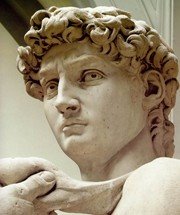
Ever since Giotto abandoned medieval hieratic art in favour of depicting nature, his successors from the quattrocento managed to find more and more ways to improve their portrayal of the real world. Techniques involving linear perspective and vanishing points, foreshortening, illusionistic devices, chiaroscuro and sfumato shading - all these methods were mastered during the High Renaissance. During the cinquecento, the near universal adoption of oil painting eliminated the matt colours of the 15th century, and made it possible for distance to be conveyed solely through the gradation of tones - a process known as aerial or atmospheric perspective. Even so, despite the growing realism being achieved in their art, High Renaissance artists aspired to beauty, and harmony more than realism. Their paintings may have been based on nature but they had no interest in mere replication. Instead they looked for ultimate truth in a study of the classical world of Greek and Roman culture. It was this that provided artists with an ideal of perfection: their aesthetics. Thus, Greek philosophy provided the secret of the perfect human type with its proportions, muscular structure, oval face, triangular forehead, straight nose, and balance - with the weight on one hip - all of which can be seen in the paintings of Raphael, and the immensely expressive sculpture of Michelangelo. The latter in particular was never afraid to bend the realistic rules of anatomy and proportion, in order to increase his power of expression. It was through Classical Greek philosophy that Renaissance theorists and artists developed their idea of 'Humanism'. Humanism was a way of thinking which attached more importance to Man and less importance to God. It imbued Renaissance art with its unique flavour, as exemplified in works like Leonardo's Mona Lisa (a non-religious painting), Michelangelo's David - a more human than religious statue - and Raphael's cool secular fresco School of Athens. Even when High Renaissance artists painted religious paintings, or sculpted a religious scene, very often they were not glorifying God but Man. They were exalting the ideals of classical aesthetics. Paradoxically, a few mythological works - such as Jupiter and Io (1533) by Correggio - do the opposite: they don't glorify men but Gods!
For details of European collections of quattrocento and cinquecento Italian painting, see: Art Museums in Europe. The rediscovery of Greek architecture and later Roman architecture, and its rejuvenation by Italian Renaissance architects such as Filippo Brunelleschi (1377-1446), Leon Battista Alberti (1404-72), Guiliano da Sangallo (1443-1516), Donato Bramante (1444-1514), Raphael (1483-1520), Michelangelo (1475-1564), Baldessare Peruzzi (1481-1536), Michele Sanmicheli (1484-1559), Jacopo Sansovino (1486-1570), Giulio Romano (1499-1546), Andrea Palladio (1508-80), and Vincenzo Scamozzi (1548-1616), led to the reintroduction of classical values in nearly all building designs of the time. Greek Orders of architecture were discovered, along with ideal building proportions, while Doric and Corinthian columns were incorporated into a variety of religious and secular structures. Renaissance domes began to appear, crowning the tops of churches and palaces.
Part of the enduring legacy of Italian Renaissance art is the Beaux-Arts style of architecture. A lavish mix of Renaissance and Baroque styles, Beaux-Arts designs emerged during the 19th century, and were championed by graduates of the Ecole des Beaux-Arts, in Paris. In America, the style was introduced by Richard Morris Hunt (1827-95) and Cass Gilbert (1859-1934). |
|
|
|
• For more about Renaissance painting and sculpture, see: Homepage.
ENCYCLOPEDIA OF ART HISTORY |