Leonardo Da Vinci
Biography of Renaissance Painter, Famous
for Mona Lisa, The Last Supper.
MAIN A-Z INDEX - A-Z of ARTISTS

|
Leonardo Da Vinci
|
|
WORLD'S BEST ART WORLD ART PRICES |
One of the greatest Old Masters of the Italian Renaissance, Leonardo da Vinci excelled as a painter, sculptor, engineer, architect and scientist. Along with Michelangelo (1475-1564) and Raphael (Raffaello Santi) (1483-1520), he is considered to be one of the three great creators of High Renaissance art in Italy (1490-1530). Renowned as a master of oil painting, including the painterly techniques of chiaroscuro (use of shadow to create a 3-D effect) and sfumato (use of glazes in slightly different tones of colour creating an almost imperceptible transition from light to dark), both techniques are visible in his masterpiece, Mona Lisa. Unfortunately, Leonardo's creative gifts were so diverse that he completed only a handful of artistic projects. Even so, he was responsible for several masterpieces of Renaissance art, including the Mona Lisa (1503-6, oil on panel, Louvre), one of the greatest portrait paintings; Vitruvian Man (1492), arguably the world's best known drawing; and The Last Supper (1495-8, oil and tempera fresco, Santa Maria delle Grazie, Milan), one of the best known Biblical paintings of all time. Sadly only a fraction of his art survives (about 15 pictures in all), not least because of his thirst for (often disastrous) experimentation with new paint techniques. Even so, these few paintings, together with a number of sketchbooks crammed with examples of figure drawing (including some of the best drawings of the Renaissance), plus anatomical studies, scientific diagrams, and his views on the techniques and aesthetics of painting, comprise a legacy rivalled only by Michelangelo. With an established reputation as one of the Best Portrait Artists and also one of the Best History Painters, Leonardo is considered by most art experts to be one of the Best Artists of All Time. |
|
COLOURS USED IN
PAINTING |
|
HISTORY ITALIAN RENAISSANCE
ERA |
Early Life and Career in Florence Born Leonardo di ser Piero da Vinci in Vinci, near Florence, he trained in the prestigious workshop of the renowned Florentine sculptor, painter and goldsmith Andrea del Verrochio (1435-88), where he received the best education available to a young artist growing up during the Renaissance in Florence. The studio was at the heart of the intellectual crosscurrents of the quattrocento, and a starting point for a number of highly talented artists including Domenico Ghirlandaio (1449-94), Perugino (1450-1523), Botticelli (1445-1510), and Lorenzo di Credi (1458-1537). In Florence, Leonardo absorbed a huge range of technical skills in drawing, (including the fine points of linear perspective, in which Verrochio excelled) painting, sculpting and modelling - as well as goldsmithing, metal working and plaster casting. Furthermore, Florence was at the centre of Early Renaissance activity, being home to eminent artists like Donatello (1386-1466), Paolo Uccello (1397-1475), Piero della Francesca (1415-92), Filippo Lippi (1406-69) and Leon Battista Alberti (1404-72), whose works decorated the city. The studies of light and perspective completed by Piero della Francesca, as well as Alberti's Treatise Della Pittura (On Painting) had a significant impact on Leonardo, as did the treatment of light and shade by Masaccio (1401-28) in the Brancacci Chapel frescoes. Another influence was the arrival in Florence of the innovative Ghent painter Hugo van der Goes (d.1482), who brought with him a number of new oil painting techniques from Northern Europe. |
|
|
|
|
As a young apprentice Leonardo showed immense talent, and it was clear that he would play an important role in Early Renaissance painting. Indeed, after seeing his pupil's angel at the left in The Baptism of Christ (1470, Uffizi Gallery), Verrocchio allegedly resolved to stop painting altogether and focus on sculpture. Leonardo remained with Verrocchio until he established his own workshop in 1477/8, although his attachment to his teacher was such that he continued collaborating with him for some years. By 1478, Leonardo was an independent artist, although his initial commission for an altarpiece for the Palazzo Vecchio chapel was never executed. Other works dating to this time include the Benois Madonna (c.1478, Hermitage Gallery, St Petersburg), the portrait Ginerva de Benci (c.1474, National Gallery of Art, Washington DC), and the unfinished Saint Jerome (c.1481, Pinacoteca, Vatican). In Milan With Ludovico
Sforza Within a couple of years of his move to Milan, his workshop was buzzing with activity. From 1485 to 1495 he completed numerous studies on painting, architecture, mechanics, and human anatomy, all of which he recorded in copiously illustrated detail in a series of notebooks. Indeed, the sheer breadth of Da Vinci's talents and interests led to a huge number of unfinished art projects. For example, during his 17 years in Milan, he actually completed only six works, sometimes lingering over a painting for years before finishing it. The major paintings of Leonardo's Milan period include two versions of The Virgin of the Rocks (1483-85, Louvre; 1490s to 1506-08, National Gallery, London), commissioned for the Confraternity of the Immaculate Conception; the portrait Lady with an Ermine (Cecilia Gallerani) (1490, Czartoryski Museum, Krakow); and The Last Supper (1495-8), a mural painting for the refectory of the Monastery of Santa Maria delle Grazie. Alas, no sooner was the latter completed that it began to deteriorate, due to Leonardo's experimental use of oil on dry plaster. His largest commissioned work was a colossal bronze sculpture - a monument to Francesco Sforza, father of Ludovico, in the courtyard of Castello Sforzesco. This too was never finished and was later destroyed. |
|
After the downfall of his patron Ludovico Sforza in 1499, Leonardo Da Vinci spent the first decade and a half of the cinquecento (16th-century) travelling around Italy, working for different masters. Returning first to Florence in 1500, he stayed at the monastery of Santissima Annunziata where, according to Giorgio Vasari (1511-74) in his Lives of the Artists, Leonardo created the cartoon of The Virgin and Child with St. Anne and St. John the Baptist, a work so admired that huge crowds travelled from all over the locality to see it. In 1502 he entered the service of Cesare Borgia, the son and leading general of Pope Alexander VI. In 1503 he was appointed to the commission of artists responsible for re-siting the marble statue of David by Michelangelo (1501-4). In the same year he began designing a decorative mural for the great hall of the Palazzo Vecchio in Florence. This too was never finished, although his full-size cartoon of the mural survives in copies, notably by Peter Paul Rubens (c.1615, Louvre). At the same time, he started work on his most famous painting - the Mona Lisa (1503-6, oil on panel, Louvre). In 1506, Leonardo was invited to return to Milan by its French governor, Charles d'Amboise. Then in 1507 he was appointed court painter to King Louis XII of France, then resident in Milan. Ironically his major Milanese commission was for an equestrian statue of Gian Giacomo Trivulzio, the French general who ousted Leonardo's original patron Ludovico Sforza. Yet again, the project remained unfulfilled although drawings have been preserved. Over the next six years Leonardo travelled between Milan and Florence. From 1514 to 1516 Leonardo was based in Rome where he maintained a workshop and undertook a variety of projects for the Pontiff, Pope Leo X (Giovanni de Medici). However, due to his notorious inability to complete works, these papal commissions were only of minor importance. As a result, unlike Raphael and Michelangelo, who both enjoyed the confidence of several popes and were therefore deeply involved in the Renaissance in Rome, Leonardo played little part in the artistic development of Italy's capital. Nor did he play an active role in the Renaissance in Venice, paying only occasional visits to the city. It was Florence which continued to be his main base while in Italy although, somewhat surprisingly, his involvement with the Medici Family in Florence was very limited. In 1516, he was created Premier Painter and Engineer and Architect of the King by Francis I of France, who thus became Leonardo's final patron. He received a generous allowance and was housed in the Chateau de Cloux, where he died on May 2, 1519. According to legend King Francis I cradled Leonardo's head in his arms as he died. Leonardo Da Vinci: As an Artist For the best part of five hundred years, Leonardo Da Vinci's reputation as an artist has rested on a handful of paintings which are considered to rank among the supreme masterpieces ever created. The virtuoso quality of these works lies in a combination of aesthetics and painterly technique, not least in his superlative skill in the relatively new medium of oil paint. His unique draftsmanship, exemplified in his Self-Portrait (c. 1510-13, Biblioteca Reale, Turin), is also visible in his larger body of drawings, which can be seen in many of the great European art collections, notably the British Royal Art Collection at Windsor Castle in England. Unfortunately, because none of Leonardo's sculptural projects were completed, his three-dimensional art can only be assessed from his drawing. The same can be said about his architecture, where his mastery of the subject is clearly evident from his architectural designs and drawings. Leonardo spent much of his life trying to create realistic, true-to-life paintings, in contrast to the previously highly stylized works of religious art. In depicting his Madonnas and other figures as real-life people, Leonardo demonstrated his complete mastery of painting techniques, including perspective, chiaroscuro and sfumato, all of which enabled him to create immensely realistic three-dimensional effects. This new true-to-life approach, along with his mastery of both disegno (design) and colorito (colour pigments) had a huge impact on succeeding generations of artists, including the iconoclastic Caravaggio (1571-1610). Leonardo's realism owed much to his lifetime study of the human body. It began with his apprenticeship to Andrea del Verrocchio, and was furthered by his dissection of human corpses at hospitals in Florence, Milan and Rome. Later, in 1510 he collaborated with Dr Marcantonio della Torre on a theoretical work on anatomy (finally published in 1680) for which Leonardo made more than 200 drawings. Overall, Da Vinci was the first painter to study the anatomical proportions of men, women and children, and was a close observer of the effects of age and emotion on human physiology. He also sketched numerous figures suffering from facial deformities or signs of illness, sometimes creating a type of caricature portrait of his subject.
Note: For analysis and interpretation of masterpieces by Leonardo Da Vinci, please see Famous Paintings Analyzed. Landscape with a View of the Arno (1473) The first work which can definitely be assigned to Leonardo Da Vinci is the famous landscape drawing in the Uffizi, (Landscape with a View of the Arno) dated 1473. Possibly never in the history of art has the first work of an artist of genius been so individual, so original or so complex as this drawing, which bears within itself the seeds of history. This first landscape coincides, in its rendering of dynamic manifestation of nature, with the theoretical and stylistic concepts later evolved by the mature Leonardo. The vision is captured at a specific dynamic moment and presents a series of corresponding perspective vistas, each with its own precise focal point; in this way it totally departs from the representational tradition with its single focal point. This complex structure reveals the essence of Leonardo's art, his incomparable balance between artistic will and poetic emotion; the rejection of the rigid geometric form of Albertian perspective coincides with a tremendous emotional power. The most complex problem relating to Leonardo Da Vinci's early years is the extent of his collaboration, while still a member of Verrocchio's studio, in the famous Baptism of Christ which is still assigned to Verrocchio in the Uffizi. As already mentioned, Botticelli was working in Verrocchio's studio at the same time as Leonardo, and it has been proved (by C.L. Ragghianti) that the entire painting is the work of these two painters. Tradition has always attributed to Leonardo the first angel on the left and the background landscape behind him. It has been decided that the landscape on the right-hand side is also the work of Leonardo; the visionary intensity with which this section is rendered has been achieved by no other artist. On closer examination we see that the painting of the figure of Christ also bears traces of this new, characteristic and unmistakable style, in spite of a certain graphic tension which might indicate that it was previously sketched in by Botticelli; and the vivid treatment of the water from which the figures rise also reveals the hand of the young Leonardo. Madonna of the Carnation (1473-8) There is no doubt that the Madonna of the Carnation, in the Alte Pinakothek, Munich, shows the influence of Verrocchio to a great extent. But the element of novelty in this work, is to be found in the infinite proliferation of perspectival and structural relationships which creates, within the figures of Madonna and Child, climaxes and moments of repose, vortices and dramatic effects of light, which are matched by an involved and intricate treatment of the landscape in depth. Here a trace of Northern fantasy recalls the recent Flemish incursion into Florentine art, with the Van der Goes at Santa Trinita and the Van Eyck at the Palazzo Medici; the world of fable invented by these Flemish painters reappears clothed in Leonardo's unique mysticism. |
|
The so-called Benois Madonna in the Hermitage, Leningrad, is a similar case; in spite of some iconographic variations, the fundamentals of the composition can already by seen in the preparatory sketch. This is a stupendous drawing: rapidly defining the upper part of the figures, the artist's brush follows through with the line of the Child's legs and Madonna's hand; pentimenti ('second thoughts') become an indispensable means of emphasizing the movement, the play of light on the Child's leg, while the lower part of the body is darkened with a heavy ink shadow which gives balance to the movement of the legs. The relationship of movement to emotion (as can be seen, for example, in the current of movement between the gesture of the Child and his expression as he looks at the flower handed to him by his Mother), gives rise to the lyrical continuity of the figure of the Mother, a type which was to remain the model for the first Madonna painted by Raphael as a young artist in Florence. The most famous and undisputed work of Leonardo Da Vinci's formative years is without doubt the Annunciation (1475-8), painted for the Monastery of San Bartolomeo a Monteoliveto, now in the Uffizi Gallery, Florence. This is a classical type of composition, in which the structure of the perspective, at least in so far as the principal and most prominent element is concerned, acts as a controlling factor and encompasses the whole composition within its close network of axes and co-ordinates - they come together in the little mound alongside the wall on the right-hand side of the painting. A first move away from the tradition hitherto regarded as historically necessary produces a free and imaginative composition where infinite relationships continuously arise within the painting and between the main subject and the surrounding space. We see too that every episode present on the canvas is organized into elements each of which has an autonomous existence. The gesture of the Madonna, as she sits framed by the jutting wing of the building, coincides with the reflection made by the falling light upon the stone, while the close-knit perspective network of the bosom, the controlled movement of the interposed suspended gesture, and the withdrawal of the head, become fleeting signals of emotion. This work in itself was able to give a new direction to Florentine Renaissance art, after the repetitive dramas of Donatello's last works and the movement towards outmoded forms in the Careggi tradition by artists who strove for continuity. Portrait of Ginevra de Benci (1478-79) The Portrait of Ginevra de Benci is also almost completely painted in monochrome. However, although in this case the painting is finished, the flesh tones show a tendency towards a lunar pallor just as they do in the unfinished, largely monochrome Adoration, and the relation of figure to space is obtained through the medium of the symbolic thicket, now dense and glistening under an evening sky, as the light fades and envelops the world in pallid rays - the hour described by Leonardo as ideal for the painter. This portrait was probably painted in 1478-79 and is perhaps the last work Leonardo produced during his first stay in Florence; in 1478 he left for Milan, disdainfully rejecting the rules of the Neo-Platonic Academy, which considered him, as an unlettered man, an object of scorn. Adoration of the Magi (c.1481) In the finished Adoration of the Magi, also in the Uffizi, the vision, in the background on the right, forms the pivot of the whole composition. The traditional sacred scene in Florentine iconography, illustrated in glowing colours by the greatest painters of the quattrocento, and used by Gozzoli and Botticelli as a means of magnifying and glorifying the House of Medici and its Academy, assumes in the mind of Leonardo an entirely different dimension. Around the group of the Mother and Child, placed right in the centre of the painting, a sea of figures emerges from the hallucinatory visions in the background; the characters move and gyrate like mystical visionaries in a state of prophetic exaltation. At the sides two pensive figures stand motionless, absorbed in their thoughts. The event has acquired a mysterious, almost esoteric dimension; nature enters into the divine act almost on the threshold of creation, and presents a scene of ruin and destruction through which the cries and gestures of man ring out as the awesome tidings are noised abroad. Here again, as in the Landscape and the Annunciation, a central focal point governs the perspective of composition and sends out ripples of inner movement. In this case the discourse has become very much more complex and rigorous; the rejection of colour has become a matter not of choosing to imitate the effect of sculpture or architecture, but of rendering atmosphere and light. The 'unfinished' effect - the "non finito" - whether by accident or design, serves to multiply to the greatest possible extent the reverberations of emotion, the infinite dynamics of the pockets of light, which are here denuded of any episodic character and become identified with the human action. Also painted about this time is Leonardo's Saint Jerome, now in the Vatican museum. The figures here are almost emblematic symbols, and the space becomes deepened by gradations of monochrome, from the ochre tones in the foreground, through the livid chalky tones of the figure, to the imperceptibly bluish tones in the left background. And if, as some art historians have pointed out, the dramatic repetition in the figures reveals signs of Leonardo's apprenticeship in the Pollaiolo style, it is Leonardo's solution in terms of light and space that is the hallmark of the new climate of art. The Virgin of the Rocks (1483-5) Around 1483, Leonardo received from the Confraternity of the Conception in Milan a commission to paint a triptych representing the Madonna, Jesus and two angels; this became the Virgin of the Rocks, arguably the most famous painting he was to do in Milan. (Note: It seems that the Duke of Milan, Ludovico Sforza himself, took possession of the painting and obliged Leonardo to make a replica of it. This he did in 1495. The first version is in the Louvre, the second version is in the National Gallery, London). There is no doubt that in this painting Leonardo's treatment of light has attained its most complex form. Two sources of light - one more definite, in the background, the other more indeterminate, in the foreground - govern the composition, bathing the shapes in a somewhat watery reflection which multiplies the dynamics of vision to infinity. The texture varies between the rapid brush-stroke and a graphic definition of the complex foliage, and attains a highly intense atmospheric effect as the two sources of light pick out some of the details emerging from the suffused glow. His vivid imagination transfigured the elements found in the Northern European painting then the fashion in Florence, in works of such poetic grandeur that they have influenced the development of artistic form down to our own time. For more details, see: Virgin of the Rocks by Leonardo. |
|
|
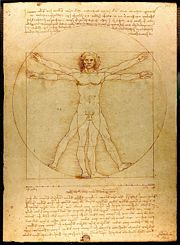
One of the most lyrical works he painted during his time at the Lombard court was the portrait of Cecilia Gallerani, mistress of Lodovico il Moro; the wonderful portrait known as the Lady with an Ermine, in Krakow. In it the visionary impetus of the last Florentine works appears to have given place to a calm contemplation of a continuous form, over which an even light produces a sense of weightlessness, while the whole dramatic effect is concentrated in the large, hypersensitive, almost painful hand holding the symbolic animal. For analysis, see: Lady With an Ermine by Leonardo. The Vitruvian Man (now in the Venice Academy Gallery) is a world-famous drawing with accompanying notes created by Leonardo da Vinci around the year 1492 as recorded in one of his journals. It portrays a nude male figure in two superimposed positions with his arms and legs apart within a circle and square. Sometimes referred to as the Canon of Proportions, it was created as a study of the proportions of the (male) human body as described by the Roman architect Vitruvius (c.78-10 BCE). It remains one of the most copied images in the world today. About the year 1495 Leonardo Da Vinci began work on The Last Supper (Il Cenacolo) in the refectory of the Monastery of Santa Maria delle Grazie in Milan. (Note: for an analysis of this work, see: Last Supper by Leonardo.) For this masterpiece of Christian art, he experimented with a technique based on an impasto using oil and tempera, to be placed on a wall covered with a layer of varnish made of a gesso mixture. But the technique proved unsatisfactory and the painting rapidly deteriorated, to such an extent that by the middle of the sixteenth century it was described as being in a completely ruined condition, and after numerous restorations which have continued up to the present day, the fresco we now see is only a shadow of the original painted by Leonardo. Below the Bramantesque vaulting of the room the scene is enacted against a background of classical perspective with a central focal point. There is an illusory effect of prolongation, as the room opens out on to the countryside through the arches in the background. The broad scale of the figures is thus placed within a structure adapted to e human measure according to the Renaissance norm; this gives rise to the effect of monumentality which was to characterize the painting of the sixteenth century. All the main figures are carefully arranged so as to balance each other as well as the figures in the other groups. This calculated balance is enhanced by the diffused light playing over the whole work, so that the figure of Christ, which is partly against the light, stands out in isolation against the luminous chalky background.
Each of the figures is placed in such a way that it occupies a definite portion of space, which barely varies from figure to figure (except in the central portion, where the figure of Christ is set apart), and the effect of this is to concentrate the greatest intensity on the central point, where the dramatic moment is focussed and held for ever. The tradition of isolating the figure of Judas on the outer edge of a painting, which Leonardo followed in his preparatory sketches for this work, was abandoned in the final version in order to avoid fragmentation and a consequent decline in dramatic effect.
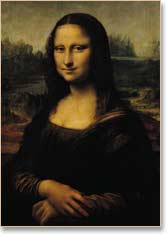
The accounts of Leonardo's painstaking execution of The Last Supper led many to regard him as the originator of the idea of the painter as a contemplative and creative thinker, rather than a mere tradesman whose job was to cover so many square yards a day. This notion concerning the dignity of the artist was taken up and developed further by Michelangelo and other sixteenth century painters. The Last Supper is not a true fresco painting since it was painted on a dry wall rather than on wet plaster, and Da Vinci sealed the stone wall with a layer of pitch, gesso and mastic, then painted over it with tempera. This painting-method has led to noticeable deterioration over the years. The painting has been the subject of endless interpretation (eg. in the novel, the Da Vinci Code), but most speculation is unconfirmed by scientific study. This exquisite work of High Renaissance portrait art is named after its subject, Lisa del Giocondo, born Lisa Gherardini, the wife of a Florentine merchant. In Italy it is known as La Gioconda. ('Mona' is a form of address like 'Madam' or 'my lady'). For interpretationa and analysis, see: Mona Lisa by Leonardo. The Mona Lisa brought a revolutionary element into the development of the Renaissance concept of portraiture. With certain exceptions, portraits by late fifteenth-century artists had tended to become schematic, but now the relationship between figure and background was no longer dependent upon the usual recession of planes in even gradation. The effect partly foreshadowed in the Portrait of Ginevra de' Benci is completely achieved here, and the Mona Lisa is an instant of total illumination, carried with equal intensity through to the rocks and sky in the background. The famous 'enigmatic' smile thus becomes a subtle vehicle for the refraction of light; it is as if we were present at the very birth of light, as though the splendour of this moment could never be repeated, and light never again have the same intensity. Note the detail of the face, showing the subtle shading effect of sfumato, particularly in the shadows around the eyes and mouth. His sfumato technique influenced numerous contemporaries, including Andrea del Sarto (1486-1530), the leader of High Renaissance painting in Florence after 1510. The Mona Lisa was a favourite of Leonardo's and it accompanied him on all his travels. • X-ray tests have established that
there are three versions of the Mona Lisa hidden under the present
one. The Mona Lisa is the central exhibit in the Louvre Museum in Paris. Some art curators value it in the region of $1 billion. It's beauty and visual effect lies in the oil painting technique (known as sfumato), created by Leonardo, which allowed him to execute the sort of subtle atmospheric shading which was impossible to produce with the egg-based tempera paint used by his contemporaries. |
|
|
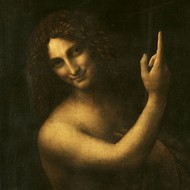
The Virgin and Child with St Anne and St John the Baptist (1500-8) In 1500, Leonardo returned to Florence and stayed with the monks of the Santissima Annunziata, for whom he painted The Virgin and Child with St Anne (cartoon in the National Gallery in London; picture in the Louvre). The unusual spatial relationship between the figures themselves and between figures and background was a great structural innovation, later adopted by Raphael (1483-1520), Fra Bartolommeo (1472-1517), Andrea del Sarto (1486-1530) as well as exponents of Mannerism, and in fact imitated by painters throughout the sixteenth century. The significance of this work will be better understood when we consider that it was produced at a time which represented perhaps the most crucial moment in fifteenth and sixteenth-century painting, when the influence of the teaching of the great Florentine masters of the previous generation still lingered, while young artists of the same generation as Leonardo (among them Botticelli, for example) were carried away by the fantastic imaginings of Flemish artists which reached them by way of Piero di Cosimo (1462-1522). The St Anne work initiates a new period in the history of Renaissance art, just as the Holy Families of Raphel and Michelangelo's Doni Tondo did in their turn. This is the period which has far too often been defined by the pseudo-historical term classicism. It is in fact, quite the reverse: a highly revolutionary way of stating the relationship between man and object, with far greater flexibility and unlimited variety, going far beyond figurative representation, and bearing the mark of one of the crucial moments in the history of art. Saint John the Baptist (1513-16) Leonardo returned to Milan, then left for Rome and from there fled to France; in his anxious and choleric old age he produced only one painting, the Saint John the Baptist, now in the Louvre. This painting expresses the extreme consequences of Leonardo's treatment of light; the light is continuously filtered from the dark background to the more prominent planes in the foreground, and itself becomes an expression of space and physiognomy, merging with the figure and the face, as it leans forward and smiles enigmatically, and with the symbolic raising of the finger; this is no longer 'a voice crying in the wilderness' but the guardian and witness of an initiatory secret, a means to the comprehension of the essence of humanity and hence the cosmic essence. Respected, and indeed revered, by the court, comforted by the company of Melzi and Salai, the old, half-paralysed Leonardo felt that his life was drawing to a close.
Because of the total lack of any completed sculpture, we have little exact knowledge of Leonardo Da Vinci's activity in this field; we know from documentary evidence and his own writings that he considered himself equally gifted in both arts - in fact, he considered that he was particularly skilled in the difficult task of bronze casting. His youthful activity in the studio of Verrocchio, himself a sculptor and only to a far lesser degree a painter, makes it highly likely that he began as an apprentice sculptor, although it is a fact that all the works of sculpture which have been attributed to Leonardo's early years, from the terracotta Madonna and Child in the Victoria and Albert Museum to the Portrait of a Lady with Flowers in the Bargello, are to be assigned either to Verrocchio himself or to Antonio Rossellino. There is no documentary evidence of any sculpture in existence which can unhesitatingly be ascribed to Leonardo. This assertion is not invalidated by the existence of bronzes and waxes which have been assigned to Leonardo with little justification, some of them intended for the decoration of the Francesco Sforza monument, others for the Trivulzio monument. These two monuments were the great projects which occupied Leonardo's mind for many years, but were never completed. Reference has been made to the fact that Ludovico il Moro commissioned a monument in memory of Francesco Sforza and that Leonardo completed only the clay model of the horse, which was later destroyed; a clear impression of the basic idea for this monument can be gained from the series of silverpoint drawings at Windsor Castle, where we see especially how Leonardo's treatment of the figure of the horse developed from one drawing to the next. In one of the first sketches he envisaged the horse as a moving figure executing a leap into space, a view which recalls Leonardo's studies in the Antonio Pollaiuolo style. Later, the horse was shown with all four legs on the ground, in the classical tradition, and further developments were introduced before the final version was produced in 1493. About twenty years later, Leonardo was engaged on a project for a funerary monument to Giangiacomo Trivulzio, a general in the service of the King of France. This monument, in the church of San Celso, Milan, was to consist of a sarcophagus acting as a base for an equestrian statue of natural size. From studies for this work which have come down to us we see how the idea for the composition arose directly out of the final plan for the Sforza monument. The restrained dynamism gave new significance to the traditional equestrian iconography as seen in the statue of Marcus. Aurelius or the works of Verrocchio and Donatello. There are no finished works to bear witness to Leonardo Da Vinci's studies in the sphere of architecture; we know he spent a long time planning the dome of Milan Cathedral, and there are innumerable plans of fortifications which he produced for the Dukes of Milan and Valentino. But the most interesting architectural work left by Leonardo is his draft Trattato sull'architettura, of which much evidence still remains. We know that this treatise was planned in two sections, the first being an exposition of the doctrine of Orders and architectonic forms, the second a discourse on building techniques. From fragments and numerous drawings which remain (prototypes of the analytical architectural drawing) it is apparent that the tremendous importance of Leonardo's theories lies in the fact that they provide a link between the theories of the fifteenth century - not only those of Filippo Brunelleschi and Leon Battista Alberti, but including also Filarete and Francesco di Giorgio - and the classical architectonic theories of the mature Donato Bramante. They later became the model for Serlio's treatise on the Orders of architecture. We must see in this continuous preoccupation with theoretical investigation, resulting in the creation of an architectonic ideal which was more valid as an abstract theory than as a practical realization, the cause of Leonardo's failure to carry his countless ideas through to completion. Theoretical Works: Ideas on Fine Art Leonardo filled countless notebooks with a huge range of sketching, studies and other artistic ideas. Eventually amounting to some 13,000 pages of notes and drawings, these scientific and artistic journals, including his Treatise on Painting (1651), have since been acquired by major institutions like the Royal Library at Windsor Castle, the Victoria and Albert Museum, the British Library in London, the Paris Louvre, the Biblioteca Nacional de Espana, and the Biblioteca Ambrosiana in Milan which owns the twelve-volume Codex Atlanticus. Leonardo's Codex Leicester (Codex Hammer) was purchased by Microsoft's Bill Gates, and is exhibited annually in different cities around the world. There is no doubt that his most important theoretical work is the Trattato della pittura, although unfortunately this too has reached us in fragmentary form. This treatise is undoubtedly the greatest contribution to the theory of painting produced at any time during the Renaissance. We find in it an examination of all the themes which were under discussion at the time. Foremost among these is the dispute concerning the primacy of the arts, which Leonardo naturally settles in favour of painting, which he classifies as a natural science because of the scientific and mathematical basis of this art. He pursued the theories promulgated by the first Florentine writers on the theory of art, but followed an original line of development through the concept of 'knowledge conquered by experience' as opposed to what he regarded as the 'fallacious spiritual sciences' of the Platonic and Aristotelian traditions. And it is in this sense that the highest value is placed upon painting and it becomes a science, even a philosophical system. The generally accepted idea of the primacy of painting among the arts gave rise to a whole cultural tradition which lasted throughout the sixteenth century, even in places where Leonardo's thought could not have penetrated; but Leonardo's view of the supremacy of painting as a combined art and science, capable of representing a synthesis of all forms of expression, is absolutely original. Leonardo considered the essence of painting to lie in relief, in rigorous modelling by means of light and shade; a second basic factor in painting being psychological expression, manifested mainly through 'motion', the features, and gestures. Another important part of the Trattato deals with the theory of proportions, encompassing the law of perspective; this was the formulation of what might be called a discovery' of Leonardo's; for although the theory was derived from the system of perspective traditional to Florentine art, it is considered by him from the point of view of changes in the actual proportions as they are affected by movement. The last part of the Trattato is devoted to an analysis of the structure of the muscles. Paintings and drawings by Leonardo can be seen in a number of the world's best art museums, including the following: - Landscape with a View of the Arno
(c.1473) drawing, Uffizi, Florence. |
|
• For a list of important dates in
the historical development of visual arts, see: History
of Art Timeline.
Visual
Artists, Greatest |