Fresco Painting
Characteristics, Types, History: Buon, Secco,
Mezzo Frescoes.
MAIN A-Z INDEX - A-Z of PAINTING

|
Fresco Painting
|
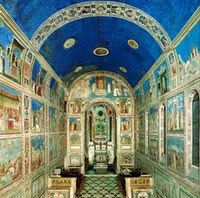 Scrovegni (Arena) Chapel frescoes The most influential series of mural paintings of the Proto Renaissance. By Giotto di Bondone (1267-1337). |
Fresco PaintingContents • Characteristics
of Fresco Painting |
|
|
What is Fresco Painting? Characteristics The art term Fresco (Italian for 'fresh') describes the method of painting in which colour pigments are mixed solely with water (no binding agent used) and then applied directly onto freshly laid lime-plaster ground (surface). The surface is typically a plastered wall or ceiling. The liquid paint is absorbed by the plaster and as the plaster dries the pigments are retained in the wall. Before paint was applied, the artist usually made a preparatory drawing (sinopia) in red chalk. |
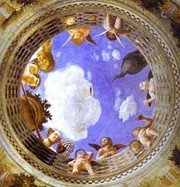 Camera Degli Sposi Frescoes Ceiling oculus panel, a perfect example of trompe l'oeil, designed and painted by Andrea Mantegna. |
|
|
There are three main types of fresco technique: Buon or true fresco, Secco and Mezzo-fresco. Buon fresco, the most common fresco method, involves the use of pigments mixed with water (without a binding agent) on a thin layer of wet, fresh, lime mortar or plaster (intonaco). The pigment is absorbed into the wall as described above. By contrast, secco painting is done on dry plaster and therefore requires a binding medium, (eg. egg tempera, glue or oil) to attach the pigment to the wall, as in the famous mural painting known as The Last Supper by Leonardo Da Vinci. Mezzo-fresco involves painting onto almost but not quite dry intonaco so that the pigment only penetrates slightly into the plaster. By 1600 this had largely replaced buon fresco on murals and ceilings. |
|
EARLY EUROPEAN FRESCOES PAINTING TERMS DIFFERENT FORMS OF ARTS |
Fresco was practised as early as 2000 BCE by the Minoans during the bronze age civilization of Crete. Famous Cretan buon fresco wall paintings include "The Toreador". Early frescoes were also painted in Morocco and Egypt, with Egyptian artists preferring the secco method for their tomb murals. Fresco paintings were also common in Greek art, as well as Etruscan culture and in Roman art (eg. Pompeii, Herculaneum), where they were mainly executed in buon fresco style. Early Christian art in Rome, notably in the catacombs, also featured fresco murals. Indeed the style was popular with artists throughout the ancient Mediterranean and in Turkey. In addition, early examples of Buddhist fresco art, completed between 200 BCE and 1100 CE, were discovered at the Ajanta caves and the Brihadisvara Temple in India. Eastern Orthodox art - especially Russian medieval painting - relied heavily on fresco wall paintings in its churches and cathedrals, in order to illustrate scenes from the Bible. Exponents included Theophanes the Greek (1340-1410) (see his fresco in the Church of the Transfiguration Novgorod); Andrei Rublev (1360-1430) (see his murals in the Cathedral of the Annunciation, Moscow, and the Cathedral of the Dormition at Vladimir); and Dionysius (1440-1502) (responsible for the fresco murals at Ferapontov Monastery). This form of Christian medieval painting, which strongly influenced Gothic art, was superceded by the school of Italian Pre-Renaissance painting (1300-1400) whose members included Simone Martini (1284-1344) - see his frescoes in the Chapel of St Martin, Assisi (1317) - Ambrogio Lorenzetti (1285-1348) - see his fresco series entitled Allegory of Good and Bad Government (1338-9, Palazzo Pubblico, Siena) - and of course the Florentine Giotto (c.1267-1337). See, in particular, his Betrayal of Christ (Kiss of Judas) (1305) and Lamentation of Christ (1305) in the Arena Chapel, Padua. |
|
|
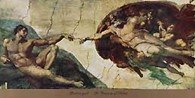
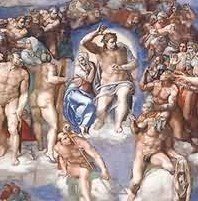
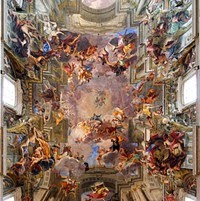
It was during the Italian Renaissance that fresco painting reached its apogee, except for Venice which was too damp. 15th-Century artists throughout Italy used fresco techniques in particular for their religious paintings in cathedrals and churches. The three most famous examples of Renaissance fresco murals include: (1) the Brancacci Chapel frescoes (1424-28) by Masaccio in Florence. See, for instance, The Tribute Money (1425-7) and The Expulsion From the Garden of Eden (1426-7); (2) the Sistine Chapel frescoes (1481-1541) by Botticelli, Perugino and others, and of course Michelangelo. See for example Perugino's early fresco Christ Handing the Keys to Saint Peter (1482). (3) the Raphael Rooms (1508-20) decorated by Raphael, in the Vatican: see, for instance, The School of Athens (1508-11) in the Stanza della Segnatura (Room of the Signature). With the passing of Renaissance art and the advent of Mannerism, popular taste began to favour large canvas oil painting and tapestries, which limited the use of fresco to upper wall areas and ceilings. But see the frescoes in the Church of San Lorenzo Florence by Jacopo Pontormo (1494-1556). Masters of this type of architectural, illusionistic, frescoes, include: Mantegna (1430-1506) and Correggio (1489-1534) - see, in particular, his extraordinary Assumption of the Virgin (Parma Cathedral) (1526-30). For more, see also Parma School of painting (1520-50). From the Bolognese school of painting, led by Annibale Carracci (1560-1609) - noted for the Farnese Gallery frescoes (1597-1608) -, to the dazzling quadratura of Andrea Pozzo (1642-1709), via such artists as Guercino (1591-1666), Pietro da Cortona (1596-1669) and Luca Giordano (1634-1705), the era of Baroque art was the last period to associate painting in the grand manner with the medium of fresco. One of the last great frescoes was Constantine ordering the Destruction of Pagan Idols (1648, Baptistery of the Lateran) by Carlo Maratta (1625-1713). By the time of the great Rococo artist Tiepolo (1696-1770), fresco was in general decline, although his soaring Wurzburg Residence frescos (1750-3) were a late high point. During the 19th century, two highly acclaimed mural painters included Theodore Chasseriau (1819-56) and Puvis de Chavannes (1824-98), both of whom produced some outstanding decorations for the city of Paris. Mexican Mural Renaissance (1920s/1930s) Diego Rivera (1886-1957), David Alfaro Siqueiros (1896-1974) and Jose Clemente Orozco (1883-1949) were the three greatest participants in the so-called Mexican Murals Renaissance, which led to a major revival of fresco painting. North of the border in the United States, the Lithuanian-born social realist painter Ben Shahn (1898-1969) was also a successful fresco painter, with a number of public arts projects to his name. See also our fine art essay: How To Appreciate Paintings. |
|
|
|
• For more about fresco paintings, see: Visual Arts Encyclopedia.
ENCYCLOPEDIA OF FINE ART |