Ancient Egyptian Art
Characteristics, History of Sculpture,
Painting, Architecture.
MAIN A-Z INDEX

|
Ancient Egyptian Art
|
|
NEOLITHIC CULTURES |
Egyptian Art (3100 BCE - 395 CE)Contents • Introduction |
|
|
A major contributor to late Neolithic art, Egyptian culture is probably the best known form of ancient art in the Mediterranean basin, before the advent of Greek civilization (c.600 BCE). Ancient Egyptian architecture, for example, is world famous for the extraordinary Egyptian Pyramids, while other features unique to the art of Ancient Egypt include its writing script based on pictures and symbols (hieroglyphics), and its meticulous hieratic style of painting and stone carving. Egyptian civilization was shaped by the geography of the country as well as the political, social and religious customs of the period. Protected by its desert borders and sustained by the waters of the Nile, Egyptian arts and crafts developed largely unhindered (by external invasion or internal strife) over many centuries. The Pharaoh (originally meaning 'palace') was worshipped as a divine ruler (supposedly the incarnation of the god Horus), but typically maintained firm control through a strict bureaucratic hierarchy, whose members were often appointed on merit.
The function of Egyptian art was twofold. First, to glorify the gods - including the Pharaoh - and facilitate human passage into the after-life. Second, to assert, propagandize and preserve the values of the day. Due to the general stability of Egyptian life and culture, all arts - including architecture and sculpture, as well as painting, metalwork and goldsmithing - were characterized by a highly conservative adherence to traditional rules, which favoured order and form over creativity and artistic expression. Decorative arts included the first examples of Nail Art. |
|
ART OF ISLAM |
|
Ancient Egypt Timeline EARLY DYNASTIC PERIOD 1st Dynasty (2920-2770 BCE) Pharaohs 2nd Dynasty (2770-2650 BCE) Pharaohs OLD KINGDOM 3rd Dynasty (2650-2575 BCE) Pharaohs |
Egyptian culture evolved over three thousand years, a period usually divided as follows: The Early Dynastic Period; The Old Kingdom (26802258 BCE); The Middle Kingdom (2134-1786 BCE); The New Kingdom (15701075 BCE), including the controversial Amarna Period of King Amenhotep (Akhenaton) (13501320 BCE). After this, came an Intermediate Period until the Ptolemaic Era (323-30 BCE) and the period of Roman rule (30 BCE - 395 CE). Ancient Egyptian civilization is symbolized by the Pyramids, most of which were constructed during the Old and Middle Kingdom periods, when the Pharaoh's power was absolute. Even today, the full significance of these funerary monuments and tombs is imperfectly understood by archeologists and Egyptologists. Testifying to the social organization and architectural ingenuity of Ancient Egyptian culture, the Great Pyramid of Giza (c.2565 BCE) remains the sole surviving member of the Seven Wonders of the Ancient World, as compiled by the Greek poet Antipater of Sidon. Egyptian Artists and Craftsmen Egyptian sculptors and painters were not artists in the modern sense of being a creative individual. Ancient Egyptian art was rather the work of paid artisans who were trained and who then worked as part of a team. The leading master craftsman might be very versatile, and capable of working in many branches of art, but his part in the production of a statue or the decoration of a tomb was anonymous. He would guide his assistants as they worked, and help to train novices, but his personal contribution cannot be assessed. Artists at all stages of their craft worked together. The initial outline sketch or drawing would be executed by one or more, who would then be followed by others carving the intermediate and final stages. Painters would follow in the same manner. Where scenes have been left unfinished it is possible to see the corrections made to the work of less-skilled hands by more practised craftsmen. Many master craftsmen reached positions of influence and social importance, as we know from their own funerary monuments. Imhotep, the architect who built the Step Pyramid complex for King Zoser, 2660-2590 BC, was so highly revered in later times that he was deified. The credit for any work of art, however, was believed to belong to the patron who had commissioned it. |
|
4th Dynasty (2575-2467 BCE) Pharaohs 5th Dynasty (2465-2323 BCE) Pharaohs |
|
6th Dynasty (2323-2152 BCE) Pharaohs 1ST INTERMEDIATE PERIOD Pharaohs MIDDLE KINGDOM 11th Dynasty (1986-1937 BCE) Pharaohs 12th Dynasty (1937-1759 BCE) Pharaohs 2ND INTERMEDIATE PERIOD 13th Dynasty Pharaohs |
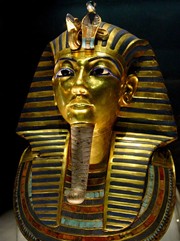
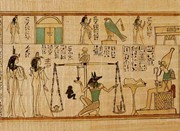
Egyptian civilization was highly religious. Thus most Egyptian artworks involve the depiction of many gods and goddesses - of whom the Pharaoh was one. In addition, the Egyptian respect for order and conservative values led to the establishment of complex rules for how both Gods and humans could be represented by artists. For example, in figure painting, the sizes of figures were calculated purely by reference to the person's social status, rather than by the normal artistic rules of linear perspective. The same formula for painting the human figure was used over hundreds if not thousands of years. Head and legs always in profile; eyes and upper body viewed from the front. For Egyptian sculpture and statues, the rules stated that male statues should be darker than female ones; when seated, the subject's hands should be on knees. Gods too were depicted according to their position in the hierarchy of deities, and always in the same guise. For instance, Horus (the sky god) was always represented with a falcon's head, Anubis (the god of funeral rites) was always depicted with a jackal's head. The use of colour in Egyptian paintings was also regulated and used symbolically. Egyptian artists used six colours in their paintings red, green, blue, yellow, white and black. Red, being the colour of power, symbolized life and victory, as well as anger and fire. Green symbolized new life, growth, and fertility, while blue symbolized creation and rebirth, and yellow symbolized the eternal, such as the qualities of the sun and gold. Yellow was the colour of Ra and of all the pharaohs, which is why the sarcophagi and funeral masks were made of gold to symbolize the everlasting and eternal pharaoh who was now a god. White was the colour of purity, symbolizing all things sacred, and was typically used used in religious objects and tools used by the priests. Black was the colour of death and represented the underworld and the night.
Egyptian Arts And The Afterlife Nearly all of Ancient Egypt's surviving paintings were discovered in tombs of the pharaohs or high governmental officials, and portrays scenes of the afterlife. Known as funerary art, these pictures depicted the narrative of life after death as well as things like servants, boats and food to help the deceased in their trip through the after life. These paintings would be executed on papyrus, on panels, (using encaustic paint) or on walls in the form of fresco murals (using tempera). In addition, models (eg. of boats, granaries, butcher shops, and kitchens) were included in the tomb in order to guarantee the future well-being of the dead person. As the spirit inhabited the body, the preservation of the latter against decay was also critical. The use of tightly wrapped bandages to mummify the corpse, and the removal and packaging of internal organs within ceramic canopic jars and other opulent sarcophagi became widespread among the ruling elite. All these arrangements helped to support a nationwide industry of Egyptian artists and craftsmen who laboured to produce the artworks (paintings, scultures, pottery, ceramics, jewellery and metalwork) required. Egyptian sculpture was highly symbolic and for most of Egyptian history was not intended to be naturalistic or realistic. Sculptures and statues were made from clay, wood, metal, ivory, and stone - of which stone was the most permanent and plentiful. Many Egyptian sculptures were painted in vivid colours.
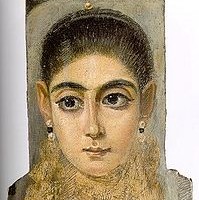
The Rule of King Amenhotep (Akhenaton) (13501320 BCE) Pharaoh Amenhotep IV (husband of Queen Nefertiti) triggered a sort of cultural revolution in Egypt. Born into the cult of Amon (Amen), a line that worshipped a wide range of gods, he changed his name to Akhenaton and, strengthened by his control of the army, instituted the worship only of Aten, a sun god. The Egyptian capital and royal court was moved to Amarna in Middle Egypt. All this led to a radical break with tradition, especially in the arts, such as painting and sculpture. They became more naturalistic and more dynamic than the static rule-bound art of previous eras. In particular, the Amarna style of art was characterized by a sense of movement and activity. Portraits of Egyptian nobles ceased to be idealized, and some were even caricatured. The presence of Aten in many pictures was represented by a golden disc shining down from above. After the death of Akhenaton, the next Pharaoh - the child Tutankhaten - was persuaded to move back to Memphis and change his name to Tutankhamen, thus reverting to Amon. As a result, Egyptian painters and sculptors largely returned to the old traditions which continued until the Hellenistic era from 323 BCE onwards. NOTE: To compare earlier Middle Eastern works of Sumerian art (c.3,000 BCE), please see the Ram in a Thicket (c.2500 BCE, British Museum, London), Kneeling Bull with Vessel (3,000 BCE, Metropolitan Museum, New York) and The Guennol Lioness (3000 BCE, Private Collection). For contemporaneous sculpture, see for instance the Human-headed Winged Bull and Lion (859 BCE) from Ashurnasirpal's palace at Nimrud, and the alabaster reliefs of lion-hunts featuring Ashurnasirpal II and Ashurbanipal, both characteristic examples of Assyrian art (c.1500-612 BCE). Hellenistic Era (c.323-27 BCE) The influence of Greek Hellenistic art on Egyptian artists, a process accelerated during the Ptolemaic Era, encouraged the naturalistic representation of individuals in paintings and sculpture, not unlike the process initiated by Akhenaton. Portraits became realistic and the rules of colour were relaxed. This trend was further encouraged by the practical Roman style of art. The most famous example of Hellenistic-Egyptian painting during the era of classical antiquity, is the series of Fayum Mummy Portraits, discovered mainly around the Faiyum basin, west of the Nile, near Cairo. A type of naturalistic portraiture, strongly influenced by Greek art, notably Hellenistic Greek painting (323-27 BCE), Fayum portraits were attached to the burial cloth of the deceased person. Preserved by the exceptionally dry conditions, these paintings represent the largest single body of original art which has survived from Antiquity. Collections of Egyptian artworks can be seen in the Egyptian Museum, Cairo; the British Museum, London; the Louvre Museum, Paris; the Agyptisches Museum, Berlin; the Metropolitan Museum of Art, New York. |
|
14th Dynasty Pharaohs 15th Dynasty Pharaohs 16th Dynasty Pharaohs 17th Dynasty Pharaohs NEW KINGDOM 18th Dynasty (1539-1295 BCE) Pharaohs Note: The rulers of Egypt were not 19th Dynasty (1295-1186 BCE) Pharaohs 20th Dynasty (1186-1069 BCE) Pharaohs |
Egyptian Painting & Sculpture: A Brief Survey The earliest incised figures and scenes
in relief date from prehistoric times when slate cosmetic panels and combs
of wood, bone, and ivory were buried in the graves of their owners. These
were carved in the simple, effective outlines of species familiar to the
people of the Nile Valley - antelopes, ibex, fish, and birds. More elaborate
ivory combs and the ivory handles of flint knives which probably had some
ceremonial purpose were carved in relief, the scene standing out from
its background. Tomb Reliefs The natural details used to fill odd corners in these tomb scenes show how much pleasure the ancient Egyptian craftsmen took in observing their environment. Birds, insects, and clumps of plants were all used to balance and complete the picture. The results of sharp-eyed observation can be seen in the details that distinguish the species of birds and fish thronging the reeds and shallow water of the marshes. |
|
|
Egyptian Frescoes C. Artistic Techniques of Relief Carvings and Painting Before any carving in relief or painting
could be done, the ground - whether stone or wood - had to be prepared.
If the surface was good, smoothing was often enough, but any flaws had
to be masked with plaster. During the New Kingdom, whole walls were plastered,
and sometimes reliefs of exquisite detail were carved in the plaster itself.
Usually mud plaster was used, coated with a thin layer of fine gypsum. The painter worked directly to a draft
on a flat surface, and began with the background. This was filled in with
one colour, grey, white, or yellow, using a brush made of a straight twig
or reed with the fibres teased out. The larger areas of human figures
were painted next, the skin colour applied, and the linen garments painted.
Precise details, such as the markings of animals and birds or the petalled
tiers of an ornamental collar, were finished with a finer brush or a pen.
The pigments were prepared from natural substances such as red and yellow
ochre, powdered malachite, carbon black, and gypsum. From about six basic
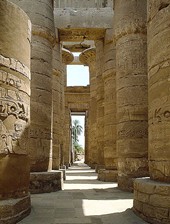
colours it was possible to mix many intermediate shades. Architecture: Pyramid Tombs and Temples Egyptian architecture is world famous for its unique underground tomb design, exemplified by the Egyptian Pyramids at Giza, along with its tomb artworks (mummy paintings, sculptures, ceramics and precious metalwork) and Sphinx. All the great monumental pyramids were erected during the era of Early Egyptian Architecture, with only a handful of smaller ones being constructed in the era of in Egyptian Middle Kingdom Architecture. After this came the golden age of Egyptian New Kingdom Architecture, with its huge temple precincts at Karnak and Luxor, after which the extended period of Late Egyptian Architecture was a distinct anti-climax. |
|
• For more about art and design in early civilizations, see: Visual Arts Encyclopedia.
Art
Glossary | Visual Artists, Greatest |