Ancient Egyptian Pyramids
Architecture, Characteristics, History,
Construction of Pyramid Tombs.
MAIN A-Z INDEX

|
Ancient Egyptian Pyramids
|
|
|
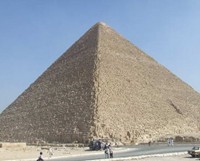
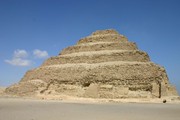
What are the Egyptian Pyramids? Arguably the most famous form of late Prehistoric art, the pyramids of Ancient Egypt are the world's largest funerary edifices or tombs. Developed from the mastaba tomb, they are one of the most enduring symbols of Egyptian art in general and Egyptian architecture in particular. Ancient Egyptians believed in an eternal afterlife, and the purpose of the pyramids was to safeguard the Pharaoh's body and all the belongings he would need after death, in order to facilitate his passage into the after-life. Thus each pyramid routinely contained a wide variety of Egyptian sculpture, mural painting, jewellery and other types of ancient art necessary to sustain the deceased in his after-death existence. So far, about 140 pyramids have been discovered in Egypt, most of which were built as burial tombs for the country's Pharaohs and their consorts, during the Old and Middle Kingdom periods (2650-1650). The oldest known Egyptian pyramids are located at Saqqara, near Memphis, just south of the Nile delta. The earliest among these is the Pyramid of Djoser (constructed about 2630 at Saqqara) which was designed during the third dynasty by the famous architect Imhotep (active c.2600-2610 BCE). The tallest one was The Great Pyramid of Giza (c.2565), which was designated one of the Seven Wonders of the World by Antipater of Sidon, and is now the sole surviving member. Exactly how many paid labourers were required to cut, transport and erect the stone megaliths from which each pyramid was constructed, is unknown, although estimates vary from 30,000 to 300,000. However, the huge resources needed to create such colossal works of ancient architecture, shows how rich and well organized Egyptian society was in the Third Millennium BCE. |
|
ART OF ISLAM |
|
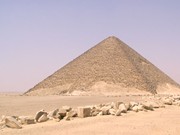
How Did Egyptian Pyramid Architecture Evolve and Develop? The architectural design of the pyramids was a reflection of both politics and religious custom. Until about 3,000 BCE, Ancient Egypt was effectively two countries with two traditions of burial. In Lower Egypt (to the north) the country was wet and flat, and the dead were buried under their family house which was usually built on higher ground. In Upper Egypt (to the south) the dead were buried away from settlements, in dry sand at the edge of the desert. A mound was usually erected over the grave. When the people and burial customs were united, during the period 3000-2700, it became customary for nobles to be interred in a simple tomb called a mastaba. This was a simple tomb consisting of a flat-roofed, rectangular structure, made from mud-bricks, with slightly sloping walls, inside which, a deep burial chamber was dug into the ground and lined with stone or bricks. After a while, the flat roof of the surface building was replaced by a pyramid design. Finally, came the idea - conceived by Imhotep - of stacking mastabas one on top of another, forming a series of "steps" that decreased in size towards the top, thus creating the familiar design of the step pyramid. Not all pyramid designs were successful. Architects employed by King Snefru constructed three pyramids: the first of these, the Pyramid at Meidum, collapsed in antiquity; the second, the Bent Pyramid, had its angle dramatically altered mid-way through its construction; only the third, the Red Pyramid proved to be successful. What is the History of the Egyptian Pyramids? The early Egyptian architecture of the Old Kingdom witnessed the construction of all the largest pyramids, including The Great Pyramid of Giza (c.2565), also known as The Pyramid of Khufu/Cheops; The Red Pyramid at Dahshur, and The Pyramid of Khafre (c.2545) at Giza. Other pyramid tombs were erected at Giza by King Menkaure (c.2504); at Sahure by King Sahure (c.2477); at Abu Sir by King Neferirkare Kakai (c.2467) and King Nyuserre Ini (c.2392). After this, during the era of Egyptian Middle Kingdom architecture (2055-1650) - a time of political uncertainty - Pharaonic pyramids were typically smaller and less substantial, as exemplified by King Amenemhat I's pyramid at Lisht (c.1962), King Senusret II's at el-Lahun (c.1878), and King Amenemhat III's at Hawara (c.1814). See also: Mesopotamian Art. The next building phase, which occurred during the aubsequent era of Egyptian New Kingdom architecture (1550-1069), focused on temple-building. Egyptian Pharaohs were no longer buried in pyramids but in mortuary temples situated in the Valley of the Kings on the west bank of the Nile opposite Thebes. A revival of pyramid construction took place during the subsequent period of Late Egyptian architecture (c.664-30 BCE). During the Napata era in neighbouring Sudan (c.700-661 BCE), a number of pyramids were constructed under the influence of Egyptian architects. Later, during the Sudanese Kingdom of Meroe (c.300 BCE – 300 CE) over two hundred more pyramid burial vaults were built. For more about the Hellenistic period (323-27 BCE), see: Greek Art. For information about building techniques in ancient Rome, please see: Roman Architecture (c.400 BCE - 400 CE). |
|
What Were the Main Characteristics of a Pyramid? The early pyramids were built differently from the later ones. The monumental pyramids of the Old Kingdom, for instance, were built out of stone blocks, while those of the later Middle Kingdom were smaller and were typically made out of mud brick cased in limestone. The early structures usually had a core of local limestone, cased in an outer layer of better quality limestone, or occasionally granite. Granite was also traditionally used for the royal chambers insided the pyramid. Up to 2.5 million limestone blocks and 50,000 granite blocks might be used to construct a single pyramid. The average weight might be anything up to 2.5 tons per block, with some very large megaliths weighing up to 200 tons. The capstone at the top of the structure usually consisted of basalt or granite, and if plated with gold, silver or electrum (a mixture of both), would dazzle observers with its reflection of the sun. Based upon the excavation of a series of workers' cemeteries discovered during the early 1990s, archeologists now think that the pyramids were built by tens of thousands of salaried workers and craftsmen, who were lodged in huge encampments nearby. Deep inside each pyramid was the King's Chamber, which contained the mummified body of the dead Pharaoh, placed inside a precious sarcophagus. In addition, as noted, a huge number of artifacts were buried with the King to sustain him in the afterlife, as well as monuments to the dead man himself: inside the Pyramid of Khafre, for instance, there were over 52 life size statues of the dead Pharaoh. Also, dummy passages were dug to prevent the later desecration of the tomb, and the theft of valuables. All Egyptian pyramids were constructed on the west bank of the Nile, where the sun sets, in accordance with official religious doctrine concerning the realm of the dead. (The pharaoh's soul supposedly joined with the sun during its descent before continuing with it in its eternal journey.) Most pyramids were clad in polished, white limestone (much of it now stolen), in order to give them a brilliant reflective appearance from a distance. The Bent Pyramid at Dahshur, is one of the few that still retains part of its original limestone covering. They were situated relatively close to the Nile, to facilitate river transport of stone from the quarries near Heliopolis. A pyramid was never an isolated structure but always an integral part of a funerary complex. Typically, this complex consisted of the pyramid itself and an adjacent mortuary temple, both of which were connected by causeway to another temple or pavilion, located close by the Nile, to which it was linked by a narrow waterway. (See also: Architecture Glossary.) Pharaohs - in conjunction with their architects, engineers and construction chief - typically began building their own pyramid the moment they ascended to the throne. The two principal factors which determined the location of a pyramid during the Old Kingdom, included its orientation to the western horizon (where the sun set) and its proximity to Memphis, the country's key city during the Third Millennium. Which are the Most Famous Egyptian Pyramids? The Pyramid of
Djoser (c.2630) (Saqqara) The Bent Pyramid
(c.2600) (Dahshur) The Red Pyramid
(c.2600) (Dahshur) The Pyramid of Khufu/Cheops
(c.2565) (Giza) The Pyramid of
Djedefre (c.2555) (Abu Rawash) The Pyramid of
Khafre (c.2545) (Giza) The Pyramid of
Menkaure (c.2520) (Giza) Construction: How Were the Pyramids Built? Egyptologists remain undecided as to the exact building method used to create the pyramids. Specifically, experts disagree about the method by which the stones were conveyed and laid (rollers, various types of ramp, or a system of levers), and the type of workforce used (slaves or paid workers, and, if paid, were they given a salary or a tax credit). Whatever the exact method of construction used, the results were extraordinary. The Great Pyramid of Giza, for instance, was built to extremely precise dimensions - a sheet of paper hardly fits between the stones - and levelled to within a fraction of an inch over the entire 13-acre base. The latest construction methods and laser levelling techniques can hardly do better. One reason why the Egyptian pyramids are such an astonishing example of megalithic art, and why they rank among the greatest works in the history of art. How to Move Heavy Blocks of Stone? One of the major difficulties faced by the early pyramid builders was how to move huge numbers of heavy stone blocks. It seems that this problem was solved using techniques which involved the following elements. To begin with, blocks of stone were lubricated with oil to facilitate movement. Also, based on the excavation of artifacts from certain temples, it seems that builders used a cradle-like machine to help roll the stones. Such a technique has been validated in tests conducted by the Obayashi Corporation, using concrete blocks weighing 2.5 tons, which proved that 18 men could drag a block up a 1-in-4 incline ramp, at a rate of roughly 60-feet per minute. However, this method does not work for much heavier blocks in the 15-80 ton weight range. Greek architecture borrowed significantly from Egyptian building techniques. What Equipment Was Used to Build the Pyramids? In 1997, experts joined forces to conduct a pyramid building experiment for a TV program. In three weeks, they erected a pyramid 20-feet tall and 30-feet wide, using 186 stones, each weighing roughly 2.2 tons. The project required the use of 44 men, using iron hammers, chisels and levers. [Note: experiments conducted with copper tools found that they were a perfectly viable alternative to iron tools, but about 20 extra men would have been needed to keep the tools sharp.]. In addition to "iron" tools, a fork-lift truck was used, but no other modern equipment was permitted. Levers were used to flip and roll stones up to 1 ton, while larger stones were towed, using wooden sledges and 12 to 20 men. How Many Workers Were Used to Build the Egyptian Pyramids? According to an estimate by consultants Daniel, Mann, Johnson, & Mendenhall in collaboration with Egyptologists, the Great Pyramid of Giza was built using an average workforce of roughly 14,500 people - rising to an occasional peak workforce of 40,000 - in about ten years, without the use of iron tools, pulleys or wheels. They calculated that the workforce could have maintained a work-rate of 180 blocks per hour and ten hour work days: calculations based on data taken from modern construction projects completed in the Third World, without modern machinery. One of the earliest art forms of Antiquity, the pyramids were part of the Ancient Egyptian tradition of stone masonry, a tradition that later mingled with Ancient Persian art and went on to influence Greek sculpture, which itself had such a huge impact on the Italian Renaissance.
For a comparison with European architecture of the Third Millennium, see: Stonehenge Stone Circle (c.3100-1100 BCE) and the Knowth Megalithic Tomb (c.2500 BCE). |
|
• For more about ancient architectural design, see: Homepage.
Art
Questions | Art Glossary |