Statue
Definition, Types, Materials, World's Greatest/Tallest
Sculpture.
MAIN A-Z INDEX - A-Z of SCULPTURE

|
Statue
|
|
|
Statues: Freestanding SculpturesContents • What is a
Statue? Definition and Characteristics |
|
|
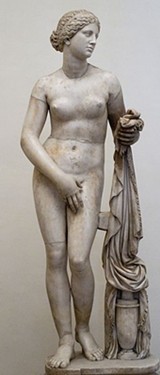
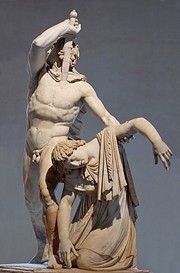
What is a Statue? Definition and Characteristics A statue is a freestanding sculpture which depicts a person or group of people. An equestrian statue depicts a horse and rider, while an equine statue portrays only a horse. Essentially a work of representational art, a statue is typically made full-length or close to life-size: in contrast, a bust depicts only a head, or head and shoulders; while a statuette or figurine is a small-scale work that can be held by hand. Lastly, unlike relief sculpture, a statue is capable of being viewed from all sides; however, precisely because it is freestanding, a statue is considerably more restricted in the range of its subject matter than a relief. In particular, its weight must be carefully balanced, thus limiting, or at least restraining, its size and shape. As a result statues tend to depict single figures and limited groups, while reliefs are free to portray more complex pictorial subjects involving crowds, battle scenes, historical events, architectural backgrounds and so on. The best sculptors of figurative statues include: Donatello (1386-1466), Veit Stoss (c.1447-1533), Tilman Riemenschneider (c.1460-1531), Michelangelo (1475-1564), Benvenuto Cellini (1500-71), Giambologna (1529-1608), Bernini (1598-1680), Jean-Antoine Houdon (1741-1828), Antonio Canova (1757-1822), Auguste Rodin (1840-1917), Duane Hanson (1925-96) and others. |
|
|
|
|
Being representational, a statue should not be wholly abstract, although it may be expressionist to the point of semi-abstraction (like Boccioni's Unique Forms of Continuity in Space). Statues may simply stand alone, or form part of an architectural structure (cathedral, altarpiece, tomb). Specific types of statue or statuette include: • Venus: type of prehistoric
statuette. The composition of statues varies enormously. They can be made from traditional materials like stone (Women's Titanic Memorial 1931), marble (The Marly Horse 1745), bronze (Burghers of Calais 1889), clay (Terracotta Army 208 BCE), wood (Holy Blood Altar 1504), or ivory (Lion Man of Hohlenstein Stadel), as well as from precious metals like gold (Broighter Boat 50 BCE), silver (Kneeling Bull with Vessel 3000 BCE), copper (Statue of Liberty 1886) or chryselephantine (Athena Parthenos 445 BCE). Other materials from which statues can be sculpted include: contemporary media such as scrap metal, plastic, aluminium, concrete or "found" items, although this latter form of junk art is usually limited to abstract rather than representational works. As a general rule of thumb, stone sculpture is most popular for monumental works located outside and open to the elements. Marble sculpture along with bronze sculpture were the two favourite materials of Greek artists, while the Romans preferred marble. Wood carving was the favourite plastic art in Germany and Austria, especially during the era of Late Gothic sculpture, while ivory carving was especially popular in Byzantine art. |
|
Before Christianity and Christian art, freestanding statues typically depicted gods or goddesses, but also secular fertility or totemic figures of various types. However, the vast majority of statues between the coming of Christ and the Age of Enlightenment (c.1700), were ecclesiastical in nature. Paid for by the Church, or by pious aristocrats, they illustrated figures from the Old/New Testaments of the Bible, or they commemorated Popes, Archbishops or other clerics. This type of religious art was especially common during the era of Romanesque sculpture (c.1000-1200) and Gothic sculpture (1150-1300), and can be seen in all the cathedrals of the time, notably Chartres, Notre Dame de Paris and Westminster Abbey. Renaissance sculpture (c.1250-1530) was also mostly Christian - see, for instance, David by Michelangelo - although, being a classical-based idiom, it also embraced secular works (Equestrian Statue of Bartolomeo Colleoni 1495), as did Mannerism (Rape of the Sabine Women 1583), Baroque sculpture (Pluto and Proserpina 1621), Neoclassicism (Voltaire 1781), and later types.
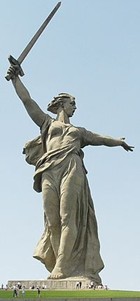
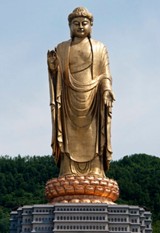
As societies became wealthier, they tended to create works of art (including statues) in order to appease their gods. In addition, as they became more confident, their leaders commissioned effigies of themselves - either as "living gods" (Egyptian Pharaohs, Alexander the Great, some Roman Emperors) (Statue of Claudius as Jupiter 41-54 CE) or simply as omnipotent Emperors (Emperor Augustus c.20-17 BCE). After the Dark Ages, this duality (Christian versus secular works) continued until about 1700, after which most statues were created to represent non-religious figures or themes. Post-1700 examples of non-religious statuary include: The Bronze Horseman 1778, Equestrian Statue of Joseph the Second 1806, Burghers of Calais 1889, End of the Trail 1915, The Destroyed City 1953 and the awesome Russian statue The Motherland Calls 1967. The nature, size, expense and - above all - impact of statues, makes them highly suitable for public display. In addition, the fact that, throughout the long history of sculpture, statues have been visible embodiments of religious and social values, means that they have always had a functional role to play, in inspiring the population at large. In short, statues are a natural form of public art, and have been for millennia. Nowadays, with mass communication taking place via television, video film, Facebook and YouTube, this situation has changed somewhat, although contemporary statues are still created for public display, notably in the Third World. A postmodernist example is Virgin Mother (2005) sculpted by Damien Hirst, which stands in the plaza of Lever House, New York City. Another example is Angel of the North (1998) a large work erected by Antony Gormley which overlooks a main road in Northern England. However, probably the three greatest public statues are The Motherland Calls (1967, situated on the Mamayev Kurgan, the heroic blood-soaked mound of Stalingrad, now Volgagrad); The Ushiku Daibutsu, Amitabha Buddha (1995, Japan); and The Spring Temple Buddha (2002, China).
420 Feet (128m) - Spring Temple Buddha
(2002) Copper cast, Henan, China. Here is a short selection of the world's most beautiful figurative statuary, in bronze, marble and stone. Please note that dates are approximate. For a longer list, see: Greatest Sculptures Ever (c.35,000 BCE-Present). Greatest Ancient Statues/Statuettes - Lion
Man of Hohlenstein Stadel (30,000 BCE) Ivory, Ulmer Museum, Ulm.
- "The Auxerre Kore" (c.630 BCE)
Limestone, Louvre, Paris.
Most statuary of the Middle Ages were produced in the form of column-statues decorating the exteriors of cathedrals (Chartres, Notre Dame de Paris, Reims, Cologne) during the Romanesque and Gothic eras.
Greatest Renaissance and Mannerist Statues - Il Zuccone (1423–35) Marble, Florence.
By Donatello.
- Pluto and Proserpina (1621-2) Marble,
Galleria Borghese, Rome. By Bernini.
- Apollo (1715) Marble, State Art Collection,
Dresden. By Balthasar Permoser.
- Tarcisius, Christian Martyr (1868) Marble,
Musee d'Orsay. By Falguiere.
- Standing Nude (1907) Stone, Pompidou
Centre. By Andre Derain.
|
|
• For more about freestanding statuary, see: Visual Arts Encyclopedia.
ENCYCLOPEDIA OF SCULPTURE |