Etienne Maurice Falconet
Biography of French Baroque/Rococo Sculptor.
MAIN A-Z INDEX - A-Z of SCULPTURE

|
Etienne Maurice Falconet
|
|
|
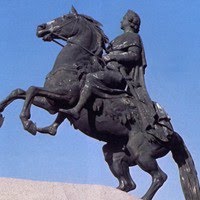
Etienne Maurice Falconet (1716-1791)The eminent 18th century French sculptor Etienne Maurice Falconet, arguably one of the more critically underrated artists of the period, leaned towards a rococo style of working, especially in his nudes. He was however capable of producing heroic works of great drama, such as his famous equestrian statue Monument to Peter the Great ("The Bronze Horseman") (1766-78), arguably the greatest piece of Petrine Art in St Petersburg. Even his nudes, which are best appreciated in their marble forms, convey a thoughtful impression, instead of the typically frivolous air of mainstream rococo. See for example Bather (1757, Louvre, Paris), and Flora (1770, Hermitage Museum, St Petersburg). Falconet became director of sculpture at the Sevres porcelain factory and later director of the French Academy of Fine Arts. Falconet's chief rival was the more classically inclined Jean-Baptiste Pigalle (1714-1785). Between them, Falconet and Pigalle gave France an ascendancy in European sculpture which it maintained until the French Revolution (1789). |
|
BEST WORKS OF SCULPTURE EVOLUTION OF SCULPTURE SCULPTURE (c.1600-1750) |
|
SCULPTURE (cont) BEST SCULPTORS |
Biography Like Pigalle, Falconet was born into a large, poor family in Paris. Initially apprenticed to a carpenter, his skill with clay figures attracted the attention of the sculptor Jean-Baptiste Lemoyne (1679-1731) who accepted him as one of his pupils, alongside the slightly older Pigalle. Although his most successful early work was his statue of Milo of Croton, which gained him membership of the French Academy in 1754, he first came to public attention in the Paris Salon of 1755 and 1757 with his sensitive marble sculptures L'Amour (1754) and the Nymphe Descendant au Bain ("The Bather") (1757, Louvre, Paris). |
|
SCULPTING MEDIA
|
|
|
By this time his patrons included the powerful Madame de Pompadour, who in 1757 secured for him the post of Director of Sculpture at the new Royal Porcelain Factory at Sevres. Over the next nine years, he breathed new life into the manufacture of small-scale unglazed porcelain figurines, influenced to a degree by the suggestive paintings of Francois Boucher (1703-70) and by mid-century theatrical designs. Examples include "Falconet's Enfants", a set of white biscuit table sculptures of putti, illustrating the Fine Arts, designed to accompany and complement the factory's grand dinner services. The fashion for such small works quickly spread to the other porcelain makers across Europe. During this time Falconet also wrote numerous pamphlets and other publications on art, including the chapter on "Sculpture" in the prestigious French Encyclopédie, in which he argued that modern sculptors had surpassed the ancients. In total, when eventually published in Lausanne (1781-1782) his writings on art, amounted to six volumes. He also found time to complete several marble sculptures, including Pygmalion and Galatea (1763, Louvre, Paris).
Russia Falconet remained at Sevres until 1766, when he travelled to Russia at the invitation of Czarina Catherine the Great, in order to complete a monument to Czar Peter I. He had been recommended to Catherine by the French philosopher and writer Denis Diderot (1713-84). Over the next twelve years, Falconet, together with his pupil and step-daughter Marie-Anne Collot, produced his greatest masterpiece - the colossal bronze statue of Peter the Great ("The Bronze Horseman") (1766-78, Decembrist Square, St Petersburg) - an emotive equestrian sculpture of the first modern Czar. The huge horse with its forelegs raised and unsupported, generating an impression of drama and power, is one of the great exemplars of the genre. No one who sees it could possibly confine Falconet to the rococo idiom, although whether "The Bronze Horseman" exemplifies Baroque sculpture or reflects the new European idiom of Neoclassical sculpture, remains unclear. Final Years Falconet returned to France in 1778, but five years later suffered a stroke, after which he ceased sculpting altogether, devoting himself instead to a revision of his writings. He died in 1791, at the age of 75. Although his reputation has suffered somewhat since his death, partly, one suspects, because he produced too many nudes and spent no time studying the masters in Italy, a revival is long overdue. Sculptures by Falconet can be seen in some of the best art museums and sculpture gardens across Europe. |
|
• For the history and types of sculpture,
see: Homepage.
Plastic
Art |