Bronze Sculpture
History, Techniques, Lost Wax Method.
MAIN A-Z INDEX - A-Z of SCULPTURE

|
Bronze Sculpture
|
|
|
Bronze Sculpture (2500 BCE - present)Contents • Introduction |
|
|
Generally speaking, wherever metallurgical technology has been developed, metal has been used in sculpture. In the past, the most common type of metal used was bronze - an alloy of tin (10 percent) and copper (90 percent) which was first perfected in Greek art of the Classical period. Indeed, contrary to the popular image of Greek sculpture being made from white marble, something like half of all Greek statues were composed of bronze. This is because bronze has a high degree of tensile strength, which - compared to marble sculpture, or terracotta - gives the sculptor greater freedom of design, especially for extended ballet-type poses. Indeed, one could argue that the use of bronze was a key factor in how the sculpture of Ancient Greece achieved its reputation, during the 5th century BCE. Alas, the valuable strength and durability of bronze, allied to its relatively simple method of forging, made it extremely valuable for use in weaponry, compared to other metals. As a result, 99 percent of all Ancient Greek and Roman bronzes were plundered and melted down for their metallic content. Since Classical Antiquity, bronze has remained a popular medium in all classes of plastic art. Almost all the greatest sculptors have used bronze casting at some point in their careers, including famous Greek sculptors (such as Phidias, Myron and Polykleitos), Renaissance artists like Donatello (1386-1466), Antonio Pollaiuolo (1432-98), Andrea del Verrochio (1435-88), and Benvenuto Cellini (1500-71), as well as Giambologna (1529-1608), Francois Girardon (1628-1715), and Auguste Rodin (1840-1917). Twentieth century sculptors who have excelled in bronze include: Brancusi (1876-1957), Alexander Archipenko (1887-1964), Ossip Zadkine (1890-1967), Henry Moore (1898-1986), Giacometti (1901-66) and John De Andrea (b.1941), to name but a few. |
|
|
|
|
Nearly all the ancient civilizations used bronze in their art. One of the best-known examples is The Dancing Girl of Mohenjo-Daro (2500 BCE, National Museum, New Delhi), a masterpiece of Indian sculpture from the Indus Valley Civilization (3300-1300 BCE). Chinese sculptors, too, understood basic lost-wax casting and section mold casting - notably during the era of Shang Dynasty art (c.1750-1000 BCE). Recent discoveries (1980s onwards) in Sichuan, have unearthed a hoard of artifacts including some extraordinary monumental bronze objects - now known as the Sanxingdui Bronzes - as exemplified by the Human Figure (c.1150 BCE, Institute of Archeology and Cultural Relics Bureau, Sichuan Province) found in Burial Pit 2 at Sanxingdui. For a guide to the artistic aims and principles of Far Eastern bronzes, see: Traditional Chinese Art: Characteristics. For the chronological evolution of sculpture (mostly Buddhist) in China, see: Chinese Art Timeline (c.18,000 BCE - present). In Egypt, during the Middle, New and Late Kingdoms (c.1986-323 BCE), large quantities of bronze figurines were made, using the lost wax method, for decorative and funerary purposes. In Europe, Mesopotamian art was probably the first to produce high quality bronzes - Egyptian sculpture being mainly stone, due to lack of minerals - and Ancient Persian art was also familiar with bronzework, as was Minoan art on Crete. On mainland Greece, bronzes were made as early as 1200 BCE, mostly religious vessels or figurines. During the period of Archaic Greek sculpture, a narrow range of figurative shapes emerged, largely confined to the idiom of the Egyptian-style Kore and Kouros, prompted by the tendency for marble or terracotta clay works to crack if an arm was extended or topple over if the body leaned at an angle. The use of bronze eliminated these pitfalls: not only was the metal stronger and lighter than either marble or clay, but heavy weights could easily be placed inside the hollow foot of the sculpture base, to provide extra stability. In other words, the medium of bronze gave sculptors the freedom to produce far more innovative and exciting poses than the rigid forms of the standing draped female (Kore) and standing nude male (Korous). That said, the transition from bronze vessels to figurative statuettes, to life-size statues, was no trivial process: it took several generations to develop. Along the way, it was necessary to develop a method of casting hollow bronzes, that did not require huge amounts of what was an extremely valuable metal. The revolutionary technique of hollow bronze casting - the optimal method for strength and lightness - is believed to have originated in ancient Mesopotamia. Whatever the case, the technique was being used by the Greeks no later than 550 BCE, and within a century led to the glorious era of High Classical Greek sculpture, and an explosion of creativity never seen in the history of sculpture. Greek sculptors like Phidias (c.488-431 BCE), Myron (Active 480-444 BCE) and Polykleitos (5th century BCE), were the first to produce life-size bronze statues, while the monumental Colossus of Rhodes - one of the famous Seven Wonders of the World and an iconic work of Hellenistic art - was made by Chares of Lindos between 292 and 280 BCE. Sadly most works have been lost. Luckily, thanks to the pragmatism of Roman art, we have numerous marble models of Greek bronzes which would otherwise be unknown to us. In addition, a wide range of bronze Roman sculpture has survived, including numerous portrait busts and statues of emperors and rulers. |
|
|
|
|
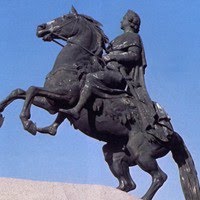
During Medieval sculpture (c.300-1000), little if any bronzework was attempted, not even in Eastern Byzantine art due to the ban on figurative works. And since the sculptural decoration of churches and cathedrals during the era of Romanesque sculpture (c.1000-1200) and Gothic sculpture (c.1150-1280) relied on stone for their statuary and reliefs, rather than bronze, the European tradition lay dormant until the era of Renaissance art (1400-1530). It was however maintained in Chinese art throughout much of this period, and also in South India by the Tamil-based Chola dynasty (c.850-1279) whose bronze casting was one of the high points of sculpture and painting in India, of the period. See also: Chinese Buddhist Sculpture (c.100-present). The new practitioners of Renaissance sculpture, often goldsmith-trained, included the Florentines Lorenzo Ghiberti (1378-1455) - noted for the Gates of Paradise on the door of the Florence Baptistery - and Donatello (1386-1466) whose David (c.1440) remains one of the greatest works of Christian art ever produced. As stone sculpture (marble) staged a comeback in the hands of Renaissance sculptors like Michelangelo and Baroque artists like Bernini, it was left to the likes of Andrea del Verrochio (1435-88), Benvenuto Cellini (1500-71), Giambologna (1529-1608) and Francois Girardon (1628-1715) to provide much of the innovation in both monumental and small-scale works. After this, the greatest Neoclassical sculptors were the creators of the three finest heroic equestrian statues of the 18th century: Andreas Schluter (1660-1714) who sculpted the Statue of Frederick William The Great (1708, Charlottenburg, Berlin); Etienne-Maurice Falconet (1716-91) who created "The Bronze Horseman" (1766-78, Decembrist Square, St Petersburg); and the Austrian Franz Anton von Zauner (1746-1822) who cast the bronze Equestrian Statue of Joseph II (1806, Josefplatz, Vienna). Nineteenth century bronze casting was dominated by the French naturalistic artist Auguste Rodin (1840-1917), while the finest 20th century sculptors included Constantin Brancusi (1876-1957) noted for Sleeping Muse (1910); Umberto Boccioni (1882-1916) who created the Futurist-style Unique Forms of Continuity in Space (1913); Alexander Archipenko (1887-1964) famous for his avant-garde Cubist-style works; Ossip Zadkine (1890-1967) who cast the striking Destroyed City (1953); Henry Moore (1898-1986) noted for his organic/biomorphic abstraction; and Alberto Giacometti (1901-1966) famous for his signature "stick figures". See also the hyperrealist bronze figures of Carole Feuerman (b.1945).
Techniques of Bronze Sculpture Numerous casting processes may be used when making bronzes. Chief among them are the lost-wax casting method (including investment casting), sandcasting and centrifugal casting. The lost-wax casting method (cire perdu) involves a number of stages, as follows: (1) A full-size model of the work is created using a non-drying clay such as Plasticine. (2) Secondly, the artist makes a mold from the shape of the model. This is done by covering the clay model with a half inch thick layer of wax and then a much thinker layer of clay. (Sometimes the mold is used to make a plaster copy which can be stored for future use or worked on further.) (3) Thirdly, the wax model is then baked in an oven or kiln. During heating, the clay hardens and the wax is allowed to run off (exiting though a small hole in the outer clay). (4) The remaining clay mold is packed in sand and filled with molten bronze. (5) When the bronze has solidified and cooled, the clay is chiseled away to reveal the bronze sculpture. (6) Lastly, the inner clay model is scraped out from inside the bronze shell, using a small opening in the bottom. When creating a large sculpture, the artist typically creates one or more small study models to perfect the desired shape and proportions. He may then progress to a larger intermediate model before attempting to fashion the full-size sculpture. Measuring devices are often used to extend the dimensions of the intermediate model and ensure correct proportions. Previously, large 3-D bronze works were always cast in one piece. Now however, thanks to new welding processes, large sculptures can be cast in several parts and then welded together. Once the casting process is completed, the bronze statue can be finished off. In Ancient Greece, for instance, the metal would be smoothed and polished, and varnish applied to the yellowish surface of the bronze, so as to obtain the precise hue required. At this point other metals would be added in order to decorate specific parts of the statue's body. Thus, gold and silver might be applied to the lips, while coloured enamel or glass was typically inserted into the eyes to make them look real. Sometimes even thin strands of copper were used to represent eyelashes and eyebrows. Real jewellery might be added. After this, the statue would be painted. In Ancient Greece, sculpture - whether bronze or marble - was rarely left uncoloured. Artists applied colour pigments, including gold, to enhance the overall effect. Indeed, sculpture-painting became an independent specialist craft. See: Classical Colour Palette. Celebrated bronze statuary can be seen in many of the best art museums and sculpture gardens around the world. Masterpieces include: Classical Bronzes - Charioteer of Delphi (475 BCE) Archeological
Museum of Delphi. Renaissance Bronzes - Florence Baptistery South Portal Door
(1336) Gilded Bronze. Andrea Pisano. Mannerist/Baroque Bronzes - Perseus with Head of Medusa (1545-54)
Florence. By Cellini. Neoclassical Bronzes - Statue of Friedrick William The Great
(1708) Berlin. By Schluter. Modern Bronze Sculpture - David (c.1872) Musee d'Orsay. By Marius
Jean Antonin Mercier. 20th Century Bronze Sculpture - Sleeping Muse (1910), Metropolitan Museum.
By Constantin Brancusi. |
|
• For more about bronze casting, see: Visual Arts Encyclopedia.
ENCYCLOPEDIA OF SCULPTURE |