Auguste Rodin
Biography of 19th Century French Realist
Sculptor.
MAIN A-Z INDEX - A-Z of SCULPTURE

|
Auguste Rodin
|
|
EVOLUTION OF PLASTIC
ART |
Auguste Rodin (1840-1917)Contents • Introduction |
|
|
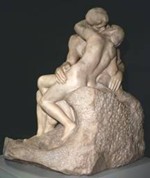
A central figure in the history and development of French sculpture, Auguste Rodin was arguably the final artist in the tradition which began with Donatello (1386-1466) and continued through Michelangelo (1475-1564), the Flemish Florentine Giambologna (1529-1608), and Giovanni Bernini (1598-1660). It was Rodin who repopularized sculpture and placed it on a par with painting. A master sculptor in all media, including bronze, stone, plaster and even wood, Rodin is noted for several outstanding masterpieces, including: The Age of Bronze (1877), The Walking Man (1877), St John the Baptist Preaching (1878), The Thinker (1881), The Burghers of Calais (1885-95), The Kiss (1888-9), Monument to Balzac (1898), and The Gates of Hell (1880-1917), his response to Dante's Inferno and Michelangelo's Last Judgement - which he worked on for much of his life. A giant of modern art, and arguably the greatest of all nineteenth century sculptors, Rodin's instantly recognizable works can be seen in his own museum in Paris (Musee Rodin), as well as a good many of the best art museums and sculpture gardens throughout the world. |
|
WORLD'S
BEST SCULPTORS |
|
MODERN PLASTIC ARTISTS |
Rodin was born in Paris in 1840, and in 1854 he enrolled at the Petite Ecole, which was an official preparatory drawing school for entry into the Grande Ecole or Ecole des Beaux-Arts. At the Petite Ecole he was taught by Horace Lecoq de Bois-Baudran, an inspiring teacher, who made his pupils draw from memory and copy eighteenth-century drawings. Rodin was only too good a pupil, and he absorbed the rococo style so well that he failed to satisfy the examiners at the Grande Ecole, who preferred academic art. He was told by others later that he was lucky to have avoided the Grande Ecole, but the consequence of failure was to cut Rodin off from the normal process of an academic training which was an almost indispensable requirement for official commissions. He was obliged to support himself by work for decorative sculptors while working for himself in the evenings. His menial work helped him to achieve great facility, but he regarded its purpose as too trivial, and his monumental ambitions had been stimulated by his work on the Loos Monument in Belgium in 1874. |
|
19TH CENTURY SCULPTORS |
|
|
In 1875, at the age of 35, he went to Italy for two months and was able to study Italian Renaissance sculpture at first hand, including the works of Donatello, Andrea del Verrocchio and Michelangelo. The confrontation with these masters confirmed his interest in character rather than ideal beauty, that had been foreshadowed in his Man with a Broken Nose of 1863, but more profoundly he absorbed Michelangelo's way of showing inner anguish and suffering through the gestures of the whole body. Rodin later described Michelangelo as the last of the great exponents of Gothic sculpture whose artists he contrasted positively with the serenity of the Greeks.
Rodin's early work had been admired by a number of connoisseurs, but his public reputation sprang from the exhibition of his first major bronze sculpture - the Age of Bronze - in 1877. It was originally exhibited under the title of the Vanquished, but his contemporaries were baffled by its apparent lack of subject. None the less Rodin quite clearly intended it to represent a man in the process of awakening as symbolic of primitive man's incipient feelings of conscience, the first triumph of reason over bestiality. The beautiful unfolding movement of the figure is achieved by showing different phases of the action as if they were taking place at one moment. The transition from somnolence to wakeful readiness begins with the legs. which are still unsteady with sleep, and moves through the stretched torso to the head and arms. which show the sudden dawning of the idea. The Age of Bronze clearly owes a lot to the Bound Slave from Michelangelo's tomb of Julius II (in the Louvre), but Rodin himself cited Rude's Marechal Ney as its true forebear, pointing to a comparable telescoping of the action from the moment that the Marechal draws the sword out of the scabbard. to the point of waving it in the air while exhorting his troops to advance. The illusion that one is seeing the movement actually being accomplished is created by showing different parts of the statue at successive moments. |
The same principle can be applied to his next major work, the St John the Baptist Preaching (1878), for which the Walking Man was originally a study. Rodin pointed out that if one took a photograph of a man in the process of walking, as Edward Muybridge had done, one would notice that at any given moment one foot or the other would be raised up from the ground. The St John has both feet firmly on the ground, while the torso leans forward; thus Rodin shows the forward movement in the process of being accomplished, while the strong arch formed by the legs gives the figure a powerful stability. Rodin also applied the principle of simultaneity to groups of figures, and he explained it by reference to Rude's Marseillaise. In Rude's work, instead of the parts of the body being in a different phase of the action at one time, the figures themselves carry out their actions at different moments but are still seen simultaneously. One looks first at the figure of La Patrie, who urges the troops to prepare for war. In the second phase the Gaul in uniform replies to the call by saluting her, while his son asks to join him; the third phase shows an old man putting on his armour while another offers advice, and in the final phase an archer limbers up as the clarion is sounded to send the spears forward into battle. |
|
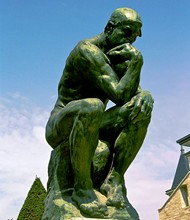
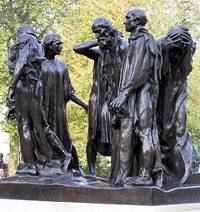
Similarly, in the statue Burghers of Calais (1885-95) each of the six burghers can be seen as representing the thoughts and gestures of one man at a moment of heroism. The group commemorates six citizens of Calais who offered themselves as hostages to Edward III to lift the siege of their town in 1447. The commission was originally for only one figure, of Eustache de Saint-Pierre their leader, but Rodin decided to show all six burghers so that the work would commemorate their communal heroism, and at the same time show true heroism as something that requires the overcoming of ordinary fears and regrets. The principal figure is Eustache de Saint-Pierre, who is the first one to volunteer, and it is to his example that the others react. The man to his left holding the key, expresses the humiliation of his city's surrender, while behind Saint-Pierre a man shows hesitancy and fear; behind the man with the key another has surrendered to despair. To the right of Saint-Pierre a man passes his hand over his eyes as if seeing the spectre of death, while behind him a young man is thinking of all he is about to leave behind. All the figures are indecisive as they contemplate their decision, except Saint-Pierre, who because of his age has the least to lose. The sequence of the action is circular because it begins with Saint-Pierre's resolute step forward, and passes through the varying emotions of the other figures and back again to him as they make their decision to go forward. The relief sculpture Gates of Hell were commissioned in 1880 for the Louvre, four years before the Burghers of Calais, but they were never fully completed, and Rodin used the groups that he designed for them as separate compositions in marble or bronze. The Gates of Hell express a more symbolic vision, which reflects the instability of modern man, his lack of absolutes and spiritual fixed points, and his eternal state of desire with no hope of fulfilment. The Poet or Thinker presides over this huge secular Last Judgment, which owes so much to Baudelaire's influence. He gradually lost interest in the Gates, and in later years he began to adopt a more restrained 'Phidian' style, which superseded his earlier 'gothic' style. He continued to depict the human body in vivid studies in clay and outline drawing, but these works were rarely exhibited, although they are now much more to contemporary taste than his rather pretentious late marbles. He saw himself as a conservative upholding the values of a decaying civilization, but the spontaneity of his late studies and his exploitation of the fragment made a vital contribution to the art of the twentieth century. As one of the few authentic masters of modern sculpture, Rodin saw himself as the successor to his iconic hero Michelangelo, although the Florentine was a carver while Rodin was mainly a modeller. He was a passionate admirer of the Gothic architecture of French cathedrals, from whose heroic reliefs he gained much of his inspiration, and his impact on the history of art was greater than any sculptor since the Renaissance. The Thinker (1881, Musee Rodin, Paris) A part of The Gates of Hell, The Thinker was situated at the centre of the lintel in the original project. Like his creator, de it Dante or Rodin, he was watching the degradation of the inferior world. His prominent muscles are tensed in the extreme and his concentration is highly visible. However, The Gates of Hell remaining uncompleted, The Thinker became an independent statue. Cast on a larger scale in 1902 - the same year that Rodin was photographed by the American artist Edward Steichen in the pose adopted by The Thinker - it was exhibited at the Salon de la Societe Nationale in 1904. The work was placed in front of the Pantheon in Paris in April 1906 and became the first sculpture by Rodin to be erected in the French capital. In 1922, it was transferred to the gardens of the Hotel Biron, former residence of the sculptor, which had been converted into the Rodin Museum in 1919. Rodin's appetite for work was paralleled by his desire for women, and he surrounded himself with a number of models and students, including the American sculptor and art-collector Gertrude Vanderbilt Whitney (1875-1942). In the final months of his life, he married his lifelong companion Rose Beuron at the age of 77. She died two weeks later, and Rodin himself nine months later. Auguste Rodin and Camille Claudel It is not easy to separate the contribution and work of Camille Claudel from that of her lover and mentor Auguste Rodin. Both as an assistant and a model she helped to create many of his masterpieces. It is even feasible that he appropriated some of her own creative ideas. Like many sculptors who worked with him it was difficult for her to escape from his giant shadow. However suggestions that she was exploited by him have been exaggerated, and she worked throughout her career in a style that was essentially created by Rodin. Her skills as a sculptor were well-developed before she met Rodin in the early 1880s. Their intense creative and personal relationship continued until 1898 but eventually foundered on his refusal to abandon his older mistress Rose Beuron. Claudel's bitterness was expressed in the obviously autobiographical three-figure group entitled The Age of Maturity. Rodin continued to offer support for Claudel's career after the end of their affair, but in 1913 her deteriorating mental health led to her entry into an asylum, where she remained for the remaining 30 years of her life. Rodin inherited the contradictions that were implicit in the situation of 19th century sculptors: he was the last important artist to try to create a style out of a synthesis of other styles. He sought the vivacity of Jean-Baptiste Carpeaux (1827-75), but also the seriousness of Francois Rude (1784-1855), the inward anguish of the Gothic combined with the open sensuality of classical Greek sculpture. As a realist, he wanted a form of art that would be immediately comprehensible to everybody, but as an admirer of Baudelaire, he wanted to express man's intangible desires. No one was more aware of this conflict than he himself, but he repeatedly sought to win commissions for public art in an attempt to revive the public monument as an art form. NOTE: Rodin was also a highly talented watercolourist, whose paintings were showcased in several galleries, including "291", owned by the photographer and modern art dealer Alfred Stieglitz (1864-1946), who gave Rodin his first one-man show in New York.
|
|
• For the history and types of sculpture, see: Homepage.
Plastic
Art |