Public Art
Architecture, Sculpture, Painting and Decorative
Designs for the General Public.
MAIN A-Z INDEX

|
Public Art
|
|
|
Public Art
|
|
Wrapped Reichstag, Berlin (1995) WHAT IS ART? |
|
The Spire of Dublin, The Spire of Dublin is 120 metres HISTORY OF VISUAL
ARTS |
Most of the public art which has survived from Antiquity consists of various types of stonework - that is, funerary monuments, statues and other religious or architectural sculpture. Today, however, the category of public art includes a huge range of works from the fine, decorative and plastic arts. As well as architecture and sculpture, it includes painting, stained glass, ceramics, mosaics, and tapestry, as well as numerous forms of contemporary art, such as Earthworks, Assemblage, Installation art and Performance (along with its associated Happenings), to name but a few. It includes transient displays, such as Andy Goldsworthy's Snowballs (London, 2000), temporary exhibitions (eg. Faberge Eggs), or temporary architectural constructions to celebrate particular events (eg. the Millennium Dome in London). Locations & Sites For Public Art Sites for municipal art are typically located in urban centres and may include squares, plaza or pedestrian areas, main thoroughfares, the approaches to public buildings such as government offices, law courts, municipal utilities and transport centres, airports, museums and libraries, university or college campuses and so on. In addition, public artworks may be sited inside national or local government offices, as well as churches or other public places of worship. Some public artworks (environmental earthworks) may be located in remote areas; other types of public art (holograms, firework displays) may be projected onto the night sky. Computer art is becoming an integral feature of the latter. |
|
PUBLIC
ARCHITECTURE CATEGORIES OF ARTS |
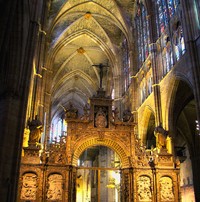
History of Public Art: Origins Greek cities were early advocates of the edifying virtues of religious and social art (predominantly sculpture), capable of being viewed and appreciated by the community at large. A supreme example of public art in Ancient Greece is the Parthenon (c.447-422 BCE) on the Acropolis at Athens. Later, Roman authorities erected mass-produced statues of the Roman Emperor in all corners of the empire, in order to demonstrate the majesty of Rome. This concept of communal aesthetics or propaganda was vigorously implemented by Pagan as well as later Christian communities. The Roman church, influenced by the Eastern Church, produced the glorious Ravenna mosaics, while Rome celebrated the end of the Dark Ages with the construction of great medieval, romanesque and gothic-style cathedrals of France, like Chartres, Rheims, Amiens and Notre Dame de Paris. Adorned with beautiful religious art including statues, mosaic art, relief-sculpture, altarpiece art, and stained glass art, these monumental buildings were public works of art, designed to inspire the community with their grandeur beauty andreligious devotion. For details, see Medieval Sculpture (400-1000); Romanesque Sculpture (1000-1200) and Gothic Sculpture (c.1150-1280). Renaissance Public Art (c.1400-1600) But undoubtedly the golden era of public art was the Italian Renaissance, whose artworks - unlike those of the Northern Renaissance - were sponsored entirely by the church or civic authorities. Giotto's Scrovegni Chapel frescoes at Padua, Donatello's bronze statue David, and Michelangelo's marble sculptures Pieta and David, bear witness to this upsurge in Christian art. |
|
|
Baroque Public Art (c.1600-1700) The 17th century witnessed the last great religious propaganda campaign, waged by the Catholic Church to regain its majesty and authority following the Reformation. This Catholic Counter-Reformation used a dramatic style of Baroque art in its architecture (eg. the renovated St Peter's Basilica Rome, and its approaches), and an inspirational form of Biblical art in its sculpture (eg. The Ecstasy of St Teresa, Cornaro Chapel, Rome, by Bernini), and in its paintings (eg. works by Rubens, Caravaggio and Velazquez) in order to communicate its message to churchgoers across Europe. During the 18th and 19th centuries, partly due to the reduction in patronage by the Catholic Church, public art in the West was largely confined to the commemoration of Bishops, Kings and other secular heroes (eg. Nelson's Column in Trafalgar Square London, or the Arc de Triomphe in Paris), and new works of urban architecture. In America, this was exemplified by public architectural masterpieces like the Capitol Building and the Smithsonian Institute in Washington DC; St Patrick's Cathedral New York (1858-79, by James Renwick); The Statue of Liberty New York Harbour (1886, designed by Frederic-Auguste Bartholdi). (See: American Architecture for more details, and for designers, see: American Architects.) In Europe public art was exemplified by a wide range of structures such as the Neo-Classical National Gallery London; the spectacular Neo-Gothic UK Houses of Parliament (1839-52, designed by Sir Charles Barry); Paris Opera House (1860-75, designed by Charles Garnier); the Eiffel Tower (1887-89), designed and engineered by Gustave Eiffel (1832-1923) and Stephen Sauvestre; and many others. See also: 19th Century architecture. Public Art During the 20th Century Political Art As stated above public art during the 20th and 21st century has dramatically widened in function, form and media. Political developments have widened the function of public art for propaganda purposes. Perhaps the most blatant modern example of public art being used for political purposes concerns the Socialist Realism art movement, launched in Soviet Russia by Joseph Stalin to support the country's drive for industrial self-sufficiency after 1927. Socialist Realism aimed to glorify the achievements of the Communist regime through a ubiquitous display of monumental heroic style posters, painting and sculpture.
In Mexico during the 1920s and 1930s, painters like Diego Rivera (1886-1957), David Alfaro Siqueiros (1896-1974) and Jose Clemente Orozco (1883-1949) helped to create the Mexican Murals movement, during which public buildings were decorated by large-scale fresco painting, typically with a nationalist political message. Art forms promoted by the Chinese authorities before, during and after the Cultural Revolution (1966-68) also fall into this category of overtly political public art. And sometimes, urban art forms such as street murals are created as a protest by minority groups against certain laws or political authority. During the 1970s and 1980s, the cities of Belfast, New York and Los Angeles witnessed this type of public art, which was designed to reinforce a political agenda. Land Art Arguably the most novel form of 20th century public art, Land Art is exemplified by the monumental earthworks, such as Spiral Jetty created in Utah (1970) by Robert Smithson, and the encirclement of eleven Florida islands in pink fabric (1983) by Christo and Jeanne-Claude (b.1935). Architecture Arguably the most open and available type of public art, 20th century building design has been dominated by Skyscraper Architecture, shaped by ever taller towers. Graffiti This term, derived from the Italian word 'graffio' meaning, to scratch, refers to illicit 'street art' sprayed or painted on buildings, in public urban areas, by freelance 'street artists'. Probably the four most famous street painters are Keith Haring (1958-90), Jean-Michel Basquiat (1960-88), Banksy (b.1973-4) and David Wojnarowicz (1954-92), all of whom have enjoyed mainstream commercial success. One of the new contemporary art movements, graffiti street art includes territorial graffiti, aggressive guerrilla art (now referred to as 'post-graffiti art'), and stencil graffiti. By comparison, the term 'street art' encompasses traditional graffiti imagery, as well as wheatpasting, sticker/street poster art, video projection, and street installations. It is commonly employed to differentiate contemporary public-space artwork from territorial or guerrilla graffiti, and visual vandalism. Neither of these forms of freelance 'artwork' fall within the definition of government sponsored Public Art. For more, see Graffiti Art. Traditional Recent public art has also included traditional works such as commemorative sculpture, architectural sculpture (eg. Ian Ritchie's Spire of Dublin known as 'the spike'), pure sculpture (eg. the Chicago Picasso), murals (eg. the UN building's tapestry copy of the oil painting Guernica (1937) by Pablo Picasso).
Contemporary Public Art Famous contemporary exponents of public art include the following artists (works): Louise Bourgeois (Maman, 1999, Guggenheim Museum Bilbao); Jean Tinguely (Stravinsky Fountain, 1983, Pompidou Centre forecourt); Claes Oldenburg (Apple Core, 1992, Israel Museum, Jerusalem); Bruce Nauman (Green Light Corridor, 1970, Samuel R Guggenheim Museum NY); Richard Serra (Tilted Arc, 1981, Federal Plaza, New York); Mark Di Suvero (Storm Angel, 1973-4, Square Chabas, Chalon-sur-Saone); Antony Gormley (Angel of the North, 1994-8, Gateshead, UK); and Anish Kapoor (Cloud Gate, 2004, Millennium Park, Chicago). Percent For Art Schemes In recent times, municipal authorities have developed new fund-raising policies, relating to the construction of publicly financed buildings, namely the Percent for Art Scheme. This typically involves the reservation of 1 percent of the construction costs of the project (up to a fixed maximum amount), for the purchase of artworks which are then displayed to the public. |
|
Art Museums - The Greatest Modern Public Art Arguably the finest public art of the modern era comprises the global network of public museums and art galleries. These institutions provide two quite separate artistic benefits to the community. First, they can have exceptional architectural beauty, as exemplified by the Pompidou Centre in Paris, or the Bilbao Guggenheim.
Collections As well as their architectural beauty, museums hold huge collections of prehistoric art, paintings, sculptures, prints and other works on paper, ceramics, mosaics, glass art, metalwork, tapestries, illuminated manuscripts and calligraphy, as well as contemporary forms like Assemblage, Installation and Video art. Among the best art museums with the greatest collections of art open to the public are: The Uffizi Gallery Florence, The Hermitage Museum St Petersburg, the Louvre Museum Paris, the Prado Madrid, the Pinakothek Museum Complex Munich, the Victoria and Albert Museum London, and of course the Metropolitan Museum of Art, the Samuel R Guggenheim Museum, and the Museum of Modern Art in New York. |
|
|
|
• For more information about community or municipal art, see: Homepage.
Art
Glossary |