Stained Glass Art
Stained Glass Art: Manufacture, Characteristics,
History.
MAIN A-Z INDEX

|
Stained Glass Art
|
 The Geneva Window (1929) by Harry Clarke, Ireland's most famous stained glass artist. |
Stained Glass ArtContents • What is
Stained Glass? |
|
VISUAL ARTS CATEGORIES |
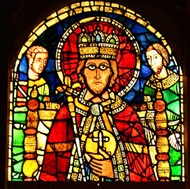
In visual art, the term 'stained glass' commonly denotes glass to which translucent colour has been added during manufacture: a process which reached its apogee in Gothic architecture, in the pictorial narrative windows of the great Christian cathedrals such as Chartres, Reims and Notre Dame de Paris. (See also English Gothic architecture 1180-1520.) Indeed, the craftsmanship of the stained glass artists who created such medieval masterpieces as the Rose window in the west front of Chartres Cathedral has rarely been equalled, an extraordinary situation given that stained glass manufacture is now easier, and that essential materials like sand, limestone and sodium - as well as metallic oxide colouring agents like copper, cobalt, iron, nickel and lead - are more readily available. Modern knowledge of stained glass chemistry is also far superior. As well as church windows, the term also encompasses the creation of other types of stained glass, including panels, domestic windows as well as three-dimensional shapes and sculpture. Today, stained glass art can be seen in some of the world's best art museums in Europe and America. |
|
|
|
HISTORY OF VISUAL
ARTS WHAT IS ART? COURSES IN STAINED
GLASS |
Characteristics
- How Is Stained Glass Made? Most glass is manufactured from a mixture of sand (silicon dioxide), limestone (calcium carbonate) and sodium carbonate - a mix known as soda-lime-silica. In medieval times, metallic oxide chemicals were added to the molten mix in order to produce the required colours. For example, the addition of copper produced blue and/or green; cobalt produced purple-blue; chromium produced chrome green or yellow; manganese or nickel produced violet; lead produced pale yellow; the colour red was more difficult to obtain, gold being the usual additive. Tonal variations of these colours were created by varying the basic soda-lime-silica mix and the amounts and combinations of colouring agent. This molten liquid was then processed using the 'cylinder method' during which it was blown then formed into a large cylindrical shape before being flattened into thin coloured sheets. These sheets were then cut into small pieces from which the artist would assemble (jigsaw or mosaic-style) his intended stained glass pictures, using strips of lead to connect the separate panes. Final enhancements might be made by adding stains or paint to the inner surface of the finished window. For example, colour enhancements were achieved using stains such as silver nitrate, 'Cousin's rose,' and (later) various types of enamel, while facial and other figurative details were painted directly onto the inner surface of the glass using a special glass paint consisting of a mixture of lead or copper filings, gum arabic, and a medium such as vinegar, wine, or even urine. When installed, the window might be given extra support through the use of iron rods and metal frames known as ferramenta. |
|
|
|
|
As well as supervising the entire manufacturing process, to ensure the integrity and correct pigmentation of the glass, the artist (in practice, a team of artists) was also responsible for the design, composition and effects of the stained glass window. Typically, he began with a series of charcoal sketches, or cartoons (drawings) of the design. From these, a series of full-size cartoons or design-plans were made, which were usually drawn directly onto the surface used for cutting, painting and assembling the glass mosaic. Special attention was paid to the exact details and colour scheme of the pictorial narrative to be depicted in the window. It might illustrate a Biblical episode from the Old or New Testament, the lives of the prophets or Saints; an event from the life of Christ, or the Holy Family. Additional symbols or motifs, identifying the individual or guild who was paying for the window, were also commonly included. All this required careful pre-planning before construction commenced. In addition, to ensure the optimum colour scheme for the stained glass, the artist had to assess the angle, amount and intensity of the light which would pass through it. For example, bright light required stronger, darker colours. This had to be balanced against the need for colour contrast, as well as the need to provide for differing light levels according to the time of day and the seasons. In short, stained glass artistry encompassed architectural design, glass manufacture, colour chemistry, cloisonne enamelling and a dozen other arts and crafts. Stained glass was a popular element in late Medieval art (c.1000-1400). It appeared during the era of Romanesque Art (c.1000-1200) before becoming an essential feature of the 'soaring' Gothic style of architecture (1150-1375). During this time, architectural advances facilitated even larger areas of glass and afforded greater elaboration of structure. This process reached its height in the Flamboyant style in Europe and the Perpendicular style in Britain. At the same time, glass design became more daring, painting became more intricate, like easel art, and improvements in silver stain allowed the artist to depict yellow hair and golden garments more realistically. The Golden Age of Gothic Stained Glass As a unique form of religious art, stained glass reached its apogee during the era of Gothic art during the 12th and 13th centuries. This development was the result of a discovery in engineering - a vaulted roof supported not by walls but by pillars. Having learned how to build a roof without walls, the Gothic architect was free to do what he liked with the spaces between the pillars, the areas which hitherto had been filled by walls. The discovery could never have been made in southern Europe, where one of the architect's duties was to keep the strong sunlight out. In the North he needed all the light he could get, and he welcomed the opportunity of turning his new dummy walls into window frames. What the wall was to the Byzantine the window became to the northern Gothic builder - an excuse for introducing colour. Here the Gothic artist was faced with a problem similar to that of the Byzantine mosaicist. He had to work in a medium that imposed its own laws on him. Smallish pieces of coloured transparent glass held together by narrow bands of lead made an excellent basis for colour decoration but were incapable of producing realism. The problem was one of pattern and colour-organization with a minimum of representational accuracy or narrative interest. Naturally iconography could not be kept out, for the church demanded it, but one cannot feel that the stained-glass craftsmen of the thirteenth century took their iconographical duties very seriously. It is impossible to regard the windows of Chartres as an illustrated Bible, as one can easily do in the case of the contemporary mosaic art in the Narthex of St Mark's in Venice. In Chartres the colour is too intense, the patterning too insistent. One cannot comfortably 'read' Gothic windows. One has to let them evoke a mood. They do so quite overpoweringly, but since the representational factor plays so small a part in their impact on the senses they can be justifiably ignored in this account of Gothic art. By the time artists had learned to treat the windows as a surface to paint a picture on, the Gothic spirit was dead.
|
|
Famous Gothic Stained Glass Windows Intended to inspire and educate the largely illiterate population in the Gospel scriptures, these translucent gems of Christian art also brought a huge amount of light into previously dim places of worship, and reinforced the image and power of the Church in Rome. Famous stained glass works of Biblical art include the Rose Window and Life of Christ Window at Chartres Cathedral, the north transept rose window at Notre Dame Cathedral Paris, the Crucifixion Window at Poitiers Cathedral, the Rose Window at Strasbourg Cathedral, the Prophet Windows at Reims, the Ascension Window at Le Mans Cathedral, the Daniel Window at Augsburg, the windows depicting The story of the Magi and The Descent of Christ from Adam at Canturbury Cathedral, the St Benedict Window at York Minster, and The Mucha Windows at Saint Vitus Cathedral in Prague. Although a significant amount of religious stained glass was lost in Britain during the Reformation, it continued to be produced in France (at Limoges) and in Italy (at Murano) most of it in the Classical style - witness the Early Renaissance 15th century glass in Florence Cathedral, designed by Paolo Uccello, Donatello and Lorenzo Ghiberti - until production was halted by the French Revolution. However, during the High Renaissance the medium declined in artistry as windows became mere transparent glass covered in paint, a process which only improved around the time of the Catholic revival (c.1810-1920) in England, which created a greatly increased demand for stained glass art. Scientists rediscovered some of the medieval stained glass techniques and colouring methods. Leading English designers during this period included William Morris (1834-1898), who championed the Arts and Crafts Movement (c.1862-1914), and Edward Burne-Jones (1833-1898). Modern art glass, which incorporates all forms of stained glass - including sculpture, stems from developments in America in the late 19th century, which duly spread to Europe. One of the first stained glass studios in America was set up by the English Bolton Brothers. Other successful American innovators included John LaFarge and Louis Comfort Tiffany. In Europe, art schools like the Bauhaus introduced glass design into the syllabus, while in America the architect Frank Lloyd Wright (1867-1959) created a number of superb glass windows. In Ireland, stained glass was revived by Harry Clarke RHA (1889-1931) - whose important works include The Eve of St Agnes (c.1923) and The Geneva Window (1927) - Sarah Purser (1848-43) of An Tur Gloine, and Evie Hone (1894-1955). After the revival of studio ceramics and other craft media in America during the 1950s, studio glass art and glassblowing was developed by Harvey Littleton. In 1962, in partnership with Dominic Labino, Littleton opened a famous glass workshop at the Toledo Museum of Art in 1962. Other glass artists included Charles Connick, William Willet and Nicolai D’Ascenzo. For examples of postmodernist glass art, see the installation of Holocaust art by Judy Chicago, entitled "The Holocaust Project: From Darkness into Light"; and the computer generated stained glass window (2007) for Cologne Cathedral, designed by Gerhard Richter (b.1932). |
|
• For more information about stained glass craftsmanship, see: Visual Arts Encyclopedia.
ENCYCLOPEDIA OF ART |