Harry Clarke
Irish Stained Glass Artist, Illustrator
and Painter. Biography.


|
Harry Clarke |
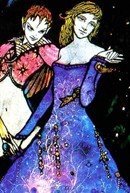 Geneva Window (1929) (Stained Glass). A masterpiece of Irish decorative art. |
Harry Clarke (1889–1931)Harry Clarke - the greatest of all Irish exponents of stained glass art, as well as a talented painter and a master of illustration - was born in Dublin, the son of a church decorator and supplier of stained-glass, at a time when the latter art form was undergoing a rebirth due to the establishment of the An Tur Gloine studios by Sarah Purser, Clarke studied briefly at (what is now) the Royal College of Art in London. However, most of his artistic technique was gleaned either from his father's workshop or at Dublin Art School night classes. The Irish international Exhibition (1907) provided his first glimpse of Aubrey Beardsley illustrations, and works by Dante Gabriel Rossetti (one of the leaders of the Pre-Raphaelites) and the Continental Symbolists. In 1910, in a Board of Education National Competition, his early work entitled The Consecration of St. Mel, Bishop of Longford, by St. Patrick was awarded the gold medal for stained glass. (See also: Stained Glass Art: Materials & Methods.) |
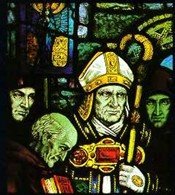 The Consecration Of St. Mel, Bishop Of Longford, By St. Patrick (1910) (Stained Glass) |
 |
Inspired to enter several prestigious London art competitions, he won a number of gold medals after which exhibited his glass works in Germany. A visit to see the Rose window and other treasures at the great Gothic cathedral at Chartres, in 1914, provided further inspiration. In 1915, he received the commission for the windows for the Honan Chapel in Cork. The result was a Byzantine masterpiece, with overtones of Russian and Greek Orthodox art, as well as a noticeable Beardsley imprint. The rest of his tragically short life was spent producing almost 150 stained glass works for secular and religious patrons - Catholic as well as Church of Ireland - exemplified by the Queens series (1917), the Eve of St Agnes (now in the Hugh Lane Gallery) and the controversial Geneva Window - illustrating top Irish artists like WB Yeats, AE Russell and JM Synge - commissioned by the Irish Free State as a gift to the League of Nations in Geneva. |
|
Interestingly, his most viewed creation was probably the window for Bewley's Café on Dublin's Grafton Street. His stained glass was particularly informed by the French Symbolist movement. During this period he also won the 1924 gold medal at the Tailteann Festival (Aonach Tailteann). Throughout his career as a glass artist, he remained a consummate perfectionist while experimenting restlessly with the material and chemicals of his trade. Irish artists influenced by Harry Clarke include his contemporaries Evie Hone, Wilhelmina Geddes and Michael Healy. Illustration In addition to his mastery of stained glass, Harry Clarke was also one of the great book illustrators in Irish art, comparable with Aubrey Beardsley, Edmund Dulac and Kay Nielsen. Influenced by the Art Nouveau and Art Deco styles, he produced numerous works or part-works, including illustrations for The Rime of the Ancient Mariner by Samuel Taylor Coleridge, and The Rape of the Lock by Alexander Pope. In 1916, he illustrated Hans Christian Andersen's Fairy Tales and Edgar Allan Poe's Tales of Mystery and Imagination. Clarke's later art included illustrations and imagery for Fairy Tales by Charles Perrault, Faust by Goethe and Selected Poems of Algernon Charles Swinburne. Most Expensive Work by Harry Clarke The auction record for a work by Harry Clarke was set in 1997, when his set of 9 stained glass panels, entitled Queens, was sold at Christie's, in London, for £331,500. |
|
More Information About Visual Arts in Ireland • For details of other stained glass
craftsmen, see: Irish Artists: Paintings
and Biographies.
History
of Irish Art |
