Visual Arts in Dublin
Painting, Sculpture, Printmaking, Photography
in Ireland's Capital City.
MAIN A-Z INDEX - A-Z of IRISH ART

|
Visual Arts in Dublin
|
 Image of James Joyce (1978) by Dublin artist Louis le Brocquy. |
Dublin Visual Arts & CultureThe Dublin Region, previously a County, is the area of Ireland that contains the city of Dublin (the capital of the Irish Republic) and surrounding urban counties. It is situated on the east coast of Ireland in the province of Leinster. It is the third smallest county in Ireland but has a population of 1.5 million. The City of Dublin (from the Irish "Dubh Linn" meaning black pool) is over a thousand years old, and is located at the mouth of the River Liffey. Today, Dublin is the most important centre of visual arts in Ireland as well as a major cultural and commercial centre within Western Europe, home to many of the top Irish art galleries, cultural venues and art schools, as well as numerous examples of public art including the architectural sculpture The Spire of Dublin, known as the 'spike', created by Ian Ritchie. |
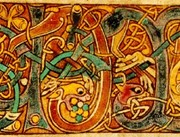
Detail Showing The Heads of Lions |
|
For facts about top prices for |
Early Celtic Arts in Dublin The National Museum of Ireland (NMI) and Trinity College (TCD) are the home of numerous artistic masterpieces which trace the history of Irish art, and form a vital part of Irish cultural heritage. Art treasures at the NMI include: the Ardagh Chalice, the Derrynaflan Chalice, the Derrynaflan Paten, the Moylough Belt, the Petrie Crown, the Tully Lough Cross and the Tara Brooch, as well as the Broighter Hoard. Many of these treasures would have been lost but for the work of the Royal Irish Academy and the Royal Society of Antiquaries of Ireland. Works of art at Trinity College Dublin include: the Book of Kells (800) the most famous illuminated manuscript of the Hiberno-Saxon style or Insular art; the Book of Dimma (620); the Book of Durrow (670) and the Mulling Gospels. These early Christian artworks contain magnificent examples of Celtic designs, with various degrees of ornamentation including precious metals. |
Examples Wall of Light Summer (2005) by Dublin Study After Velazquez. Portrait of |
Growth of Visual Arts in Dublin Growing prosperity and cultural enlightenment in Dublin during the eighteenth century, led to a noticeable growth in the arts. The Royal Dublin Society was founded in 1731, the Royal Irish Academy in 1785, the Royal Hibernian Academy in 1823 - all of whom helped to foster Irish painting and Irish sculpture. This process continued in the later nineteenth century with the expansion of the Dublin Metropolitan School of Art (now the National College of Art and Design, NCAD) - one of the best art schools in Europe - the opening of the National Gallery of Ireland (1864), the National Museum of Ireland (1890), and the Hugh Lane Gallery (1908). In addition to these growing collections of traditional and modern artworks, more public art was commissioned: such as the sculptures of Oliver Goldsmith and Edmund Burke in Trinity College and the memorial to Daniel O’Connell, in O’Connell Street. |
|
CULTURAL PREHISTORY
OF DUBLIN THE MOST VALUABLE
VISUAL ART ART IN IRELAND |
|
NATIONAL PRINT MUSEUM IRISH HISTORICAL MONUMENTS |
Art & Culture in Dublin Today During the twentieth century, the birth of the Irish State added further stimulus to Dublin's cultural reputation, which has been nurtured over the years by successive governments. Today, a number of national initiatives in the arts and heritage continue the process. Bodies such as the Irish Department of Arts, Culture Ireland, and the Irish Arts Council provide a wide range of support for Irish art in general and Irish artists in particular. In addition, new Dublin institutions like the National Print Museum, the Irish Museum of Modern Art and the Chester Beatty Library, the Gallery of Photography (Temple Bar), the expansion of the collections of Irish Art, European Art, Drawings and Watercolours and Sculpture at the National Gallery of Ireland, and the enhancement of the Dublin City Gallery The Hugh Lane, have created a real renaissance in the city. This has led to significant growth in the number and quality of Dublin's art galleries, and enhanced opportunities for Dublin artists, painters and sculptors. The presence of numerous exhibition centres like the RDS, Ballsbridge has facilitated regular national art exhibitions, showcasing works from new and emerging artists. For example, see Dublin Art Fair. |
|
|
Handicrafts in Dublin Craftspeople and crafts within the Dublin area are funded through the Crafts Council of Ireland, based in Kilkenny. New Forms of Art The city is also the home of a new type of social painting activity, invented by Dublin artist Deirdre Geraghty, called Art Jam. Dublin Studios, Cooperatives and Art Groups The demand for affordable studio space and artistic facilities has fostered a number of cooperative artists groups in the Dublin area. Check online for up-to-date details. Here are a few possibilities. Art Alley,
Malahide Merrion
Square Artists Common
Place Studios Stoney
Batter Studio Broadstone
Studios Fire Station
Artists' Studios La Catedral
Studios Red Stables
Studios Talbot
Gallery and Studios Note: If you wish to promote an artists group in the Dublin region providing affordable art studio space for painters and/or sculptors, please contact us.
|
|
• For more information about Dublin-based
visual arts bodies, see: Irish Art
Organizations.
ENCYCLOPEDIA OF ART |