|
20th Century Visual Arts in Ireland
(c.1900-80)
By the end of the century, partly
coinciding with the Celtic Arts Revival, a new generation of Irish visual
artists began to emerge including Jack B Yeats (1871–1957), Beatrice
Elvery (Lady Glenavy) (1881-1970), Sean Keating (1889-1977), Maurice MacGonigal
(1900-1979) and Sean O'Sullivan (1906-1964), as well as the more internationally
minded Mainie Jellett (1897-1944) and Evie Hone (1894-1955).
After the birth of the new State in 1921,
20th
century Irish art was strengthened in numerous ways, not least by
greater investment in education and public arts facilities (eg. the Dublin
Metropolitan Gallery of Modern Art, founded after Hugh Lane). However,
a degree of isolation and cultural stagnation became evident - as reflected
in the dispute between the traditionalists versus the more avant-garde
Dublin artists: a dispute which culminated
in the formation of the Irish
Exhibition of Living Art (1943) to provide an alternative showcase
to the RHA for contemporary Irish painting.
More recent landmarks include the 'Troubles' in Northern Ireland, which
greatly impeded the development of an all-Ireland approach to art and
culture.
20th century Irish
sculpture fared no better. From the early 19th century to roughly
1950, most Irish sculptors devoted the bulk of their energy to commemorating
deceased bishops, politicians, soldiers and rebels. Not until the second
half of the 20th century did the subject matter widen sufficiently to
permit real opportunities for individual expression. See also: 20th
Century Irish Artists.
Irish
Art: Late 20th Century - Early 21st Century (c.1980-2008)
Despite the political and economic problems
of the latter part of the 20th century, the Irish fine art market continued
to flourish throughout the island, as evidenced by the growing number
of record prices achieved by Irish artists in auctioneers sales rooms.
In addition, during the 1990s, new funding and support structures for
professional painters and sculptors, along with the development of new
art galleries and commercial collections, created a new climate of cultural
opportunity and awareness. The Irish Museum of Modern Art (IMMA) was opened
in Dublin, and the Lewis Glucksman Gallery in Cork City, while three centres
were established to support sculpture, including the National Sculpture
Factory in Cork. At the same time, Irish art organizations like the Arts
Council began to pay particular attention to developing public access
to the arts in towns like Wexford, Waterford, Cork, Tralee, Listowel,
Mullingar, Limerick, Galway, Castlebar, Sligo, Monaghan, Drogheda and
Dublin, and most local authorities now employ specialist Arts Officers.
In addition, new legislation was introduced which abolished tax on the
artistic income of full-time artists. This measure considerably improved
the financial position of many indigenous painters and sculptors. It also
helped to attract numerous artists from overseas, thus strengthening the
visual arts skill-base in the country. See also: Contemporary
Irish Artists.
Also in the 1990s, thanks largely to
the National Lottery and the Percent For Art levy imposed on all major
building projects in the Republic, public art became a regular feature
of the Irish landscape - the most notable example being "The Spire
of Dublin", a granite and stainless steel architectural sculpture
known as 'the spike', designed by Ian Ritchie RA.
The 21st century began well for the Irish
art market. World record prices were set at Sothebys and Christie's
auctions for Jack B. Yeats, Willliam Orpen, John Lavery and William Scott
(1913-89), Louis le Brocquy (1916-2012), Sean Scully (b.1945), and Nathaniel
Hone (The Elder) (1718-84), among others. Meantime works by Francis Bacon
(1909-1992) smashed all records for contemporary painting. (For more details,
see: Most Expensive Irish
Paintings.)
For a personal view of the top contemporary
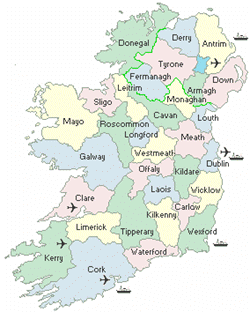
painters from the 32 counties of Ireland, see Best
Irish Artists.
Recession (2008 onwards)
Unfortunately, the health and
status of the visual arts in Ireland has suffered a severe set-back in
the wake of the recent international recession. Art sales fell significantly
in 2008, again in 2009 and the Irish art market is unlikely to show any
improvement in 2010. At the same time, commercial building - the basis
for the Percent For Art scheme - is massively down, and the overall art
budget has been reduced by 18.5 percent. Already 67 percent of artists
earn less than €10,000 per annum from their creative work: a situation
which is likely to worsen before returning to normal.
What Has Been
the Greatest Influence on Visual Art in Ireland?
Historically, the greatest single influence
(both positive and negative) on Irish art has been geography. For example,
the relatively sheltered position of the country ensured that Ireland
was the only Western European country to avoid Romanization, thus permitting
the full development of Celtic style design traditions. It also facilitated
the early growth of Christianity as well as the unique Irish monastic
culture (which duly spread to England and the Continent), both of which
(along with Celtic craftwork) were key factors in the Irish Art Renaissance
of 500-800 CE. Ireland's island status has also helped to inculcate a
strong national identity, without which the country's artistic traditions
would surely have been subsumed within those of its more populous neighbours.
On the negative side, Ireland's "sheltered"
position has also contributed to the country's isolation from European
trends and developments in all the visual arts. In addition, it contributed
to the immense power of a Roman Catholic Church which had no hesitation
in blocking artistic as well as social reform. As a result, even after
Irish Independence, many writers (eg. James Joyce and Samuel Beckett)
and visual artists (eg. Francis Bacon) preferred to practice their creativity
outside Ireland. In addition, it was only in the second half of the 20th
century that museums and galleries were allowed to widen their acquisitions
policies to include modern works, previously banned or frowned upon. Arguably,
all this retarded the developed and appreciation of art in Ireland by
many decades. Even today, for instance, Irish art-collectors appear to
place an unreasonably high value on Irish painting, compared to works
by "foreign" artists.
What is the Future
For Visual Art in Ireland?
On the positive side, there is no lack
of artistic talent in the 32 counties. Irish artists continue to excel
at home and abroad in all media and genres. Moreover, the country's "green"
image, neutral status, and zero-tax structure for artistic income, should
continue to hold and attract high quality artists.
On the negative side, as in other countries,
there has been a detectable slide towards conceptual and other non-representational
art forms. So far, this tendency has gone largely unchallenged - indeed,
judging by recent Graduate Art Shows in Ireland, it continues to be encouraged.
However, given the meltdown in the international contemporary art market,
as well as the rise in popularity of traditional painting - as practised
by many Eastern European schools - this conceptual/abstract approach may
prove to be a long term weakness. One hopes that the Irish arts establishment,
as well as the educational authorities at NCAD and the Crawford College
of Art and Design, have the situation under review.
The Importance
of the Internet For 21st Century Visual Arts in Ireland
A critical factor for the future of Irish
art in the twenty-first century will be how artists, curators and galleries
(among others) manage to exploit the Internet. For example, at present,
Irish art museums are way behind their international competitors in this
regard - it is still not possible to view the major Irish collections
of art online. By comparison, many American and European museums offer
a wealth of online educational resources. Given the huge wealth generated
by the Irish economy during the 1990s and 2000s, and also the significant
contributions to the arts from the National Lottery and Percent For Art
scheme, it seems strange that Ireland lags so far behind in this critical
area.
|