Illuminated Manuscripts
History and Design of Gospel and Other Biblical
Illuminations.
MAIN A-Z INDEX

|
Illuminated Manuscripts
|
|
DESIGNS OF THE ANCIENT
CELTS |
Illuminated Manuscripts (c.600-1200)Contents • Introduction Further Resources Note: According to radiocarbon dating tests, the world's oldest illuminated gospel manuscripts are the Ethiopian Garima Gospels (c.390-660 CE) and the Syrian Rabbula Gospels (c.586 CE). See also Early Christian Art (150-550). |
|
|
|
|
EVOLUTION
OF CELTIC ART |
|
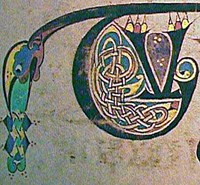
One of the most famous forms of Medieval art, Irish illustrated manuscripts like the Book of Durrow (c.650-680) and the Book of Kells (c.800), were some of the first decorated Christian gospel texts, dating from the early seventh century CE. In due course, they were followed by Medieval Christian artworks such as Carolingan and Byzantine illuminated manuscripts. Influenced by early illustrated texts from the Coptic Christians of Egypt, these illuminated manuscripts went on to influence Islamic art in the form of painted Persian manuscripts and calligraphic artworks. This Insular art form of book illustration, which emerged from a fusion of early Biblical art, traditional Celtic culture and design, with Anglo-Saxon techniques, took place as Irish missionaries, monasteries and monastic art spread across Ireland (eg. Kildare, Durrow, Clonmacnois, Clonfert, Kells and Monasterboice), Scotland (eg. Iona) and England (eg. Lindisfarne off the coast of Northumbria) in the seventh and eighth centuries. Ultimately, this Hiberno-Saxon style created some of the most outstanding works in the history of Irish art of the Middle Ages. |
|
|
These illuminated manuscripts were a mixture of religious text, copied from the bible, illustrated throughout by numerous decorative embellishments, of either abstract or representational art. Historiated letters, Celtic crosses, trumpet ornaments, rhombuses, pictures of birds and animals, were all used. Sometimes whole pages would contain nothing but illustrations. These so-called carpet pages would typically preface each Gospel and usually contained an intricate set of geometric or Celtic interlace designs, sometimes framing a central cross. These books were not all written in an identical style. Moreover, the artist monks who worked on them displayed varying levels of skill or familiarity with traditional Celtic art as well as Continental and Byzantine art. In general, Celtic artists were less comfortable creating representational art than they were with more abstract art. There is also considerable variation in the colours used both for the text and the illustrations. Some books were bound in leather, others in wood and leather. The amount of metalwork, in the form of clasps, attachments and other adornments also varied. Some religious manuscripts had none, others (eg. Lindisfarne Gospels) were adorned with gold and silver - even gems. The highly ornate manuscripts were typically used as ceremonial Bibles or Gospels. They would be kept on the altar, rather than in the monastery library, and would be used for reading aloud and in processions on feast days. Because of their religious significance as well as their precious metalwork, many of these books were extremely valuable and great efforts were made by the monks to preserve them from pillage. Some (eg. Codex Amiatinus), were even presented to the Pope. The golden era of Irish illuminated manuscripts was roughly 650-1100 CE. The more important books, all produced in Irish or Anglo-Irish monasteries, contained the Gospels or other holy scripture from the Bible, all written in Latin. To praise the word of God and to help educate and inspire the monasteries' growing flock of Christian converts these books had to be made as beautiful as possible. However, producing an illustrated book during the medieval era of the seventh, eighth, ninth and tenth centuries was no easy feat. Viking raids and freezing temperatures turned the making of these Celtic Christian artworks into an arduous, sometimes dangerous activity. Religious art of this type was decorated to varying degrees and in varying styles, and displays a wide variety of colour combinations. Some manuscripts used black or purple as a background for their folios (pages), others used lighter colours or no colour. Decorations might be created using different combinations of red, yellow, green, blue, violet, purple, and turquoise blue. Some even used gold text. Although over time much of the colour and beauty of these artworks has faded, they must have appeared dazzling to the monks and people of the day. Even now, the fantastic Celtic intricacy of the decorative spirals, rhombuses, carpet pages and miniature pictures testifies to the outstanding creativity of this early religious art. |
|
|
Each Page Hand-Made There were no printing machines during these medieval times, so each folio or page had to be written by hand, making each manuscript a unique piece of biblical art. Nor was there any paper, so all the text was copied onto animal skins - either vellum (derived from the Old French Vélin, for "calfskin") or parchment (from sheepskin). Lime was applied to the skin to remove its hair, after which it was stretched onto wooden frames to be dried and smoothed, before being cut and folded into sheets. Once the vellum or parchment was prepared, the monastery's calligraphers and scribes began the laborious task of copying the chosen religious text, word for word. Irish artists from among the monks would then begin the illustrations. Thus one manuscript might be worked on simultaneously by a group of monks, all under the supervision of a chief scribe. Novice monks typically did the mundane tasks of preparing the skins, making the goose quill pens, and mixing pigments for the artist-monks. The more accomplished of them might be permitted to paint basic designs, or to lay gold leaf. After some years of performing these low-level tasks, he would be assigned the responsibility of designing a page on his own. Meanwhile, the intricate embellishment of the holy manuscript would be undertaken by experienced scribes and artist-monks. It was painstaking work, with elaborate illuminations requiring weeks to complete. The size of the pages varied from book to book, but typically was about 12 by 14 inches. Moreover, the illustrations - especially in the more ornate and highly decorated manuscripts like the Book of Durrow, the Lindisfarne Gospels or the Book of Kells - were so detailed that they were only just visible to the human eye. Many of the most intricate designs were first sketched on a large wax tablet before being recopied in miniature onto the vellum. At the same time, other monks would be working on the design work of the book's cover, adding motifs or complex decorative patterns. These decorations would be further embellished by the addition of jewellery or precious metals (gold and silver). Typically, such lavish ornamentation was confined to books containing the Gospels, which would then be used on the altar for ceremonial occasions, or carried in procession on important Feast days during the religious calendar. When completed and also when being prepared, these valuable illuminated manuscripts were closely guarded within the monastery, to prevent their seizure by Viking and other marauders. Even so, many precious books were stolen or pillaged for their gems and precious metals. Monasteries along the coast were repeatedly attacked, and their devoted inhabitants butchered by Vikings. The danger of this happening often meant that some books (eg. the Book of Kells) had to be kept hidden for long periods, thus preventing them from being completed. |
|
Typical Content of Illuminated Manuscripts Most Gospel Books contained a certain amount of prefatory material, followed by the four Gospels. The introductory matter would often include a prologue by St Jerome relating to the Latin text. It also covered the arrangement of the Gospels themselves. During the medieval era, the verse and chapter divisions of the Bible had not yet been devised, making it hard for monks and priests to navigate around the text. Early Christian scholars tackled this problem in several ways, producing a variety of synopses and indexes. The most influential of these were the Canon Tables, which divided the text into numbered sections and enabled the reader to cross-refer from one Gospel to the next. The system was invented in the early 4th century by Eusebius of Caesarea, the biographer and personal adviser of Emperor Constantine. From an early date, these Canon Tables were presented in attractively painted arcades, becoming one of the focal points of the manuscript. Decorations
& Illuminations By convention, these four creatures also
referred to Christ's incarnation (the winged man), His majesty (the lion,
a regal beast), His role as the Saviour of mankind (the calf or ox, traditionally
sacrificial animals) and the Ascension (the soaring eagle). The most widely
accepted attribution of the symbols was laid down by St Jerome. He linked
Matthew with the winged man, Mark with the lion, Luke with the ox or calf,
and John with the eagle. Once again, however, the Celts did not fall into
line immediately with this proposal. In the Book of Durrow, for instance,
the lion was employed as the symbol of St John. Early Irish Illuminated Manuscripts in Context Of the wealth of Irish manuscripts which has come down to us from the early centuries of the Christian era (c.500-850), two in particular, the Book of Durrow (c.650) and the Book of Kells (c.800), stand as monuments of decorative art in that critical period in the history of West European culture. The former dates from the dawn of that rich flowering of Christian art in Ireland, the influence of which was to spread so far into continental Europe during the next two centuries; the latter, from the time at which this art had attained its fullest and most idiosyncratic development. Neither was completely cut off from what had gone before, nor from what was to follow. Still, no work of parallel quality in similar character to the former has come down to us. Both are distinctly different from the styles of Carolingian Art (c.750-900), Ottonian Art (c.900-1050), and the Italian High Renaissance (c.1490-1530), which stand historically between them and us. And, paradoxically enough, it is just the features which distinguish those two gospel-books from illuminated manuscripts nearer in time to our period that bring them closest to the live art of the present century. Today we find that the intensity, imagination and freedom with which the script in both these books is handled, the sharp, clear outlines of the illuminations and the epigrammatic concision of image are what particularly appeal to our taste. The characteristics which writers - schooled to a nineteenth-century view - criticized most sharply offer us little difficulty today: little that is aesthetically unfamiliar. For example, as Elfrida Saunders says in English Illumination. There is no attempt at representation of solidity and the colour is quite arbitrary. Hair may be painted blue or even different colours in stripes... An effect of broken colour is aimed at, even in figure representations: the clothes form either a harlequin pattern of patches or stripes of different colours... In these manuscripts, the same awkwardnesses due to an entire ignorance of linear perspective are seen as in early Egyptian tomb-paintings; a body is represented in full view while the sides and feet are shown; or a side view of the nose is placed on a face which is turned frontwards." Our present-day acceptance of such a free handling of compositional elements in visual art is the fruit of a struggle carried on during the first half of the 20th-century by artists who realized the importance of breaking from the strait-jacket of representational conventions inherited from the classical and Renaissance worlds, and the possibilities of expression such a liberation would open up. The Irish Abstract artists of the Book of Durrow, the Book of Kells and other related manuscripts came to this freedom of outlook naturally. It was part of their heritage. They had no strait-jacket out of which they had to break. At the western extremity of Europe, they had few links with classical Greece or Rome. Their art was a natural growth by assimilation. We recognize in the spiral designs and "trumpet patterns", so characteristic of it, the influence of their Celtic metal-working forbears. We see in the interlace, the fret and the ecclesiastical iconography, evidence of an acquaintanceship with Syrian and Coptic manuscripts, either brought to Ireland by the missionaries or seen by the scribes abroad. Later, in the interlaced animal motifs, we have an unquestionable response on the part of the Irish illuminators to the same features in Germanic or Celtic decoration - different as they become in their Irish adaptation from both these apparent sources. Basic to all this, and indeed the essential discipline of the Irish illuminator's art, is their scrupulous and individual script which they clearly regarded as an aesthetic expression in itself, not merely as a utilitarian vehicle. In no other part of Europe and at no other period of European art has script been treated with greater intensity, imagination, and freedom than in Anglo-Saxon Insular book illumination from the seventh to the ninth century. Here alone a level of perfection is reached that can be compared with Islamic or Chinese calligraphy; judged by this standard all pre-Carolingian continental book illustration looks poor and clumsy. "The significance of the Irish script as a cultural symptom", Professor Ludwig Bieler writes in Ireland, Harbinger of the Middle Ages, "emerges most clearly when its genesis is compared with that of other 'national scripts' of the early Middle Ages. All the others - the Visigothic script in Spain, the Beneventan script in southern Italy, the local types of the Merovingian kingdom, the Rhaetian and Alemmanic scripts in the districts of Chur and St. Gall, and the less characteristic scripts of northern Italy and western Germany - can be understood as attempts at normalizing the degenerate cursive script of late antiquity in the hope of thus producing a serviceable book-hand. The Irish script, it seems, was a deliberate creation out of elements of several scripts inherited from antiquity which the earliest missionaries had brought with them." Professor Luce points out the fusion which the scribes achieved in the assimilation of their heritage and their borrowings: "The script element taken over from the ancient world is integrated in an ornamental style that had been developed to a high point by the Celts of the Iron Age." And he stresses the fact that this ornamentation was an art in its own right and not, like later ornament, a mere accessory to figurative representation. This is the essential individuality of Irish illumination throughout its great period: the complete integration of every factor in the book, in spite of a jealous discreteness in each detail, given its character by discipline of the script. Even before the Book of Durrow, we have an austere exemplification of this in the Cathach of Saint Columba (c.610-620). This preciously conceived book boasts little ornament beyond simple hollow initials ending in small spirals and surrounded, in certain instances, by lines of dots which introduce each psalm. According to the paleographer Lowe, the Cathach "represents the pure milk of Irish calligraphy". And, while it is generally conceded to be the earliest specimen of national script in Ireland, it already announces in its integrity, its clarity and the concreteness of its detail, the great works (more colourful if no less intense) to come after it. Today the clarity, intensity and definition of these masterworks of Irish illumination (and of others such as the Book of Armagh, the Stowe Missal, and the Book of the Dun Cow) may come as a surprise to those who associate the term "Celtic" with the vague, the misty and the mystical, as the result of a concept which had its roots in the beginnings of the Romantic revival in the mid-eighteenth century and its exhaustion in the "Celtic twilight" movement of the 1890s.
Chronological List of Selected Illustrated Manuscripts From 795 onwards, murderous Viking raids on monasteries across Ireland, caused a constant exodus of monks, scribes and calligraphic artists to Christian monasteries and religious centres in Europe. Although this spread the Celtic style of illustration and decoration further afield, by the 11th/12th century, the numbers of Irish-based religious artists had gradually dwindled, leading to a decline in the quality of gospel illumination produced in the country. Codex Usserianus Primus Written around 600-610, and believed to be the oldest of all Irish manuscripts, its name derives from James Ussher, Archbishop of Armagh, hence it is also known as the Ussher Gospels. Its decorations are limited to linear and dot patterns in the colophons, and a single image - a cross outlined in black dots at the end of the Luke gospel. Cathach of St. Columba Now kept at the Royal Irish Academy, the Cathach of Columba (Colmcille) was completed around 610-620, and is the earliest surving manuscript of the Celtic Insular style of art. The name derives from the word 'cathach' meaning 'one who fights' and the manuscript was taken into battle as a lucky icon by the O'Domhnaill clan. Part of the text was supposedly written by Saint Columba himself. Book of Durrow Now at Trinity College Library, Dublin, the Book of Durrow (written c.650-80) is one of the oldest books still in existence. Styles of ornamentation employed, include Celtic spirals, tracery and trumpet ornaments. The spherical forms were not used merely as embellishment, but were interpreted in general as being symbols of the world because of the religious movement they illustrated. According to tradition, King Flann considered the Book of Durrow to be such a precious relic that he kept it in a specially made shrine-safe. Durham Gospels Now in the Durham Cathedral Library, the Durham Gospels were written in the late seventh century (c.680-90) by Lindisfarne monks, supposedly the same ones that created the Echternach Gospels. Antiphonary of Bangor Book of Lindisfarne/Lindisfarne Gospels Now at the British Museum, London, the Book of Lindisfarne was written between 690 and 720. Originally adorned with gold and silver, it was stated to be the work of Eadfrith, Bishop of the Lindisfarne Church, its later amendments were executed by the same scribes who corrected the Durham Gospels. The Lindifarne Gospels are considered to be second only to the Book of Kells in the quality and amount of embellishment. Echternach Gospels Now kept at the Bibliotheque Nationale, Paris, the Echternach Gospels (also referred to as the Gospels of Saint Willibrord) were written by a Northumbrian scribe between 690 and 715. Codex Amiatinus Now at the Biblioteca Medicea Laurenziana in Florence, the Codex Amiatinus was completed in Northumbria about 715. It is stated that Abbot Ceolfrith commissioned three ornamental Bibles to be written - one manuscript being for the monastery in Wearmouth, another for the monastery at Jarrow and a third to be presented to the Pope. The latter was taken by Abbot Ceolfrith on a pilgrimage to Rome in 716. The manuscript was lost during the journey and its subsequent history is largely unknown. However there is no doubting its authenticity. Parts of one of the other pair of Ceolfrith Bibles have also been found and are now lodged at the British Library in London. Book of Lichfield Now at Lichfield Cathedral Library, this manuscript (also known as the Gospels of St. Chad or the Lichfield Gospels) was written in Ireland about 730. The Irish connection is evidenced by its similarity with Irish and Northumbrian manuscripts. Book of Dimma Now lodged at Trinity College, Dublin, the pocket Gospel Book of Dimma was an early illuminated text, written in the 7th/8th century, with few decorations, mainly comprising illuminated initials and a few Evangelist portraits. It was written at the monastery at Roscrea, County Tipperary. The manuscript is particularly appealing for its ornate colours of yellow, pink, orange, green and blue, and its style which is comparable to the St Gall Gospel Book and the Echternach Gospels which was produced at Lindisfarne Library. Codex Aureus Now in the Kungliga Bibliotek, Stockholm, the Codex Aureus (similar in style to the Vespasian Psalter) was written at Canterbury in about 750, and is noted for its dazzling use of gold text. The unknown chief scribe was clearly a master of Byzantine art but a relative novice at Celtic artwork, although one of his assistants was more skilled at traditional Celtic design. St Gall Gospel Book The mid-8th century St Gall Gospel manuscript was written in Ireland before being taken to the monastery at St Gall by an Irish monk in the 9th century. The text comprises 268 pages and its illumination consists of Evangelist portraits with facing initial pages. It has a fully illuminated Chi-Rho and carpet page, and - unusually - has a last judgment page and a crucifixion page. Its rich abstract decoration (simple interlace, key patterns, spirals and entwined animals) mainly features the colours pink, mauve, yellow and blue. Gospel of St John This 68-page Irish manuscript has a number of similarities with other books. The portrait of St John is like the St Matthew in the Book of Dimma and the eagle above his head is like the portrait of St John in the St Gall Gospel Book. The Gospel Book of Cadmug This mid-8th century illustrated text is an Irish pocket Gospel Book created by the scribe Cadmug. Produced either in Ireland or on the Continent, it is comparable with the Book of Mulling. Mulling/Moling Gospels The Mulling Gospels were written at the Monastery of Saint Molling in County Carlow, Ireland, about 790. Produced as a 'pocket' Gospel, for personal rather than ceremonial use, its text is enscribed in a faster, less formal style. The ornamentation suggests that the artist had a good knowledge of traditional Celtic art but was less familiar with continental art. The Book of Mulling was a predecessor to the Book of Armagh and was written in Irish minuscule script; the colours employed in its embellishments and portraits include white, blue, green, yellow, ochre, brown, mauve, purple and cherry red. The Stowe Missal This is a Pocket service book - made at Tallaght or Terryglass during the late 8th century by a scribe named Perigrinus - which contains the texts necessary for the performance of mass, including chants, prayers and readings, plus ceremonial rubric. Gospel of St John Also supposedly created by Perigrinus the author of the Stowe Missal, in the late 8th century, it contains eleven pages featuring excerpts from the Gospel of St John. The portrait of St John is framed by the symbol of an eagle with outstretched wings, while panels of knotwork designs and key patterns are arranged on either side. Book of Kells One of the great masterpieces of Irish art, now kept in Trinity College Library Dublin, the Book of Kells (written c. 800) is regarded as the foremost illustrated text of the period. See Book of Kells. Book of Armagh A pocket Gospel Book written in fine minuscule script by Ferdomnagh, a scribe at Armagh, under the supervision of Torbach, the abbot of Armagh (807-8). The text's initials are illuminated with animal heads, birds, fish, interlace and trumpet spirals. In 937 a shrine (since lost) was created for the manuscript by Donnchadh, son of Flan, King of Ireland.
Macregol Gospels This illustrated manuscript (also called the Rushworth Gospels) was completed in Ireland around 810. According to a colophon on the last page, its scribe and painter was Mac Regol (died in 820), the abbot of Bin in Offaly. There is an Evangelist page and an initial page at the beginning of each Gospel. The colours are mainly golden yellow, bright red, violet, green, black and a shade of brown. It is one of the largest of the Irish Gospel Books. Book of Deer Written in the early ninth century by unknown authors, the Book of Deer contains simple but beautiful illuminations in traditional Scottish style. Later, (1000-1200 CE) an account in Scottish Gaelic of the foundation of the monastery was added. It includes the story of how Colmcille (Saint Columba) converted Bruide Mac Maelchon (556-584), king of the Picts. The Book of Deer comprises 86 pages: the first six chapters of the Gospel of St. Matthew, the first four chapters of St. Mark's Gospel, the first three chapters of St. Luke's Gospel and the whole of St. John. It also contains the Apostles' Creed. While the manuscript was written by only one scribe, two or more created the illustrations. Macdurnan Gospels Now at Lambeth Palace Library, London, this Pocket Gospel Book, a little smaller than the Book of Armagh, (also known as the Lambeth Gospels) was written either in Ireland or Iona about 910. Scholars are undecided whether it was produced by Mael Brigte Mac Durnan the abbot of Armagh (888-927) or commissioned by him. Its colours are predominantly purple, green and orange with white for the face, hands and feet of the Evangelists. Like in the Book of Armagh, each of the Gospels begins with a portrait page and a large initial page. The manuscript was given to Christ Church, Canterbury, by King Athelstan who died in 939. Cotton MS Vitellius F.XI The Double Psalter of St Quen MS 24
(A.41) The Book of Dun Cow MS 23.E.25 Another manuscript which can be dated with some certainty about the end of the eleventh century and of which part can be reasonably ascribed to a specific artist is the Lebor na Huidre (the Book of the Dun Cow), (Catalogue No. 1229) in the library of the Royal Irish Academy in Dublin, the oldest surviving manuscript entirely in Irish. Sixty-seven leaves of this book survive, measuring on the average 28 x 20 cm (a few are smaller). Except for an interpolated page, it is written in two columns in a regular, fairly legible Irish uncial with the beginnings of some sentences in Irish majuscules. It is felt that there is evidence of the hands of three scribes in the manuscript, though the name with which it is most definitely associated is that of Maelmuire Mac Ceileachair, a member of the Clonmacnoise family of Conn na mBocht, who is known to have died in Clonmacnoise in 1106. For this reason the manuscript is likely to have been written at Clonmacnoise in the last quarter of the eleventh century. Its name comes from Saint Ciaran's pet cow, whose hide was preserved in the monastery of Clonmacnoise, and is mentioned in several texts as a relic which it was felt brought comfort to a soul departing the body. Its relation to the Lebor na Huidre is not clear. Possibly the book had been wrapped in it, or kept in the same building with it; and one tradition holds that the sixth-century original from which this manuscript was copied had been written on the hide itself. The Book of Dun Cow is a varied collection of verse and prose inscribed in thick black ink on inadequately prepared vellum sheets. Its main embellishment consists of both a wire-and-ribbon style of decoration with small animal heads as terminals. The colours, now faded, are mostly yellow, purple and red lead. In it the oldest surviving version of the Tdin has been preserved. It represents a transition from the earlier decorated Irish books which are all essentially Latin texts, chiefly gospels and liturgical books, to the decorated books of the fourteenth and fifteenth centuries which are nearly always collections of texts in Irish and never books for ecclesiastical use. Irish Missal Completed about 1125, this manuscript (sometimes referred to as Irish Missal of Corpus Christi, Oxford) was written in the Viking Urnes style and is noted for its very early wooden binding. Other Illuminated Manuscripts (11th Century Onwards) • MS Rawlinson B502 • Southampton Psalter • Psalter of St Caimin • Chronicle of Marianus Scottus • Epistle of St Paul MS Lat. 1247
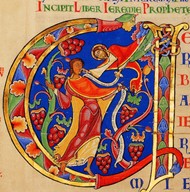
• Drummond Missal • Liber Hymnorum • Book of Leinster • Corpus Missal • Rosslyn Missal • Coupar Angus Psalter • Corpus Gospels The cultural significance of these Irish gospel manuscripts should not be underestimated. Without the devotion of Irish monks and scribes, who - as well as copying biblical texts - also copied many of the secular Greek and Roman works from classical authors such as Homer, Plato and Virgil, part of the world's great culture from Antiquity might have been lost forever during the Barbarian conquest of the Continent, and the Renaissance would never have happened. Irish illuminated manuscripts were the third and final type of early Irish visual art, after the Megalithic Passage Tomb artworks of Newgrange during the Neolithic era and the ornamental gold artifacts of the Irish Bronze Age. Medieval Book Painting: England and the Continent (c.1000-1500) During the course of succeeding centuries, these beautiful book paintings from Irish monasteries were followed by other Biblical (and secular) illustrated books by artist-monks from the Carolingian and Ottonian courts, and also by Byzantine theologians. But the best Medieval manuscript illumination was produced in England and on the Continent during the period 1000-1500 CE. First came a number of exceptional Romanesque illuminated manuscripts (c.1000-1150), such as the St Albans Psalter, the Bible of St Benigne, the Egbert Psalter, the Winchester Bible and the Moralia Manuscript. After this, painters like Jean Pucelle produced the finest Gothic illuminated manuscripts (1150-1350), including The Belleville Breviary (1323-26, Bibliotheque Nationale, Paris) and The Hours of Jeanne d'Evreux (1324-28, The Cloisters, Metropolitan Museum of Art), as well as other works such as: the Psalter of St Louis, the Bible Moralisee, the Minnesanger Manuscript, the Amesbury Psalter, and Queen Mary's Psalter. They were followed, during the era of International Gothic illuminations, by masterpieces such as the Brussels Hours, by Jacquemart de Hesdin (c.1355-1414); Les Tres Riches Heures du Duc de Berry (1413, Musee Conde, Chantilly) by the Limbourg Brothers (fl.1390-1416); and works by the great French artist Jean Fouquet (1420-81). |
|
• For more on the history of illustrated gospel texts, see: Visual Arts Encyclopedia.
ENCYCLOPEDIA OF IRISH AND CELTIC ART |