Definition of Art
Meaning, Classification of Visual and Fine
Arts, Aesthetics.
MAIN A-Z INDEX

|
Definition of Art
|
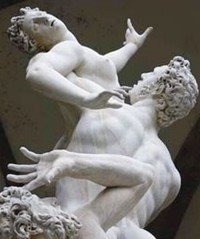 Rape of the Sabine Women (1583) by the hugely influential Florence-based Mannerist sculptor, Giambologna. |
|
MEANING OF AESTHETICS QUESTIONS ABOUT
ART |
What is Art?There is no universally accepted definition of art. Although commonly used to describe something of beauty, or a skill which produces an aesthetic result, there is no clear line in principle between (say) a unique piece of handmade sculpture, and a mass-produced but visually attractive item. We might say that art requires thought - some kind of creative impulse - but this raises more questions: for example, how much thought is required? If someone flings paint at a canvas, hoping by this action to create a work of art, does the result automatically constitute art? Even the notion of 'beauty' raises obvious questions. If I think my kid sister's unmade bed constitutes something 'beautiful', or aesthetically pleasing, does that make it art? If not, does its status change if a million people happen to agree with me, but my kid sister thinks it is just a pile of clothes? |
|
|
Art: Multiplicity of Forms, Types and Genres Before trying to define art, the first thing to be aware of, is its huge scope. Art is a global activity which encompasses a host of disciplines, as evidenced by the range of words and phrases which have been invented to describe its various forms. Examples of such phraseology include: "Fine Arts", "Liberal Arts", "Visual Arts", "Decorative Arts", "Applied Arts", "Design", "Crafts", "Performing Arts", and so on. Drilling down, many specific categories are classified according to the materials used, such as: drawing, painting, sculpture (inc. ceramic sculpture), "glass art", "metal art", "illuminated gospel manuscripts", "aerosol art", "fine art photography", "animation", and so on. Sub-categories include: painting in oils, watercolours, acrylics; sculpture in bronze, stone, wood, porcelain; to name but a tiny few. Other sub-branches include different genre categories, like: narrative, portrait, genre-works, landscape, still life. In addition, entirely new forms of art have emerged during the 20th century, such as: assemblage, conceptualism, collage, earthworks, installation, graffiti, and video, as well as the broad conceptualist movement which challenges the essential value of an objective "work of art". For more, see: Types of Art. |
|
Contemporary sand art - how EVOLUTION OF ART |
|
NUDITY IN ART PROBLEMS OF DEFINITION DEFINITION OF BEAUTY DEFINITION OF SCULPTURE DEFINITION OF ARTIST |
Definition of Art is Limited by Era and Culture Another thing to be aware of, is the fact that art reflects and belongs to the period and culture from which it is spawned. After all, how can we compare prehistoric murals (eg. stone age cave painting) or tribal art, or native Oceanic art, or primitive African art, with Michelangelo's 16th century Old Testament frescoes on the walls and ceiling of the Sistine Chapel? Political events are the most obvious era-factors that influence art: for example, art styles like Expressionism, Dada, and Surrealism were products of political uncertainty and upheavals. Cultural differences also act as natural borders. After all, Western draughtsmanship is light years away from Chinese calligraphy; and what Western artform compares with the art of origami paper folding from Japan? Religion is a major cultural variable that alters the shape of the artistic envelope. The Baroque style was strongly influenced by the Catholic Counter-Reformation, while Islamic art (like Orthodox Christianity), forbids certain types of artistic iconography. In other words, whatever definition of art we arrive at, it is bound to be limited to our era and culture. Even then, categories like Outsider art have to be taken into consideration. See also: Primitivism/Primitive Art. Conclusion As you can see from the above, the world of art is a highly complex entity, not only in terms of its multiplicity of forms and types, but also in terms of its historical and cultural roots. Therefore a simple definition, or even a broad consensus as to what can be labelled art, is likely to prove highly elusive. |
|
DEFINITION
OF CRAFT WORLD'S GREATEST
ART |
History of the Definition of Art For a guide to movements and periods, see also: History of Art. The original classical definition - derived from the Latin word "ars" (meaning "skill" or "craft") - is a useful starting point. This broad approach leads to art being defined as: "the product of a body of knowledge, most often using a set of skills." Thus Renaissance painters and sculptors were viewed merely as highly skilled artisans (interior-decorators?). No wonder Leonardo Da Vinci and Michelangelo went to such efforts to elevate the status of artists (and by implication art itself) onto a more intellectual plane. |
|
FINE ARTS COURSES MOST VALUABLE ARTWORKS |
Post-Renaissance Meaning of Art The emergence of the great European academies of art reflected the gradual upgrading of the subject. New and enlightened branches of philosophy also contributed to this change of image. By the mid-18th century, the mere demonstration of technical skills was insufficient to qualify as art - it now needed an "aesthetic" component - it had to be seen as something "beautiful." At the same time, the concept of "utilitarianism" (functionality or usefulness) was used to distinguish the more noble "fine arts" (art for art's sake), like painting and sculpture, from the lesser forms of "applied art", such as crafts and commercial design work, and the ornamental "decorative arts", like textile design and interior design. Thus, by the end of the 19th century, art was separated into at least two broad categories: namely, fine art and the rest - a situation that reflected the cultural snobbery and moral standards of the European establishment. Furthermore, despite some erosion of faith in the aesthetic standards of Renaissance ideology - which remained a powerful influence throughout the world of fine art - even painting and sculpture had to conform to certain aesthetic rules in order to be considered "true art". Meaning of Art During the Early 20th Century Then came Cubism (1907-14), which rocked the fine arts establishment to its foundations. Not simply because Picasso introduced a non-naturalistic branch of painting and sculpture, but because it shattered the monotheistic Renaissance approach to how art related to the world around it. Thus, Cubism's main contribution was to act as a sort of catalyst for a host of new movements which greatly expanded the theory and practice of art, such as: Suprematism, Constructivism, Dada, Neo-Plasticism, Surrealism and Conceptualism, as well as various realist styles, such as Social and Socialist Realism. In practice, this proliferation of new styles and artistic techniques led to a new broadening of the meaning and definition of art. In its escape from its "Renaissance straitjacket", and all the associated rules concerning "objectivity" (eg. on perspective, useable materials, content, composition, and so on), fine art now boasted a significant element of "subjectivity". Artists suddenly found themselves with far greater freedom to create paintings and sculpture according to their own subjective values. In fact, one might say that from this point "art" started to become "indefinable". The decorative and applied arts underwent a similar transformation due to the availability of a vastly increased range of commercial products. However, the resultant increase in the number of associated design and crafts disciplines did not have any significant impact on the definition and meaning of art as a whole. Meaning of Art Post-World War II The cataclysm of WWII led to the demise of Paris as the capital of world art, and its replacement by New York. This new American orientation encouraged art to become more of a commercial product, and loosen its connection with existing traditions of aestheticism - a trend furthered by the emergence of Abstract Expressionism, Pop-Art, and the activities of the new breed of celebrity artists like Andy Warhol. All of a sudden, even the most mundane items and concepts became elevated to the status of "art". Under the influence of this populist approach, conceptualists introduced new artforms, like assemblage, installation, video and performance. In due course, graffiti added its own mark, as did numerous styles of reinterpretation, like Neo-Dada, Neo-Expressionism, and Neo-Pop, to name but three. Schools and colleges of art throughout the world dutifully preached the new polytheism, adding further fuel to the bonfire of Renaissance art traditions. Postmodernism and the Meaning of Art The redefinition of art during the last three decades of the 20th century has been lent added intellectual weight by theorists of the postmodernist movement. According to the postmoderns, the focus has shifted from artistic skill to the "meaning" of the work produced. In addition, "how" a work is "experienced" by spectators has become a critical component in its aesthetic value. The phenomenal success of contemporary artists like Damien Hirst, as well as Gilbert and George, is clear evidence in support of this view. For more about experimental artists, see: avant-garde art. |
|
In light of this historical development in the meaning of "art", one can perhaps make a crude attempt at a "working" definition of the subject, along the following lines:
This is simply a "working" definition: broad enough to encompass most forms of contemporary art, but narrow enough to exclude "events" whose "artistic" content falls below accepted levels. In addition, please note that the word "artist" is included to allow for the context of the work; the word "beautiful" is included to reflect the need for some "aesthetic" value; while the phrase "that is considered by his audience to have artistic merit" is included to reflect the need for some basic acceptance of the artist's efforts. Theory and Philosophy of Art: Discussion Issues Q. If We Appreciate Its Positive Impact, Do We Need to Define Art? For centuries, if not millennia, people have been emotionally affected - sometimes overwhelmed - by works of art: from Greek Sculpture, to Byzantine architecture, the stunning creativity of Renaissance and Baroque Old Masters like Donatello, Raphael and Rembrandt, and famous painters of the modern era, like Van Gogh, Picasso and Auguste Rodin. Poetry, ballet and films can be equally uplifting. So while we may not be able to explain precisely what art is, we cannot deny the impact it has on our lives - one reason why public art is worth supporting. Q. How Does a Definition of the Meaning of Art Help Us? The very essence of creativity means it cannot be defined and pigeon-holed. Any attempt at doing so, will quickly become out-of-date and thus pointless, even counter-productive. What happens, for instance, if an artist produces something that by popular consensus is "art", but isn't accepted as such by the arts establishment? It's worth remembering that we still can't define a "table" or an "elephant", but it doesn't cause us much difficulty! Q. Is Art Simply a Reflection of Our Personal Values? It's fair to say that someone educated in the values of Renaissance art, and who therefore has a reasonable understanding of traditional painting, is less likely to regard postmodernist installations as art, than a person without such an understanding. Similarly, a person who loves TV and thinks museums are generally rather boring and unexciting places, is more likely to be impressed with contemporary video art than someone else who is comfortable with traditional museum exhibitions. Because of this, one might say that a person's attitude to art says more about his or her personal values, than the art itself. Q. Who Has the Right to Define Art? Since no consensus among art critics as to the meaning of art is likely to emerge anytime soon, which set of "experts" should be allowed to take charge: Artists, sociologists, historians, lawyers, philosophers, archeologists, anthropologists, or psychologists? After all, the world is full of so-called "experts" - structuralists, proceduralists, functionalists, as well as the usual crop of political theorists like Marxists and so on - who can't agree on what counts as art. So who do we give the job to? |
|
|
Traditional and contemporary art encompasses activities as diverse as:
All these activities are commonly referred to as "the Arts" and are commonly. classified into several overlapping categories, such as: fine, visual, plastic, decorative, applied, and performing. Disagreement persists as to the precise composition of these categories, but here is a generally accepted classification. This category includes those artworks that are created primarily for aesthetic reasons ('art for art's sake') rather than for commercial or functional use. Designed for its uplifting, life-enhancing qualities, fine art typically denotes the traditional, Western European 'high arts', such as: • Drawing Another type of Western fine art, which originated in China, is calligraphy: the highly complex form of stylized writing. |
|
|
The Evolution of Fine Arts After primitive forms of cave painting, figurine sculptures and other types of ancient art, there occured the golden era of Greek art and other schools of Classical Antiquity. The sacking of Rome (c.400-450) introduced the dead period of the Dark Ages (c.450-1000), brightened only by Celtic art and Ultimate La Tene Celtic designs, after which the history of art in the West is studded with a wide variety of artistic 'styles' or 'movements' - such as: Gothic (c.1100-1300), Renaissance (c.1300-1600), Baroque (17th century), Neo-Classicism (18th century), Romanticism (18th-19th century), Realism and Impressionism (19th century), Cubism, Expressionism, Surrealism, Abstract Expressionism and Pop-Art (20th century). For a brief review of modernism (c.1860-1965), see Modern art movements; for a guide to postmodernism, (c.1965-present) see our list of the main Contemporary art movements. The Tradition Fine art was the traditional type of Academic art taught at the great schools, such as the the Accademia dell'Arte del Disegno in Florence, the Accademia di San Luca in Rome, the Académie des Beaux-Arts in Paris, and the Royal Academy in London. One of the key legacies of the academies was their theory of linear perspective and their ranking of the painting genres, which classified all works into 5 types: history, portrait, genre-scenes, landscape or still life. Patrons Ever since the advent of Christianity, the largest and most significant sponsor of fine art has been the Christian Church. Not surprisingly therefore, the largest body of painting and/or sculpture has been religious art, as has other specific forms like icons and altarpiece art. Visual art includes all the fine arts as well as new media and contemporary forms of expression such as Assemblage, Collage, Conceptual, Installation and Performance art, as well as Photography, (see also: Is Photography Art?) and film-based forms like Video Art and Animation, or any combination thereof. Another type, often created on a monumental scale is the new environmental land art. The term plastic art typically denotes three-dimensional works employing materials that can be moulded, shaped or manipulated (plasticized) in some way: such as, clay, plaster, stone, metals, wood (sculpture), paper (origami) and so on. For three-dimensional artworks made from everyday materials and "found objects", including Marcel Duchamp's "readymades" (1913-21), please see: Junk art. This category traditionally denotes functional but ornamental art forms, such as works in glass, clay, wood, metal, or textile fabric. This includes all forms of jewellery and mosaic art, as well as ceramics, (exemplified by beautifully decorated styles of ancient pottery notably Chinese and Greek Pottery) furniture, furnishings, stained glass and tapestry art. Noted styles of decorative art include: Rococo Art (1700-1800), Pre-Raphaelite Brotherhood (fl. 1848-55), Japonism (c.1854-1900), Art Nouveau (c.1890-1914), Art Deco (c.1925-40), Edwardian, and Retro. Arguably the greatest period of decorative or applied art in Europe occurred during the 17th/18th centuries at the French Royal Court. For more, see: French Decorative Arts (c.1640-1792); French Designers (c.1640-1792); and French Furniture (c.1640-1792). This type refers to public performance events. Traditional varieties include, theatre, opera, music, and ballet. Contemporary performance art also includes any activity in which the artist's physical presence acts as the medium. Thus it encompasses, mime, face or body painting, and the like. A hyper-modern type of performance art is known as Happenings. This category encompasses all activities involving the application of aesthetic designs to everyday functional objects. While fine art provides intellectual stimulation to the viewer, applied art creates utilitarian items (a cup, a couch or sofa, a clock, a chair or table) using aesthetic principles in their design. Folk art is predominantly involved with this type of creative activity. Applied art includes architecture, computer art, photography, industrial design, graphic design, fashion design, interior design, as well as all decorative arts. Noted styles include, Bauhaus Design School, as well as Art Nouveau, and Art Deco. One of the most important forms of 20th applied art is architecture, notably supertall skyscraper architecture, which dominates the urban environment in New York, Chicago, Hong Kong and many other cities around the world. For a review of this type of public art, see: American Architecture (1600-present). |
|
The 'Arts Versus Crafts' Debate According to the traditional theory of art, there is a basic difference between an 'art' and a 'craft'. Put simply, although both activities involve creative skills, the former involves a higher degree of intellectual involvement. Under this analysis, a basket-weaver (say) would be considered a craftsperson, while a bag-designer would be considered an artist. In this rather artificial distinction between arts and crafts, functionality is a key factor. Thus, a jeweller who designs and makes non-functional items like rings or necklaces would be considered an artist, while a watchmaker would be a craftsperson; someone who makes glass might be a craftsman, but a person who makes stained glass is an artist. The idea is that artists are somehow superior because they 'create' things of beauty, while craftsmen perform repetitive or purely functional actions. There may be some truth behind this theory, but many types of craftsmanship seem no different to genuine art. An example perhaps, is a cartoonist-animator, exployed to draw thousands of similar pictures of a cartoon character like 'Charlie Brown'. True, his 'art' is purely functional and highly commercial, but no one could deny he was an artist. Note: see also: Arts and Crafts Movement (1862-1914). The Impact of the Renaissance on the Western Concept of Art In general, until the early Renaissance of the 15th century, all artists were considered tradesmen/craftsmen. Even the greatest painters like Giotto, Botticelli, Leonardo da Vinci and Raphael were seen as no more than skilled workers, while master sculptors like Donatello were seen as mere specialist stone-cutters and bronze metalworkers. Indeed, it was Leonardo's and Michelangelo's stated aim to raise the level of the artist to that of a profession - an ambition which was duly realized in 1561 with the founding of the first Art Academy in Florence, which was set up to train people in the profession of drawing (disegno). However, although Renaissance artists succeeded in raising their craft to the level of a profession, they defined art as an essentially intellectual activity. This fixed Renaissance idea of art being primarily an intellectual discipline was passed on down the centuries and still influences present day conceptions of the meaning of art. Despite some modifications, as exemplified by changes in art school curricula, fine art still maintains its notional superiority over crafts such as applied and decorative arts. |
|
We may not be able to define art, but we can explore it further by asking questions about its nature and scope. Here are some of the key questions along with a short commentary. (See also: Colour Art Glossary) • What's the Point
of Art? Sceptics say that art is a waste of time. Even the famous poet WH Auden confessed that no poem saved a single person from the Nazi gas-chambers. And while this may sound a rather meaningless statement, it highlights the notion that art has a limited use in our daily life, except in the case of attractive-looking buildings, teapots, cars or clothes. There are two broad answers: first, applied art is a major branch of art which cannot easily be separated from fine art, because the root of all design (which is the foundation of applied art) is fine art. Second, ever since Homo Sapiens developed the facility of contemplation, he has expressed his thoughts in pictorial form. At the same time, he has continued to appreciate beauty - whether in the form of human faces or bodies, sunsets, animal-skin colours, cathedrals or sculpture. In a nutshell, to create and to appreciate art is to be human. That's the point. |
|
How to Distinguish Good Art from Bad Art? Not being able to define art doesn't mean that all artworks are good. Trouble is, who decides where good art ends and bad begins? This popular question may stem from our natural desire to avoid being hoodwinked by snake-oil salesmen dressed up as 'artists', but whatever its origin it is not a particularly important issue. In practice, professional artists need public acceptance. So while temporary art-fashions may occasionally promote works of apparently dubious value, the general public (as well as the artistic community) is unlikely to stand by and allow bad art to become commonplace. Why Do Art Experts Make Everything Sound So Complicated? An example of this might be the jargon-infested articles commonly encountered in arts magazines, where nobody seems to use plain language anymore. Other culprits include exhibition catalogues and art books. The writers of this stuff might say that such jargon is no more than necessary shorthand, and that it is mostly written for other 'experts'. But is this really true? For example, it is almost impossible to find a book with a simple explanation of Cubism. So how does a young student get to understand why Picasso and Braque's revolutionery movement is so important? The same could be said about dozens of things in the world of art. And some abstract art sounds so complicated that we almost need a PhD in order to properly 'comprehend' it. (See next question for examples) Examples of Meaningless Art Reviews: Why use this Jargon? Modern reviewers, critics and artists frequently resort to meaningless nonsense when trying to describe a piece of "art". Here are some examples which have been kept anonymous to spare their authors' embarassment. All were taken from press releases or websites of 'respectable' bodies:
What's the Meaning of Abstract Art? It Looks Weird! Up until the late nineteenth century, most painting and sculpture adhered to traditional principles. Typically, it was representational and naturalistic. Then Impressionism changed everything by introducing non-natural colour schemes: a process continued by the Fauves and the Expressionists. Then Cubism rejected the notion of depth or perspective in painting, and opened the door to more abstract art, including movements like Futurism, De Stijl, Dada, Constructivism, Surrealism, Neo-Plasticism, Abstract Expressionism, and Op-Art, to name but a few. In Ireland, painters like Mary Swanzy, Mainie Jellet and Evie Hone were early pioneers of such modern art. Because abstract art has few if any naturalistic elements, it is not as instantly appreciable as (say) a classical portrait or landscape. And if you prefer a work of art to portray recognizable people and surroundings, then abstract art is not likely to be for you. But, let's be honest, is this so different from recoiling at the idea of wearing a particular colour or style of clothing? Different people like different things, and this applies to art as much as to jobs, cars, houses, furniture, vacations, and everything else you can think of. Abstract, or non-naturalistic paintings tend to contain an implicit message or follow a particular theory of art. This can make them less likeable and less beautiful to some people, but it doesn't mean they can't be outstanding works of art. |
|
It is extremely hard for most full-time artists to earn a living from (say) their painting or sculpture. To this, the sceptics retort: "well if no one wants to buy their stuff, why should the tax-payer pay for it?" One should not dismiss this concern too lightly. After all, these sceptics aren't saying that artists shouldn't practise their art, simply that an artist should seek private sponsorship. One answer to the question is this. First, in reality, most art colleges train students in a range of highly commercial activities, notably in the area of applied art and design. So for these individuals there is no question of subsidy. Moreover, those students who do opt for a full-time career as a painter or sculptor, are choosing a very arduous and materially unrewarding type of life. Not least because sponsorship (in the form of public commissions, bursaries, artist-in-residences, and other grants) is actually very meagre. The level of public subsidy of the arts in Western countries remains pretty low, compared to other equivalent areas. So even here, the amount of public money being spent on works of art is not especially significant. Nonetheless, public money is being spent, and here is a reason for it. Beauty, whether in the form of an attractive-looking car, a well-designed public building or square, a colourful dress, or an inspiring sculpture, is one of the few phenomena that lifts the spirits and reminds us there is more to life than the price of eggs. But without art, this range of aesthetic experiences will gradually dwindle, as beauty becomes progressively downgraded as a worthwhile goal. Literature (if not history) is full of examples of this type of society, where functionality is everything and citizens wear the same drab clothing, dwell in the same drab apartments, and lead the same drab lives. Online Collections of Painting and Sculpture There are tons of paintings and sculptures online. (This website alone displays thousands of different images.) Search for the best art museums such as the Uffizi Gallery (Florence), the Louvre (Paris), the Prado Museum (Madrid), the Pinakothek Gallery (Munich), the Tate Gallery (Britain, Modern, Liverpool and St Ives), the National Gallery (London), the Gemaldegalerie (Berlin), Hermitage Museum (St Petersburg), the Metropolitan and Guggenheim Museums (New York) and the National Gallery (Washington DC), to name but a few. Unfortunately, Irish art galleries (with the notable exception of the Crawford Gallery in Cork) are not as visible on the Internet as they should be, but there are plenty of private art galleries in Ireland that have wonderful displays that are available to browse. See also: Art News Headlines. For more about the classification of art, see: Visual Arts Encyclopedia. |
|
Art
Glossary |