Engraving
Type of Intaglio Printmaking: History, Mezzo-tint,
Drypoint.
MAIN A-Z INDEX - A-Z of ART MOVEMENTS

|
Engraving
|
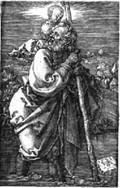 St Christopher (1521). Engraving by the German North Renaissance printmaker Albrecht Durer. |
Fine Art Engraving: Type of PrintmakingThis fine-art intaglio printmaking process, derived from goldsmith engraving techniques, dates from pioneering work by Northern Renaissance German printers during the first half of the 15th century. Engraving involves the incision of a design onto a metal surface (usually copper), by making grooves using a steel tool with a square or diamond-shaped end, called a burin. This produces a high quality line with a clean edge. Other tools - like mezzotint rockers, roulets and burnishers - are employed by the printmaker to create additional textured effects. Up until the mid-19th century, engraving (also called copper-plate engraving or line engraving) achieved widespread popularity as a method of replicating fine art images on paper, as well as illustrations for books and magazines. Since then it has been almost completely replaced by etching and other techniques. |
|
DIFFERENT FORMS OF ARTS |
|
PRINTMAKING TERMS |
The Engraving Process Once the lines of the drawing have been cut out of the copper, the plate is inked. Then the surface is wiped clean, leaving only the incisions containing ink. The plate is then put into a printing-press, along with a sheet of paper. The paper picks up the impression of the ink from the grooves, thus completing the print. Variations of Engraving: Mezzotint and Drypoint Mezzotint: In this variant of engraving, invented by the German Ludwig von Siegen (1609-1680), the metal plate is scored all over, creating a rough surface. The desired image is produced by scraping smooth the part of the surface which is to be left white. Mezzotint is noted for its range of tonal effects, not only because a scored or scoured surface holds more ink than one with a smaller number of simple lines - thus creating rich colours, but also because the technique can be fine-tuned using various tools to produce very fine gradations in tone. Mezzotint was widely employed by English artists and printmakers from the mid-eighteenth century onwards, to replicate portraits and landscapes. |
|
|
Drypoint: Invented by an unnamed 15th century German artist, drypoint - unlike traditional etching which is executed with a V-shaped burin which produces a smooth hard-edged mark - is performed with a sharp point, which leaves softer and more blurred lines. Until the introduction of electro-plating (steelfacing), which hardened the plate, drypoint was only feasible in small runs because the soft blur was destroyed during printing. Famous practitioners of drypoint include Albrecht Durer, Rembrandt, and the German Expressionist Max Beckmann. History Fine art engraving developed in Germany during the 1430s from techniques employed by goldmiths. Indeed several pioneer engravers had a background in goldwork. This led to the use of copper printing plates to replicate fine prints onto paper. Among the foremost practitioners of this method during its early golden age (1470-1535) were Albrecht Durer the first portrait engraver; Martin Schongauer (1448-91) noted for his copper engravings, Hans Baldung-Grien the engraver of witches and magic subjects, Albrecht Altdorfer noted for his landscape engravings, the Dutch printer Lucas van Leiden, and the Flemish engraver Hendrik Goltzius. In Italy, engravers included the great Marcantonio Raimondi, and the Florentine goldsmith Maso Finiguerra who strongly influenced Antonio Pollaiuolo, noted for The Battle of the Nudes (c.1465). Andrea Mantegna was another virtuoso Italian engraver, as was Ludovico Carracci (1555-1619) - who, together with Annibale Carracci (1560-1609) and his brother Agostino Carracci (1557-1602), co-founded the Bolognese School of painting. In France, engravers included Jean Duvet, noted for his excessive ornamentation, and Etienne Delaune. In the 17th century, the top European engravers included: Michael Lesne, Robert Nanteuil the great portraitist, Ludwig von Siegen inventor of Mezzotint, Peter Paul Rubens, his pupil Anthony Van Dyck and Rembrandt. Later, the French artist Claude Mellan introduced his cross-hatching technique. With the invention of etching - a much easier technique - engraving gradually declined, although many artists and printmakers (eg. Rembrandt) used a combination of both. In the 20th century, copper-plate engraving was revitalized as a serious art form by the printmakers Josef Hecht and Stanley William Hayter (creator of Atelier 17), and some artists and draftsmen continue to produce engravings for their original artistic value.
Note: For other forms of graphic art processes, see: Woodcuts (oldest printmaking technique), Lithography (planographic technique), Silkscreen Printing (popularized by Warhol), and Giclee Prints (Inkjet printer). |
|
• For more about etching, engraving, lithography, silkscreen or giclee prints, see: Visual Arts Encyclopedia.
ENCYCLOPEDIA OF PRINTMAKING ART |