Graphic Art
Visual Arts of Drawing, Sketching, Illustration,
Cartoons, Calligraphy.
MAIN A-Z INDEX

|
Graphic Art
|
|
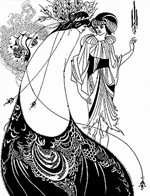
Salome (1892)
|
Graphic Art
|
|
Examples Apocalypse Now (1988) Computerized Graphic Art LATEST GRAPHIC ARTWORKS |
Calligraphic Art The supreme type of graphic art is surely calligraphy, the art of stylized writing, originating in the Far East. The two great forms of calligraphic art derive from the Arabic and Oriental languages (Chinese, Japanese, Vietnamese and Korean), although the art has been consistently practised in the languages of India, Tibet, Persia, Latin and others. Abstract Designs Another exemplar of decorative graphics is Celtic style designwork. This derives from the Ancient Celts, and from Hiberno-Saxon Insular art. Its curvilinear motifs had a strong influence on the development of modern styles of artistic design like Art Nouveau. |
|
VISUAL ARTS CATEGORIES |
Illustration Another form of graphic art is simple illustration, involving black and white drawings or sketches which explain a piece of text, although a better example of textual graphic work is monochromatic illumination - the art of embellishing text through the use of complex typographical and alphabetical symbols. Poster Design Peaking during France's Belle Epoque (1890s), poster art was made possible by Jules Cheret (1836-1932) and his invention of his "three stone lithographic process", and popularized by the Post-Impressionist Toulouse-Lautrec (1864-1901), the Czech artist Alfonse Mucha (1860-1939), and a number of decorative artists and designers including Theophile Steinlen (1859-1923), Eugene Grasset (1845-1917), Albert Guillaume (1873-1942), Pierre Bonnard (1867-1947), Edouard Vuillard (1868-1940), Leonetto Cappiello (1875-1942), Lucian Bernhard, William Bradley and Edward Penfield. For more information, see: History of Poster Art. Computer Graphics In the era of postmodernist art, the term 'graphics' has come to denote computer-generated imagery, as used for example on television in the form of expository diagrams, in commercial printing and on the Internet. It is what used to be called commercial art, and is not confined to black and white works. In this commercial sense, graphic artists inhabit an area close to graphic design, as practised in areas of applied art such as textiles, wallpapers, tiles and so on. For the latest exponents of graphic art, please see: Top Contemporary Artists. TO SEARCH FOR A PARTICULAR MOVEMENT, |
|
|
|
• For more about graphic design, see: Homepage.
Art
Glossary |