Ink and Wash Painting
Chinese/Japanese Brush Paintings: Mo-Shui,
Sumi-e, Soomookwa.
MAIN A-Z INDEX - A-Z of PAINTING

|
Ink and Wash Painting
|
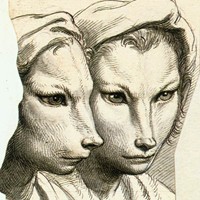 Physiognomic Heads Inspired by a Weasel (c.1670) Louvre, Paris. Ink and wash painting by the French Baroque artist Charles Le Brun. |
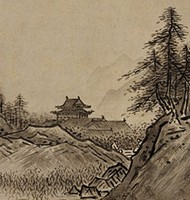
Ink and Wash PaintingIn fine art, the term 'Ink and wash painting' denotes an Oriental or East Asian method of painting. It is also referred to as 'brush painting'. The Chinese refer to it as mo-shui, while the Japanese call it suibokuga or sumi-e, and the Koreans know it as Soomookwa. The traditional painting medium for ink and wash is black ink, typically applied with long-haired brushes (from animals like goat, wolf, badger, rabbit, boar, or sheep) onto paper or silk. The completed painting is then mounted on scrolls, which are hung or rolled up. The ink itself comes in the form of a carbon stick which is ground and the resulting particles mixed with water. See also: Pen and Ink Drawings. |
|
PAINTING TERMS |
|
DIFFERENT
FORMS OF ARTS
|
History First used in Chinese art, ink and wash painting was invented by Wang Wei, during the era of Tang Dynasty art (618-907), and after further development the technique spread to Japan around 1350 and peaked in popularity among Japanese artists and calligraphers during the Muromachi era (1338-1573). For a list of dates in the development of Asian painting, see: Chinese Art Timeline (c.18,000 BCE - present). Noted Chinese practitioners include the painters: Bada Shanren, Daqian Jushi, Xu Beihong, Mi Youren and Qi Baishi; while Japanese exponents include: Josetsu, Shubun, Shingei, Oguri Sokei, and Hasegawa Tohaku. For more, see: Chinese Painters. For styles of painting on the Indian subcontinent, see: Classical Indian Painting (Up to 1150 CE) and Post-Classical Indian Painting (14th-16th Century). Style As in Calligraphy, the brushstroke in Chinese painting is less a means of applying ink than a philosophical or emotional statement. Zen Buddhism and Confucianism are each associated with differing brushstroke styles and methodologies. The ink and wash artist positions the brush vertically above the surface of the paper and controls its rhythmic movements from his shoulders. Exact precision is needed in this form of Oriental art as a brushstroke cannot be changed once it is made. For an outline of the artistic conventions and aesthetics behind Far Eastern ink and wash painting, see: Traditional Chinese Art: Characteristics. See also: Japanese Art. Western Ink Painting Being less familiar with the traditional calligraphic arts, Western artists have tended to use ink more for preparatory studies, literary and topological illustrations than as a medium for easel artworks. In graphic art, the precision and permanence of a line drawn in ink is far superior to that of dry media. Inks used were typically made from either carbon-based materials (bistre) like charcoal, or from berries or dyes derived from insects or shellfish. However more modern gum-based Indian ink is less prone to fading. The ink was originally applied using a dip-pen, the ancestor of today's fountain pens, felt-tip and technical drawing pens. A number of Old Masters have used ink to create extremely fine works of drawing art. Such painters include Goya, Nicolas Poussin, Rembrandt and John Constable, while more modern exponents include Edouard Manet and Picasso. |
|
• For facts about painting types,
styles and history, see: Fine Art Painting.
ENCYCLOPEDIA OF FINE ART |