Edouard Manet
Biography of French Impressionist Artist.
MAIN A-Z INDEX - A-Z of ARTISTS

|
Edouard Manet
|
|
|
Edouard Manet (1832-1883)Contents • Introduction NOTE: For analysis of works by Impressionist
painters like Edouard Manet, |
|
WORLD'S
BEST MODERN ART COLOUR |
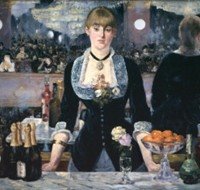
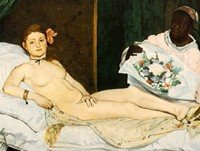
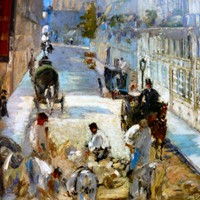
One of the pioneers of modern art, the Impressionist Edouard Manet captured all Parisian life in his shimmering paintings. Associated with the progressive Realism movement, his modernist approach was spurned by a French art establishment that was scandalized by the female nudes in his paintings Luncheon on the Grass (1862, Musee d'Orsay) and Olympia (1863, Musee d'Orsay). As a result, Manet became a standard-bearer for the younger generation of modern artists, and the initial leader for the Impressionism movement. Although he refused to label his own work, and never took part in any Impressionist Exhibitions in Paris, his unique style of French painting influenced numerous contemporaries, and had a major impact on the evolution of modern art in Paris. Best remembered for his genre-painting - featuring Parisian bars, cafes, races and cabarets - as well as his portrait art, his work reflected both the joys of the city and the loneliness of urban life. His masterpieces include: Concert in the Tuileries Gardens (1860-1, National Gallery, London), The Execution of the Emperor Maximilian (1867, Museum of Art, Mannheim), Luncheon in the Studio (1868, Neue Pinakothek, Munich), The Balcony (1868, Musee d'Orsay), Portrait of Berthe Morisot (1872, Musee d'Orsay), Roadmenders in the Rue de Berne (1878, Musee d'Orsay) and A Bar at the Folies-Bergere (1881-2, Courtauld Institute, London). |
|
WORLDS TOP ARTISTS |
|
|
Manet was born in Paris, the son of Auguste Manet, a high official in the Minstry of Justice. His mother, Eugenie Desiree Fournier, was the daughter of a diplomat and god-daughter of Marshal Bernadotte. He was expected to go into law, but - against the wishes of his father, who hoped he would become a lawyer - Manet decided on a career in the navy, but promptly failed the entrance examination. In 1845, on the advice of his uncle, Manet enrolled in a drawing course where he met Antonin Proust, who was to eventually become Minister of Fine Arts and a life-long friend. Between 1850 and 1856 Manet studied fine art painting under the academic painter Thomas Couture, who specialized in traditional large-scale history painting. During this time he also studied and copied Old Masters in the Louvre, like Titian, Frans Hals, Francisco de Goya and Diego Velazquez. In 1857 he paid a visit to Delacroix to ask his permission to copy Dante and Virgil in Hell in the Musee du Luxembourg. He also travelled to The Hague and Florence in order to make copies of Titian and Rembrandt. His copies, in fact, were transpositions in which he attempted to define structures leaving aside the detail. According to his friend Antonin Proust, "he was constantly searching for an immediate passage from shade into light. The luminous shadows of Titian filled him with enthusiasm. He went wild over the Old Masters." |
|
TOP ART PRICES |
|
|
At the time Manet first started painting, in 1850s Paris, everyday city scenes were not popular subject matters. Artists could only expect to succeed by showcasing their work at the official exhibition of the French Academy - an annual show known as the Salon - whose conservative members favoured a hierarchy of genres, that placed historical paintings and polished technique above all else. However, within 25 years the Impressionists would blow apart these old-fashioned concepts of academic art. Manet - like Edgar Degas (1834-1917), Henri Fantin-Latour (1836-1904) and others - was strongly influenced by the Old Masters, and yearned to be seen as a true inheritor of their structure and composition, his modernist interpretation made him few friends inside the French Academy of Art. Even so, he was highly regarded by the coming generation of French painters for his style, his subject-matter and fresh approach. He often placed colours side by side, which allowed the eye to optically mix them, rather than using the traditional method of mixing the colours together on the palette. His brushstrokes were loose, which meant parts of the canvas were not always covered completely. This allowed critics to say his work looked 'unfinished'. Manet was determined to show everyday scenes, beggars, street singers, construction workers and fashionable ladies drinking in cafes. He was influenced by the new medium of photography, which is reflected in his paintings where a passer-by occasionally enters a scene, half cut off, as if captured in a random photo. In a Bar in Folies-Bergere, for example, you can see the legs of a trapeze artist reflected in the mirror in the top left corner. This would never happen in a carefully planned academic picture. After his early years, he rarely painted religious or mythological subjects. Controversy at the Paris Salon In 1859 he submitted his Absinthe Drinker
(NCG, Copenhagen) to the Salon, but, in spite of representations
by Delacroix, it was refused. At the next Salon, however, in 1861,
he was successful: his Portrait of the Artist's Parents (1860,
Musee d'Orsay) and Le Guitariste (1860, Metropolitan Museum of
Art, NY) were well received and even won an "honorable mention". Manet's nudes in particular caused a stir and were constantly rejected by the Salon. His Luncheon on the Grass (1862, Musee d'Orsay) - eventually exhibited at the Salon des Refuses - scandalised people because the woman was fully naked, surrounded by clothed gentleman and had the audacity to stare directly at the viewer. When his picture Olympia (1863, Musee d'Orsay) - a nude based on both Goya's Nude Maja (1797) and Titian's Venus of Urbino (1538) - was exhibited, art critics advised pregnant women to avoid the picture in case the shock should prove too much! This goddess was not cloaked in a mythological aura, she was an ordinary woman, who stared without apology directly at the viewer as her maid arrives with flowers from potential suitors. Manet plays on the sensual innuendoes of the day: the maid is black, and at the time it was thought black people were highly physical. Yet this maid is fully clothed, it is the white courtesan that is brazenly naked. She was compared to the street-walkers of the dance hall, and viewers found the scene very uncomfortable. The shock and novelty of Manet's art provoked a scandalized response with the appearance of each new work. But younger artists - including Claude Monet (1840-1926), Renoir (1841-1919), Pissarro (1830-1903), Sisley (1839-1899), and Cezanne (1839-1906) - bored and utterly uninspired by offcial art, found in Manet the signs of new life for which they had been waiting, and made him the unwilling standard-bearer for the Impressionist revolution for which he was paving the way. All were influenced by his emphasis on colour and the effects of light. He also became friends with the Impressionist Berthe Morisot, who convinced him to try plein-air painting, to which she had been introduced by her friend Camille Corot (she was later to become Manet's sister-in-law). (Note: for more about the Impressionist idiom, please see: Characteristics of Impressionist Painting 1870-1910.)
Despite having the leadership of the budding Impressionist group thrust upon him, Manet resisted becoming involved in their group exhibitions, partly because he did not want to be identified with one group, and partly because the traditional, conformist side of him still wanted to exhibit at the Salon. After Luncheon on the Grass and Olympia, he painted some very different compositions. Themes included: Spanish - Lola de Valence (1862, Musee d'Orsay), Mlle Victorine Meurent in the Costume of an Espada (1862, Metropolitan Museum of Art), Spanish Dancers (1863, Phillips Collection, Washington DC), The Dead Matador (1863, Metropolitan Museum of Art, NY); marine scenes - Battle of the Ships Kearsage and Alabama (1864, Philadelphia Museum of Art); outdoor scenes - Racing at Longchamp (1864, Chicago, Art Institute); mythological - Surprised Nymph (1861, Museo Nacional de Bellas Artes, Buenos Aires); contemporary historical - The Execution of the Emperor Maximilian (1867, Museum of Art Mannheim, and National Gallery London); religious subjects - The Dead Christ (1864, Metropolitan Museum of Art, NY); numerous types of genre painting - Women at the Races (1864, Cincinnati Art Museum), Boulogne Docks by Moonlight (1869, Musee d'Orsay); and even some examples of still life painting - Peonies in a Vase (c.1864, Musee d'Orsay). |
|
|
The year 1868 saw the completion of Luncheon
in the Studio (1868, Neue Pinakothek, Munich), as well as The
Balcony (1868, Musee d'Orsay), which features Manet's sister-in-law,
Berthe Morisot, whose portrait he painted several times. But in the same
year the Salon rejected several of his submissions, including:
The Piper (1866, Musee d'Orsay) and The Tragedian (National
Gallery of Art, Washington DC). Aroused by the blatant prejudice of the
decision, the writer Emile Zola leapt to Manet's defence in a series of
articles in L'Evenement, for which Manet showed his thanks by completing
his Portrait
of Emile Zola (1868, Musee d'Orsay).
These influences helped him to lighten his palette, and this was the period when he painted some of his most luminous masterpieces, including: The Railway (1873, National Gallery of Art, Washington DC), On the River (1874, Metropolitan Museum, NY), Argenteuil (1874, Museum of Fine Art, Tournai), and The Monet Family in the Garden (1874, Metropolitan Museum, NY). But in 1874, when his friends staged the first official Impressionist group show, Manet withdrew, leaving Monet as the group's most important figure. Influenced by Zola's Naturalism,
Manet then executed a series of canvases, including: Nana (1877,
Kunsthalle, Hamburg), The Waitress (1878, National Gallery, London),
At Old Lathuile's (1879 Museum of Fine Art, Tournai), In the
Conservatory (1879, SMPK, Berlin) and The Bar at the Folies-Bergere
(1881-2, Courtauld Institute, London) in which the expression of visual
sensations is pushed to its limits. In some of these works it is possible
to speak of the abolition of the subject, so brilliantly improvised is
the treatment of faces and atmosphere. (See also: Best
Impressionist Paintings.) Although he did not gain significant recognition during his lifetime, after his death, his painting The Bar at the Folies-Bergere was exhibited at the Salon, and his old friend who was Minister for Arts obtained the Legion of Honor for him, to be awarded posthumously. Now rated as one of the most famous painters in modern art, Manet was a prolific artist, and left behind over 400 oil paintings and countless watercolours and pastels. A master of illustration, he left behind a number of works, such as those for Mallarme's translation of Poe's The Raven and his more important poems, such as L'Apres-midi d'un Faune. He also painted his Portrait (1876, Musee d'Orsay) which, though small in format, ranks among his greatest masterpieces. Paintings by Edouard Manet hang in the best art museums across the world, notably the Musee d'Orsay, Paris. Here is a small selection of his greatest works. - Concert in the Tuileries Gardens
(1860-1) National Gallery, London. |
|
• For more biographies, see: Famous
Painters.
ENCYCLOPEDIA OF VISUAL ARTISTS |