Realism
History, Characteristics of Realist Art
Movement and Naturalism.
MAIN A-Z INDEX - A-Z of ART MOVEMENTS

|
Realism
|
|
|
Realism in Art (19th & 20th Century)Contents • Origins |
|
|
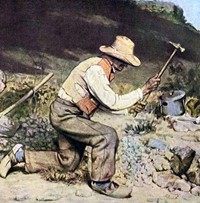
From 1400 to 1800, Western art was dominated by Renaissance-inspired academic theories of idealized painting and high art executed in the Grand Manner. Thereafter, caused partly by the huge social changes triggered by the Industrial Revolution, there was a greater focus on realism of subject - that is, subject matter outside the high art tradition. The term Realism was promoted by the French novelist Champfleury during the 1840s, although it began in earnest in 1855, with an Exposition by the French painter Gustave Courbet (1819-77), after one of his paintings (The Artist's Studio) had been rejected by the World Fair in Paris. Courbet set up his own marquee nearby and issued a manifesto to accompany his personal exhibition. It was entitled "Le Realisme". |
|
EVOLUTION
OF VISUAL ART FINEST
MODERN PAINTING
|
|
|
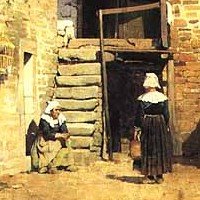
Characteristics: Genres and Subject Matter The style of Realist painting spread to almost all genres, including History painting, portraits, genre-painting, and landscapes. For example, landscape artists went out to the provinces in search of the 'real' France, setting up artistic colonies in places like Barbizon, and later at Grez-Sur-Loing, Pont-Aven, and Concarneau. (But note the difference between naturalism and realism.) Favourite subject matter for Realist artists included: genre scenes of rural and urban working class life, scenes of street-life, cafes and night clubs, as well as increasing frankness in the treatment of the body, nudity and sensual subjects. Not surprisingly, this gritty approach shocked many of the upper and middle class patrons of the arts, both in France and in the Victorian art of England, where Realism was never fully embraced. A general trend, as well as a specific style of art, Realism heralded a general move away from the 'ideal' (as typified by the art of Classical mythology, so beloved by Renaissance artists and sculptors) towards the ordinary. Thus, in their figure drawing and figure painting, Realists portrayed real people not idealized types. From now on, artists felt increasingly free to depict real-life situations stripped of aesthetics and universal truths. (No more cute-looking child beggars, picturesque streets and views, healthy-looking contented peasants and so on.) In this sense, Realism reflected a progressive and highly influential shift in the significance and function of art in general, including literature as well as fine art. It influenced Impressionism - see, for instance, Realism to Impressionism (1830-1900) - and several other modern art styles, such as Pop-Art. The style retains its influence on the visual arts to this day.
|
|
|
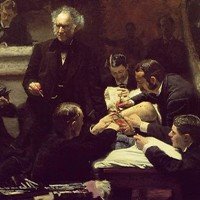
Realist artists, strongly associated with the 19th century movement include: Jean-Francois Millet (1814-75), Gustave Courbet (1819-77), Honore Daumier (1808-79). However, many more were influenced by Realism without allowing it to dominate their work. An interesting example is the Russian painter Ilya Repin (1844-1930), who produced outstanding realist style works such as Bargemen on the Volga (1870), as well as Krestny Khod (Religious Procession) in Kursk Gubernia (1883). Another example is Jules Bastien-Lepage (1848-84), whose naturalism was a strong influence on the conservative strand of Impressionist painting. The realist style was taken up and adapted by French Impressionists like Edgar Degas (for example, in his picture The Absinthe Drinker): for more, see Realism to Impressionism (1830-1900). The Germanic Biedermeier style of Romantic realism - a comforting domestic idiom popular in Germany, Austria and Denmark, not unlike the seventeenth century Dutch Realism School - is discussed in German Art, 19th Century. Famous 19th Century Realist Paintings The main schools of Realism during the nineteenth century included: the English Figurative School, the French School (led by Gustave Courbet), the Russian School (led by Ilya Repin), the German School (led by Adolph von Menzel), and the American School (led by Thomas Eakins). In addition, numerous artists produced paintings in the realist style, including the Romantic Theodore Gericault (notably his asylum portraits), the Impressionist Edgar Degas (notably his ballet pictures) David Wilkie (1785-1841) Ferdinand
Georg Waldmuller (1793-1865) Carl
Spitzweg (1808-1885) Adolph von Menzel (1815-1905) Honore
Daumier (1808-79) Jean-Francois
Millet (1814-75) Gustave
Courbet (1819-77) Ivan
Shishkin (1832-98) Vasily
Perov (1833-82) Franz
von Lenbach (1836-1904) Winslow
Homer (1836-1910) Ivan
Kramskoy (1837-1887) Luke Fildes (1843-1927) Mihaly Munkacsy (1844-1900) Wilhelm
Leibl (1844-1900) Konstantin
Savitsky (1844-1905) Ilya
Repin (1844-1930) Thomas
Eakins (1844-1916) Christian Krohg (1852-1925) John Singer Sargent (1856-1925) Max
Klinger (1857-1920) Isaac
Levitan (1860-1900) Frederic
Remington (1861-1909) Abram
Arkhipov (1862-1930) Joaquin
Sorolla Y Bastida (1863-1923) |
|
With two horrific world wars, a worldwide depression, the holocaust, the Vietnam War and the appearance of nuclear weapons, twentieth century realist artists had no shortage of subjects. Indeed, modern realism appeared in a wide variety of forms. Here is a short introduction to a selection of realist schools and themes in fine art painting and sculpture. This Italian term implies extreme raw realism, without any interpretation. The word first appeared in the violent melodramatic operas of Mascagnie, such as Cavalleria Rusticana (1890), and was taken up by Italian artists like Telemaco Signorini (1835-1901). The Ashcan School was a small group of painters who strove to chronicle everyday life in New York City during the pre-war period, producing realistic and unvarnished pictures and etchings of urban streetscapes and genre scenes. Led by Robert Henri (1865-1929), who was influenced by the strong unglamorous realism of Thomas Eakins and Thomas Anshutz, the Ashcan school included other painters like Everett Shinn (1876-1953), George Luks (1866-1933), George Wesley Bellows (1882-1925), William Glackens (1870-1938) and John Sloan (1871-1951). The legacy of the Ashcan School endured in the American Social Realism scene painting of the 1920s and 1930s, thanks to Edward Hopper (1882-1967): see, in particular, his House by the Railroad (1925, MOMA) and Lighthouse at Two Lights (1929, Metropolitan Museum). An American painting movement which depicted urban/industrial landscapes often in a Cubist/Futurist manner, its members were known by a variety of labels such as "Cubist-Realists", "Immaculates", "Sterilists" or "modern classicists". The style was also known as "sharp-focus realism." The best known exponents of Precisionism were Charles Sheeler (1883-1965), Charles Demuth (1883-1935), and Georgia O'Keeffe (1887-1986). The term Social Realists describes the urban American Scene artists who worked during the Depression era. Social Realism is a naturalistic style of realism which focuses exclusively on social issues and everyday hardships. Best known members of the Social Realism school include Ben Shahn (1898-1969), Jack Levine and Jacob Lawrence. All were significantly influenced by the earlier Ashcan School of New York city. A form of public propaganda art instituted by Joseph Stalin during the period of forced industrialization in Soviet Russia, which began in the late 1920s. A monumental heroic style of art, Socialist Realism glorified the new Soviet Man and Worker in huge murals, posters, and other forms of public art, using bold reds and blacks and evocative imagery. Maxim Gorky was lured back to Russia as an artistic front for the movement. Needless to say, this propagandist art bore little resemblance to reality on the streets and in the factories. Socialist Realism was the first in a series of communist proletarian styles of art, which eventually came under the control of the Soviet arts supremo Andrei Zhadanov. Socialist Realism was taken up in Spain and France by artists like Renato Guttuso (eg. Sulphur Miners, 1949) and Andre Fougeron (Martyred Spain, 1937). |
|
A bizarre art-form, Surrealism was founded in Paris in 1924 following the publication of Andre Breton's manifesto. Based on the psychoanalytical ideas of Sigmund Freud, Surrealism sought to release the creative potential of the unconscious mind. Two broad types of Surrealist art emerged. The fantasy-like paintings of Salvador Dali (1904-89) Rene Magritte (1898-1967), and the automatism of Joan Miro (1893-1983). Despite its bizarre style and a relatively short span, Surrealism proved immensely resilient as an influence, and continues to this day. Famous Surrealist paintings include Dali's The Persistence of Memory (1931) and The Disintegration of the Persistence of Memory (1954). A parallel art movement to Surrealism was Magic Realism, whose paintings are anchored in everyday reality, but with overtones of fantasy. The name was coined by the German art historian and critic Franz Roh in 1925, in a book entitled Nach Expressionismus: Magischer Realismus. Magic Realism was part of the Return to Order - a reaction against avant-garde art which arose after World War I. Members of the school included (in Italy) Giorgio de Chirico (eg. The Painter's Family, 1926), and Alberto Savinio, and (in Germany) Alexander Kanoldt and Adolf Ziegler. The name is also sometimes applied to certain American painters of the post-WWII period, such as Paul Cadmus (1904-1999), Philip Evergood (1901-1973) and Ivan Albright (1897-1983). In Germany, Magic Realism overlaps with the movement Die Neue Sachlichkeit (New Objectivity). American Scene Painting and Midwest Regionalism (1925-45) American Scene Painting embraced several different strands of realism, all of which employed specifically American imagery. The midwest version of American Scene Painting was known as Regionalism, which was exemplified by painters such as Grant Wood (1892-1942), John Steuart Curry (1897-1946), Thomas Hart Benton (1889-1975), and later Andrew Wyeth (1917-2009). Note also the widespread popularity of the great realist illustrator Norman Rockwell (1894-1978). Formed in 1938, this was a left-wing modern realist group of artists who taught at or graduated from the School of Painting and Drawing in Euston Road, London. Rebelling against avant-garde art, they proclaimed the supremacy of portraying traditional subjects in a realist manner, so as to make art more understandable and socially relevant. Members of the school included Graham Bell, William Coldstream, Lawrence Gowing, Rodrigo Moynihan, Victor Pasmore and Claude Rogers. Holocaust art consists of three types. Nazi propaganda imagery used to underpin their genocidal activities; images (nearly all drawings) created by victims that record individual experiences; and post-war memorials of the Shoah (mostly sculpture). During the 1950s, the former Beaux Arts Gallery in London (run by Helen Lessore) was an important venue for contemporary realist painting. In 1952-4 it staged solo exhibitions for four young British realist painters John Bratby, Derrick Greaves, Edward Middleditch and Jack Smith, known subsequently as the Beaux Arts Quartet, and from December 1954, were also renowned as the Kitchen Sink painters. The latter term was coined as a result of their mundane subject matter. Examples of their realism are: Still Life with Chip Fryer (1954) and The Toilet (1955) by John Bratby, Sheffield Weir II (1954) by Edward Middleditch, and Figure in a Room I (1959) by Jack Smith. |
|
American Contemporary Realism (1960s/Early 1970s) This term describes the relatively straightforward realistic approach to representation taken by artists in the post-abstract era. Well aware of modern abstract concepts of art, contemporary realists nevertheless prefer to paint or sculpt in a more traditional manner. Among the famous painters associated with this approach to fine art are William Bailey, Neil Welliver and Philip Pearlstein. Note that Contemporary Realism differs from Photorealism owing to the latter's somewhat exaggerated and ironic tone. Photorealism emerged in the late 1960s, when they began painting scenes in a style almost identical to photographs. Photorealist subjects are typical banal and without special interest, and may even be depicted as much to display the virtuoso representational skills of the artist. Even so, Photorealism can be exceptionally visually striking. Important members of the Photorealist movement are Richard Estes (b.1932) whose speciality is street scenes with elaborate window reflections and Chuck Close (b.1940) who specializes in large up-front, neck-up portraiture. Other photorealists also typically focus on one particular subject. John Doherty is one of Ireland's best known photorealist artists. Hyperrealism is a general term describing the extreme form of realistic painting and sculpture which emerged in the early 1970s. It is also referred to as Super-Realism, and in painting is synonymous with Photo-Realism. In sculpture famous photorealist artists include Duane Hanson (1925-96), John de Andrea (b.1941) and Carole Feuerman (b.1945). Some of the recent work of Ron Mueck and Robert Gober could also be considered Hyper-Realist. Notable painters include Chuck Close, Robert Bechtle, Richard Estes, Audrey Flack, Ralph Goings. In some ways the heir to artists like Norman Rockwell (1894-1978), the populist Scottish artist Jack Vettriano (b.1951) has carved out a lucrative niche for himself as a nostalgic subject-painter, selling large numbers of posters and other decorative designs. Cynical Realism (China) (1990s) Cynical Realism is a satirical style of Chinese contemporary painting which appeared in the 1990s following the suppression of the Tiananmen Square demonstrations. Cynical Realists borrowed imagery from various traditions, including Surrealism and Symbolism, as well as classical figure painting. |
|
• For other art movements and periods,
see: History of Art.
ENCYCLOPEDIA OF ART HISTORY |