Impressionism
Aims, Greatest Impressionists, Impact on
Western Art.
MAIN A-Z INDEX - A-Z of ART MOVEMENTS

|
Impressionism
|
|
INFLUENCES BEST MODERN PAINTING |
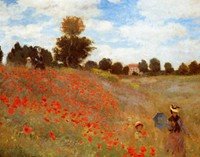
Impressionism is arguably the most famous French painting movement ever. The actual name "Impressionism" was coined by the French art critic Louis Leroy, after visiting the first exhibition of Impressionist painting in 1874 where he saw Impression: Soleil Levant (1872) by Claude Monet. Ironically, Monet only decided on the title when completing the exhibition catalogue, and almost named the work View of the Harbour at Le Havre! In total, between 1874 and 1882, the Impressionists staged seven exhibitions, all in Paris. First appearing in Paris during the late 1860s and early 1870s, Impressionism was not recognized initially as anything special. Many of the members of the group were at odds with the official Salon, the organizing body for the French Academy of Fine Arts, whose selection-jury operated with unpredictable severity. So although other painters were impressed by some of its early works, Impressionism was not acknowledged as an important style of painting, either by art critics, collectors or the public. As a result, most Impressionist painters suffered severe financial hardship, and all had to fight for attention and commissions from patrons and critics alike. Despite friendships with leading figures in other areas of the creative arts (like the writer Emile Zola and the poet Baudelaire) mutual support and reassurance within the group was the critical factor in its survival. |
|
PAINTING COLOURS/HUES |
|
WORLD'S GREATEST
ARTWORKS HISTORY OF ART |
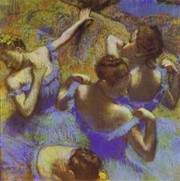
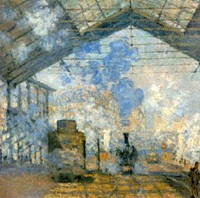
Main Characteristic of Impressionism Pure Impressionism, as advocated by Monet, was outdoor plein-air painting, characterized by rapid, spontaneous and loose brushstrokes: supreme examples being his series of paintings of Rouen cathedral, Waterloo Bridge, Gare Saint-Lazare, haystacks, and water lilies. Its guiding principle was the realistic depiction of light; Impressionist artists sought to capture fleeting moments, and if, during these moments, an object appeared orange - due to the falling light or its reflection - then the artist painted the object orange. Or if the sun turned the surface of a pond pink, then pink it would be. Naturalist colour schemes, being devised in theory or at least in the studio, did not allow for this. Loose brushwork, coupled with a non-naturalist use of colour, gave the movement a revolutionary edge, and opened the way for movements such as Expressionism and Fauvism. The Impressionists' main priorities included: (1) the immediate and optically accurate depiction of a momentary scene; (2) the execution of the whole work in the open air (no more preparatory sketches and careful completion in the studio); (3) the use of pure colour on the canvas, rather than being first mixed on the palette; (4) the use of small strokes and dabs of brightly-coloured paint; and (5) the use of light and colour to unify a picture, instead of the traditional method of gradually building up a painting by outline and modelling with light and shade. For more, see: Characteristics of Impressionist Painting (1870-1910). The roots of Impressionism lay in the naturalism of Camille Corot (1796-1875) and the plein-air painting methods of the early 19th century Barbizon school led by Theodore Rousseau (1812-67). Impressionists specialized in landscapes and genre scenes (eg. Degas' pictures of ballet dancers and Renoir's nude figures). Portrait art was another popular genre among Impressionist painters - it was after all one of their few regular sources of income - and still-lifes were also painted.
|
|
|
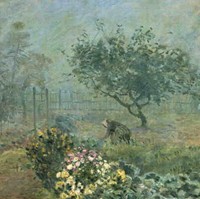
The Seven Greatest Impressionist Painters Claude Monet (1840-1926) became the centre of attention in the movement. Helped by the coastal and beach scene Impressionist Eugene Boudin (1824-98), he carried out the Impressionist program quite conscientiously. It was his supreme attempt at complete objectivity. If nature, during any particular quarter of an hour, was 'off colour' (and nature is often guilty of surprising lapses) Monet would blindly follow her into a morass of chromatic bad taste. His own sense of colour harmony was sometimes deplorable. But he had the greatest knowledge of plein air painting, and introduced very advanced ideas on landscape painting into the Impressionist circle. Camille Pissarro (1830-1903), a great teacher, was the most prolific printmaker of the group and the only one to show at all the Impressionist exhibitions. A lifelong anarchist, he made almost no money and his emotional attachment to certain colours and scenes meant that he didn't have quite the same ruthlessly objective attitude to painting as Monet. By comparison, the loner Alfred Sisley (1839-1899) - the most dedicated landscape artist after Monet - lived a middle-class lifestyle, and only became dependent on his art in middle age. He was as good an observer as Monet, but his range was narrower: he was content to record the more 'normal' conditions of light and in consequence his landscapes avoid the appearance of being 'stunts' that Monet's often give. These three painters - Monet, Pissarro and Sisley - formed the shock troops of Impressionist landscape painting.
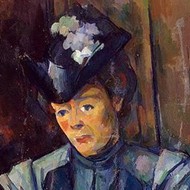
Manet (1832-83) was revered by the other Impressionist painters. He was related to the French Emperor, and by the age of twenty-nine was already accepted as the leading figure of the new realistic painting, prior to Impressionism. Noted for his modern approach to oil painting and his revolutionery reinterpretations of neoclassical themes, he was interested above all in becoming re-accepted by the Salon. Manet was objective as any painter. Before him perhaps Velazquez was the painter who least obtrudes his own temperament, and it was in homage to Velazquez rather than to Titian that he painted his notorious Olympia. He was more conscious of the impact of light than Velazquez, but except in his later, outdoor, sketches done under the influence of the Impressionist landscape painters, he did not adopt the 'divisionist' technique by which Monet strove to render the vibration of light. Degas (1834-1917) was not particularly interested in the impact of light, but he was fascinated by something equally transient - the unpremeditated gestures of everyday life. His eye pounced with the swiftness of a hawk on such gestures, and he gave them an additional air of naturalness by picking up at least one hint from the camera. The camera cannot compose a picture. It merely takes a portion of what is before it and cuts it off like a slice of cake. It has no compunction in slicing, say, right through a figure; it has no sense of balance, of symmetry. Out of this haphazard treatment Degas evolved a new system of composition. He gives the impression of a snapshot, casual and fortuitous, but for all that there is nothing casual in his design. The balance is as careful as in any composition by Poussin, and much more daring. He made a subtle art of seeming casual. His characters have the air of being taken unawares, yet they never have that appearance which the camera invariably gives, of having been frozen in mid-gesture, Degas's most able follower was the English Walter Sickert, who, without having Degas's hawk-like pounce, saw life in much the same way - taking unawares the fascinating little accidents that make up its sum. Degas recorded them with some measure of disillusionment; Sickert did it with a kind of painterly chuckle. Two years younger than Manet, Degas came from the same social background. The two painters, both pure city people, became friends and frequented the same circles in Parisian society. Degas was arguably the most complex of all the founders of Impressionist art: initially he hated plein-air painting and preferred working in his studio, where he demonstrated amazing versatility in drawing, watercolours, pastels, and sculpture. Another artist who came from a wealthy family was Paul Cezanne (1839-1906), son of a banker from Aix. Due to his shyness and southern, rustic ways he had problems in the best Parisian circles. When he was given a large exhibition in Paris in 1895, he had not exhibited a painting in the city for 20 years. Auguste Renoir (1841-1919), who came from a very poor family, literally had to starve to succeed as an artist. He was helped by Narcisse Diaz, one of the founders of the Barbizon School, and worked closely with Monet on landscapes before moving into studio work involving portraiture and figurative painting. Despite early similarities, Renoir's art was different to Monet's. It was not really concerned with fleeting moments or transient depictions of light. Renoir's sunshine is eternal, even his female nudes are eternal. They are women seen as a child might see its mother: soft, radiant and eternal. To this extent one might say that Renoir is part of the main stream of art rather than revolutionary Impressionism. The most important female Impressionist painters were Berthe Morisot (1841-95) and the American Mary Cassatt (1845-1926). |
|
|
The Impressionist Circle: Some Personal Details Manet and Degas - Socially and Financially Secure Edouard Manet was the artist who was regarded by the other Impressionist painters as their leader, with a strange unanimity which seems unusual to us today. We only know his work, while the knowledge of the artist's personality has only been passed down by reports from contemporaries. Edouard Manet was born in Paris in 1832 and along with Pissarro was the oldest in the group. His mother was related to the Emperor, and Manet never lost contact with the leading circles. Because of his social status and his great talent he would certainly have been admitted to the Ecole des Beaux Arts, but instead of this he chose to attend the studio of Thomas Couture. Couture was an excellent teacher and because of his reputation his pupils were able to show paintings in the Salon quite early in their careers. Manet's first submission was highly regarded, and by the age of twenty-nine he was already accepted as the leading figure of the new realism. The image of the poor artist certainly does not apply to him. Edgar Degas, who was two years younger than Manet, came from the same social background. Manet's attention was drawn to him as he copied paintings in the Louvre. The two painters became friends and frequented the same circles in Parisian society. Manet already had contact to other open-minded artists from which later the group of Impressionists was to take shape. He brought Degas into this circle. Cezanne - the Unsophisticated Provincial Another artist who came from a wealthy
family was Paul Cezanne, son of a banker from Aix-en-Provence. Admittedly
he had serious financial problems for many years because he was afraid
of admitting his love of art and somewhat illegal living conditions to
his rather tyrannical father. It was because of this that he only came
to appreciate his father's fortune in the second half of his life, at
a time when he was already so well-known as a painter that he probably
would have been able to live off the proceeds from his paintings if it
had been necessary. Because of his southern, almost rustic ways he had
problems in the best Parisian circles. As well as this, his demure and
difficult to understand paintings did not attract sympathy for his work.
This was responsible for his remaining unknown longer than the other Impressionists.
Cezanne withdrew more and more from his circle of friends. From 1885,
he lived separated from his wife and children in Aix in self-imposed solitude,
at first on the country estate which he jointly inherited, later, when
the estate had been sold, in a small house on the outskirts of the town.
When he had problems climbing the stairs to his loft studio he had a simple,
but large studio built. His increasing fame was hardly recognized by the
artist himself, in fact, he rejected it. When Cezanne was given a large
exhibition in Paris in 1895, he had not exhibited a painting in the city
for almost twenty years. The young art dealer Ambroise Vollard (1867-1938)
took the risk of holding a Cezanne exhibition in his gallery. Until then
Cezanne had been regarded by his artist friends and in the small circle
of people who were interested in his work at all at the most as a mediocre
talent. But his exhibition opened people's eyes: here the greatness of
the artistic personality could be guessed at. Vollard presented works
from a master of modern art. It was not just his friends who realized
that, but also the public now recognized Cezanne's immortality. No other
painter from the group left such deep impressions for the following generation
of artists. In his lifetime he stood alone, only supported in his artistic
desires by a few friends such as Renoir and Pissarro. Camille Pissarro, the oldest of the Impressionists, was born in the West Indies. So that he could receive an ample education the young Camille was sent to a French boarding school. When his education at school was over, he returned home with the unshakable desire to become an artist. In 1855 he was eventually allowed to study to become a painter. After fruitless attempts in various studios he finally ended up with Charles Suisse who limited his free painting school to the provision of space and models and did not make any corrections. After this Pissarro remained free from any academic compulsions and turned towards landscape painting. At first he was fascinated by Richard Parkes Bonington (1802-28) and John Constable (1776-1837), but then he orientated himself to Charles-Francois Daubigny (1817-1878), Camille Corot (1796-1875), Gustave Courbet (1819-77) and Jean-Francois Millet (1814-75) who themselves struggled to be accepted. In 1859 he was already able to exhibit a painting in the Salon. In the same year his parents also moved to Paris. This improved his living conditions for a time. However, when he chose his parents' servant to be his wife, his father, angry at the marriage unbefitting his son's social class, threw the young couple out of the house and withdrew any future financial support. Pissarro was, among the friends, the one who practically never got away from financial worries for the whole of his life. He had a family to feed and was the only one of the Impressionists who did not find a rich patron and supporter. Although he painted incredibly fast, he always had low prices and his way of working meant that he always had a number of unfinished paintings. Light was always the most important artistic element for him. But because of this he was very dependent on the landscape and had to consider the time of day and finish working as soon as the light began to fade. He was also dependent on the weather. He got into the habit of working on several canvasses at once, often the same motif at different times of day, for example, one in the morning mist and another picture in shining mid-summer sun. Admittedly he had to abandon several motifs when he was unable to complete them in one working period when, after a long period of bad weather, the season changed. Sisley - Benefited from Family Business Another young painter who came from a prosperous
house and therefore was able to follow a career as an artist without any
worries about his financial situation was Alfred Sisley. His mother was
musically minded and when the son showed strong tendencies towards drawing,
his father only made a half-hearted attempt to persuade him to begin a
business career. He agreed to his son beginning an artistic training and
his fortune often enabled the young artist to help poorer artist friends
in critical situations. Sisley painted for years without making himself
in any way financially dependent on his work. He married, had children
and lived a middle-class lifestyle. During this time Renoir created his
famous portrait of the Sisleys dressed in the expensive clothes befitting
their social class. Actually the only Impressionist thing about this painting
is the treatment of light. At the end of the 1860s, Sisley's father became
seriously ill, the family business got into difficulties and had to close.
Sisley was suddenly faced with the necessity of supporting himself and
his family from the sale of his paintings. He moved in with Monet and
later to the neighbouring Les Sablons, in a landscape in which
he was especially able to work well. The personality of Claude Monet had a special place in the development of Impressionism. In the artistic area he became the centre of attention in the movement. It was also he who introduced very advanced ideas on landscape painting into the circle of young artists. Claude Monet was born in Paris but his youth was spent in Le Havre where his father, who was a merchant, supplied ships. The harbour life and the wide beaches made strong impressions on the boy. He entered art by drawing - notably cartoons. In those years the thriving press was very dependent on illustration of all types. Even people whose reading abilities were not so strong could understand cartoons and illustrative sketches and therefore the editors attempted to introduce as many pictures as possible. Monet trained himself from journals such as these, and due to his great talent he quickly found his own style. When the possibility of exhibiting in a carpenter's window arose, the young man was able to sell his drawings to tourists. However, much more important was the fact that Eugene Boudin (1824-98), a brilliant painter of coastal scenes, noticed the young Monet and recognized the young man's talent. He had worked in Paris for a long time and was able to assist the progress of the young painter in the metropolis. Monet went to Paris with the proceeds from the sales of his cartoons and some money from his father and began working at the Academie Suisse. Soon he came into contact with other young artists who would one day be called Impressionists. Monet was the member of the group with the greatest knowledge of plein-air painting. In Le Havre he had made comprehensive studies and had been taught by Boudin. He was therefore able to share his practical knowledge with the others. At the beginning of 1861 Monet had to start his military service and leave his friends. He volunteered for Africa where he soon became ill and had to return home. Eventually his family bought him out of the army, a possibility which the State offered to wealthy citizens. In 1862, Monet again painted in Le Havre together with Boudin and the Dutchman Johan-Barthold Jongkind (1819-91). Jongkind was a very skilled landscape painter and the abilities of the two older painters flowed through their clever pupil into the circle of young Impressionists in Paris to which Monet returned at the beginning of 1863. Monet no longer attended the Academie Suisse. Like most of his friends he moved to Charles Gleyre to continue his studies there. Soon the Studio Gleyre was to become the nucleus of French Impressionism. Morisot - Female Painter From Affluent Urban Background Berthe Morisot was the only woman who belonged to the early core of Impressionist painters. Her path to art corresponded to the conventional attitudes which were open to a daughter from a good home. Her father was prefect of the department Cher, she was born in Bourges in 1841. She spent her youth in Limoges, together with her oldest sisters. When her father was called to the highest office in Paris, the family moved to an elegant house in Passy, and the girls went to an exclusive private school where music and art were part of the curriculum. When Berthe and her sister showed some talent, it was natural for the mother to promote this talent. Although the painters who taught them, warned the parents that if they became good painters, it would have a very negative effect on the social advancement of the attractive girls, the parents would not be put off. The girls had a spacious studio built in the garden and were encouraged in their studies by renowned artists like Corot, Henri Fantin-Latour (1836-1904) and Puvis de Chavannes (1824-98) who were often guests in the house. Berthe, who soon stood out as the one who worked more intensively, received a lot of stimulus and very early access to the Salon. Bazille - Painter, Supporter and Collector One of the artists who strongly promoted the union of Impressionists was the very talented Frederic Bazille (1841-70), an especially cordial, open and obliging person. His early death was the reason for his work only appearing in the early phase of Impressionism. Bazille came from Montpellier where his parents belonged to the leading social class. His parents had a liking for the arts and therefore had absolutely nothing against their son training to become a painter, especially as he had already shown a certain amount of talent. However, his father insisted on him studying medicine and taking art lessons as a second subject. Bazille entered Charles Gleyre's studio and he increasingly fell behind with his medicine studies. But he always retained a good relationship with his parents. His rich father supported him to the best of his ability and it happened quite often that Bazille was the good Samaritan in the circle of friends whose financial situation was not so stable. He gave them money for food and let them use his beautiful studio. As he had a helpful and sympathetic nature, always mediated and conciliated in the hard conflicts between the friends, he became the good spirit among the artist folk. He became an especially good friend of Auguste Renoir, who was one of those artists who came from a poorer family and literally had to starve to be able to follow his path to art. Auguste Renoir was born in Limoges in 1841, the son of a tradesman. He came to art in a roundabout way. First he was employed as a porcelain painter, then he went through various stages of working as a commercial artist before he was finally able to attend the Gleyre studio where he was joined by Claude Monet and Frederic Bazille before the year's end. Gleyre closed his studio every year in spring for a few weeks' holiday, and during this time the friends went to Fontainebleau to paint in the forest, a diversity which was kept up for several years. They preferred Chailly or Marlotte, as Barbizon was too busy for them. In Marlotte, a settlement of a few farmhouses, they lived in the Auberge de la Mere Anthony where Sisley above all was attracted to the landlord's daughter Nana who appears as a model on many of Renoir's paintings. For Renoir's further artistic development the meeting with one of the successful artists from the Barbizon School was an experience of such far-reaching consequences that, when he was older, he still reported the story of this meeting to his son. Several rowdies from Paris abused him as he painted in a clearing in the forest. Renoir became involved in a struggle and suddenly received help from a tall limping man who used his wooden leg and crutch as weapons and so got Renoir out of the situation. This helper in need was Narcisse Diaz (1807-76), one of the founders of the Barbizon School. He had a look at Renoir's work and took an active interest during the following days. In a short time he made the young colleague dispense with his heavy dark painting and showed him how much shimmering light there is in dark shadowed areas. After 1868 the friends did not travel to Fontainebleau regularly. For Renoir above all the twilight under the trees was no longer enough, he wanted sunshine in its full intensity. The banks of the Seine became the chosen area of the young artists for the next years. Only Monet remained for some time in Chailly. Impressionist Routine and Travels The constant change from staying in the
country and spending months in Paris remained the basic routine of the
Impressionists for many years. Nature offered them huge stumulation but
they needed the city to further their careers. Only Manet and Degas were
pure city people and very seldom visited the countryside. As it was, after
Fontainebleau, the Normandy coastline became a favourite destination.
It was undoubtedly Monet who turned his friends' attention there. Monet
himself spent the summer mainly in Le Havre or Sainte-Adresse,
a small seaside resort where an aunt had an estate where the family regularly
stayed during the holidays. In 1864, Monet invited his painter colleague
Georges Bazille. They sailed on the Seine and first went to Honfleur
which lies opposite Le Havre. Honfleur with its old alley-ways and the
cool Atlantic breeze must had a great effect on Bazille who came from
southern France. The town had already been discovered by many artists:
Bonnington, Corot and Courbet had painted there, as had Jongkind and of
course Boudin (who lived there) - they usually stayed at La Ferme Saint-Simean,
an inn situated on a hill, from where they could savour the overpowering
view. War in 1870 caused Monet and Pissarro to go to England to avoid being called up for military service. Their stay there was exceptionally important for both artists. Among other things they made an exact study of Turner's work. London also opened a few doors regarding contact to art dealers. In 1871, Monet returned to Le Havre. Here he painted the sunrise above the sea in 1873 whose title "Impression: Sunrise" later gave the group of artists their name. In the painting are the silhouettes of ships in Le Havre harbour, barely recognizable in the mist, an impertinence for contemporary taste, although the theme had been painted almost fifty years before by William Turner. That painting had been much admired by Monet and Pissarro in London. During the Franco-Prussian war the young Paul Durand-Ruel (1831-1922) moved to London where he got to know Monet and Pissarro and bought his first paintings from them. After the war, when he had established himself in Paris, he kept in contact and became one of the first art collectors of the Impressionists and often acted as a friend and patron. The Seine was a favourite destination for Impressionist painters and the varied landscape around the river served as a motif for a great number of paintings. La Grenouillere was a popular place because of the landscape, but also because of the girls and the boatsmen who went there. In the nearby Restaurant Fournaise, Renoir painted his Oarsmen's Breakfast in which we find Aline, who was later to become his wife, playing with a little dog and - in a sportshirt - the young engineer and painter Gustave Caillebotte (1848-94). Caillebotte learned a lot from Monet (the two of them painted together several times during long excursions, and there are several paintings which have an amazing similarity), but he gained more fame as a financially secure collector. Monet and Renoir were saved from the worst by Caillebotte's help when they were in a serious financial predicament. He was a lifelong friend of Renoir's and named him as executor of his estate when he died. Renoir, who was himself fatally ill, was left with a unique collection of Impressionist masterpieces with the provison that he should convince the Louvre to accept the collection. It was only with unending effort that Renoir succeeded in persuading the museum to take the legacy. Victor Chocquet was another of the important personalities of Impressionism. He was not a painter but a customs officer. However, he adored Impressionist painting and used all the money which he could save from his small salary to buy pictures from his Impressionist friends. In 1875, the Impressionists organized their first auction of paintings in the Hotel Drouot. It was not, however, a success. Purchases were extremely modest, and some of the public were angry at the paintings offered for sale. It came to blows and the police had to intervene to enable the auction to take place and prevent abusive behaviour. Of all the artists represented, only Berthe Morisot could be more or less satisfied, while Renoir, who was especially dependent on sales, only sold a few paintings and at miserable prices. Victor Chocquet bought his first picture from the Impressionist circle at this auction and commissioned Renoir to paint a portrait of his wife. The result was that Chocquet became one of the truest friends of Renoir, Pissarro and Cezanne. His financial means were limited, but he collected paintings with passion and solely because of his love of art, without any thought of financial speculation. There was a special bond of friendship between Chocquet and Cezanne as this reserved painter who was difficult to approach found an upright confidential relationship with this friend who resembled him a lot in character. For more supporters, see: Impressionist Patrons Dealers and Collectors. |
|
By the 1880s, after a series of successful exhibitions in Paris, the Impressionist movement began to fragment. Some members, the purists like Monet, preferred to focus almost exclusively on the study of light. Others, like Pissarro and Sisley continued painting plein-air landscapes, but without Monet's ideological fervour. Renoir travelled and focused on figurative works - in nature and in the studio. Degas settled on genre studies and other studio work, after a period of interest in painting racehorses. Cezanne left Paris, settled in Aix-en-Provence and focused on his quest to discover natural forms - a task in which he succeeded brilliantly, inspiring Picasso and Braque to develop their early Cubist style of painting. Later Impressionists: Neo-Impressionism, Post-Impressionism Post-Impressionism, the name given to the general style that followed Impressionism during the 1880s and 1890s, involved the next generation of painters who were less content to be dictated to by nature (or Monet), and preferred instead to experiment with colour (eg. Henri Matisse 1869-1954, Paul Gauguin 1848-1903 and the Fauvists), with colour theory (eg. the apostle of Neo-Impressionism, the tragically short-lived Georges Seurat 1859-91), with everyday scenes (eg. Toulouse-Lautrec 1864-1901, Mary Cassatt, 1844-1926 and Edouard Vuillard 1868-1940), or with forms of expressionism (eg. Van Gogh 1853-90). Post-Impressionist painting includes a range of very different styles, whose only common denominator is discontent with merely imitating nature. The Impact of Impressionism on Western Art Impressionism is probably the best-loved as well as the single most identifiable style in the history of Western art. Although not as overtly revolutionery as certain modern art movements such as Cubism, anti-art Dada, or Surrealism, the impact of Impressionist painting on Modern Art was enormous. It set entirely new standards for how artists "saw" and depicted nature - influencing generations of painters including numerous artistic communes, at Grez-Sur-Loing, Pont-Aven, and Concarneau in France - as well as the faraway Heidelberg School (c.1886-1900) of Australian Impressionism, led by the English-born Tom Roberts (1856-1931) and Arthur Streeton (1867-1943). In the United States, where the tradition of Barbizon naturalism and 19th century academic realism was particularly strong, American Impressionism only took off after 1893. Until then, the style was pioneered by progressive painters like the society portraitist John Singer Sargent (1856-1925) - see his masterpiece The Daughters of Edward Darley Boit and El Jaleo (1882, Isabella Stewart Gardner Museum, Boston) - Mary Cassatt (1845-1926), William Merritt Chase (1849-1916), Theodore Robinson (1852-96), J. Alden Weir (1852-1919), John H Twachtman (1853-1902), and Childe Hassam (1859-1935). Ultimately, by tearing up all the rules about naturalism and realism in painting, Impressionism paved the way for the modernist styles of Expressionism and even Cubism. It continues to exert a significant influence on painting today. Famous French Impressionist Paintings See also: Best Impressionist Paintings. Camille Pissarro (1830-1903) Edouard Manet (1832-83) Edgar Degas (1834-1917) Alfred Sisley (1839-1899) Paul Cezanne (1839-1906) Claude Monet (1840-1926) Jean-Frederic Bazille (1841-70) Berthe Morisot (1841-95) Pierre-Auguste Renoir (1841-1919) Gustave Caillebotte (1848-94) Paul Gauguin (1848-1903) Georges Seurat (1859-1891) Edouard Vuillard (1868-1940) COLLECTIONS French Impressionist art theory was introduced to Britain around 1863 by James McNeil Whistler (1834-1903) from 1863 when he settled in London. His pupil Walter Sickert (1860-1942) founded the British Impressionist movement known as the Camden Town Group, whose members included: Walter Bayes (1869-1956), Robert Bevan (1865-1925), Malcolm Drummond (1880-1945), Harold Gilman (1876-1919), Charles Ginner (1878-1952), Spencer Gore (1878-1914) (President), JD Innes (1887-1914), Augustus John (1878-1961), Henry Lamb (1883-1960), Percy Wyndham Lewis (1882-1957), JB Manson (1879-1945) (Secretary), Lucien Pissarro (1863-1944), William Ratcliffe (1870-1955), Walter Sickert, and John Dolman Turner (1873-1938) and Maxwell Gordon Lightfoot (1886-1911) who was replaced, after his resignation and suicide, by Duncan Grant (1885-1978). Examples of Impressionist works painted in Britain include: Girls Running, Walberswick Pier (1888-94) by Philip Wilson Steer, and The Piazzetta and the Old Campanile, Venice (c.1901) by Walter Richard Sickert. Patrons, Dealers and Collectors Most 19th century artists were entirely
dependent on private collectors and dealers in order to make ends meet.
From the late 1890s onward, following the arrival of American collectors,
the market for Impressionist paintings was relatively buoyant. However,
during the earlier decades, when they were relatively unknown, Impressionists
were supported by the painter/collectors Frederic Bazille (1841-1870)
and Gustave Caillebotte
(1848-94), as well as the following patrons: |
|
• For styles of 19th-century painting, see: Visual Arts Encyclopedia.
ENCYCLOPEDIA OF ART HISTORY |