Paul Cezanne
Biography and Paintings Explained.
MAIN A-Z
INDEX - A-Z
of ARTISTS

|
Paul Cezanne
|
|
WORLD'S
BEST MODERN ART |
Paul Cezanne (1839-1906)Contents • Summary NOTE: For analysis of works by modernist
painters like Cezanne, |
|
|
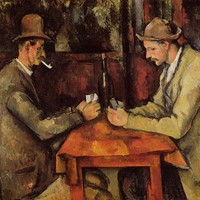
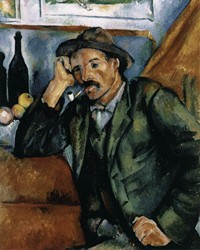
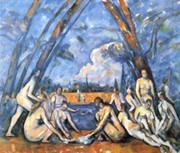
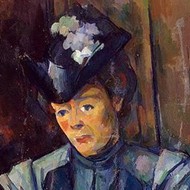
An important contributor to both Impressionism and its successor movement Post-Impressionism, the French painter Paul Cezanne is often called the "father of modern art". His innovation in the fields of composition, perspective and colour led to the transition from 19th century to 20th century art. Picasso said he was 'my one and only master...Cezanne was like the father of us all'. Influenced by the Impressionist Camille Pissarro, Cezanne specialized in landscape painting - see his series of Mont Sainte-Victoire paintings (1882-1906) - and still life painting. During his late period he also created some sublime portrait art, as exemplified by the masterpieces The Card Players (1892-6); Woman with a Coffee Pot (1890-5); Man Smoking a Pipe (1892); The Boy in the Red Vest (1889-90); Lady in Blue (1900); and the classical Young Italian Woman Leaning on her Elbow (1900). Furthermore, his important work of modern art entitled The Large Bathers (Les Grandes Baigneuses) (1898-1905) had a huge influence on the Cubism of Picasso and Braque. |
|
ART OF IMPRESSIONISM POST-IMPRESSIONISM |
|
WORLDS TOP ARTISTS |
Paul Cezanne was born in Aix-en-Provence in 1839, his father was a wealthy banker and merchant. He developed an interest in art early on in life, but his father was determined that he should pursue a more stable career. From 1852 to 1858 Cezanne received a solid education in the humanities at the College Bourbon in Aix. Here he became a friend of Emile Zola. In 1859 he went to study law at the University of Aix, but only lasted a year before confessing to his father that he wanted to move to Paris and work as an artist. He was strongly encouraged in this decision by his childhood friend, Emile Zola who was already living in the capital at the time. Cezanne's father eventually agreed to finance this change of career. Les Quatre Saisons (The Four Seasons) (1860, Paris, Petit Palais), with which he decorated the Jas de Bouffan, a country house which his father had just brought, is mainly notable for a youthful clumsiness. However, Cezanne's first stay in Paris only lasted 6 months - deeply dissatisfied with his painting skill, he destroyed most of his canvasses and returned home full of self doubt and started working in his father's business. Early Paintings: First Contacts With Impressionism A year later, he decided to try painting again. His early works are dark and moody and remain so for a while. He failed the entrance exams for the Ecole des Beaux-Arts, and the Paris Salon also rejected his paintings. It was around this time that Pissarro introduced him to the Impressionist painters Manet (1832-83), Renoir (1841-1919) and Degas (1834-1917). From 1862 to 1869, moving between Aix and Paris, Cezanne witnessed the conflict between the dull culture of official circles and the revolutionary realism of Courbet (1819-77) and the Salon des Refuses of 1863. The work of Delacroix (1798-1863), which combined traditional subject-matter with a modern, painterly style, appeared to Cezanne, in the retrospective exhibition of 1864, to offer a style that suited him. Receptive to all these diffferent influences, Cezanne went to meetings at the Cafe Guerbois and was fascinated by the bold, emotional effects of the work of Theodore Gericault (1791-1824) and Honore Daumier (1808-79). Cezanne directed his excessive feelings and his suffering into what he called his couillard ('butch') manner. Using muddy paint, heavy with thick black pigment, he painted scenes of an erotic, macabre kind inspired by Italian Baroque and Spanish Baroque art (L'Orgie [The Orgy], 1864-8 Lecomte Collection; La Madeleine [The Magdalene], 1869, Musee d'Orsay; and L'Autopsie [The Autopsy], 1876-9, Lecomre Collection). His portrait art and still-life paintings were more carefully considered, and show a surprising strength and intensity (Le Negre Scipion [The Negro Scipion], 1865, Sao Paulo Museum; Portrait d'Emperaire [Portrait of Achille Emperaire], 1866, Musee d'Orsay; La Pendule au Marbre Noire [The Black Marble Clock] 1869-71, private collection, Paris). During the Franco-Prussian War, he stayed at L'Estaque, painting boldly coloured landscapes of the beaches (La Neige fondante a L'Estaque) (Melting Snow at L'Estaque], 1870, Buhrle Collection, Zurich).
|
|
|
In 1872-3, after the birth of his son, Cezanne settled at Auvers-sur-Oise , near Camille Pissarro (1830-1903) who was to prove a considerable influence. The two men spent time painting together. Pissarro introduced him to Impressionism, and his work was exhibited alongside the other Impressionist painters in the now famous 1874 exhibition, held in the studios which the photographer Nadar had just vacated on the 2nd floor of 35 Boulevard des Capucines, and which he kindly lent them. Secure in his personal life with Hortense Fiquet, and with his friends Pissarro, Armand Guillaumin (1841-1927) and Dr Gachet around him, he painted landscapes like the (House of the Hanged Man) (Maison du Pendu) (1873, Musee d'Orsay) and still lifes like the Buffet (Sideboard) in the Budapest Museum (1873-7) that reveal a strongly personal vision. Preserving psychological analysis for his challenging, passionate self-portraits (Lecomte Collection 1873-6; Phillips Collection, Washington, 1877), Cezanne focused in his other works on capturing the subtleties of volume and tone. The geometrical arrangement of Madame Cezanne au Fauteuil Rouge (Madame Cezanne in a Red Armchair) (1877, Museum of Fine Arts, Boston), the calm dialogue of Nature Morte au Vase et aux Fruits (Still Life with Vase of Fruit) (1877, Metropolitan Museum), the arrangement of trees and water in his peaceful Bridge at Maincy (1879, Musee d'Orsay) - all show a preoccupation with form and composition. The rhythmic variations and deliberarely stylized bodies in the Lutte d'amour (1875-6, private collection, Washington) and the Bathers, male and female,which from that time on he began to paint, recall Rubens and Titian.
In 1877 Cezanne showed 16 oils and watercolours at the third Impressionist exhibition in the empty apartment which Gustave Caillebotte (1848-94) had rented at 6 rue Le Peletier for the occasion. This time the show was boldly entitled "Exhibition of Impressionists", despite opposition from Degas (1834-1917), and was to remain the most significant of all the group's showings. It consisted of 230 works by eighteen painters, but those of Cezanne (and Alfred Sisley) were a revelation. Unrecognised and scorned up to this point, he now received exceptional respect from his comrades, who set aside one entire wall of the central room for his oil paintings (still-lifes, landscapes, and a portrait of Chocquet) and watercolours. Unfortunately, despite all these efforts, as well as greater interest from the public, few paintings sold. Depressed by this reception and offended by the sneers of press and public, Cezanne stopped exhibiting with his friends and colleagues. However, he enjoyed no more success with the official Salon jury, which rejected Cezanne's submissions every year from 1864 to 1881. Finally, in 1882, following the intervention of a friend, it accepted Cezanne's submission Portrait of Louis-Auguste Cezanne, Father of the Artist, (1866, National Gallery of Art, Washington, DC), which was his first and last Salon exhibit. Post-Impressionist Development In the early 1880s Cezanne and his family settled in Provence where they remained, except for brief trips at home and abroad, until his death. The move signalled a clear break from Paris-centred Impressionism and reflected Cezanne's preference for his native south. At intervals, Cezanne visited Paris where he would sometimes be seen at the Nouvelle-Athenes cafe. More often, however, he was in the provinces: wirh Zola at Medan in 1880; wirh Pissarro at Pomoise in 1881; with Renoir (1841-1919) at La Roche-Guyon, then at Marseilles, where he met Adolphe Monticelli (1824-86), a favourite of Napoleon III, in 1883; with Claude Monet (1840-1926) and with Renoir at L'Estaque in 1884. This was a time of fertile maturity, when Cezanne moved away from the Impressionists, improved his brushwork, and worked ceaselessly at the same motifs. Although Pissarro continued to paint faithfully from nature, Cezanne began to react against such a lack of structure. He said he wanted to create something 'solid and durable, like the art of the museums'. He turned his attention to still life, painting over 200 as he demonstrated his analysis of nature, stating that the most common underlying geometric shape of nature is the 'cylinder, sphere and the cone'. (Apples and Oranges, 1895-1900, Musee d'Orsay). He wanted to 'do Poussin from life' by treating nature 'with cylinder and sphere'. Accordingly the subjects which he chose from nature, among them Gardanne (1886, Barnes Foundation, Merion), the rocks at Aix (1887, Tate Gallery, London), and the sea at L'Estaque (1882-5, Metropolitan Museum and Musee d'Orsay; 1886-90, Art Institute of Chicago), were submitted to a process of analysis partly based on geometrical principles (cylinder, sphere and cone etc.), and partly on the desire to release the medium of painting from its primary descriptive function. The light harmony of Vase bleu (Blue Vase) (1883-7, Musee d'Orsay) seems to preserve the delicacy of his watercolours, with their controlled rhythm and fine lines. Cezanne produced over 400 of these watercolours but, outside a small circle of collectors that included Renoir and Degas, they remained unknown until the art dealer Ambroise Vollard (1866-1939) exhibited them in 1905. They include such remarkable works as La Route (The Road) (1883-7, Art Institute of Chicago); Le Lac d' Annecy (1896, City Art Gallery, St Louis, Missouri); Trois Cranes (Three Skulls) (1900-6, Art Institute of Chicago); and the Pont des Trois-Sautets (1906, Cincinnati Museum). |
|
|
Irritable, defiant and, from 1886, increasingly isolated (in that year his father had died and he had broken off relations with Zola, whose L'Oeuvre, which had used him partly as a model, had wounded him), Cezanne was now known to only a few intimates. But although a mysterious figure, he had a certain fame. The Nabis, led by Pierre Bonnard (1867-1947), Paul Serusier (1865-1927), and Maurice Denis (1870-1943), were from then on profoundly influenced by him.
See also the art collector Duncan Phillips (1886-1966), who was a passionate collector of both Bonnard and Cezanne. Between about 1890 and 1900 Cezanne produced a group of major works of Post-Impressionist painting that, in contrast to the brilliant and ephemeral world of the Impressionists, aimed to be 'something solid, like the art of the museums'. In the breadth of Woman with a Coffee Pot (1890-5, Musee d'Orsay), in the dynamic and masterly Mardi Gras (1888, Pushkin Museum), or in the important series of The Card Players, probably inspired by the work of Le Nain Brothers in Aix Museum (1890-5, versions held in various museums), Cezanne showed the full range of his genius. Analysis often charged with emotion characterizes The Boy with the Red Vest (1890-5, E.G.Buhrle Foundation and other museums), Man Smoking a Pipe (1890, Hermitage Museum), Portrait of Ambroise Vollard (1899, Petit Palais, Paris) and - one of his most famous landscape paintings - Le Lac d' Annecy (1896, Courtauld Institute Galleries, London). Two other gems from Cezanne's final period are Lady in Blue (1900, Hermitage) and The Young Italian Woman Leaning on her Elbow (1900), a classical portrait which was bought by Matisse, and is now in the J.Paul Getty museum. Admired by young painters (he was visited by Bemard Camoin while, at the Salon des Independants of 1901, Maurice Denis exhibited his Homage a Cezanne), and finally recognized at the Salon d'Automne of 1903, Cezanne continued to work at the themes that obsessed him. He produced endless versions of the figurative Les Baigneurs (1900-5, Barnes Foundation, Merion; National Gallery, London) - culminating in his masterpiece, the Large Bathers (Grandes Baigneuses) (1898-1905, London/Philadelphia) - as well as landscapes of Mont Sainte-Victoire (1882-1906, versions in several museums), a well-known landmark near Aix. With allusive, nervous brushwork, in the short time that remained to him he created the dreamlike vibration of Le Chateau Noir (1906, versions in Pushkin Museum; Museum of Art, Philadelphia; Buhrle Collection, Zurich). Although Cezanne's health deteriorated in later life, he still made the short journey to his studio to paint everyday. He usually travelled by carriage, and one day, angered by the increase in the fare, he decided to walk. It started to rain, he caught a chill, which turned to pneumonia. A week later, in October 1906, he died. Legacy, Reputation As an Artist Cezanne's influence on the history of art was huge. A master of most painting genres, his use of colour had something in common with post-impressionists like Paul Gauguin (1848-1903) and Van Gogh (1853-1890). But it was his constant search for an underlying structure to composition that paved the way for the revolution in abstract art in the 20th century. He constantly questioned what he saw and how he represented it on canvas, an approach continued after his death by still life artists like Giorgio Morandi (1890-1964), Georges Braque (1882-1963) and Juan Gris (1887-1927). A retrospective of 57 paintings took place in 1907 at the Salon d'Automne, which exerted a huge influence on Picasso and Braque who were in the process of formulating their prototype Cubism, as well as the Worpswede painter Paula Modersohn-Becker (1876-1907) and many others. A key figure in French painting, Cezanne's vision was exploited by a wide variety of modern artists, from Fauvists to Cubists. It was promoted in England by Post-Impressionist exhibitions organized by Roger Fry in 1912 and 1913. Cezanne's conception appeared from then on, and for a considerable time to come, to be the starting point for all pictorial analysis. Cezanne's work includes about 900 paintings
and 400 watercolours, and is represented in most of the best
art museums throughout the world, notably the Musee d'Orsay, Barnes
Foundation (Merion, Pennsylvania), the Metropolitan Museum of Art and
the Museum of Modern Art (New York), and the Courtauld Institute and the
National Galllery (London). Also, following the nationalization of collections
assembled by Sergei Shchukin
(1854-1936) and Here is a short selection of what we believe are Paul Cezanne's finest pictures. Figurative Landscapes Still Lifes Self-Portraiture Watercolours |
|
• For more biographies of great artists,
see Famous Painters.
ENCYCLOPEDIA OF VISUAL ARTISTS |