Theodore Gericault
Biography of French Romantic Artist, Portrait
Painter.
MAIN A-Z INDEX - A-Z of ARTISTS

|
Theodore Gericault
|
|
|
Theodore Gericault (1791-1824)Contents • Biography |
|
|
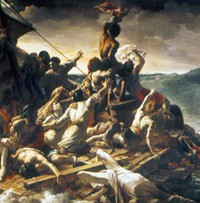
One of the first great exponents of 19th century French Painting, and of the style known as Romanticism, Theodore Gericault lived as well as painted with all the verve of the Romantic style. Blessed with independent wealth, he could indulge his twin passions, for painting and horses, as and when he wished. He had less formal training than most artists of his day, and only applied himself seriously to his art when inspired - as with his great masterpiece, The Raft of the Medusa (1819, Louvre). Influenced by his more academic predecessor Antoine-Jean Gros (1771-1835), Gericault was a powerful influence on the younger Eugene Delacroix - who became one of the greatest Romantic artists - as well as the populist Parisian history painter and engraver Paul Delaroche (1797-1856). Gericault was also one of the best portrait artists, noted for his haunting realist studies of asylum inmates. His untimely death came after many months of suffering, following a fall from a horse. |
|
WORLDS TOP ARTISTS PRINTMAKING WORLD'S GREATEST ART TOP ART AUCTION PRICES |
|
|
Born into a wealthy bourgeois family in Rouen, Gericault moved to Paris as a boy. During his youth, he was fascinated by all aspects of equestrianism, such as races, circuses, and riding schools. When in 1808 he joined his first studio, it was that of Carle Vernet, who was primarily a horse painter. In 1810, he moved to the studio of Pierre Guerin for more serious academic training; but his real artistic education was derived from the three years he spent copying in the Louvre (1811-14). His first Salon exhibit, Officers of the Imperial Guard (1812) is a blaze of colour and movement, quite natural in the context of Imperial France; it is strongly reminiscent of the work of the neoclassicist Antoine-Jean Gros, who was much admired by Gericault. Until his departure for Rome in 1816, to study High Renaissance painting, most of his work was in this vein, and he was sufficiently inspired by Napoleon not only to paint several pictures of military life - such as Charging Chasseur (1812, Louvre) and Wounded Cuirassier Leaving the Field of Battle (1814, Louvre), but also to enlist for a few months in 1814. However, his art broadened as a result of seeing the Old Masters, during his trip to Italy. Probably the most impressive painting executed during his stay is The Riderless Horse Race in Rome (1816-17), which transposes the sporting event to a timeless era, uniting the heavily muscled figures from Michelangelo with the flat relief-like depiction of the horse in the centre, in the manner of a Greek frieze. |
|
|
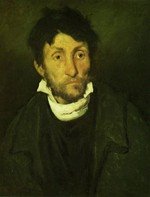
Returning to Paris in the autumn of 1817, Gericault was in a quandary. His work had gained power through his study of the Renaissance, but he was dissatisfied with works like the Race of the Riderless Horses which did not depict current events. A child of France's most heroic age, he could not ignore the dynamic representation of contemporary reality as practiced by artists like Gros, nor the influence of the increasingly popular British Romantic writers, notably Byron and Walter Scott. He wanted to paint a subject from modern life in monumental terms. Having experimented rather unsuccessfully with various themes, he came across a pamphlet describing the privations of those who had survived being cast adrift on a raft of a ship called the "Medusa". Abandoned to their fate on a raft by a mutinous crew, the survivors returned to France to tell a horrifying tale of exposure and near starvation, avoided only by cannibalism. Overcome with enthusiasm, Gericault interviewed the authors of the pamphlet, and determined to paint a vast canvas. He toyed with sketches of many different scenes before he settled on the final version, but once decided, he worked with complete dedication. To force himself to remain in his studio, he shaved his head; and to ensure the correct representation of dead bodies, he worked in the company of corpses. In fact, The Raft of the Medusa (1819, Louvre) is a truly innovative painting, not only in raising a subject from modern life to the proportions once reserved for paintings of the Antique, but also in its construction. Gericault was extremely daring in organizing his painting around a pyramid, which culminates in the figure of the negro waving a rag in the direction of the rescue ship, faintly visible on the horizon. However, this composition gives such power to the expression of hope among the shipwrecked survivors that it succeeds admirably. As a history painting which involves a relatively low-brow theme, The Raft of the Medusa belongs to the tradition popularized by the American painter John Singleton Copley (1738-1815) in his painting Brook Watson and the Shark (1778, National Gallery of Art, Washington DC). Unfortunately, neither the French Academy - guardian of the rules of academic art - nor the government saw any benefit in encouraging this type of sensationalism. Not surprisingly therefore, despite its painterly qualities, the Medusa was not well received by the critics, nor was it bought by the government as Gericault had hoped it would be. Disillusioned by his relative failure after so much intense work, he took the painting to England early in 1820; he made a considerable amount of money by showing it there in a travelling exhibition. In England, Gericault's style again underwent a radical change. He had been, in 1817, one of the first artists to take up the newly invented process of lithography; he now put this expertise to good use, producing a series of 13 plates illustrating the life of the English poor. These engravings are inspired in part by the genre painting of English artists, although they have nothing of the maudlin sentimentality of the latter. The most important work he produced in England is undoubtedly The Epsom Derby (1821, Louvre). Returning to his first love, horses, Gericault here conceives the movement of that most gracious of animals in entirely new terms. The whole impression given is one of movement, with the horses shown galloping flat out to increase the feeling of speed. Minor English sporting painters may have suggested this style to Gericault, but it is essentially new, and no echo of it is found in French art until the advent of Edgar Degas, almost 50 years later. Gericault also produced several unusual examples of still-life painting, such as Anatomical Pieces (1818). Gericault's entire history is one of change and innovation, and nothing is more novel than his famous series of portrait paintings of the insane. Painted for a Dr Georget, one of the pioneers of psychiatry, each of these mesmerizing examples of portrait art illustrates a different psychotic condition - such as kleptomania, delusions of grandeur, and so forth. It is not certain whether these works were painted by Gericault as a favour to Dr Georget, or whether they were in fact a kind of occupational therapy prescribed by Georget for one of Gericault's frequent bouts of depression. Gericault painted ten of these canvases in all; only five are extant, a fine example being The Mad Assassin (1822). Their unique quality lies in the fact that they were among the first portraits in the history of art to depict an abnormal mental state as an illness, rather than as a subject for laughter. In any event, they rank among the most striking 19th century portraits, by any artist. Between his return to France in 1822, and his death two years later, Gericault painted very little, the only really significant work being The Lime Kiln (1823). Successive equestrian accidents weakened him, and as he was unwilling to take good care of himself, he eventually died. Near death, he exclaimed in typical Romantic but essentially untrue fashion: "If only I had painted five pictures: but I have done nothing, absolutely nothing." In fact, critics now suggest that Gericault was one of the key forerunners of modern art, especially in his embrace of the new Realism, without which the likes of Delacroix and Gustave Courbet (1819-1877) might have struggled to achieve their fame. Works by Theodore Gericault can be seen in many of the best art museums throughout the world, notably the Louvre Museum in Paris. |
|
• For more biographies of French artists,
see: Famous Painters.
ENCYCLOPEDIA OF VISUAL ARTISTS |