Edgar Degas
Biography of Impressionist Figurative Genre
Painter.
MAIN A-Z INDEX - A-Z of ARTISTS

|
Edgar Degas
|
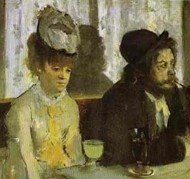 Absinthe (1876) Musee d'Orsay, Paris. One of the greatest genre paintings of the Impressionist period. |
Edgar Degas (1834-1917)Contents • Introduction NOTE: For analysis of works by Impressionist
painters like Edgar Degas, |
|
IMPRESSIONIST MOVEMENT
|
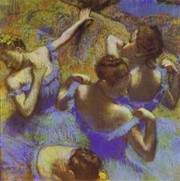
One of the key figures of modern French painting, the shy, haughty Edgar Degas was one of the core members of the Impressionism art movement although he preferred to be associated with Realism. Strongly influenced by the great Old Masters, notably J.A.D.Ingres (1780–1867), he is renowned above all for his outstanding figure painting, and is best known for his studies of ballerinas. His portraits, too, are exemplary, and some - like Portrait of a Young Woman (1867, Musee d'Orsay, Paris) - bridge the gap between classical tradition and modern art, in a manner similar to those of the great Russian realist Ivan Kramskoy (1837–1887). Unlike other Impressionist painters including Monet, Pissarro, Sisley and to a lesser extent Renoir, he had no interest in plein air painting and preferred the calm, composed atmosphere of the studio to the thoughtless spontaneity of outdoor work. He worked in various media including, oils, watercolours, pastels and bronze sculpture. Although recognized as one of the best genre painters, he also produced numerous history paintings, portraits, still lifes and even landscapes. His best works include: Race Horses in front of the Stands (1866-8); The Bellelli Family (1858-67); The Ballet Class (1874, Musee d'Orsay, Paris); L'Absinthe (1875, Musee d'Orsay); Women Ironing (1884); Woman Combing Her Hair (1887-90); The Blue Dancers (1899, Pushkin Museum of Fine Arts, Moscow); and the bronze sculpture Little Fourteen-Year-Old Dancer (1879, original is now in the Metropolitan Museum of Art, New York). Many of Degas' paintings are now available as prints in the form of poster art. |
|
|
|
BEST MODERN ART MODERN ARTISTS WORLDS TOP ARTISTS |
Hilaire Germain Edgar Degas was born in Paris, into an art-loving family. His father was a wealthy banker and his mother was an American from New Orleans. He started painting seriously early on in life and at the age of 18 turned a room in the family home into a studio, making copies of art works in the Louvre. However, his father expected him to study law, which he did so for a year, before giving up his studies to join the Ecole des Beaux-Arts. It was around this time that he met the renowned Jean Auguste Dominique Ingres who advised him to "draw lines young man, many lines". At the Ecole, he studied drawing under Louis Lamothe, who placed emphasis on traditional academic art especially draftsmanship. He furthered his studies with a 3-year trip to Italy, where he spent all his time painting copies of Renaissance masterpieces by Raphael, Michelangelo and Titian. He was influenced also by the German realist history painter (and closet-Impressionist) Adolph Menzel (1815-1905). History Paintings and Family Portraits Returning to Paris in 1859, he completed a number of historical works in a quasi-orthodox style. This was because, like Menzel, Degas' early ambition was to be a historical painter: it was only in his early 30s that he changed course and began to specialize in genre-painting. Typical examples of his history painting at this time include: Young Spartans Exercising (1860, National Gallery, London); Semiramis Building Babylon (1861, Louvre, Paris) and War Scene from the Middle Ages (1865, Louvre). The preparatory drawings that he made for these paintings, however - studies of draperies and nudes, such as Standing Nude (1865, Louvre) - already display a confident, vigorous graphic line. In particular, they demonstrate a thorough mastery of the lesson of J.A.D.Ingres, whom Degas, throughout his life, held to be the greatest painter of his age. At the same time he started painting portraits of families and friends, combining a classical and romantic style, while revealing great qualities of simplicity (see for instance: Rene Degas with an Inkwell (1855) Smith College, Northampton, Massachusetts). In fact this remarkable series of family pictures, painted between 1858 and 1870, are also close in spirit to Ingres in their association of a sense of reality with the concept of ideal beauty. His portraits of Therese Degas, Duchess Morbilli (c.1863, Louvre) and of a slender, serious Giulia Bellellin (1867, Louvre), have a delicate psychological depth and certain charm. Moreover, his studies for the Therese Degas portrait, complete with Ingres-like drawing and delicate colouring - in pastel and oils - of the various other figures in the portrait, are among the most harmonious compositions he ever produced. |
|
|
|
|
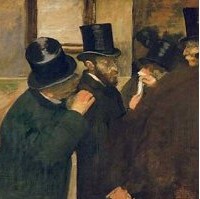
In 1862, while copying a Velazquez in the Louvre, he met the celebrated Edouard Manet (1832-83), who introduced him to a group of young progressive artists centred around Claude Monet (1840-1926). Although he became a member of this so-called group, Degas felt that he had little in common with these (Impressionist) painters, most of whom preferred to paint outdoors - a habit he had little time for. Even so, it was largely due to their influence, that over the next few years he gave up historical painting altogether and focused on more contemporary genre paintings of horse racing, ballet, cafes and street scenes. His development found critical outlet in the theories of Louis-Emile Duranty, whose article on "The New Painting" echoed his interest in Baudelaire's modernism and in unconventional subjects - for example the world of the turf and the theatre - highly coloured and artificial settings with which his social life had already made him familiar - see for instance: Gentleman Race: Before the Departure (1862, Musee d'Orsay); Racehorses and Jockeys in front of the Stands (1869-72, Musee d'Orsay); At the Racecourse in the Country (1870-3, Museum of Fine Arts, Boston). Very soon he became interested in the dance and in opera. He painted the Portrait of Mademoiselle Fiocre in the Ballet, 'La Source' (1866-8, Brooklyn Museum), an odd, almost Symbolist painting, with an acid turquoise in the dancer's dress, and followed this with The Dance Foyer at the Opera (1872, Louvre), with its pale blue-greys and yellows. It was during this period that he introduced new and original effects in his composition, which was now often asymmetrical - see The Orchestra of the Opera (1868-9, Louvre). He also employed traces of the Japanese style then in fashion - see Woman with Chrysanthemums (1865, Metropolitan Museum of Art, New York). In 1870 he enlisted in the National Guard during the Franco-Prussian war, which meant he did not have much time to paint. After the war, he took a trip with his brother Rene to see his mother's family in New Orleans. One famous work from this time is his realist composition known as The Cotton Exchange (1873, The Fogg Art Museum, Harvard University), which received favourable reviews back in France. He returned to Paris in 1873. His father died the following year, and Degas inherited considerable wealth. However, his brother had amassed enormous business debts, so Degas was forced to sell everything to avoid bringing scandal to the family name. For the first time ever, he became wholly reliant on selling his art for income. He was now worried about money and became more ill-tempered and pessimistic than ever. In spite of this misanthropy he was fond of Manet and Gustave Moreau (1826-1898) and proved a helpful friend to the sculptor Albert Bartholome on the death of his wife, Perie de Fleury. In 1874 Degas, along with Monet's band of progressive painters decided to organise their own group exhibition, outside of the strict confines of the highly conservative Salon. It opened on the second floor of 35 Boulevard des Capucines, in Paris. Degas showed 10 paintings, compared to Monet (5 paintings, 7 sketches), Renoir (6 paintings), Berthe Morisot (9 paintings), Cezanne (3 paintings), Pissarro and Alfred Sisley (5 landscapes each). Surprisingly, the group - christened "Impressionists", after Monet's composition Impression: Sunrise - was met with derision, both by the critics and the public and the show made a loss. (See Impressionist Exhibitions Paris.) Little did anyone realize that within a generation Impressionism would be a world famous art style, and that Impressionist paintings would be snapped up by art collectors from Boston to Moscow. Degas' own paintings from this time include: Race Horses (c.1866, Musee d'Orsay), Young Woman Standing Next to a Table (c.1867, Musee des Beaux-Arts, Algiers), Portrait of Monsieur and Madame Edouard Manet (c.1868, Municipal Museum of Art, Kitakyushu, Japan) and Woman Ironing (c.1869, Neue Pinakothek, Munich). Technically Degas differed from the other Impressionists because he never adopted the Impressionist name, and avoided plein air painting. As he said himself, "no art was ever less spontaneous than mine. What I do is the result of reflection and of the study of the Old Masters." Despite this, his subject matter (scenes of Parisian life), his composition (often off-centre), his experimentation with vivid colour, and his friendship with key Impressionist artists including Manet, all bring him within the fold of the Impressionist school. (See also: Characteristics of Impressionist Painting.) And indeed he continued to exhibit regularly with the Impressionists until 1886, after which time he allowed his entire output to be handled by his faithful dealers, in particular Paul Durand-Ruel (1831-1922). See also: Impressionists Renoir, Sisley, Pissarro, Degas, Cezanne. The New Realism of Photography Impressionist or realist, Degas (like Manet and the later Toulouse-Lautrec) stubbornly resisted the cult of the countryside, along with the Impressionist dogma of painting out of doors, directly from the subject. Although he visited the Cafe Guerbois - a favourite meeting place of painters and other artists - until 1870, and afterwards the Cafe de las Nouvelle-Athenes - where he enjoyed meeting Manet, Zola and Cezanne - Degas was never really interested in naturalism, or in depicting fleeting changes in light. Instead, he became fascinated with movement and sought to translate the bizarre new realism of photography into the medium of painting. See in particular his exquisite ballet paintings, including: Ballet Rehearsal on the Set (1874, Musee d'Orsay), Dance Class (1874, Musee d'Orsay), Dancing Examination (1874, Metropolitan Museum of Art, New York), The Star (1876, Musee d'Orsay) and Dancers Practising at the Bar (1876, Metropolitan Museum of Art). See also: Impressionist Group Splits. As he became older, he often left large sections of his paintings slightly unfinished. He blamed an eye condition for this, although his contemporaries were to point out that anyone with 'inadequate vision' could hardly have executed such wonderful paintings. For all his artistic developments, some habits remained constant. For example, he always preferred to work in his studio and figure drawing remained his primary interest. He painted very few landscapes in his time. He was a careful artist, and always planned his works impeccably, with a precise palette - (see also 19th century colour palette). After about 1880, his preferred medium became pastel in his sketching of ballet dancers and milliners, mainly from memory of earlier works, and his portrait art more or less ceases. In 1881 he exhibited his now famous Little Dancer, a bronze sculpture. Towards the end of his life, as his eyesight began to fail, he turned more and more to sculpture, modelling figures and horses. He became quite wealthy during his career and amassed such a large collection of art that he considered owning a private museum to house it. Instead, it was auctioned off after his death. He died a lonely old man at the age of 83. Most of his friends were already dead. Degas's art, in fact, does give an extraordinary sense of fleeting impressions, but it is also reflective, built-up, seeking perfection and depth. Above all, Degas cared for line; his swift, precise drawings show his remarkable skill and his feeling for movement, analysed and projected in a single sweep of the pencil (the Louvre has some exciting series of studies, and the Bibliotheque Nationale in Paris several sketchbooks.) In order to break up the lack of movement in his canvases, he used off-centre compositions, raised the line of the horizon, overturned perspective and indulged in compositions which are often cut off abruptly by the frame. He also turned his mind quite often to photography, and practiced it himself. But he loved exploiting in his compositions the dazzle of artificial light, which emphasized forms (see Miss La-La at the Cirque Fernando, Paris (1879) National Gallery, London). In his oil painting and pastel works, which became more frequent after 1880, the tones were brilliant blues, rich reds and oranges; and the monochrome planes shimmered from the few brushstrokes of pure colour that enlivened them. Degas probed restlessly, tirelessly trying out each pose and each subject again and again. He rejected Symbolism, which meant escape, and the aestheticism of Art Nouveau, which he found decadent. He was a sharp observer of everyday life. His famous dancers are above all ethereal, childish creatures, transfigured by the phosphorescent gleam of the footlights (see Ballet Rehearsal on the Stage (1874) Louvre). They are suspended, coloured arabesques, but they are also, paradoxically, stupid little urchins exhausted by the monotony of rehearsals, resting, stretching, adjusting their hair or their clothes with clumsy movements, whey-faced and splay-footed (See Dancers in the Wings (1890-5) City Art Gallery, St Louis, Missouri). In fact, Degas was not seeking any seductive grace in the ballet. He liked absurd positions best, and unlikely-looking feats of balance. His eye was even more pitiless when he looked at women at their toilet. He watched them at length, in the bath, getting out of the bath, soaping themselves, rubbing themselves, washing neck, leg or torso (see The Bath (c.1890) Chicago Art Institute). He showed them in detail, caught them at moments when they might think themselves alone, crouching animal-like, grotesquely busy with intimate care of themselves, scratching themselves. Many of these works are exhibited in pastel (see After the Bath (1885) MoMA, New York; or Woman Combing her Hair (1887-90) Louvre). Degas's vision was no more indulgent when
he looked at working-class women or the cafe world. He painted subjects
of which Zola approved, but not in the Realist manner of Courbet.
His Women Ironing (1884, Louvre), his laundresses and seamstresses,
his young milliner crouched over the table making a hat, make no moral
or political statement: they merely evoke, in a masterly way, a moment
in the lives of ordinary people. These works are notable for their bold
composition and violent use of colour, as exemplified by the three hats
in At the Milliner's (1881, Metropolitan Museum of Art, New York),
standing out against an orange wall. See also: Impressionist
Painting Developments. Like his delicate In the Luxembourg Gardens (1876-80, Montpellier Museum), several attractive studies show that this middle-class Parisian also loved landscapes; in these pictures he omitted detail in order to express only a poetic, meditative calm. In 1869 he produced a series of bare seascapes in pastel, then about 1890, a number of monotypes drawn from memory of valleys and broad meadows. Degas' art, ceaselessly renewed, and with an innovatory realism, strongly influenced his contemporaries. He had no formal pupils, but he went on to influence a generation of other artists including Jean-Louis Forain (painter, lithographer/illustrator), Mary Cassatt (leader of American Impressionism), and Walter Sickert (leader of the English Impressionists). Toulouse-Lautrec (1864-1901), whom Degas defended from the beginning of his career, inherited the artist's taste for drawing and his sharp observation of Parisian life. The French and Belgian academic realists took from him his subject matter, and sometimes - as in the case of the society portraitist Giovanni Boldini (1842-1931) - his flamboyant colour. But it was the Nabis above all, including Pierre Bonnard (1867-1947) and Edouard Vuillard (1868-1940), who were most in tune with the intimate spirit of Degas' work, with its harsh tones, and were to transpose it into a happier world. See also: Legacy of Monet's Impressionism. Works by Edgar Degas hang in the best art museums around the world, notably the Musee d'Orsay and major American galleries like the Metropolitan Museum of Art in New York. A collection of his sculpture can be seen in the National Gallery of Art Washington DC. |
|
• For more biographies of great artists,
see Famous painters.
ENCYCLOPEDIA OF VISUAL ARTISTS |