|
|
Early Paintings
Renoir's first submission to the Paris
Salon in 1864, Esmeralda Dansant avec Sa Chevre (Esmeralda
Dancing with her Goat), was accepted, but later Renoir destroyed the painting,
thinking it too sombre and academic. He then fell deeply under the influence
of the great French realist Gustave Courbet
(1819-77), having met him at Marlotte near Fontainebleau. This influence
is evident in his first large-scale composition, Auberge de la Mere
Anthony (The Inn of Mere Anthony) (National Museum of Stockholm),
rejected by the Salon in 1866, and also in one of his first nudes Diane
Chasseresse (Diana the Huntress) (1867, National Gallery of Art, Washington),
rejected by the Salon in 1867. Meanwhile Renoir was painting portraits
to good effect, catching the sitter's personality: Bazille (1867,
Musee d'Orsay), those of the Sisley Family (1868, Wallraf-Richartz
Museum, Cologne) and the Femme a l'Ombrelle (Woman with a Parasol)
(1867, Folkwang Museum, Essen), hung in the Salon in 1868. Other notable
works include Young Boy with a Cat (1868, Musee d'Orsay).
Impressionism
However, it was Impressionism that was
to free Renoir from these various influences. From 1869 when he painted
La Grenouillere (Winterthur, Oskar Reinhart Foundation) in company
with his close friend Claude Monet, he became obsessed with the study
of reflections on water, and began adding small accents of colour to replace
the drawing. The two painters continued along these lines after 1870 at
Argenteuil, where they painted regattas and a variety of landscapes. But
Renoir, unlike his friends, had not abandoned the human form, to which
he also tried to apply Impressionist principles. (Note: to understand
more about Renoir's landscape art, see: Characteristics
of Impressionist Painting 1870-1910.)
He was comparatively successful with Parisian
Women Dressed as Algerians (1872, National Museum of Western Art,
Tokyo), in which he was obviously influenced by Eugene Delacroix (1798-63),
and with his Cavaliers au bois de Boulogne (Horsemen in the Bois
de Boulogne) (1872, Hamburg Museum), rejected by the Salon in 1873 but
shown at the Salon
des Refuses. His true brilliance emerged only in Madame Monet
Reclining on a Sofa (1872, Gulbenkian Foundation, Lisbon) and in La
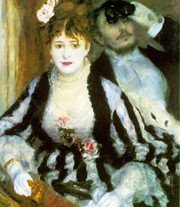
Loge (The Box at the Opera) (1874, Courtauld Institute, London) as
well as La Danseuse (The Dancer) (1874, National Gallery of Art,
Washington), the two latter paintings being shown with four other canvases
and a pastel at the first Impressionist Exhibition. Other exhibitors included
Monet, Sisley, Eugene Boudin (1824-98),
Cezanne (1839-1906), Berthe
Morisot (1841-95), Edgar Degas (1834-1917)
and Camille Pissarro (1830-1903).
Impressionist
Portraiture
After this Renoir's development quickened,
and from 1876 he applied his Impressionist skills to portrait
art, with which he was again successful, showing 15 paintings at the
second Impressionist Exhibition in 1876. This was a lucky year for Renoir.
He rented a studio in the Rue Cortot in Montmartre where he produced some
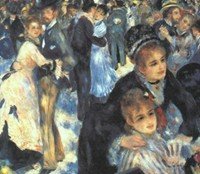
of his most famous works, such as Le Moulin de la Galette (in 1990,
this work sold for $78 million), La Balancoire (The Swing), Torse
de femme au soleil (Nude in Sunshine) (all in the Musee d'Orsay, Paris),
and Sous la Tonnelle (Under the Arbour) (Puskin Museum, Moscow).
In all these different canvases, which he exhibited in 1877 at the third
Impressionist Exhibition, Renoir aimed at capturing the effect of light
filtering through trees on to figures in the shade (which, the critics
said, make them resemble corpses). It was also at this time that Renoir
became acquainted with the publisher Georges Charpentier and was frequently
invited to his glittering salon, where he met the leading political, literary
and artistic figures of the day.
To earn a living he had to undertake many
commissions, including works of decorative art and a number of portraits
of mothers with their children: Madamoiselle Georgette Charpentier
(1876, private collection); Child with a Watering Can (1876, National
Gallery of Art, Washington); Madame Georges Charpentier (1876-7,
Musee d'Orsay); Portrait de Madamoiselle Jeanne Samary (1878, Hermitage),
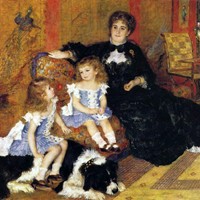
and the magnificent Portrait de Madame Charpentier et de ses Enfants
(1879, Metropolitan Museum of Art, New York). These last two portraits
were shown at the 1879 Salon, Renoir refusing to show at the fourth Impressionist
Exhibition, no doubt in the belief that this would compromise his success
with Parisian society, which accepted him as a brilliant portraitist.
He displayed less worldliness but equal
brilliance in his paintings of the habitues of small suburban bistros
and in his Portrait d'Alphonsine Fournaise (1879, Musee d'Orsay).
He took no part again in the fifth Impressionist Exhibition of 1880, showing
instead two canvases at the Salon, La Femme au Chat (Woman with
a Cat) (1880, Williamstown, Clark Art Inst.) and Fishing for Mussels
at Berneva (1879, Merion, Barnes Foundation). These were painted during
a holiday at Wargemont, near Dieppe, where he was staying with the diplomat
Paul Berard, whose guest he often was during the summer.
It was perhaps this double life, both fashionable
and commonplace, that prompted him to go to Algeria for a time for a rest,
from the beginning of March to 15th April 1881. He returned with several
portraits of Algerian women and vividly coloured landscape
painting: Fields of Banana Trees, Ravine of the Wild Woman,
Arab Fete at Algiers (all Musee d'Orsay).
|