|
|
What Happens
In a Life Drawing Class?
Also called Life Drawing, most figure drawing
classes involve drawing a naked model. Without clothes the model can be
rendered in a timeless fashion. (See also Female
Nudes.) Stripped of culture and place in time, there is no difference
between those figures drawn today and those created in a Renaissance classroom.
The nude figure, depending on pose and artistic skill, can suggest every
aspect of humanity from the pathetic to the narcissistic or heroic. If
you attend a figure drawing class, you are participating in a tradition
that is hundreds, possibly thousands of years old. The structure of your
class will depend on the venue and person offering the course. Some teachers
prefer to let students render their own sketches, offering tips or corrections
as the work progresses. Other teachers take a more instructional approach
- first doing and then encouraging the students to try. The latter approach
is more appropriate for beginner students.
Typical Figure
Drawing Course
The following is an outline of a typical
6-stage figure drawing course. During the class, a variety of media can
be used to represent the model's body, including: pencil, pen and ink,
charcoal, crayon, pastels, chalk or mixed media, although pencil is the
classical tool. (See also: Pencil
Drawings as well as Charcoal
Drawings and Pen-and-Ink
Drawings.)
Stage 1
Basic proportions of the human body and how all the parts relate to each
other.
Stage 2
Drawing a live model in 3D form, grasping measurements and center line.
Stage 3
Creating a convincing silhouette and learning to draw the head, torso,
legs and arms accurately.
Stage 4
Continue practicing the human figure, also adding tones and shades for
a more convincing modelling and shadow casting.
Stage 5
Practice drawing the hands and feet from different angles and work on
your modelling and rendering skills.
Stage 6
Create finished drawings ready for group exhibition or for your portfolio.
History of Figure
Drawing
The earliest known drawings of human figures
were created as part of the prehistoric tradition of cave
painting, from about 17,000 BCE onwards, in France and Australia.
In France, the earliest drawing of a man - a prone stick-like figure -
can be seen in the Shaft of the Dead Man (15,000 BCE) at Lascaux
Cave, in the Dordogne. On the other side of the world, human forms
first appeared in the Kimberley region of Western Australia. Known as
"The Bradshaws", this unique style of aboriginal
art, at least 17,000 years old, consists of stick-figures (up to 6-feet
in height) drawn in fine detail with accurate anatomical proportions.
Despite animals being drawn in quite a life-like fashion, Paleolithic
drawings of humans remain rigidly non-naturalistic. Not until the late
Mesolithic era (c.6,000 BCE) do we see more natural-looking pictures of
humans. However, the fact that these drawings of matchstick men have survived
at all, is a miracle, and owes a great deal to the fact that artists sketched
on rock.
Ancient art
from the early civilizations of antiquity (Mesopotamia, Ancient Egypt,
Greece, Persia, Rome) also featured drawings of humans, but typically
these were sketched on less weather-proof media, such as papyrus or wood
panels, and few have survived. The only type of figurative art which survived
antiquity in any significant amount, was statuary and relief sculpture,
although Ancient Greek sculptors succeeded in inspiring later generations
of stone masons, painters and draughtsmen. (See also: Greek
Art.) In particular, they championed the idea that the human body
was the ideal subject for a work of art:
a view echoed and developed further by the masters of the Italian
Renaissance, notably Leonardo, Michelangelo and Raphael. For their
influence, see also the Classical
Revival in modern art (1900-30).
Italian Renaissance:
The Golden Age of Drawing
It was these three artists in particular,
that made drawing - or disegno
- respectable, since up to then it had been regarded as merely preparatory
design work - rather than an independent form of fine
art - or, it was used to simply record and copy finished works of
art, including paintings and statues. The wider availability of paper
after 1550 also meant that drawings could more easily be produced and
collected. Leopold de Medici and Giorgio Vasari both amassed a great collection
of sketches (Medici had amassed 12,000 drawings by 1689). The Renaissance
era (c.1400-1600) unquestionably represented the apogee of drawing as
an art form. Workshop apprentices working for painters, sculptors and
goldsmiths absorbed the fundamentals of sketching from working with drypoint
and metalpoint on wax tablets, before proceeding to more expensive media,
such as chalk or charcoal.
Leonardo Da Vinci (1452-1519)
Leonardo was a master of
topographic human anatomy, executing a large number of detailed sketches
of muscles, tendons and other anatomical features. He intended to publish
his drawings in a treatise on anatomy, but on his death in 1519, the drawings
remained unpublished among his private papers. Their significance was
lost to the world for 400 years but today they can be viewed in the British
Royal Art Collection at the Queen's Gallery, Buckingham Palace. He
strove to depict the universal nature of man. Among his drawings he listed
'joy, with different ways of laughing', as well as the 'cause of laughter'.
He strove to capture the different movements of killing, 'flight, fear,
ferocity, boldness' as well as 'weeping in different ways'. Not happy
with depicting the human figure on the outside, Leonardo wanted to know
what made them tick on the inside. In the 1500s the Black Death plagued
Europe, and the artist made the most of the opportunity by dissecting
as many corpses as he could lay his hands on. He was probably one of the
first artists to accurately draw the human reproductive system. Other
masterpieces by Leonardo include: Head of Girl, (study for Virgin
of the Rocks 1483) executed with silverpoint on light brown paper;
Five Grotesque Heads (1494), pen and ink drawing.
Michelangelo Buonarroti (1475-1564)
Michelangelo, too,
was a prolific draughtsman, sketcher and exponent of figurative art. After
the death of Raphael in 1520 he dominated Renaissance
art for another 40 years. His primary interest was the male
nude and he relentlessly sketched figures in different poses in an
attempt to undercover the essence of their spirit. He executed numerous
preliminary studies for his two masterpiece sculptures, the Pieta and
David, as well as copies
of sketches for his landmark Genesis
fresco (1508-12) and Last
Judgment fresco (1536-41), painted on the ceiling and altar wall of
the Sistine Chapel. (See also: the Creation
of Adam.) Michelangelo's other drawings encompass works in pen and
ink, pen and wash, charcoal as well as red and black chalks. He never
intended most of his drawings to be exhibited in public and would have
been horrified at the thought. Biographers speculate it was perhaps because
he wished to conceal the amount of preparation work he did for his major
works. In fact, just before he died he burnt a lot of his drawings. One
exception perhaps was his drawing Tityus (1533, Royal Collection,
Windsor Castle). Tityus was a gift and one of the first drawings to be
considered an artwork in its own right.
Raphael (Raffaello Santi) (1483-1520)
Raphael, another master of human
anatomy, often began his figure sketching with an under drawing using
a stylus. The sharp tip of this instrument left faint impressions on the
surface of the paper. He then drew with red chalk over the impressions
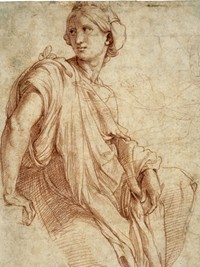
when he was satisfied with the outline. An example is his study for the
Phrygian Sibyl (1511, British Museum). This female figure is wearing
classical drapery and has very masculine arms and legs (she was probably
drawn from a male model). Many of Raphael's drawings are finished to a
high-degree, with white highlights and shading. He often relied on drawings
to refine his poses for his paintings, and judging by the large amount
of surviving sketches, he was more prolific in this area than Michelangelo
and Leonardo.
Greatest Renaissance
Exponents of Figure Drawing
• Pisanello
(1394-1455)
• Fra Angelico (c.1395-1455)
• Jacopo Bellini (1400-1470)
• Fra Filippo Lippi (1406-69)
• Benozzo Gozzoli (1420-97)
• Gentile Bellini (1429-1507)
• Giovanni Bellini
(1430-1516)
• Andrea Mantegna (1431-1506)
• Botticelli (1445-1510)
• Luca Signorelli (1445-1523)
• Pietro Perugino (1445-1523)
• Leonardo Da Vinci (1452-1519)
• Filippino Lippi (1457-1504)
• Vittore Carpaccio (c.1465-1525/6)
• Fra Bartolommeo (1472-1517)
• Michelangelo (1475-1564)
• Lorenzo Lotto (1480-1556)
• Raphael (1483-1520)
• Sebastiano del
Piombo (1485-1547)
• Andrea del Sarto
(1486-1530)
• Titian (1485-1576)
• Correggio (Antonio Allegri)
(1489-1534)
• Giulio Romano (c.1492-1546)
• Baccio Bandinelli (1493-1560)
• Pontormo (Jacopo Carrucci) (1494-1556)
• Rosso Fiorentino
(1494-1540)
• Parmigianino (Francesco
Mazzola) (1503-40)
Drawing Media Used
by Renaissance Artists
Here are just a very few examples of the
media used in Renaissance drawings
and sketches in order to obtain precise effects.
• Metalpoint and brown wash over black
chalk heightened with white on salmon-pink paper.
• Metalpoint heightened with white gouache on lilac-grey paper.
• Brush and brown wash with ink, traces of red wash, on parchment.
• Pen and brown wash, heightened with white over traces of black
chalk on blue-green paper.
• Brush drawing in grey-brown and white distemper on linen tinted
dark grey.
• White highlighting and brown gouache over metalpoint on ochre paper.
• Black chalk, pen and ink with brown wash and white highlighting.
• Black chalk with touches of white highlighting, pen and grey ink
on grey-beige paper.
• Pen and ink and faint brown wash over black chalk on pink-tinted
paper.
Red chalk was another popular drawing
medium during the Renaissance era, as it was the preferred medium for
nude sketches because of its malleability and ability to portray human
flesh.
Modern Drawings
of the Human Figure
Since the Renaissance, nearly every art
movement, including Baroque, Rococo, Neoclassicism, Realism, Impressionism
and Expressionism, has featured artists who were supremely talented at
sketching, and who executed drawings in a wide variety of media. Here
are a tiny handful of great sketchers with examples of their works.
- Albrecht
Durer: Madonna with Many Animals (1503, Albertina, Vienna)
- Rembrandt: An artist in a
Studio (1632, Rijksmuseum)
- Nicolas Poussin: Abduction
of the Sabine Women (1634, Met Museum NYC)
- Watteau: Study for
L'Indifferent (1710, Rotterdam)
- Francois Boucher: Vertumnus
and Pomona (1760–70, Met Museum NYC)
- Jacques-Louis David: Male Nude (1764, Louvre)
- Jacques-Louis David:
The Three Horatii Brothers (1785, Musee Bonnat)
- Pierre-Paul Prud'hon: Seated Female Nude (c.1795-1800, Met Museum
NYC)
- Goya: Three Men Digging (c.1800,
Prado)
- Edouard Manet: Deux Religieux Agenouilles (1857, Musee d'Orsay)
- Honore Daumier: Literary
Discussion in Second Class (1864, Le Charivari)
- Honore Daumier: The Third Class Carriage (1864, Walters Art Museum)
- Edgar Degas: Dancer Adjusting
Her Slipper (1873, Met Museum NYC)
- Edgar Degas: Woman Bathing in Shallow Tub (1885, Musee d'Orsay)
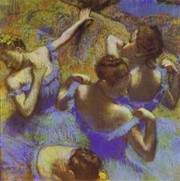
- Edgar Degas: Blue Dancers (1899, Pushkin Museum of Fine Arts)
- Edgar Degas: The Dancers (1899, Toledo Museum of Art)
- Henry Moore: Women Seated in the Underground (1941, Tate)
- Francis Bacon: Turning
Figure (1959-62, Tate Collection)
How Much is a Drawing
Worth?
It's only a sketch on paper, right? What
can it really be worth? Well, in 2012 a sketch of a man's head entitled
Head of a Young Apostle (1519) by Raphael sold for a record £29.7
million at auction, smashing its pre-sale estimate of £10-15 million.
Educational Resources
• Art
Evaluation: How to Appreciate Art
• How to Appreciate Paintings
• How to Appreciate Sculpture
|