Titian
Biography/Paintings of Venetian Renaissance
Painter.
MAIN A-Z INDEX - A-Z of ARTISTS

|
Titian
|
|
|
Titian (Tiziano Vecellio) (c.1488-1576)Contents • Introduction The most important painter of the Renaissance in Venice, Titian was active during the High Renaissance (c.1490-1530) and subsequent Mannerism period (1530-80) of the cinquecento. Details of his early creative life remain unclear. Influenced by Giovanni Bellini, the father of Venetian painting, he collaborated with Giorgione (1477-1510) in the fresco decoration of the Fondaco dei Tedeschi (1508-9), and in the frescoes of the Scuola del Santo in Padua (1510-11). In 1515 he began working for the Gonzaga, Este, Farnese and Rovere families, and also the French King Francis I (1494-1547). In 1533, he was appointed court painter to Emperor Charles V (1500-1558). In 1545 he worked for Pope Paul III (1527-98). A master of oil painting, who changed his style several times during his career (he completed more than 600 works, including some of the greatest Renaissance paintings), he is best known for his religious art, his portraiture and his mastery of colour painting. |
|
|
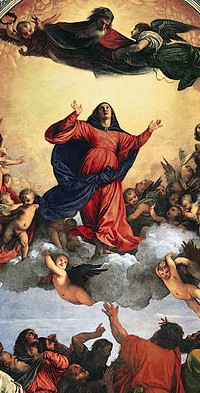
In addition to his work with a brush, he also produced some of the best drawings of the Renaissance. Such was his dominance over other Old Masters in Venice that they nicknamed him the "sun amidst small stars". He became the painter and doyen of the wealthy Venetian intellectual classes, and was a close friend of the writer and publicist Pietro Aretino, who did a great deal to establish Titian's fame during his lifetime. His best known masterpieces include the huge altarpiece of the Assumption of the Virgin (1516-18, S.Maria dei Frari), Sacred and Profane Love (c.1514, Borghese Gallery), The Entombment of Christ (1523-26, Louvre, Paris), Martyrdom of St. Peter (1530, now lost), his female nudes such as the Venus of Urbino (1538, Uffizi, Florence), Danae (1544-5, Museo di Capodimonte, Naples), and Venus and Adonis (1553-4, Prado), as well as the portraits Man with a Glove (1520, Louvre), Pope Paul III with his Grandsons (1545-6, Museo di Capodimonte), and Charles V on Horseback (1548, Prado).
|
|
COLOURS USED IN
PAINTING |
|
WORLDS TOP ARTISTS WORLD'S BEST ART TOP ART PRICES |
Titian was born Tiziano Vecellio to a well-established wealthy family, in a small village near Belluno in Northern Italy. He was the second of the five children of Gregorio Vecellio, a notary from Cadore. Little is known of his early life, except that at the age of 10, his father - recognising his son's artistic talent - sent him to Venice to study art. He first trained under the mosaicist Sebastiano Zuccati and then in the Bellini studio under Gentile Bellini (c.1435-1507), then Giovanni Bellini (1430-1516). Giovanni's passion for the sensuous use of colour had a huge impact on the young Titian. Giorgione: Titian's Real Teacher The year 1508 was decisive in Titian's early career for it was then that he and Giorgione - another pupil of Bellini - were commissioned to decorate in fresco the Fondaco dei Tedeschi. Giorgione was to paint the main front from the Grand Canal, while Titian was to do the wall giving on to the Merceria. Only a few fragments survive of this work, while the rest must be seen in the engravings made by Zanetti in the 18th century. If these few scraps are any proof, Titian's real teacher was Giorgione, who impressed on him his way of suggesting forms rather than stressing them, as well as conveying his feelings abour nature. But it is also true that from the beginning the pupil differed from the master, whose contemplative lyricism he did not share, or his indifference to earthly reality.
|
|
|
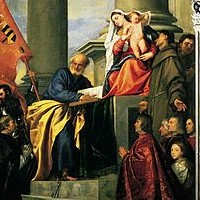
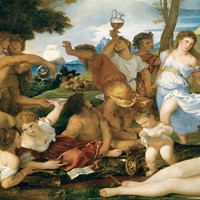
Endowed with a dramatic temperament and considerable nervous energy, Titian put the lessons of 15th-century naturalism to good use in the religious paintings for the Scuola del Santo in Padua (The Miracle of the Newly Born Child, The Healing of the Wrathful Son, The Miracle of the Jealous Husband), executed in 1511. In these scenes he organizes his space into a rhythmic composition that stresses a succession of volumes enveloped in bold, contrasting colours. 'Real' men and women act out their passions against a landscape treated as a stage-set, in a space where they are the masters, rather than in the mysterious atmosphere of Giorgione. Some of Titian's works, displaying a progressive detachment from Giorgione, are thought by today's critics to be earlier than 1508-11, or at least contemporary. Four panels from chests have survived from Titian's early years: The Birth of Adonis and The Forest of Polydorus (1505-1510, Museo Civico, Padua); Endymion (Bames Foundation, Merion, Pennsylvania); and Orpheus and Eurydice (Accademia Carrara, Bergamo). Already an obvious sensitivity to effects of space and colour is visible, alien to Giorgione, and Titian can be seen exploring new themes and the 'constructive' use of colour. From this first period also date a Circumcision (Yale University Art Gallery, New Haven), a Flight into Egypt (Hermitage), Jacopo Pesaro Presented to St Peter by Pope Alexander VI (Antwerp Museum) and a Virgin and Child with St Anthony of Padua and St Roch (Prado, Madrid), so like the work of Giorgione that it seems deliberate. Titian's portrait art, in contrast to that of Giorgione, which is full of pathos, is more strongly characterised: Gentleman Leaning on a Book (National Gallery of Art, Washington DC); and the Lady (National Gallery, London). In his Portrait of a Man with a Blue Sleeve (National Gallery, London) the presentation, which is still Giorgionesque, is simplified by the employment of several large planes: the fullness of a sleeve, the puffed-out satin clothes, the projection of the image by the sharp division of the balcony. The wood-engraving of the Triumph of the Faith (c.1511; the first of five editions is in the Print Room at Berlin-Dahlem) represents a climax in Titian's reaction against Giorgione's influence. But in October 1510 Giorgione died; his other rebellious pupil, Sebastiano del Piombo (1485-1547), left for Rome, and Giovanni da Udine and Morto da Fellere went to central Italy. This period gave birth to works in which the demarcation line between the hands of the two artists is hard to distinguish. The Outdoor Concert (Louvre) seems to have been completed by Titian after being left unfinished by Giorgione, while the Noli me tangere (1511-1512, National Gallery, London), The Concert ( Palazzo Pitti, Florence), The Allegory of Human Life (Edinburgh, N.G.), The Gypsy Madonna (1512, Kunsthistorisches Museum, Vienna) and the Carrying of the Cross (Venice, Scuola di S. Rocco) are all full of a Giorgionesque feeling. After the Baptism of Christ (c.1512, Doria Pamphilj Gallery, Rome) and the Sacra Conversazione (c.1513, Magnoni Collection, Reggio Emilia) Titian's art is characterised by a new figurative feeling and the search for that serene and majestic beauty emblematic of the Renaissance. Representative of the new trend are: a series of Sacre Conversazioni (Munich, Alte Pinakothek; Edinburgh, National Gallery; London, National Gallery); Salome (Galleria Doria Pamphilj, Rome); Flora (Uffizi); A Woman at Her Toilet (Louvre); and Sacred and Profane Love (1514, Museo Galleria Borghese, Rome). This last is one of the highest peaks of Titian' s classicism and, in the peaceful harmony of the landscape and beauty of the figures, one of the supreme expressions of Renaissance art. An equal harmony is typical of other Sacre Conversazioni (Prado, Madrid; Alte Meister Gallerie, Dresden), as well as Christ and the Widow's Mite (Alte Meister Gallerie, Dresden), the Madonna of the Cherries (1515) and Violante (1515-1518) (both Kunsthistorisches Museum, Vienna). In the enormous altarpiece of the Assumption for the Church of S. Maria Gloriosa dei Frari in Venice, commissioned in 1515 and erected in the church on 20th March 1518, Titian's classicism gave way to a naturalism and a passion that the Venetians, unprepared for such boldness, found disconcerting. This ardour is somewhat abated in the three paintings for Alfonso I d'Este: Worship of Venus (1518-19) and Bacchanal of the Andrians (1523-5) - both in the Prado Museum, Madrid - and Bacchus and Ariadne (1523, National Gallery, London). Between 1518 and 1520 Titian painted an Annunciation for Treviso Cathedral; in 1520 he signed and dated a Madonna and Child Appearing to Sts Francis and Blaise and to the Donor Alvise Gozzi (Ancona Museum), and between 1520 and 1522 the Averoldi Polyptych, in five panels, for the Church of S. Nazaro e Celso, Brescia. In all these works, and especially in the Resurrection of Christ in the Averoldi altarpiece, Titian's regard for the great High Renaissance artists Raphael (1483-1520) and Michelangelo (1475-1564) is perceptible in the dramatic intensity of feeling and the vigorous accents. A deep awareness of the model's psychology and a simplified structure are typical of the portraits of Vicenzo Mosti (c.1523-5, Palazzo Pitti, Florence), the Man with a Glove (c.1523-4, Louvre) and Federico Gonzaga (after 1525, Prado). In contrast, The Madonna and the Pesaro Family (1519-26, Venice, Church of S. Maria Gloriosa dei Frari) is very complicated, with its lofty effects of monumental architecture and perspective stretching into infinity. Although Raphael was the inspiration behind Titian's masterpiece The Entombment of Christ (c.1523-5, Louvre), the way in which light is used gives the work a restlessness that is Titian's own. Unfortunately another masterpiece, the Martyrdom of St Peter, is lost: bombed by an Austrian shell in 1867. Painted by Titian for the Church of SS. Giovanni e Paolo, and completed on 27th April 1530, it was enthusiastically described by Vasari and Aretino, and brought to an end the figurative period that had begun with the Frari Assumption. The Virgin with the Rabbit (1530, Louvre) and the Virgin and Child with St John the Baptist and St Catherine (1530, National Gallery, London), are calmer in their flexibility and modelled landscapes. This glorification of feminine beauty is more spontaneous, and even homely, in the Portrait of a Young Woman in a Furred Gown (c.1535-7, Kunsthistorisches Museum, Vienna) and in the Bella (c.1536, Palazzo Pitti, Florence). |
|
|
By the mid 1520s, Titian had become one of the most famous artists of the Italian Renaissance. Rulers saw themselves through his art, and therein realized their most sublime aspirations. The artist's relations with the court of the Este family were succeeded in 1523 by a new connection with the Gonzaga court, and with Francesco Maria della Rovere. In 1530 Titian had his first meeting with Charles V in Bologna; three years later, in the same town, the Emperor made him a Palatine count and a Knight of the Order of the Golden Spur. He invited the artist to the court at Augsburg, between 1548 and 1550, and again in 1550-1. This lofty patronage is proof of Titian's reputation as one of the best portrait artists, a genre that satisfied his taste for realism. The paintings of Charles V (c.1532-3, Prado), of Cardinal Ippolito de' Medici (1533, Palazzo Pitti, Florence), of the Duke and the Duchess of Urbino (1538, Uffizi), of Francis I (1538, Louvre) and of Alfonso d' Avalos (1536-8, Ganay Collection, Paris) met all his clients' demands for pomp and majesty. For more details, see: Venetian Portrait Painting (c.1400-1600). In addition, he also painted the portraits of animals, other artists, writers and friends. Overall, his portraiture ranks with the work of other master portraitists like Rembrandt (1606-69) and Rubens (1577-1640). The pronounced naturalism in the Presentation of the Virgin in the Temple (1534-8, Accademia, Venice) and in the Venus of Urbino (1538, Uffizi) gave way in Titian's works to the Mannerism which had been introduced into Venice during these years by Salviati and Giorgio Vasari (1511-74), and which must already have made an impression on Titian during the time he had spent in the Mantua of Giulio Romano. The three-dimensional tension peculiar to Mannerist artists characterizes the 12 Portraits of Roman Emperors (begun in 1536 for the Sala di Troia of the Palazzo Ducale in Mantua, then lost, and today known only by the engravings of Sadeler) and is also evident in Alfonso d'Avalos Addressing his Soldiers (1540-1, Prado), The Crowning with Thorns (c.1543, Louvre) and Ecce Homo (1543, Kunsthistorisches Museum, Vienna), and in three ceilings - The Sacrifice of Abraham, Cain and Abel, and David and Goliath - for the Church of S. Spirito in Isola (1542; now in the sacristy of the Church of S. Maria della Salute, Venice). In the realm of the portrait this tension is resolved by the energy Titian employed to capture the personality of his sitters, who appear variously as prudent, cunning, arrogant or devout (Ranuccio Farnese, 1541-2, National Gallery of Art, Washington DC; Pope Paul III, 1546, Museo Nazionale di Capodimonte; the Doge Andrea Gritti, National Gallery of Art, Washington DC; Charles V at the Battle of Muhlberg, Prado, Madrid; Charles V Seated, Alte Pinakothek, Munich; Philip II, 1551, Prado; Votive Painting of the Vendramin Family, 1547, National Gallery, London).
The years after 1550 show no slackening in Titian's creative activities. He executed simultaneously works for Venice (Pentecost, 1555-8, painted for the Church of S. Spirito, now in the Church of S. Maria della Salute; The Martyrdom of St Lawrence, finished in 1559, Venice, Church of the Gesuiti; Wisdom, for the ceiling of the antechamber of the Biblioteca Marciana, after 1560) and for Ancona (Christ on the Cross with the Virgin, St Dominic and St John, 1558, Church of S. Domenico). To please the curious tastes of Philip II of Spain, he painted the famous 'poesie', a series of erotic mythological paintings (Danae, 1554, and Venus and Adonis, 1553-4, both in the Prado; Diana and Actaeon and Diana and Callisto, 1556-9, exhibited at National Gallery, Edinburgh; The Death of Actaeon, c.1559, National Gallery, London; The Rape of Europa, 1562, Gardner Museum, Boston). He also painted religious topics (St Margaret, 1552, Escorial, 1567, Prado; The Entombment, 1559, Prado; Agony in the Garden, 1562; The Martyrdom of St Lawrence and St Jerome, 1565, Escorial). The expressiveness of all these works derives from the way in which the forms seem to dissolve as though by a process of self-combustion.
Titian had now reached the last phase of his activity: the representation of a naturalistic vision where the already eroded classical ideal no longer interested him. He developed a style which paid small regard to contour or plasticity: very free in handling, and almost harsh, where people and nature were painted in splashes and clots, slashes almost, of colour, the outlines softened, the highhlights modulated, sometimes with a smudged finger. From this smoky disaggregation of the paint golden lights loom out in The Annunciation (1566, Venice, Church of S. Salvatore); a crackling impasto in Venus Binding the Eyes of Cupid (1560-2, Museo Galleria Borghese, Rome), in St Sebastian (c.1570-2, Hermitage) and in The Crowning with Thorns (Alte Pinakothek, Munich); a rosy light in Tarquin and Lucretia (1570-1, Fitzwilliam Museum, Cambridge), which is even more striking in the alternate version in Vienna (Akademie); a melancholy, turbulent sky in Shepherd and Nymph (1570-6, Kunsthistorisches Museum, Vienna); and a great fire which bathes in purple The Scourging of Marsyas (1570-6, Kromeriz Museum). This 'magic impressionism' is also characteristic of Titian's last portraits: Francesco Venier (1554-6, Thyssen Collection, Lugano); The Antiquary Jacopo Strada (1567-8, Kunsthistorisches Museum, Vienna); Self-Portrait (1568-70, Prado), painted for his children to remember him by, where, from the heavy impasto, a spectral, unearthly figure stands out. Titian died in Venice of the plague in his house at Birri on 27th August, 1576, leaving unfinished a Pieta (1575) (Venice Academy Gallery), a complex, troubled work which was intended for his vault in S. Maria Gloriosa dei Frari and which was completed by his follower Palma Giovane. His son died shortly after him, while thieves who were taking advantage of the chaos and fear in the city plundered the family mansion. Titian was interred in the famous Basilica Santa Maria Gloriosa dei Frari, Venice and lies near his renowned painting of the Madonna di Ca'Pesaro. Titian's influence on the history of art in general, and Venetian art in particular, should not be underestimated. (See: Legacy of Venetian Painting on European art.) He revolutionized the technique of oil painting by freeing up brushstrokes and using colour more expressively. This inspired other great artists like Tintoretto (1518-94) - Titian's younger contemporary, and rival, in Venice - as well as El Greco (1541-1614) (who was apprenticed to Titian in his later years), Rubens, Delacroix and the Impressionists. In company with figures like Giotto, Botticelli, Leonardo, Michelangelo and Raphael, Titian remains one of the giants of the Italian Renaissance. His works can be seen in the best art museums around the world. |
|
|
|
• For more about the art of Venice,
see Venetian Renaissance
architecture (1400-1600).
Visual
Artists, Greatest |