Altarpiece Art
Types of Altarpieces: Triptych, Polyptych,
Diptych.
MAIN A-Z INDEX - A-Z of ART MOVEMENTS

|
Altarpiece Art
|
|
DIFFERENT FORMS OF ARTS WHAT IS ART?
|
Altarpiece Art (c.1000-1700)Contents • Introduction The altarpiece was one of the highpoints of Christian art during the Late Gothic, Italian Renaissance, Northern Renaissance, and Counter-Reformation periods. This type of religious art typically consists of one or more paintings, or sculptures (stone or wood-carvings) carved in the round or in relief, or simply a screen or decorated wall. It can stand on, above or behind the altar. Historically, most altarpieces date from about 1000 CE onwards, when the shrine was relocated to make the altar the focal point of the church. Altar panel-paintings only became common in the 15th century; they were created using either oil paint or egg tempera, on wooden panels. Most altarpiece iconography is closely linked to Biblical art, typically featuring Saints and members of the Holy Family. From about the mid-sixteenth century - the time of the Catholic Counter-Reformation Art (c.1560-1700) - altarpieces made up of linked panel paintings were replaced with canvas paintings. |
|
|
|
|
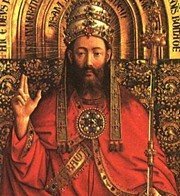
There are two basic types of altarpiece. (1) The reredos, a large and often elaborate construction in wood or stone, typically rising from the floor behind the altar. Examples include: St Mary, Krakow (1477-89) carved by Veit Stoss; St Jakob Kirche, Rothenburg (1499-1504) carved by Tilman Riemenschneider; High Altar of the Virgin Mary (1613-16), at Saint Nicholas at Uberlingen, by Jorg Zurn. (2) The retable - a simpler structure featuring relief sculpture or painted panels, standing at the back of the altar itself, or on a surface behind it. Examples include: The Dijon Altarpiece (1394-99) by Melchior Broederlam; The Ghent Altarpiece (1432) Saint Bavo Cathedral, by Hubert and Jan van Eyck; The Avignon Pieta (1454-6) by Enguerrand Quarton; The Isenheim Altarpiece (1506-15) Monastery of St. Anthony, by Matthias Grunewald; and the Pala d'Oro, Basilica di San Marco, Venice. Lastly, some altarpieces were simply religious paintings (painted on canvas or wood) fixed to the altar wall, like: Giovanni Bellini's celebrated San Zaccaria Altarpiece (1505, Church of San Zaccaria, Venice); Raphael's Sistine Madonna (1515, Gemaldegalerie Alte Meister, Dresden) which was designed for the high altar of the Benedictine abbey church of San Sisto (St. Sixtus) in Piacenza, and his Transfiguration (1518-20) intended originally for the French Cathedral of Narbonne. The Madonna of the Harpies (1517) painted by Andrea del Sarto (1486-1530) for the high altar of San Francesco de'Macci in Florence, is another example, as is Titian's extraordinary Assumption of the Virgin (1516-18) - arguably the greatest altarpiece of the Italian Renaissance - which can still be seen in the church of Saint Maria Gloriosa dei Frari, Venice. For more of Titian's innovations in altarpiece painting, please see Venetian altarpieces of the sixteenth century. An altarpiece might even be attached to a church pillar, as in the case of the St Matthew Altarpiece (1367-8) designed for the Florentine church of Or San Michele, now in the Uffizi Gallery, Florence. Most Retables of painted panels were either in triptych form (3-panels), or polyptych form (more than 3 panels). The 2-panel variety, known as a diptych was typically created for personal veneration, rather than public worship. |
|
|
A Triptych was a popular format for altar paintings from the Middle Ages onwards (c.1000 CE). Consisting of a central panel and two hinged "wings", triptychs were installed in Eastern Orthodox as well as Western Christian churches. From the 15th century onwards, non-church triptychs were popular with Netherlandish Renaissance painters such as Hans Memling and Hieronymus Bosch, while modern exponents have included Francis Bacon (see: Three Studies for Figures at the Base of a Crucifixion, 1944), among others. Famous Triptych Altarpieces • Annunciation
Triptych (1333) by Simone
Martini. A polyptych was a hinged altarpiece with more than 3 panels. Polyptychs usually had one large central panel, to which a number of "side" panels, or "wing panels" were attached. This form of altarpiece was especially common in Early Renaissance churches and cathedrals. Famous Polyptych Altarpieces • Maesta
Altarpiece (1311) by Duccio di Buoninsegna Note: Polyptych altarpieces include: tetraptychs (4 panels); pentaptychs (5 panels); hexaptychs (6 panels); heptaptychs (7 panels); octaptychs (8 panels). A diptych has 2 hinged panels that fold together. Diptychs have been made for personal use since Roman times, after which they served as devotional religious items during the Early Christian Art era. Such personal diptychs were also known as "travelling icons". They were popular in early Flemish painting, among artists like Jan van Eyck, Rogier van der Weyden, Hans Memling and Hugo van der Goes, for secular portraiture as well as portraits of the Holy Family and scenes from the Bible. Early examples include: the Wilton Diptych (1395-99) by unknown artists; the Melun Diptych (1450-55), by Jean Fouquet. A modern example of the format is the Marilyn Diptych (1964) by Andy Warhol. |
|
• For details of major movements of
religious painting, see: History of Art.
ENCYCLOPEDIA OF ART HISTORY |