Jan van Eyck
Biography of Northern Renaissance Flemish
Oil Painter.
MAIN A-Z INDEX - A-Z of ARTISTS

|
Jan van Eyck
|
|
|
Jan van Eyck (c.1390-1441)Contents • Introduction
|
|
|
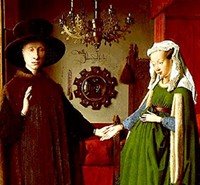
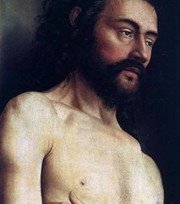
A Flemish painter and one of the leading Flemish painters of the Netherlandish Renaissance, Van Eyck mastered the art of oil painting, which was a new invention. He is considered one of the most talented painters of 15th century Europe and is best known for his highly realistic figure painting, usually on religious subjects, and portrait art. His hallmark three-quarter pose of face together with his mastery of oils brought a startling new realism to portraiture, and made him one of the foremost painters of the Northern Renaissance, much in demand by the newly emerging bourgeoisie and merchant class. His most notable works include the Ghent Altarpiece, (1425-32, Saint Bavo Cathedral, Ghent), the Arnolfini Portrait (1434, National Gallery, London) and the Annunciation, 1434 (National Gallery of Art, Washington). |
|
RENAISSANCE IN NORTH
EUROPE |
|
WORLD'S FINEST ART For a discussion about What is Art, aesthetics,
and associated issues |
Born in Maaseik, Belgium around 1395, little is known of his early life. It is thought that the painter Hubert van Eyck was his brother. Another younger brother, Lambert van Eyck is mentioned in court documents and it is thought he may have been a painter too. Van Eyck secured a career working at court, first for John of Bavaria between 1422 and 1424 and then with Philip The Good, Duke of Burgundy between 1425 and 1441. These positions were highly prestigious, and the regular salary allowed him to pursue a certain artistic independence. In fact Eyck developed a very close relationship with the Duke who served as godfather to one of his children, supported his widow on his death and later helped one of his daughters with funds to enter a convent. Van Eyck's family bore a coat-of-arms, which demonstrated that they belonged to gentry. And it is clear that he was literate because he signed his paintings, an unusual practice at the time. The Ghent Altarpiece is considered his first masterpiece (and one of the finest examples of Northern religious art), followed closely by the Arnolfini Portrait. Van Eyck's ability to manipulate oil paints to produce realistic representations of the natural world is why he became so popular, and remains so to this day. |
|
WORLDS TOP ARTISTS WORLD
ART PRICES |
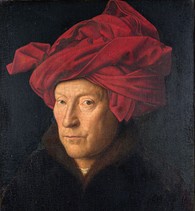
He frequently aimed to deceive the eye by using mirrors to reflect actions taking place off canvas. This can be seen in the Arnolfini Portrait, where the mirror on the rear wall reflects 2 figures entering the room, one is probably Van Eyck himself. The signature above reads 'Jan van Eyck has been here. 1434'. It was almost a version of early graffiti art. This work is a portrait of Giovanni di Nicolao Arnolfini and his wife, but is not meant as a record of their wedding. Mrs Arnolfini is not pregnant, as is so often thought, but holding up her full-skirted dress, as was the fashion at the time. Another reflected self-portrait, can be seen in the shield of Saint George in the Virgin of Canon van der Paele, 1434-36. Eyck was able to manipulate paint to create fleeting clouds and light reflections on different surfaces from metal to glass, dull to luminous. These effects can also be seen in his work Virgin of Canon van der Paele, in the glinting gold thread of Saint Donatian's cape, and the glow of pearls and dazzling jewellery of the holy figures. Other important works include the The Stygmata of St. Francis, c.1428-30 (Galleria Sabauda, Turin); Crucifixion and Last Judgement diptych, 1420-25 (Metropolitan Museum of Art, New York); Madonna in the Church, c.1425 (Staatliche Museen, Berlin); Portrait of a Man in a Turban, 1433 (believed to be a self-portrait) (National Gallery, London); St. Barbara, 1437 (Royal Museum of Fine Arts, Antwerp); Madonna and Child at the Fountain, 1439 (Royal Museum of Fine Arts, Antwerp); Portrait of Christ, 1440 (Groeningemuseum, Bruge) and St. Jerome, 1440 (Detroit Institute of Art, Detroit). As was common practice at the time, Van Eyck had a workshop in Bruges with assistants who made exact copies, pastiches and variations of his completed panel paintings for the market. He died in June 1441 and was buried at the Church of St Donatian (which was later destroyed in the French Revolution). In a 1454 biography, Jan Van Eyck was named the 'leading painter' of his day, alongside Antonio di Puccio Pisano (Pisanello) and Rogier van der Weyden. He influenced a generation of Flemish artists and after his death, his large volume of works went on to influence artists all over Europe. |
|
|
The Art of Jan Van Eyck (1395-1441) One of the greatest Old
Masters of early Flemish
painting, Jan van Eyck's artistic interests and activities, when compared
with those of his brother Hubert, seem singularly narrow. He was chiefly
a portraitist. Much of the last sixteen years of his life was spent in
travel as a confidential agent for the Duke of Burgundy. For these years
we have twelve pictures, mostly tiny portraits and small altarpieces,
with whatever he may have painted on the Ghent Altarpiece. It is a very
scanty production, even allowing for pictures now lost, and it suggests
that Jan had little creative urge, but depended on occasion. It seems likely that the very elaborate
Annunciation, in the National Gallery of Art, Washington, may have
been painted at Lille before 1425. The event takes place in a Gothic church
which, while fantastic in design, recalls the high naves of French churches
of about 1300. Upon this interior Jan lavished work and attention. Everything
is accounted for - stained glass, mural painting, pictured tiles, complicated
stone carving. The details are marvellous, but the feeling of interior
light is only feebly conveyed, the figures are badly out of scale with
the architecture and in perfunctory relations to each other. The faint
smirk on the archangel Gabriel's face forecasts the nervous grin of St.
George in the Van der Paele Madonna. It is a trait which suggests an artist
trying to express a feeling which he does not really experience. |
|
|
The altarpiece of Our Lady and Child with St. Donatian, St. George and Canon van der Paele, at Bruges, is generally regarded as Jan's masterpiece, and perhaps justly so. Of the larger panels of the moment no other is so profusely enriched. Stuffs, embroidered and jewelled borders, polished and curiously carved stone-work, elaborately fashioned metal, translucent glass, are juxtaposed, with hardly a gap to rest the eye or release the imagination. As painting, in a harsh and metallic way, it is magnificent. The Van der Paele Madonna was signed in 1436, shortly after Jan's marriage. He was in his mid-40s and at the height of his powers. The little unfinished St. Barbara (1437), is the only creation of Jan's that is gracious and charming. Had he finished it, doubtless he would have painted out much of the charm. The exceptional attractiveness of this little picture depended on a very simple decision - to give St. Barbara an actual tower in process of building instead of the usual tiny emblematic tower. She sits meditatively over her book of hours, oblivious of the work going on in her honour behind her. The elaborately lovely Gothic structure rises lightly. Workmen are busy on ledges, on scaffolds and about the base. Jan either had great talent for architectural design, or, as is more likely, thriftily and tastefully used the sketch of an architect friend. Beyond the tower there are receding, gently drooping and rising lines of hills, punctuated by single trees and coppices. There is much about this picture that makes one wish Jan had been an engraver; the point rather than the brush seems the tool really congenial to him. As showing the way in which an early Flemish picture was prepared, this little panel is indeed precious. When we think of parts of the Adoration of the Lamb left unfinished by Hubert, we must imagine them like the St. Barbara, elaborately drawn out on the panels and needing only to be coloured. The tiny panel of Our Lady and Child
by a Fountain, dated 1439 and at Antwerp, has evident relation to
the garden pictures of the Rhenish school. The closed garden, hortus
conclusus, and sealed fountain, fons sigillata, are established
symbols of Mary's virginity. Jan has worked out the details of vines,
flowers and the fountain with the most loving care, and the very small
scale of the picture, as always, has been favourable to him. For the Madonna
he has chosen a type which is at once exceptional and wholly his own,
in a Mary who is humble and tender without aristocratic pretensions, while
he shows an unusual vivacity of observation in the naturally flung attitude
of the active Christchild. However that be, the procedure of painting
a portrait not from the sitter but from a carefully prepared drawing remained
standard for Western Europe for over two centuries. It was the method
of Hans Holbein, of the Clouets
and their successors. It had many advantages over the practice of painting
from the sitter, which grew up during the era of Renaissance
art (1400-1530). The final character of the portrait was established
in a single intent act of observation. To attain this character, the significant
forms had to be sought strenuously, and eliminations and syncopations
made unsparingly. On such intense initial observation the artist stood
firmly. The painting was guided as to colour
by notes on the drawing and by memory. Consequently colour and lighting
were somewhat generalized. The painting went on confidently and one may
imagine almost mechanically. There was no concern with small particularities
of colouration, no confusion from change of mood or shifting of light.
Such portraiture was not precisely true to any momentary appearance, but
it had a timeless sort of truth of its own, taking the sitter out of a
changing world into a realm that is changeless. |
|
|
Dated about a year later, the portrait
of a Man
in a Red Turban, in the National Gallery, London, differs only
in being more linear and in the transparency of the shadows. It expresses
an old age at once shrewd, wistful and defiant. Without good reason many
critics regard this as a self-portrait. Despite, or perhaps because of
a somewhat provincial and homemade look, it is one of the more pleasing
of Jan's male portraits. The portrait of the goldsmith, Jan de Leeuw,
at Vienna, has more style than most of Jan's portraits. It is handsomely
set in the frame, even if the hand holding a ring is awkwardly placed.
The plastic effect is secured without over-emphasizing the modelling.
It is an attractive presentation of a capable and robust personality.
It has nothing of the strenuously homemade look of many of Jan's portraits,
rather an Italian simplicity, concentration and elegance. All this may
suggest either that in painting a fellow craftsman Jan worked with exceptional
sympathy, or, equally likely, that he had become conscious of his defects
and was seeking a broader style. By this time he must have seen the admirable
portraits of Rogier van der Weyden - sensitive, broadly conceived, distinguished
for tactful elimination - as well as his wonderful masterpiece Descent
From the Cross (1435). He could not imitate them, his nature forbade
that, but he could move their way. This was in 1436. |
|
|
On July 9, 1441, the Church of St. Donatian, at Bruges, received payment for burying Jan's body. About a month later the Duke made the substantial gratuity of 360 livres to the widow. Less than a year later Jan's brother, Lambert, arranged for moving the body from the churchyard to more honorable sepulture in the church itself, and the estate endowed an annual mass for the repose of his soul. They were taking notable pains after his death about a person who had been notable in life. Wherever we meet Jan in records it is as the employee of some potentate. He had met the great of the earth, had traveled widely. The Duke had stood godfather to his children, and had used him for difficult and delicate missions. To the courtly, official world in which he moved, Jan brought acceptance and a most accurate eye. Without criticism he gave the look of his world. The imagination goes forward two centuries to another painter and court chamberlain, Velasquez. With the difference imposed by the times, he was to do at Madrid what Jan had done at Bruges - give a dispassionate but amazingly truthful account of what he saw about him. From painters who are also chamberlains, official or unofficial, no poetry is to be expected. Enough if they give us the unvarnished truth. Jan's age at death we do not know, but it is unlikely that he had reached his sixties. Velasquez, too, barely reached that term. To be at once artist and courtier apparently does not make for longevity. Lest this article gives the impression
of trying to debunk the talent and fame of Jan van Eyck ask yourself the
following questions: Pupils: Petrus Christus In his various religious pictures, represented at Madrid, Berlin, Antwerp, Washington and New York, Petrus is a good rather than a striking artist. He shows some tendency to increase the relative scale of the figures, is always thoughtful; as a colourist, rather adequate than distinguished. One delightfully romantic painting, at New York, an Annunciation before an ivy-clad Gothic portal, is generally ascribed to him. If so, it must be regarded as a remarkable and probably quite early assimilation of the idealizing manner of Hubert. This entrancing little picture has been ascribed to Hubert van Eyck, although more likely it is a copy or version of a lost picture by Hubert. The slack quality of the figure painting hardly justifies an attribution to any great painter. Petrus Christus was an excellent portraitist. His portraits are related to the observer, have a certain vivacity rare at the time. None of them seem highly distinguished except the grim and amazingly vivid likeness of a Carthusian, in the collection of Mr. Jules Bache. In the facility of its execution and relatively large scale it marks a progress. Indeed at long range one might pardonably indulge the momentary error of seeing a very hard and early Rubens. It is dated 1466, and is far more modern in accent than the contemporary portraiture of Rogier van der Weyden and Dirck Bouts. Petrus Christus's most inventive picture is the St. Eligius with a Bridal Pair, (1449). It is conceived entirely as a genre painting, for St. Eligius is merely a goldsmith in his shop, shrewdly dealing with a cautious young husband and wife. The picture is quite beautifully painted and the lighting of a roofed but open space very carefully studied. It is perhaps the better that there is no emphasis of the shopping motive, the attraction resting on the assemblage and refined representation of materials. It stands at the head of a long line of genre subjects in half length, notably those of Quentin Massys and his imitators. Our last notice of Petrus Christus is in 1473 and we know that by 1477 he was dead. He had followed with humility and intelligence the best models, and had made his own modest contribution to the progress of his art. Of rather few minor painters can as much be said. The art of the Van Eycks is an episode and not in the direct line of Gothic realism. Just as the Burgundian dependencies in which they lived managed to keep out of the tragic events of the Hundred Years' War, so the art of Jan and Hubert van Eyck evaded the harsher religious emotions of the time. Their art has always a courtly and moderated character, and this they passed on to the later school of Bruges, and such masters as Hans Memling (c.1433-94). Works by Jan Van Eyck can be seen in the best art museums across the world. |
|
|
|
• For the evolution of fine art, see:
History of Art Timeline.
Visual
Artists, Greatest |