Hieronymus Bosch
Biography of Dutch Religious Painter.
MAIN A-Z INDEX - A-Z of ARTISTS

|
Hieronymus Bosch
|
|
|
Hieronymus Bosch (1450-1516)Contents • Biography |
|
WORLDS GREATEST
ARTISTS WORLD'S COSTLIEST ART |
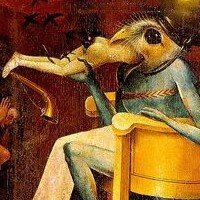
Regarded as one of the most imaginative Old Masters of the Netherlandish Renaissance, Hieronymus Bosch (also called van Aeken) was a 15th century Dutch painter, renowned for his fantasy figure painting of demons, machines and grotesque, sometimes nightmarish, imagery. Although Dutch, he had a huge influence on the progress of Flemish painting, to the south. Noted for his brilliant and rapid painting technique, Bosch's works are marked by their luminous colours, flecked highlights and chalk underdrawing. A native of Hertogenbosch, a member of the Brotherhood of the Holy Virgin - he devised the stained glass and crucifix for the Chapel of the Brotherhood - and thus a highly respectable citizen of the community. Strongly influenced by the religious notions of the time, his most famous works, mostly triptychs - all depicting sin and moral failing - include: The Haywain Triptych (1490, Prado, Madrid); The Temptation of St Anthony (1500; National Museum of Art, Lisbon); Garden of Earthly Delights (1500-05, Prado Museum, Madrid); and The Last Judgment (1500s, Alte Pinakothek, Munich). In his own time it was widely assumed his paintings were meant merely to amuse; since then, some scholars have attributed a deeper meaning to his highly original and complex works. But whether these works should be seen as picture books or puzzles, they have ensured Bosch's place as one of the best artists of all time. |
|
|
|
|
Bosch was born in Hertogenbosch, the capital of the Dutch province of Brabant. Little is known of his life, training or what he thought about his own art. His date of birth is only an estimate, based on a dated hand drawing, which may have been a self-portrait. As far as we know, he lived and worked his whole life in Hertogenbosch. He came from a family of painters, and it is likely that he learned drawing and painting from his father. It is known that he had 3 brothers, all of whom went on to become painters and were members of the Brotherhood of the Holy Virgin, a wealthy organisation that commissioned various works from members of the Bosch family. Their father was artistic adviser to the Brotherhood. Some time around 1480, Bosch married Aleyt Goyaerts van den Meerveen, who was apparently a good few years older than him. She had inherited a house and farm from her family. |
|
|
|
|
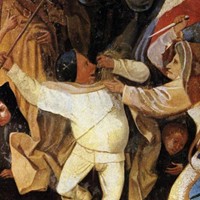
Bosch became a very popular painter during his time, and was hugely inventive, producing fantastical, almost Gothic nightmarish visions. His work provided a complete contrast to the religious art of the Italian Renaissance, which portrayed man in control of a rational universe. In addition, both his artistic subject matter and his free and painterly brushwork, which contrasts sharply with the jewel-like brilliance of the Jan Van Eyck tradition, set him apart from the mainstream of Netherlandish art. Also, his paintings have a slightly rough finish, which was in noticeable contrast to other Dutch and Flemish painters at the time, who tried to finish paintings as smoothly as possible, to belie the fact that they were man-made. Bosch's general outlook was extremely pessimistic and his unque brand of Northern Renaissance art gave vivid expression to the profound anxieties that troubled the human mind as the Gothic world drew to its close. He was obsessed by sin and depravity, by the snares laid by the devil for the unwary human soul on its perilous journey through this life, and by the torments of hellfire. Bosch's powerful imagination created a haunted world where good and evil wage perpetual war. His moralistic genre-painting is filled with strange monsters and hideous plants bearing evil fruits; fantastic structures and strange mineral forms are scattered through fiery landscapes. Yet, despite its difficulties, Bosch's art must be examined in the context of the orthodox religious beliefs of his time. Many of the sources of his iconography may be found in contemporary language, proverbs, and folklore, and in late medieval sermons and visionary poetry. |
|
|
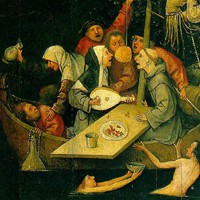
The chronology of Bosch's paintings is highly controversial. A small group of biblical scenes and didactic genre paintings, characterized by stiff, awkwardly placed figures and hard, sharp brushwork, are generally accepted as early works. The themes of his painting - including The Ship of Fools, (Louvre, Paris), The Stone Operation (Prado, Madrid), and the Seven Deadly Sins (Prado, Madrid) - are those of contemporary satirical writing. Bosch castigates the vices of charlatans and quacks, of rich men, and of lecherous monks and nuns. The Haywain Triptych (c.1485-1490) The subject of The Haywain was new in Netherlandish art. The inner and outer wings show the Creation and Fall of Man (inner) and Hell (outer). On the central panel a crowd of demons pulls a vast haycart, with a pair of lovers on top, towards hell. Behind ride dignitaries of Church and State, while beside it an unruly mob fight over handfuls of hay. Their greed and depravity is the subject of the painting. Bosch's source was a contemporary ballad or proverb; the hay also symbolizes the worthlessness of all material gain. The Last Judgment Triptych (c.1500s) The two major triptychs, The Last Judgment
(Alte Pinakothek, Munich) and The Haywain (Prado, Madrid), were
painted in Bosch's middle period (c.1500). In the central panel of The
Last Judgment Bosch created a highly original hellish landscape, infested
by a swarm of devils and covered by burning pits and furnaces, bizarre
constructions, and instruments of torture. Many of the monsters are half
animal, half human. Others combine animal forms with inanimate ones, and
startling juxtapositions of scale increase the horror of the effect -
as in the egg, pierced by an arrow, that scuttles about on booted legs.
Some of Bosch's imagery is developed from traditional medieval symbols
and he was further inspired by the grotesques that appear on medieval
illuminated
manuscripts; yet there is no precedent for the extraordinary fertility
of his invention. The Deadly Sin of Lust is almost certainly the subject of Bosch's most difficult triptych, The Garden of Earthly Delights (Prado, Madrid), probably painted after 1500. One of his most complex religious paintings, it is divided into 4 panels. The outer panels, when closed, show the Third Day of Creation, painted in grisaille. Inside, the Garden of Earthly Delights is flanked on the right by Hell and on the left by the Garden of Eden. This central panel shows a garden landscape of enchanting and fragile beauty, painted in pearly pinks and blues. Here, groups of small nude figures, spread out decoratively as though on a tapestry, indulge in every kind of physical activity. They ride on beasts, cavort in ponds and streams, nibble at luscious fruits, and entwine themselves with giant birds. There are over 1,000 figures in the work, each highly individual and involved in their own action. Almost all the details are erotic symbols drawn from contemporary folklore. Bosch certainly intended to represent not innocence but depravity; the surface beauty of the painting underlines the alluring and deceptive pleasures of sin, and the soft fruits symbolize the transience of carnal pleasure. The Garden of Earthly Delights demonstrates that lust is the main reason for man's downfall. The Temptation of St Anthony Triptych (c.1500) Especially in his later years, Bosch was
fascinated by the temptations and torments that beset those hermits and
holy men who sought to achieve union with God by a life spent in contemplation
and denial of the needs of the flesh. A series of paintings on this theme
culminates in the brilliant colour
of the triptych of The Temptation of St Anthony (1500; National
Museum of Art, Lisbon). Bosch took the details of the story from the Lives
of the Fathers and The Golden Legend. The left and right wings
show traditional scenes - the saint attacked by demons and rescued, unconscious,
by his friends, and his temptation by a naked devil-queen. The central
scene, however, is far more complex and its details have been interpreted
in many different ways. St Anthony, his hand raised in blessing, kneels
before a ruined tomb. He is surrounded by a throng of devils who symbolize
the temptations that had beset him in the desert. They cluster and press
around him with a terrifying intensity, and many of their bodies are fearsome
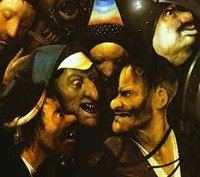
mixtures of human, animal, and inanimate forms. Bosch painted many other traditional Christian subjects from the life of Christ, especially scenes from the Passion. The triptych of the Adoration of the Magi (Prado, Madrid) is one of his most baffling works. The scene takes place before a dilapidated hut, in which lurks a crowd of men with menacing faces and bizarre clothing. Their presence has never been satisfactorily explained, but they suggest the universal conflict of good and evil: reminders of the all-pervading presence of evil recur throughout the splendid panoramic landscape which links the three panels. A series of half-length paintings of the Passion of Christ, which may date from late in Bosch's life, are more straightforward. These exploit to the full the contrast between Christ's humility and the bestiality of his persecutors. In Bosch's last Passion scene, Christ carrying the Cross (Museum of Fine Arts, Ghent), the deformed and leering faces of the mob are grotesquely ugly. Yet Christ remains aloof and serene; his carrying of the cross promises a victory over evil, which was Bosch's final message. For a similar approach, see the Disrobing of Christ (El Espolio) (1577) by El Greco (1541-1614). Paintings by Hieronymus Bosch can be found in the best art museums and private collections all over the world, but many of these are only copies of his original works. He never dated his works, and signed few, which makes them difficult to attribute. Only about 25 pictures and a handful of drawings can be attributed to him with reasonable certainty. Aside from those mentioned above, they include: Allegory of Gluttony and Lust (c.1490-1500, Yale University Art Gallery, New Haven); The Conjurer (c.1500, Musee Municipal, St-Germain-en-Laye); Death and the Miser (c.1490, National Gallery of Art, Washington DC); Ecce Homo (1485-1490, Philadelphia Museum of Art; original version at the Stadelsches Kunstinstitut mit Stadtischer Galeria, Frankfurt am Main); The Extraction of the Stone of Madness (The Cure of Folly) (c.1475, Museo del Prado); Paradise and Hell (c.1510, Museo del Prado); and Terrestrial Paradise (c.1500, Palazzo Ducale, Venice). In the 21st century, some scholars have come to believe that Bosch was merely using his art to reflect the religious and moral codes of his day, depicting stories which could quite easily be heard in a church ceremony in the middle ages. Others claim that Bosch was one of the best history painters and, moreover, hundreds of years ahead of his time - perhaps in fact an early exponent of Surrealism, along the lines of Salvador Dali. Some writers have tried to link him to the dream works of Freud. Whatever the case, he remains one of the most extravagant and famous medieval artists of Northern Europe. He died in 1516 and many painters went on to imitate his style, including the landscape painter Joachim Patenier (1485-1524). After the painter’s death, King Philip II of Spain, who shared Bosch’s surreal dark vision of the world, bought many of the artist’s works, which is why there are so many in Madrid's Prado Museum, today. Considered by many art historians to be one of the most imaginative figurative artists of the Northern Renaissance, perhaps even in the history of art, it wasn't until the emergence of Pieter Bruegel the Elder (1525-69) that Bosch had a worthy successor. See, for instance: The Fight Between Carnival and Lent (1559, Kunsthistorisches Museum, Vienna), Netherlandish Proverbs (1559, Gemaldegalerie, SMPK, Berlin), Children's Games (1560, KM, Vienna) and the unforgettable Mad Meg (Dulle Griet) (c.1562, Museum Mayer van den Bergh, Antwerp). |
|
• For more about the Netherlandish Renaissance, see: Homepage.
Visual
Artists, Greatest |